

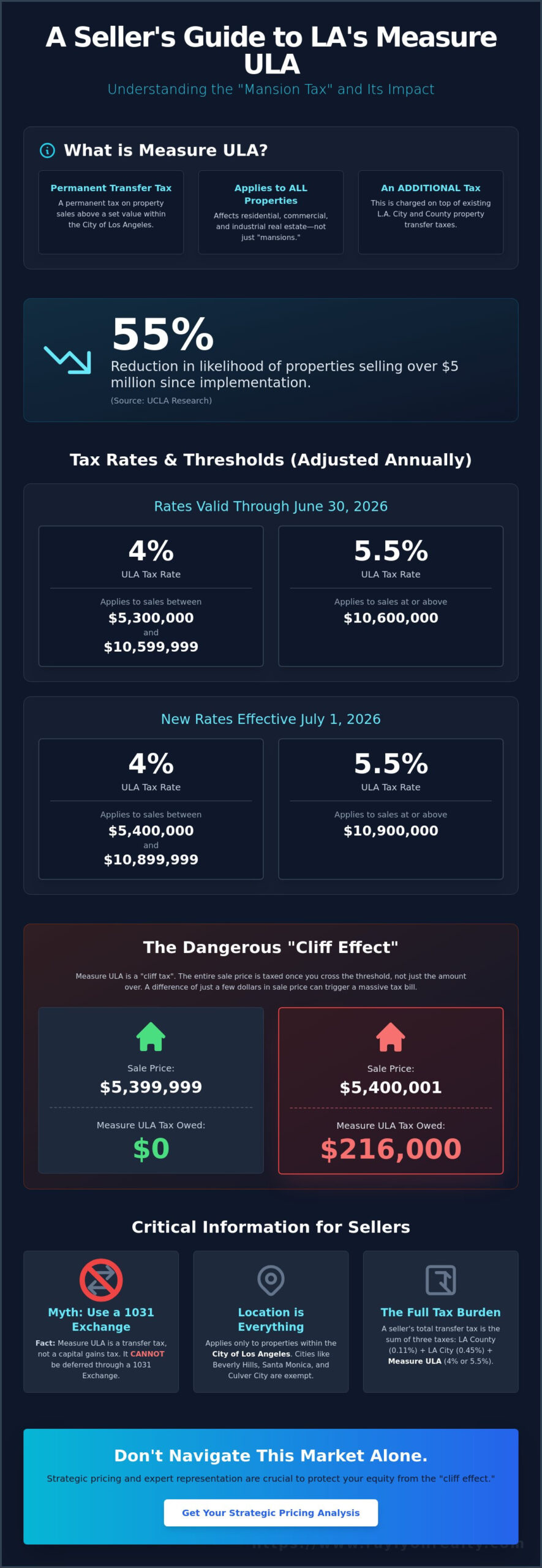
UCLA research shows that Measure ULA has led to a 55% reduction in the likelihood of properties selling for over $5 million since its implementation. If you’re planning a sale in 2026, that statistic isn’t just a data point. It’s a clear sign that pricing your Westside home requires a highly strategic approach to avoid the “threshold cliff.” It’s common to feel overwhelmed by the math, especially when you’re trying to figure out exactly what is the mansion tax in los angeles and how it differs from your standard city and county transfer fees.
I know it’s frustrating to realize that a small price increase could trigger over $216,000 in unexpected closing costs. This guide will clear up the confusion by providing the current 4% and 5.5% rates and the new thresholds taking effect on July 1, 2026. You’ll learn how to calculate your true tax liability based on gross sales price, discover which organizations qualify for exemptions, and gain the expert pricing insights I use to protect my clients’ equity in this cautious market. We’ll look at the specific math for properties near the $5.4 million mark to ensure you don’t leave money on the table during your next transaction.
Key Takeaways
- Measure ULA is a permanent transfer tax that applies to all property types, including residential and commercial, valued over specific thresholds.
- Understand exactly what is the mansion tax in los angeles by reviewing the 4% and 5.5% rates and the new thresholds taking effect on July 1, 2026.
- Learn why Westside sellers are increasingly utilizing off-market strategies to manage exposure and navigate a market where luxury inventory has shifted significantly.
- Avoid costly mistakes by debunking the 1031 exchange myth; Measure ULA is a transfer tax, not a capital gains tax, meaning it cannot be deferred through an exchange.
- Discover how expert representation and “block to block” knowledge help you price strategically to avoid the “cliff effect” and protect your equity during a high-stakes sale.
What is Measure ULA? Defining the Los Angeles Mansion Tax
Measure ULA is a permanent documentary transfer tax on high-value properties located specifically within the City of Los Angeles. While the media often uses the nickname “mansion tax,” this label is slightly misleading because the tax applies to residential, commercial, and industrial real estate alike. Whether you’re selling a luxury estate in Brentwood or a multi-unit apartment building in Venice, the tax applies if the price crosses the threshold. By May 2026, industry reports confirmed that this tax has generated over $1 billion in total revenue since its implementation on April 1, 2023. Understanding what is the mansion tax in los angeles is the first step in protecting your equity during a high-stakes Westside sale.
The concept of a Mansion Tax has been debated across various global markets, but the Los Angeles version stands out for its high rates and lack of a “marginal” structure. It’s also vital to distinguish this from the standard taxes you already expect to pay. Measure ULA is an additional charge on top of the Los Angeles County Documentary Transfer Tax ($1.10 per $1,000) and the City of Los Angeles base Real Property Transfer Tax ($4.50 per $1,000). Sellers must account for all three to avoid double-counting confusion during closing.
To better understand how this tax fits into the broader local real estate market, watch this helpful video:
Why Was Measure ULA Implemented?
Voters approved the “Homelessness and Housing Solutions Tax” on the November 2022 ballot with a clear objective. The city intended to create a permanent funding source for affordable housing production and tenant protection programs. As we move through 2026, the debate regarding its effectiveness continues. Many industry experts argue the tax has chilled the luxury market, while city officials point to the billion-dollar fund as a necessary tool for social stability. This tension remains a central part of the conversation for any property owner near the tax thresholds.
Does it Apply to Your Neighborhood?
The most important detail for Westside sellers is the city boundary. Measure ULA only applies to properties within the City of Los Angeles limits. For example, if your property is in the City of Santa Monica, you’re in a “safe” zone regarding ULA, though you’ll face Santa Monica’s separate Measure GS tax. My block to block knowledge is essential here, as boundaries can be tricky. Impacted areas include Brentwood, Bel Air, Pacific Palisades, and Venice. Neighborhoods that are technically separate cities, such as Beverly Hills, West Hollywood, and Culver City, are not subject to this specific tax.
Calculating the Cost: Thresholds, Rates, and the “Cliff Effect”
The math behind Measure ULA is simple but brutal. Unlike a standard income tax where you only pay a higher rate on the dollars within a specific bracket, this is a gross receipts tax. This means you pay the full percentage on the total sales price. If you sell your property at a financial loss, you still owe the city the full tax amount. According to the Los Angeles Office of Finance, thresholds adjust annually every July to account for inflation. Through June 30, 2026, a 4% tax applies to sales between $5,300,000 and $10,599,999. Anything at $10,600,000 or higher triggers a 5.5% rate. Starting July 1, 2026, these numbers shift. The 4% rate will then apply to sales between $5,400,000 and $10,899,999, while the 5.5% rate hits everything at $10,900,000 or more.
The $5 Million Cliff: A Mathematical Warning
The “cliff effect” is the most dangerous aspect of understanding what is the mansion tax in los angeles. Imagine two neighbors. One sells their home for $5,399,999 and owes $0 in ULA tax. The other sells for just two dollars more at $5,400,001 and is immediately hit with a $216,000 tax bill. This creates a massive “no man’s land” in pricing where it rarely makes sense to sell just over the threshold. To navigate this, I often suggest putting a bit of “lipstick” on a property through strategic staging to ensure its value is high enough to justify the tax, or pricing carefully to stay safely below the cliff. In high demand areas, checking a Mar Vista neighborhood guide can help you see how local comps align with these high-stakes price points.
Who Pays the Tax: Buyer or Seller?
In the City of Los Angeles, the seller typically bears the burden of all transfer taxes. While everything in a real estate contract is technically negotiable, buyers in the current market rarely agree to take on a six figure tax liability that the city legally assesses at the close of escrow. This reality directly impacts your net proceeds. If you’re aiming for “top dollar,” you have to account for this 4% to 5.5% haircut before you even consider commissions or traditional closing costs. If you’re feeling unsure about your property’s current value relative to these cliffs, you can reach out for a strategic valuation to see exactly where your home stands in the current market.
Market Impact: How the Mansion Tax Changed Westside Real Estate
Since the implementation of Measure ULA on April 1, 2023, the Westside luxury market has undergone a structural transformation. UCLA research indicates that the tax led to a 55% reduction in the likelihood of a property selling for over $5 million. This isn’t just a minor cooling of the market; it’s a fundamental shift in how owners approach their assets. My block to block knowledge in areas like Venice and Mar Vista reveals that even specific streets are reacting differently to these new financial pressures. Sellers are no longer just asking what is the mansion tax in los angeles, they’re asking how to survive it while protecting their equity.
One of the most significant trends is the rise of the “off-market” deal. High-end sellers are increasingly looking for quiet, private transactions to manage their exposure. When a home is priced near the $5.4 million threshold, a public listing can sometimes invite lowball offers from buyers who are hyper-aware of the tax cliff. By utilizing off-market opportunities, we can often find the right buyer without the public pressure that comes with a traditional MLS listing. This strategy helps maintain a property’s perceived value while navigating the complex math of the 4% or 5.5% tax rates.
Fix-and-flip investors are also facing a new reality. In the past, a developer might buy a distressed property for $3 million, invest $1.5 million in a high-end rebuild, and aim for a $5.5 million sale. Under the current rules, that $5.5 million sale triggers a $220,000 tax bill that didn’t exist a few years ago. This extra cost eats directly into profit margins, making many new construction projects non-viable. It forces investors to be much more selective, which ultimately impacts the quality and volume of inventory available on the Westside.
Inventory Shifts in Luxury Hubs
Listing volumes in hubs like Brentwood and Bel Air have fluctuated as sellers wait for more favorable market conditions. We’ve seen a surge in creative financing and buyer credits as tools to bridge the gap between buyer expectations and seller tax burdens. Some sellers are choosing to lease their properties rather than sell at a loss, waiting for potential legislative changes or a more robust market. This creates a “lock-in” effect where high-value inventory stays off the market for longer periods than we’ve seen in previous cycles.
Commercial and Multi-Family Consequences
The “mansion” tax label is often a misnomer because it hits apartment building owners and commercial investors just as hard as estate owners. When an apartment complex sells for $12 million, the 5.5% tax adds $660,000 to the closing costs. This massive overhead can discourage the sale and development of multi-family housing, which is a critical part of the real estate agents in los angeles ca market landscape. For a technical breakdown of how different property types are handled, the Los Angeles Office of Finance Measure ULA FAQ remains the definitive government resource for current regulations.
Exemptions and Strategic Planning for Sellers
While the financial impact of Measure ULA is broad, the list of those who can legally avoid it is quite narrow. Primary exemptions are reserved for qualified 501(c)(3) non-profits, government entities, and certain affordable housing providers. For the vast majority of Westside homeowners, these exemptions won’t apply. This makes it even more critical to understand the nuances of what is the mansion tax in los angeles before you sign a listing agreement. Relying on outdated advice can lead to a massive surprise at the closing table when the title company deducts hundreds of thousands of dollars from your proceeds.
One of the most dangerous misconceptions I hear is the “1031 Exchange” myth. Many investors believe they can defer Measure ULA just like they defer capital gains taxes. This is incorrect. Because Measure ULA is a documentary transfer tax and not a capital gains tax, a 1031 exchange has no impact on it. The tax is due immediately upon the transfer of the deed. Similarly, some sellers have attempted to split a single property into multiple parcels to stay under the threshold. You should be aware that the City of Los Angeles is actively cracking down on “artificial” parcel splits designed solely to evade the tax. If a split doesn’t have a legitimate land-use purpose, you could face significant penalties and legal challenges.
Can You Avoid the Mansion Tax?
Legitimate strategic planning is about transparency, not tax evasion. I strongly warn against “price gouging” or under-reporting a sale price, as the city monitors these transactions closely. However, there are legal ways to manage the math. For example, if a home includes high-value personal property like custom furniture, fine art, or specialized equipment, those items can sometimes be sold via a separate bill of sale. Since Measure ULA only applies to the real estate value, separating $150,000 in furniture from a $5.45 million sale could potentially bring the real property value below the tax threshold. This requires precise documentation and the guidance of a professional estate agency that understands the local regulations.
The Role of Appraisals
A strategic appraisal is your best defense when pricing a home near a threshold cliff. If your property has significant deferred maintenance, such as an aging roof or foundation issues, documenting these costs is vital. These “flaws” provide a factual basis for a lower valuation that can keep a sale price safely under the $5.4 million mark. By presenting a clear case for why a home is valued at $5.35 million instead of $5.45 million, we protect your equity from the 4% tax hit. If you want to see how these strategies apply to your specific property, contact me for a strategic consultation today.
Why Expert Representation Matters for $5M+ Transactions
Selling a home for over $5 million in the City of Los Angeles is no longer a straightforward transaction. It’s a high-stakes financial maneuver that requires a deep understanding of local tax law. With Measure ULA adding a 4% to 5.5% tax to your closing costs, your choice of representation directly impacts your final net proceeds. When homeowners ask me what is the mansion tax in los angeles and how it affects their specific sale, I don’t just provide a definition. I provide a strategic roadmap that accounts for every dollar. Having an agent who understands these tax implications from day one is your biggest competitive advantage in a market characterized by hesitation.
I’ve spent years flipping properties, managing rentals, and even building my own home from the ground up. This hands-on experience means I look at your property through the lens of an investor. I know exactly where to put “lipstick” on a house to maximize its ROI and where to address deferred maintenance to justify a strategic price point. My personal experience in construction and property development allows me to see value that other agents might miss. My goal is always to help you walk away with top dollar, even after the city takes its significant cut.
Strategic Marketing for High-Value Homes
Marketing a $5M+ property in 2026 requires a nuanced approach to attract buyers who understand the current landscape. We need to position your home as a turn-key masterpiece that justifies its price tag despite the added tax burden. I leverage a vetted network of contractors, stagers, and designers to ensure your home’s presentation is flawless. By creating a sense of scarcity and high value, we can often overcome the market hesitation that has slowed down many Westside transactions since the tax was implemented.
Ready to Sell on the Westside?
Success in the current market depends on planning, not luck. If you’re considering a sale, you shouldn’t wait until you’re in escrow to calculate your tax liability. I offer custom valuations that include a comprehensive tax impact analysis so you know exactly what your net proceeds will look like. Whether you’re in Brentwood, Venice, or Pacific Palisades, I’m here to provide the “block to block” knowledge and strategic advice you need to navigate this complex environment. Contact Ray Lyon Realty for a strategic consultation today and let’s discuss how to protect your equity in your next transaction.
Protect Your Equity in the 2026 LA Market
Selling high-value Westside real estate now requires a mix of technical precision and local market savvy. You’ve seen how the 4% and 5.5% rates create a significant “cliff effect,” where a few dollars in price can lead to a six-figure tax bill. Because Measure ULA is based on gross sales price, there’s no room for error in your closing cost estimates. Knowing exactly what is the mansion tax in los angeles and how the July 1, 2026, threshold adjustments impact your bottom line is the first step toward a successful exit.
As a top-rated Westside expert with a proven track record in $5M+ sales, I use my block-to-block market knowledge to help you price strategically. We’ll look at your home’s unique value to ensure you don’t leave money on the table. Whether navigating off-market opportunities or documenting deferred maintenance, my goal is to maximize your ROI. It’s a complex landscape, but the right strategy still achieves record-breaking results. Get a Professional Valuation for Your Westside Home today. Let’s make your next move your most successful one yet.
Frequently Asked Questions
Is the Los Angeles Mansion Tax a one-time fee?
Yes, the mansion tax is a one-time documentary transfer tax paid when the property title changes hands. You won’t see this on your annual property tax bill; it’s strictly a closing cost handled during the escrow process. Sellers typically pay this amount in full at the close of the transaction, rather than in recurring installments over time.
Does Measure ULA apply to properties in Beverly Hills or Santa Monica?
No, Measure ULA does not apply to Beverly Hills, Santa Monica, or Culver City. These are independent incorporated cities with their own tax structures. If you’re wondering what is the mansion tax in los angeles and if your Westside home is affected, you must verify if the address falls within the City of Los Angeles boundaries. Even a street address that says “Los Angeles” might technically be in an unincorporated area or a separate city.
Can I deduct the mansion tax from my federal income taxes?
You generally cannot deduct this tax as an itemized deduction on your federal return. However, it can often be treated as a selling expense that reduces your capital gains. This lowers your taxable profit, so it’s vital to keep your closing statement for your CPA. This adjustment to your cost basis is a standard way to handle transfer taxes during a high value sale.
What happens if I sell my home for exactly $5 million?
A sale of exactly $5 million in early 2026 results in $0 of Measure ULA tax. Because the thresholds are adjusted for inflation every year, the 4% tax currently only kicks in at $5,300,000 for sales closing before June 30, 2026. If you sell for $5 million, you’ll only be responsible for the standard city and county transfer fees, saving you from the high ULA rates.
Are there any exemptions for senior citizens or first-time sellers?
There are no exemptions for senior citizens or first-time home sellers. The city calculates the tax solely on the gross sale price of the property. If the transaction exceeds the current inflation-adjusted threshold, the tax is due regardless of the seller’s age or personal circumstances. Only specific non-profits and government agencies are currently eligible for exemptions under the law.
How is the Measure ULA revenue actually being spent in 2026?
The city allocates the funds to the House LA Fund. As of January 2026, over $1 billion has been generated to build affordable housing units and provide legal counsel for tenants facing eviction. The goal is to stabilize the local housing market through these dedicated resources. This funding supports projects designed to prevent homelessness and increase the supply of income restricted units across the city.
Does the mansion tax apply to inherited property?
Inheriting a property doesn’t trigger the tax on its own. The tax only applies when a sale or transfer for consideration occurs. If you inherit a home and keep it, you don’t owe ULA; however, if the estate later sells that home to a buyer for $5.5 million, the tax will be deducted from the sale proceeds. The city looks for a change in ownership accompanied by a financial payment.
Will the $5 million threshold ever increase?
Yes, the threshold increases every July 1st based on the Chained Consumer Price Index. For example, the entry point for the 4% tax moves from $5,300,000 to $5,400,000 on July 1, 2026. This annual adjustment helps prevent bracket creep caused by inflation in the real estate market. Sellers should always check the latest figures from the Office of Finance before pricing their homes near these limits.