
In 2026, finding a home in Westside LA isn’t just about browsing listings; it’s a high-stakes strategic negotiation where the fastest offer rarely wins against the smartest one. You’ve likely felt the weight of the competition or worried about the mountain of legal disclosures unique to the Golden State. It’s completely normal to feel overwhelmed by high entry costs and those hidden fees that seem to pop up at the eleventh hour. Truly understanding what are the steps to buying a house in california is the only way to transform that anxiety into a genuine competitive advantage.
We believe a home is more than a place to live; it’s a strategic investment. This expert-led roadmap is designed to give you total mastery over the 2026 market, ensuring you move from browsing to closing with absolute confidence. We’ll walk you through a clear chronological checklist, from securing off-market opportunities to navigating the complex contractual clauses that protect your interests. By the end, you’ll have an insider’s perspective on how to secure your dream home while avoiding the financial pitfalls that catch others off guard.
Key Takeaways
- Learn exactly what are the steps to buying a house in california with a chronological roadmap designed for the competitive 2026 market.
- Discover how to evaluate micro-market values in Westside LA neighborhoods like Santa Monica and Mar Vista to ensure your investment is sound.
- Master the California Residential Purchase Agreement to craft winning offers that balance price with strategic terms and contingencies.
- Navigate the escrow phase with confidence by understanding mandatory state disclosures like the TDS and NHD to avoid property issues.
- Prepare for a successful close by mastering the final walkthrough and the deed signing process with local experts.
The 2026 Roadmap: 7 Essential Steps to Buying a House in California
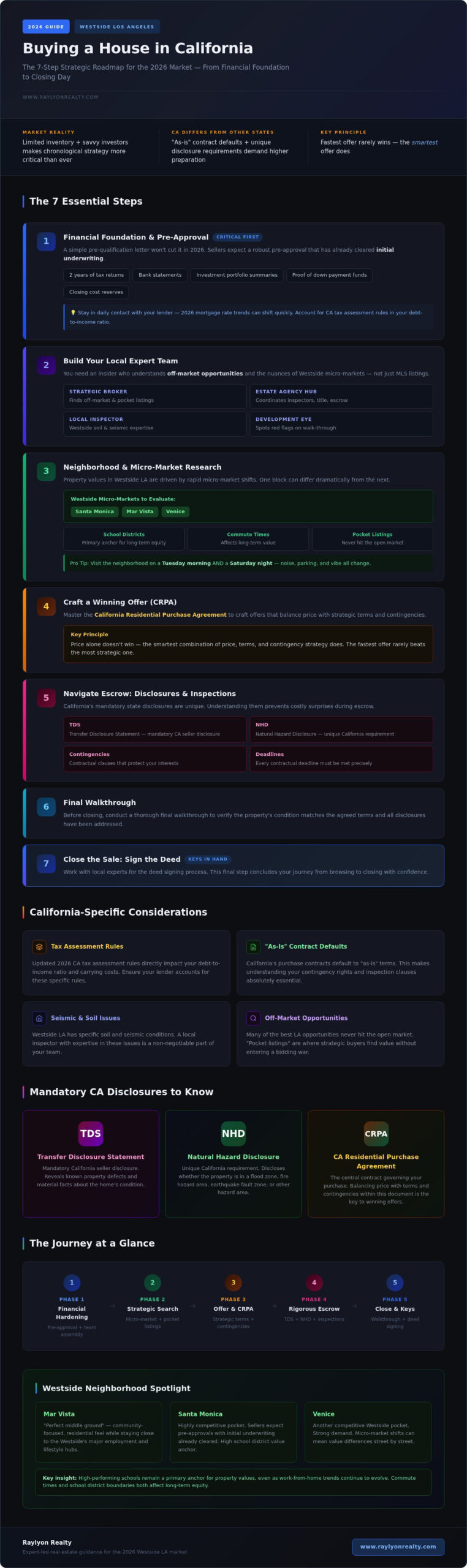
Buying property in the Golden State requires a distinct strategy compared to the rest of the country. Understanding what are the steps to buying a house in california means recognizing that our legal disclosures and tax assessments demand a higher level of preparation. The 2026 market context is defined by limited inventory and savvy investors, making the chronological flow of your purchase more critical than ever. California’s process differs significantly from other states due to its specific “as-is” contract defaults and unique disclosure requirements. The journey moves from financial hardening to a strategic search, then through a rigorous escrow process, ending with the keys in your hand. In this high-stakes environment, being ready isn’t enough. You must be positioned to win.
Step 1: Financial Foundation and Pre-Approval
A simple pre-qualification letter won’t cut it in 2026. Sellers in competitive pockets like Venice or Santa Monica expect a robust pre-approval that has already cleared initial underwriting. This shows the seller you’re a sure thing, not a risk. You’ll need your most recent two years of tax returns, bank statements, and investment portfolio summaries ready for instant digital delivery. Because 2026 mortgage interest rate trends can shift quickly, staying in daily contact with your lender is vital. Lenders today also look closely at updated California tax assessment rules for 2026, so ensure your debt-to-income ratio accounts for these specific carrying costs. Having clear proof of funds for your down payment and closing costs is mandatory for making a competitive offer. When you know exactly what are the steps to buying a house in california, you realize that financial speed is your greatest asset.
Step 2: Building Your Local Expert Team
The right partner does more than just open doors. You need an insider who understands off-market opportunities and the nuances of Westside micro-markets. This is where real estate agents in los angeles ca provide a massive edge. A standard agent might show you what’s on the MLS, but a strategic broker finds what isn’t there yet. A professional estate agency acts as your central hub. They coordinate between inspectors, title officers, and the escrow team to ensure every contractual deadline is met. We treat every purchase as a strategic investment. We leverage years of development and flipping experience to spot red flags during the initial walk-through. Your team should also include a local inspector who knows the specific soil and seismic issues of the Westside. This proactive approach reduces stress and ensures your capital is protected from the start.
Targeting the Right Neighborhood: From Santa Monica to Mar Vista
Success in Westside LA starts with street-level intelligence. In 2026, property values aren’t just about square footage; they are driven by rapid micro-market shifts. One block might be quiet and residential, while the next is bustling with new retail developments. Understanding what are the steps to buying a house in california involves looking beyond the list price and analyzing how commute times and school district boundaries affect long-term equity. High-performing schools remain a primary anchor for property values, even as work-from-home trends continue to evolve.
Don’t rely solely on public data. Many of the best opportunities in LA never hit the open market. These “pocket listings” are where strategic buyers find value without a bidding war. When you are mapping out what are the steps to buying a house in california, this granular research is a core part of the homebuying process steps that many buyers skip. To truly understand a neighborhood, visit it on a Tuesday morning and again on a Saturday night. The vibe changes. Noise levels shift. Parking availability fluctuates. These details matter for your daily life and your resale value.
Evaluating the Westside Lifestyle
Choosing between Westside pockets is a lifestyle decision that impacts your daily happiness and your wallet. For many, mar vista los angeles offers the perfect middle ground. It provides a community-focused, residential feel while staying close to the tech hubs of Silicon Beach. Contrast this with Santa Monica, where you pay a premium for coastal proximity and world-class amenities. Venice offers a completely different, artistic energy with unique architectural styles. We look at appreciation trends by zip code to ensure your chosen neighborhood aligns with your five-year or ten-year financial goals.
The Property Search Strategy
Online portals are great for browsing, but they don’t tell the whole story. When you attend an open house, look for “potential” rather than perfection. Check the orientation of the sun, the condition of neighboring properties, and the quality of recent renovations. Some of the best returns come from properties with “good bones” that need cosmetic updates. We help our clients identify these diamonds in the rough before they become bidding war targets. If you want to see how we track these exclusive Westside opportunities, let’s start a conversation about your specific goals.
Crafting a Winning Offer on the California Residential Purchase Agreement
Understanding what are the steps to buying a house in california requires a deep dive into the paperwork that binds the deal. In the 2026 market, simply offering the list price rarely secures a property in high-demand areas like Mar Vista or Santa Monica. Sellers are looking for the “path of least resistance.” This means your offer must be clean, certain, and strategically structured to stand out from a dozen others. Price is only one lever you can pull. Often, the terms of the deal carry just as much weight as the dollar amount on the first page.
The psychology of the seller is your most valuable data point. Many sellers in 2026 are looking to move quickly or are managing complex trust sales. They prioritize buyers who demonstrate financial strength and a commitment to the timeline. A common misconception is that the highest price always wins. In reality, a slightly lower offer with no appraisal contingency or a shortened inspection period is frequently more attractive than a high-priced offer that feels like it might fall apart during escrow.
The Anatomy of a Strategic Offer
The California Residential Purchase Agreement (RPA) serves as the primary legal document governing residential home sales across the state. Beyond the purchase price, you must carefully define your escrow length; 21 to 30 days is standard, but some sellers may prefer a faster close or a rent-back period. Your offer should also acknowledge the required California residential purchase disclosures early to show you’ve done your homework. While “buyer’s letters” were once popular, 2026 regulations emphasize fair housing compliance, so we focus on professional, data-driven cover letters that highlight your financial readiness instead of personal details.
Negotiation Tactics for Bidding Wars
When you reach the stage of what are the steps to buying a house in california that involves multiple bids, you need advanced tactics. Escalation clauses can be effective in Los Angeles, automatically increasing your bid by a set increment above the next highest offer. However, these must be used with a firm cap to protect your investment. You might also consider “waiving” certain contingencies, such as the appraisal, if you have the cash reserves to cover a potential gap. Finally, increasing your Initial Earnest Money Deposit (EMD) to the 3% legal limit in California signals to the seller that you are a serious, high-intent buyer with skin in the game.
Navigating Escrow: Disclosures, Inspections, and Contingencies
Escrow acts as the neutral third-party phase of your transaction. This period ensures all contractual conditions are met before money and title change hands. When you’re mastering what are the steps to buying a house in california, you’ll find this is the most document-heavy stage. California law requires sellers to provide specific disclosures, including the Transfer Disclosure Statement (TDS) and the Seller Property Questionnaire (SPQ). You’ll also receive a Natural Hazard Disclosure (NHD) report. This document details if the property sits in a fire, flood, or seismic zone. Most California contracts default to a 17-day contingency period. This is your critical window to investigate every detail of the property’s condition and legal standing.
If your inspections reveal issues, you don’t have to walk away immediately. You can submit a “Request for Repair.” This is a strategic negotiation where you ask the seller for repairs, a price reduction, or a closing cost credit. Sellers in 2026 often prefer offering credits to avoid the hassle of managing contractors themselves. We help you prioritize which repairs are essential for safety and which are merely cosmetic, ensuring your investment remains sound.
The Inspection Gauntlet
Don’t treat inspections as a mere formality. For a Westside home, you need a specialized team that looks beyond the surface. We recommend a three-pronged approach to your physical due diligence:
- General Home Inspection: A comprehensive review of the structure, electrical, and plumbing systems.
- Termite and Pest Inspection: A mandatory check for wood-destroying organisms, which are common in coastal climates.
- Sewer Lateral Inspection: A camera-based look at the line connecting the house to the city main.
Properties in Santa Monica or Mar Vista require specific attention to foundation integrity and drainage. Older homes often have clay pipes that are prone to root intrusion. Additionally, your NHD report is vital for understanding fire risks. In 2026, being in a High Fire Severity Zone can significantly impact your ability to secure affordable homeowners insurance, so we verify these details early in the process.
Clearing Contingencies and Loan Commitment
Removing contingencies is an active, written process in California. It isn’t automatic. Once you’re satisfied with the inspections and your loan is fully approved, you’ll sign a Contingency Removal form. This is the point of no return for your initial deposit. If the appraisal comes in lower than the purchase price, you may face an “appraisal gap.” You’ll need to negotiate a lower price with the seller or be prepared to cover the difference in cash. Your lender will finalize your mortgage commitment during this time, moving you toward the finish line. If you want a partner who knows exactly what are the steps to buying a house in california to protect your interests, our team is ready to guide you through every disclosure.
Closing the Sale: Final Walkthrough and Signing the Deed
The finish line is finally in sight. After weeks of due diligence and negotiation, the final major hurdle in understanding what are the steps to buying a house in california is the final walkthrough. This isn’t a new inspection. Instead, it’s your “Verification of Property Condition.” You’re confirming the seller has made all agreed-upon repairs and that the home is in the same state it was when you signed the contract. We accompany you to check that all appliances work, the systems are functional, and no new damage occurred during the seller’s move-out process. If something is amiss, we address it with the listing agent immediately to ensure it’s resolved before you take ownership.
Next comes the signing. You’ll meet with a mobile notary or visit the escrow office to sign the loan documents and the grant deed. This is a high-stakes moment where our attention to detail ensures every signature is in place. Once signed, the documents go back to the lender for a final review. When they’re satisfied, they trigger the funding. The deal isn’t officially closed, however, until the County Recorder’s Office logs the deed. This “recording” is the legal moment you become the owner. Ray Lyon Realty stays in constant contact with the title officer to track this process, so you know the exact minute you can legally unlock your new front door.
Closing Costs and Final Wire Transfers
Closing costs in California typically include title insurance, escrow fees, and county transfer taxes. It’s vital to have these funds ready in your liquid accounts. Safety is our top priority during this phase. We always advise clients to verify wire instructions via a known phone number before sending their down payment to prevent wire fraud. You’ll often hear the terms “funding” and “recording” used interchangeably, but they’re distinct. Funding happens when the lender sends the money to escrow; recording happens when the county confirms the title transfer. Only after recording are you officially the homeowner.
Taking Possession and Beyond
The handoff of the keys is both a legal milestone and a symbolic start to your new chapter. Our team provides a post-closing checklist to help you transition smoothly into your Westside home. This includes transferring utilities, re-keying the locks for security, and filing a homestead declaration to protect your equity. We don’t just disappear after the sale. We believe in building long-term relationships with our clients. Whether you need a referral for a trusted contractor or strategic advice on a future 1031 exchange, we’re here to help you maximize the value of your investment. Knowing what are the steps to buying a house in california is just the beginning of your journey as a successful property owner.
Secure Your Strategic Advantage in 2026
Navigating the 2026 real estate market requires more than just a search engine; it demands a tactical mindset and a deep understanding of local micro-markets. You’ve learned how to build a rock-solid financial foundation, target the right Westside neighborhoods, and master the complexities of the California Residential Purchase Agreement. By following this roadmap, you’ve gained the clarity needed to handle escrow disclosures and final walkthroughs like a seasoned investor. Knowing exactly what are the steps to buying a house in california is your first major win on the path to homeownership.
We pride ourselves on providing high-touch, personalized service that turns transaction stress into strategic success. From identifying off-market gems in Mar Vista to negotiating winning terms in Santa Monica, we’re here to ensure your close is as smooth as possible. Don’t leave your dream home to chance in this competitive landscape. Start your strategic home search with Ray Lyon Realty today and let’s turn your vision into reality. Your new front door is closer than you think.
Frequently Asked Questions
How long does the average escrow take in California?
Most California escrows last between 30 and 45 days, though competitive Westside transactions often aim for a swift 21-day close. This timeline provides enough room for inspections, the appraisal, and final loan underwriting. If you’re paying with cash, you might close in as little as 10 days. The exact duration is negotiated during the offer stage and depends heavily on your lender’s efficiency and the complexity of the property’s title.
Do I need a lawyer to buy a house in California?
You aren’t legally required to hire an attorney to purchase residential property in California. Most buyers rely on a specialized real estate broker and an escrow officer to manage the legal paperwork and title transfer. However, if you’re dealing with a complex trust sale or a unique investment structure, consulting a legal professional can provide an extra layer of protection. For standard purchases, the California Residential Purchase Agreement is designed to be handled by licensed agents.
What is the most important contingency in a CA real estate contract?
The inspection contingency is arguably the most critical protection for any buyer. It gives you a dedicated window, often 17 days by default, to investigate the home’s physical condition and the Natural Hazard Disclosure report. This is when you’ll discover if there are foundation issues or seismic risks. Without this contingency, you could lose your initial deposit if you back out due to property defects found later. It’s the ultimate safeguard for your investment capital.
How much are closing costs for a buyer in Los Angeles?
Buyers in Los Angeles should typically budget between 1% and 3% of the total purchase price for closing costs. These fees cover items like title insurance, escrow services, and recording fees. While the seller often pays the county transfer tax, other costs like loan origination fees and prepaid property taxes fall on the buyer. We provide a detailed estimate early in the process so there aren’t any surprises when it’s time to wire your final funds.
Can I buy a house in California with a 3% down payment?
Yes, it’s possible to secure a home with as little as a 3% down payment through various conventional loan programs or FHA options. While a 20% down payment is the traditional benchmark to avoid private mortgage insurance, many first-time buyers use low-down-payment strategies to enter the competitive Westside market sooner. When you’re learning what are the steps to buying a house in california, understanding these financing levers is key to making your first move without years of additional saving. For expert assistance with mortgage options, Integrity Estates Realty offers professional brokerage services to guide you through the process.
The Natural Hazard Disclosure is a state-mandated report that informs you if a property is located in a zone prone to earthquakes, fires, or floods. In California, this document is essential because it impacts your future insurance costs and resale value. For instance, homes in high-risk fire zones may require specialized, more expensive coverage. Reviewing the NHD during your contingency period ensures you aren’t walking into a high-risk situation without a clear financial plan.
What happens if I back out of a home purchase in California?
If you back out while your contingencies are still active, you can typically cancel the contract and receive your full earnest money deposit back. However, once you’ve signed the formal contingency removal forms, your deposit is at risk. In California, the “liquidated damages” clause usually limits the seller’s claim to 3% of the purchase price. We work diligently to ensure you have every piece of data needed before you take that final step of removing your protections.
How do I find off-market properties in Santa Monica?
Finding off-market opportunities requires deep local connections and a broker who is active in the community. Many “pocket listings” in Santa Monica are sold through private networks before they ever reach public portals. We leverage our personal history in property development and our relationships with other top Westside agents to give our clients access to these exclusive deals. This is a vital part of what are the steps to buying a house in california for those looking to avoid bidding wars.