

You might believe that the only way to beat an all-cash offer in Pacific Palisades or Brentwood is to waive every protection you have. In reality, stripping away your safeguards is often a strategic blunder that puts your hard-earned deposit at unnecessary risk. Having real estate contingencies explained for buyers is about more than just understanding the fine print; it’s about mastering the safety net that allows you to walk away if a property isn’t what it seems.
It’s stressful to think about losing tens of thousands of dollars because of a missed deadline or a hidden foundation issue. We understand that pressure, especially in a market as fast-paced as Los Angeles. This guide will show you how to use contingencies as powerful negotiation leverage to win your dream home while keeping your deposit secure. You’ll learn the specific California timelines for 2026 and how to navigate the contract with the confidence of a seasoned Westside investor.
Key Takeaways
- Safeguard your earnest money deposit by understanding how contractual safety nets allow you to cancel a deal without financial penalty.
- Get real estate contingencies explained for buyers to master the essential “Big Four” protections, ensuring both the home’s condition and the bank’s appraisal meet your standards.
- Gain a competitive edge in the Westside market by strategically shortening standard 17-day timelines to win against all-cash offers.
- Navigate the high-stakes escrow period with a clear map of what happens from day one until the final contingency removal.
- Leverage professional property development insights to spot hidden issues and negotiate effectively when inspections reveal unexpected repairs.
The Buyer’s Safety Net: What Are Real Estate Contingencies?
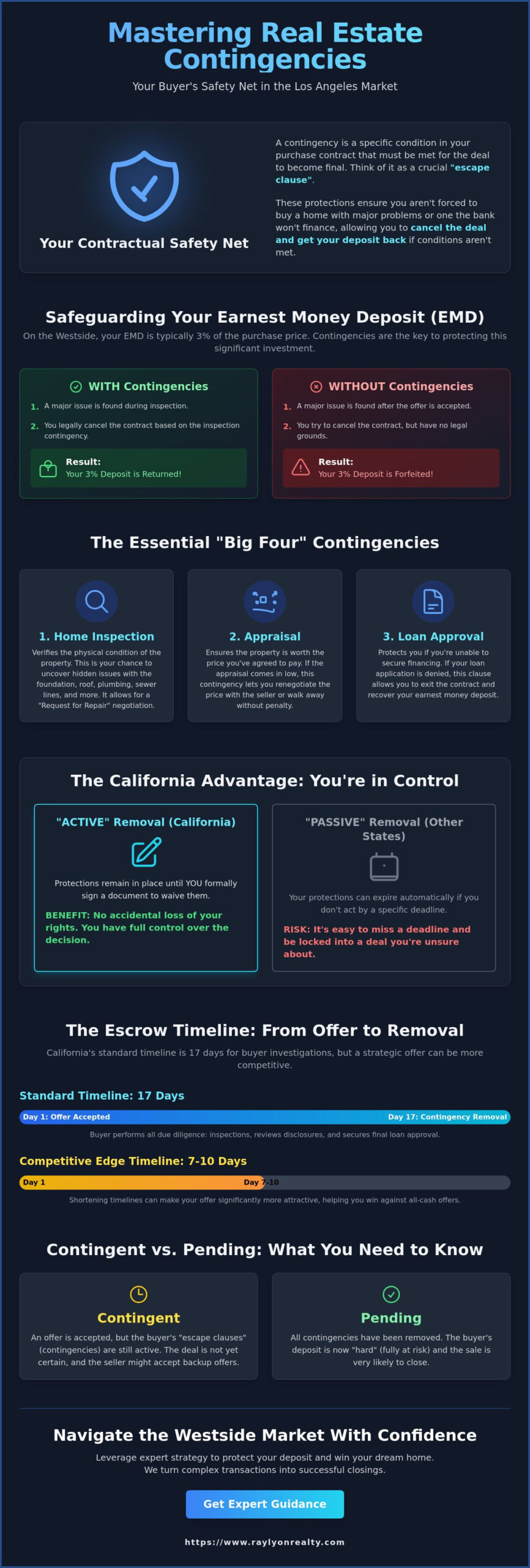
In the high-stakes environment of Los Angeles real estate, a contingency is a specific condition that must be met before the deal becomes legally binding. You can think of a contingency as a “get out of jail free” card that applies to specific conditions like home inspections or loan approvals. Entering into a real estate contract without these safeguards is a risk most buyers can’t afford. Getting real estate contingencies explained for buyers is vital for anyone looking to buy on the Westside, especially as we look toward the market shifts of 2026. This year, we’ve seen enough volatility in interest rates and inventory levels to make even seasoned investors pause. These protections ensure that you aren’t forced to close on a home that has major structural problems or a valuation that doesn’t match the price tag.
To better understand how these moving parts fit into your home buying journey, watch this helpful overview from an industry expert:
California uses an “active” contingency removal process, which is a major benefit for buyers. Unlike some states where your rights might automatically expire after a certain date, California requires you to sign a formal document to waive your protections. This gives you a much-needed layer of control during the escrow process. You don’t have to worry about a deadline passing and suddenly being locked into a deal you’re no longer sure about. It puts the ball in your court to decide when you’re satisfied with the property’s condition and the bank’s willingness to fund the loan.
How Contingencies Protect Your Earnest Money
When you find a home on the Westside, you’ll typically put down an Earnest Money Deposit (EMD) of around 3% of the purchase price. Without contingencies, backing out of the deal for almost any reason would mean forfeiting that entire deposit to the seller. These legal clauses ensure that if the inspection reveals a crumbling foundation or the bank refuses to fund the loan, you can cancel the contract and get your money back. It’s the difference between a calculated investment and a high-stakes gamble with your savings. Protecting that 3% is our top priority during the first few weeks of escrow.
Contingent vs. Pending: Knowing the Difference
You’ll often see these status markers while browsing public property portals. A “Contingent” status means the seller has accepted an offer, but the buyer still has active “outs” they haven’t waived yet. During this phase, the home is technically still available for backup offers, which is a common tactic in the competitive world of Santa Monica real estate. Once those contingencies are removed, the status changes to “Pending,” signaling that the deal is almost certain to close and the buyer’s deposit is now fully at risk. Understanding these nuances helps you stay focused during your search.
The Big Four: Essential Contingencies for Every LA Home Buyer
Understanding the “Big Four” is where your strategy truly begins to take shape. While every contingency in a real estate sales contract offers a layer of protection, these specific clauses are the heavy hitters that define your escrow experience. Having real estate contingencies explained for buyers helps you see these not as hurdles, but as essential milestones that ensure your investment is sound. They provide the necessary structure to verify that the home you’re buying matches the value and condition you were promised during the initial walkthrough.
Home Inspection and Physical Due Diligence
In the Westside, a general inspection is just the starting point for a savvy buyer. Many of our local homes have decades of history, which means you need specialized eyes on sewer lines and chimneys. I often look at properties through a “renovator lens” to help clients distinguish between a major deal-breaker and a simple cosmetic fix. If the inspection turns up issues, we enter the “Request for Repair” phase. This is a secondary negotiation where we ask the seller for credits or repairs, ensuring you don’t inherit someone else’s maintenance debt without a fight.
Appraisal and Financing: The Money Clauses
The appraisal contingency is your primary shield against overpaying for an asset. If the bank’s valuation comes in lower than the purchase price, an “appraisal gap” is created. You’ll then decide whether to cover that difference in cash, negotiate the price down, or use your contingency to walk away. In 2026, with interest rates remaining a focal point of every financial conversation, the loan contingency is vital. It’s important to remember that being pre-approved isn’t the same as having a full loan contingency. The latter protects you if the lender’s final underwriting process hits a snag at the eleventh hour.
Title and HOA Documents: The Fine Print
The Preliminary Title Report is a non-negotiable review, especially for coastal properties where easements or ancient liens can complicate ownership. If you’re looking at Santa Monica condos, the HOA contingency is where we dig for “Special Assessments” or upcoming major repairs that could spike your monthly costs. We also look closely for unpermitted work. It’s a common issue in LA; knowing a garage conversion isn’t legal before you close can save you from future code enforcement headaches. If you’re ready to start your search, working with an experienced Westside realtor can help you navigate these complexities with ease.
Navigating the Westside Market: Strategic Contingency Removal
In the high-velocity markets of Santa Monica and Venice, the standard contract is often just a starting point for negotiation. Having real estate contingencies explained for buyers involves understanding that while the California Residential Purchase Agreement (RPA) sets a default period of 17 days for most investigations, those numbers are rarely set in stone. To win in a multi-offer situation, we often look at the contingency period as a strategic lever rather than a fixed rule. Shortening these timeframes is one of the most effective ways to show a seller you are serious without completely stripping away your safety net.
Many successful buyers on the Westside choose to compress their inspection or appraisal periods to 7 or 10 days. This demonstrates efficiency and gives the seller confidence that the deal will move forward quickly. These timeframes must align with California Department of Real Estate guidelines, which ensure that both parties have a clear path to closing. If a buyer fails to remove a contingency by the agreed-upon date, a seller might issue a “Notice to Buyer to Perform,” which is a formal request to move the process along or risk cancellation.
The “Pre-Inspection” is another pro move for those who want to be ultra-competitive. By bringing in an inspector before you even submit your offer, you can potentially waive the inspection contingency entirely. This allows you to submit a “non-contingent” physical offer that looks as strong as cash to a seller. It’s a savvy way to handle real estate contingencies explained for buyers who have found their perfect home and want to eliminate any doubt in the seller’s mind.
Winning Bidding Wars in Mar Vista and Venice
In neighborhoods like Mar Vista, demand frequently outstrips supply. In these pockets of the Westside, a “clean” offer with fewer contingencies or shorter timelines often beats out a higher price offer that comes with long strings attached. Sellers value certainty. If you can prove you’ve already vetted the property or have a massive down payment that makes an appraisal gap irrelevant, you become the most attractive candidate in the pile. We focus on making your offer the path of least resistance for the seller.
The Risks and Rewards of Non-Contingent Offers
It’s a common fear: “Do I have to waive everything to win?” While the market is competitive, you don’t always have to leave yourself exposed. A non-contingent offer is a firm commitment with no easy exit, so it should only be used when you are 100% certain about the property and your financing. There are absolute must-haves that I rarely suggest waiving, such as the Title contingency. You need to know that the person selling you the home actually has the legal right to do so. Strategic removal is about calculated risk, not blind gambling.
The Escrow Timeline: From Offer Acceptance to Contingency Removal
Once your offer is accepted, the excitement of finding a home quickly shifts into a disciplined, timeline-driven process. Having real estate contingencies explained for buyers is meaningless without a clear map of the deadlines you’ll face. In California, the clock starts ticking the day after acceptance, and every day counts when you’re protecting your deposit. This period is your window to verify every detail before your money becomes non-refundable.
Within the first three days, you’ll need to deposit your Earnest Money into escrow. This is the financial “handshake” that shows the seller you’re serious. While your money is held in escrow, it’s still protected by the contingencies we’ve discussed. However, the standard 17-day “investigation period” is now in full swing, and you’ll need to move quickly to coordinate inspectors and review disclosures.
The Investigation Period (Days 1–17)
This 17-day window is the standard timeframe in the California Residential Purchase Agreement for you to perform your due diligence. It covers everything from physical inspections to reviewing the title report and HOA documents. If you find that 17 days isn’t enough, perhaps because a specialized structural engineer is backed up, your agent can request an Extension of Time (ET) from the seller. The role of a professional estate agency is to manage these shifting deadlines so you never accidentally miss a protection window.
Formally Removing Contingencies (The CR Form)
One of the most misunderstood parts of the process is how these protections actually end. In California, contingencies don’t just expire because a date passed. You must use the Contingency Removal (CR) form to “actively” waive your rights. This is a formal, signed document where you tell the seller you’ve checked everything and are moving forward. Having real estate contingencies explained for buyers includes knowing that you can remove contingencies one by one or all at once, depending on your comfort level and the progress of your investigations.
If a buyer refuses to remove a contingency after the deadline, the seller can’t just take the deposit immediately. They must first issue a Notice to Perform, giving the buyer a final chance to either remove the contingency or cancel the deal. Once that CR form is signed and delivered, you’ve reached the “point of no return.” Your deposit is now “hard,” meaning it’s non-refundable if you decide to back out for a reason you’ve already waived. If you want a partner who can help you navigate these high-stakes deadlines with precision, contact our Westside team today to ensure your interests are protected at every turn.
The Ray Lyon Advantage: Strategic Negotiation in Complex Transactions
Understanding the rules of the game is essential, but winning on the Westside requires a partner who knows how to play the hand you’re dealt. Having real estate contingencies explained for buyers is just the foundation. The real value comes from applying that knowledge to the specific house, the specific seller, and the specific neighborhood you’re targeting. My background in property development and flipping gives our clients a unique edge. I’ve seen homes at their best and their worst, which allows me to spot potential issues that a standard inspector might miss.
This “renovator’s eye” means we can identify “hidden” risks early in the process. We don’t just wait for the inspection report to tell us there’s a problem; we anticipate it. This proactive approach allows us to draft offers that are both protective and attractive to sellers. Whether you’re looking at new construction or a classic Venice bungalow, we ensure your contingencies are tailored to the actual risks of the property. This strategic foresight is what prevents a dream home from turning into a financial burden.
Strategic Negotiation Beyond the Sales Price
When an inspection reveals a significant issue, the deal doesn’t have to end. This is where savvy negotiation becomes your greatest asset. In many cases, I advise clients to negotiate for closing cost credits rather than asking the seller to perform repairs. Sellers often look for the cheapest way to fix a problem, while a credit allows you to choose your own contractors and ensure the work is done to your standards. It’s a cleaner way to close that keeps the timeline on track while protecting your long-term investment.
We also have extensive experience handling appraisal gaps. If the bank’s valuation doesn’t meet the purchase price, we don’t panic. We use our granular knowledge of Santa Monica and Mar Vista market trends to present a case to the appraiser or negotiate a price reduction with the seller. Our goal is always to keep the deal moving forward without you overextending your finances. We understand that real estate contingencies explained for buyers are only as good as the negotiator standing behind them.
Partnering with Ray Lyon Realty
Searching for a home in 2026 requires more than just access to the MLS. It requires a strategic partner who treats your investment as if it were their own. We pride ourselves on making every client a top priority, offering a level of personal investment and market insight that you won’t find at a high-volume, generic firm. Beyond public listings, our deep roots on the Westside often give us access to off-market opportunities where terms can be more flexible than in a public bidding war.
If you’re ready to master the Westside market and secure your dream home with confidence, we’re here to help. Contact Ray Lyon Realty to start your home search today and let’s build a winning strategy for your next move.
Take the Next Step Toward Your Westside Home
Buying a home in competitive neighborhoods like Santa Monica, Mar Vista, or Venice doesn’t have to feel like a high-stakes gamble. You’ve seen how real estate contingencies explained for buyers can transform a stressful contract into a strategic advantage. By mastering the “Big Four” and understanding the active removal process in California, you’re now equipped to protect your deposit while making winning offers. These protections ensure that your investment is based on solid facts rather than just hope.
Our team brings over 15 years of local expertise to the table, combined with a specialized background in property flipping and investment. We know exactly what to look for behind the drywall and how to negotiate credits that keep your deal on track. We’re here to ensure you feel supported and informed from the first showing to the final walk-through. Ready to navigate the LA market with confidence? Contact Ray Lyon Realty today! Your dream home is waiting, and we’re excited to help you secure it.
Frequently Asked Questions
Can a seller back out if I have contingencies?
A seller cannot back out simply because you have contingencies; these clauses are designed to protect you, not them. Once the seller signs the contract, they’re legally committed to the sale. They can only cancel if you fail to meet your obligations, such as missing a deadline for contingency removal after they’ve issued a formal notice. This gives you the upper hand to investigate the property thoroughly without fear of losing the deal.
What is the most common contingency to waive in a bidding war?
The appraisal contingency is the most common protection waived in high-stakes bidding wars. Buyers often feel comfortable doing this if they have extra cash to cover a potential valuation gap. While waiving it makes your offer look stronger, it’s a move best reserved for those with a significant down payment. Having real estate contingencies explained for buyers helps you decide if this specific risk is worth the potential reward.
How long is the standard contingency period in California?
The standard investigation period in California is 17 days by default. In the competitive Westside market, sellers often push for a much shorter window, such as 10 or 12 days. It’s important to coordinate with your inspectors and lender immediately to ensure you can complete your due diligence within these tighter timeframes. We always help our clients manage these clocks to keep their deposits safe and their offers competitive.
Can I lose my deposit if I back out during the inspection period?
You won’t lose your deposit if you back out during the inspection period, as long as your contingency is still active. This safety net is the core reason for including these clauses in your offer. If you discover a major issue like a cracked foundation or unpermitted work, you can cancel the contract and receive a full refund of your earnest money. Just ensure you submit the cancellation before the removal deadline.
What happens if the home appraises for less than the purchase price?
If the appraisal comes in low, you can negotiate a price reduction or cover the difference yourself. Your appraisal contingency gives you the right to walk away with your deposit if the bank won’t value the home at the contract price. This is a vital protection in a market where prices can fluctuate. It prevents you from being forced into a loan that exceeds the actual value of the asset.
Is a “home sale contingency” common in the Los Angeles market?
Home sale contingencies are extremely rare in the Los Angeles market. Sellers in Mar Vista or Brentwood usually have multiple offers and prefer buyers who aren’t waiting on another sale to close. If you need to sell your current home first, we often suggest other strategies to make your offer competitive. A home sale contingency is often seen as too much risk for a Westside seller to accept in 2026.
Can I add new contingencies after the seller accepts my offer?
You can’t add new contingencies once the seller has accepted your offer. The contract is a legally binding agreement, and any new terms would require a signed amendment from both sides. This is why it’s so important to have real estate contingencies explained for buyers before you sign. Once you’re in escrow, the seller has very little incentive to give you more ways to cancel the deal without penalty.
What is a “Notice to Perform” and when should I worry about it?
A Notice to Perform is a formal warning that you’ve missed a deadline, and it’s something you should take seriously. Sellers use this to nudge buyers who are slow to remove contingencies or submit paperwork. It usually gives you two days to fulfill your obligation. If you don’t act within that window, the seller has the legal right to cancel the contract and move on to a backup buyer.