

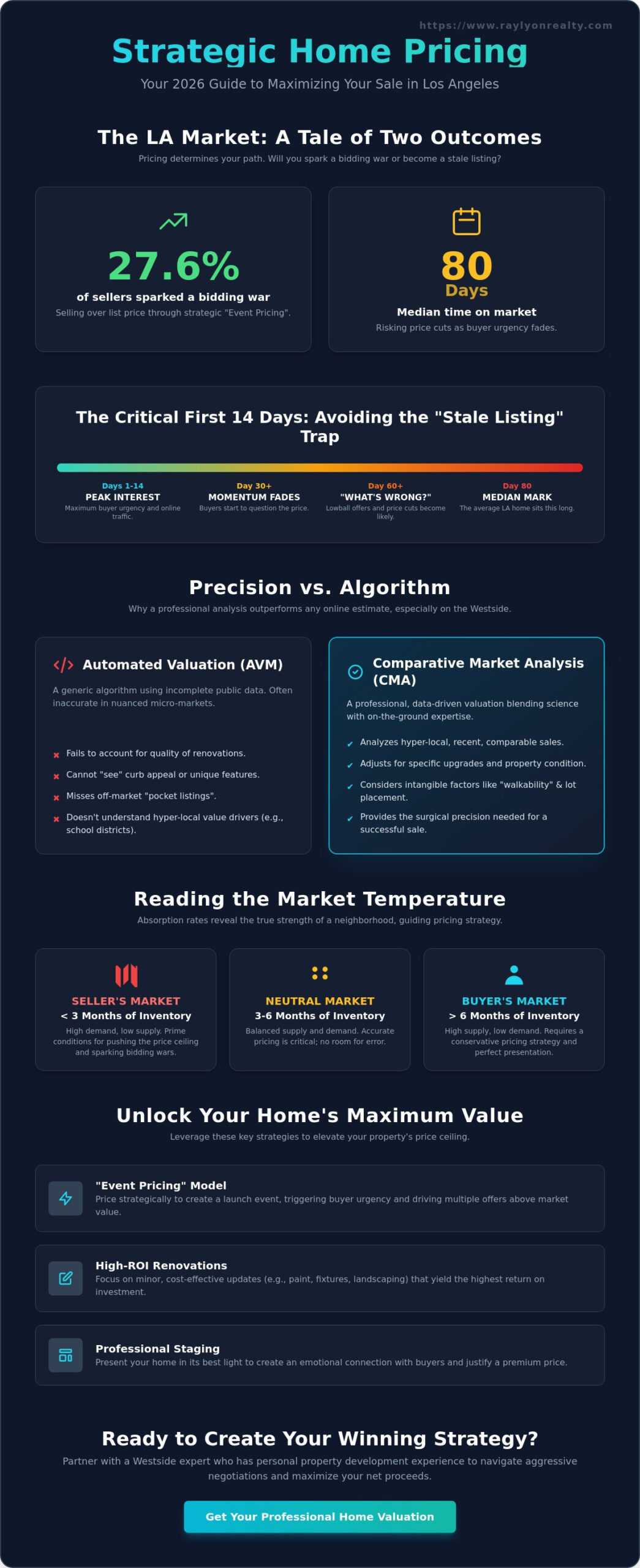
What if your list price isn’t actually what your home is worth? In a market where the median home currently sits for 80 days, setting the right number is less about appraisal and more about psychology. If you’re wondering how to price your home for sale in los angeles, you’ve likely seen the 27.6% of sellers who managed to spark a bidding war and sell over list price this year. You don’t want to be the homeowner watching the clock hit 60 days while buyers assume something is wrong with your property. It’s about finding the sweet spot that creates market velocity before your listing goes stale.
It’s frustrating when Zestimates don’t match the reality of your Westside street or when you aren’t sure if that kitchen refresh will actually pay off. I understand that stress because I’ve been in the trenches of property development and luxury listings myself. This guide will show you how to use pricing as a strategic marketing tool to maximize your net proceeds. We’ll break down the latest 2026 data, from Measure ULA thresholds to hyper-local Westside micro-markets, so you can move forward with total confidence and a clear plan of action.
Key Takeaways
- Understand why generic city data fails and how to analyze Westside micro-markets to predict local buyer behavior.
- Learn the “Rule of Three” for a Comparative Market Analysis to master how to price your home for sale in los angeles with more accuracy than any online algorithm.
- Discover the “Event Pricing” model used by luxury listing agents to trigger bidding wars and drive the sale price above market value.
- Identify the specific minor renovations and staging techniques that provide the highest return on investment and push your property’s price ceiling.
- See how leveraging a realtor with personal property development experience can help you navigate aggressive negotiations and maximize your net proceeds.
The 2026 Los Angeles Real Estate Landscape: Why Pricing is Hyper-Local
Many sellers look at county-wide headlines and assume they know their home’s value. In reality, there isn’t a single “Los Angeles market.” It’s actually a patchwork of micro-markets where one block behaves entirely differently than the next. If you want to know how to price your home for sale in los angeles, you have to look at price elasticity near tech hubs like Silicon Beach. Demand there often stays resilient even when broader economic data looks shaky. Even with the “Golden Handcuff” effect keeping inventory low, buyers are still highly selective about which pockets they’ll pay a premium for.
To better understand how these factors come together, watch this video on pricing strategies:
Pricing is a timing game. The “Stale Listing” trap is real. If you miss the mark in the first 14 days, you lose the “new listing” momentum that drives 2026 buyer urgency. To avoid this, we use The Comparative Market Analysis (CMA) to look at what buyers are actually paying right now. It’s about data, not just feelings or what your neighbor says they want for their house. When a home sits for too long, buyers start to wonder what’s hidden behind the walls.
The Westside Nuance: Santa Monica to Mar Vista
Specific boundaries create price floors that are hard to ignore. In Santa Monica, being in a coveted school district can add hundreds of dollars to your price per square foot. Meanwhile, the Venice “walkability” premium continues to drive competition for smaller lots. While the median sale price in Los Angeles is roughly $975,000, Westside pockets often start much higher. If you’re looking further inland, our Mar Vista neighborhood guide highlights how specific value drivers like lot size and proximity to trendy retail hubs can shift your pricing strategy by six figures.
Inventory vs. Absorption Rates in 2026
While the median days on market in Los Angeles is currently around 80 days, that’s a trailing indicator. It tells you what happened months ago. We look at the absorption rate to see the true strength of a pocket. This rate measures how long it would take to sell the current inventory if no new homes hit the market. This data helps us decide if we can push the price ceiling or if we need to be more conservative. It’s the difference between a successful bidding war and a price cut 30 days later.
- Seller’s Market: Less than 3 months of inventory.
- Neutral Market: 3 to 6 months of inventory.
- Buyer’s Market: More than 6 months of inventory.
The Comparative Market Analysis (CMA): The Science of Home Valuation
Determining your home’s value isn’t a matter of checking a single website and calling it a day. While The 2026 Los Angeles Real Estate Landscape gives us a broad view of price appreciation, a professional CMA provides the surgical precision needed for a successful sale. An Automated Valuation Model (AVM) is just an algorithm. It doesn’t know that you just installed wide-plank white oak flooring or that your neighbor’s house sold for a discount because it sits on a busy corner. A CMA bridges the gap between raw data and the emotional reality of a buyer standing in your living room.
Why Zestimates Fail in the Westside
In neighborhoods like Santa Monica or Pacific Palisades, two houses with identical square footage can have a $250,000 price difference based on “intangibles.” Algorithms can’t see the quality of a $50,000 kitchen upgrade or the specific curb appeal that makes a buyer fall in love. Public data also frequently misses “pocket listings,” which are off-market transactions common in high-end LA pockets. If you rely solely on tax assessments or online estimates, you’re likely working with incomplete information that could lead to underpricing your asset.
The Three Pillars of a Professional CMA
To master how to price your home for sale in los angeles, we look at the market through three distinct lenses. This “Rule of Three” ensures your price is grounded in reality while remaining competitive.
- Pillar 1: Recent Solds (The Reality Check). We look at homes that closed within the last 90 days. This is the only data point that reflects what a buyer actually paid and what a bank actually appraised.
- Pillar 2: Pending Sales (The Current Pulse). These are homes currently under contract. They tell us exactly where the market is moving this week, providing a real-time look at buyer demand.
- Pillar 3: Active Listings (The Competition). This is who you’re fighting for eyeballs. We analyze these listings to ensure your home offers better value than the house two blocks over.
Beyond the numbers, we adjust for architectural significance and lot utility. A flat, usable lot in the canyons is a rare prize that commands a much higher premium than a sloped one. We also consider the “whisper price,” which is the unofficial feedback we get from our network of local agents before your home even hits the MLS. This strategy allows us to test the waters and refine your list price for maximum impact. If you’re ready to see how these factors apply to your property, you can request a strategic valuation from our team to get started.
Strategic Pricing Models: Choosing Your Listing Philosophy
Pricing your home isn’t just a math problem; it’s a psychological opening move. When deciding how to price your home for sale in los angeles, you need to choose a philosophy that matches your risk tolerance and your desired timeline. I’ve seen many sellers treat their list price as a final destination. In reality, it’s a tool to control the narrative of your sale. In the 2026 market, where the median sale price hovers around $975,000, your strategy determines whether you’ll be among the 27.6% of sellers who close above their asking price.
There are three primary models to consider. The Market Value Price is the most straightforward. It relies on the CMA data we discussed earlier to list your home exactly where the recent “solds” suggest it should land. The Aspirational Price involves testing the market ceiling by listing 5% to 10% above the data. This is a high-risk move in 2026. With 30-year fixed mortgage rates between 6.49% and 6.71%, buyers are sensitive to overpricing. If you miss the mark, you risk sitting well past the 80-day median market average.
The most effective strategy for the Westside is often Event Pricing. This involves intentionally underpricing the property by a small margin to trigger a bidding war. By creating a perceived “deal,” you drive massive foot traffic during the first weekend. This leads to multiple offers, which gives you the leverage to negotiate better terms and a higher final price than a standard listing would achieve.
Don’t forget the importance of price brackets. Most buyers search the MLS in round numbers. If you list your home at $2,005,000, you’ll miss every buyer who capped their search at $2,000,000. Listing at $1,999,000 ensures you show up in both the “under $2M” and “above $1.5M” search results, effectively doubling your digital eyeballs.
The Psychology of the Bidding War
In a low-inventory environment, underpricing creates a sense of scarcity. We often set an “Offer Review Date” about 7 to 10 days after the initial launch. This concentrates buyer energy into a single window. When buyers know they’re competing against others, they’re more likely to waive contingencies or offer higher “as-is” terms. Transparency is key here. Disclosing that you have multiple offers creates a “fear of missing out” that often pushes the final proceeds far beyond the initial list price.
The Danger of the ‘Price Drop’ Narrative
If your initial price misses the mark, you’ll quickly see “blood in the water.” Savvy investors and aggressive buyers watch for price reductions like hawks. A price drop signals that the seller is getting desperate. Beyond the optics, the math of the “carrying cost” is brutal. With current interest rates, every extra month you sit on the market costs you thousands in mortgage interest and taxes. It’s often more profitable to take a slightly lower offer in week two than to hold out for a “dream price” that requires a massive reduction in month four.
Maximizing Your Price Ceiling: The Prep and Staging ROI
Your home’s condition is the primary lever that determines how much flexibility you have with your listing strategy. While the median price per square foot in Los Angeles is currently $616, properties that are truly “turnkey” often command a significant premium above that baseline. If you’re deciding how to price your home for sale in los angeles, you have to realize that buyers in 2026 are looking for the path of least resistance. With 15-year fixed mortgage rates sitting between 5.875% and 6.06%, many buyers prefer to pay a higher purchase price for a finished home rather than financing a renovation at a higher cost later.
I’ve spent years in property development and renovation, and I’ve seen how minor, strategic upgrades can shift your CMA pillars. We call this the “Ray Lyon” approach. Instead of recommending a $100,000 overhaul, we focus on high-impact changes that push your home into a higher pricing bracket. Staging isn’t just about filling a room with furniture; it’s about creating an emotional “must-have” feeling that justifies a bidding war. When a buyer walks into a perfectly curated space, they stop looking for flaws and start imagining their life there. This shift in perception is what allows us to set a higher price ceiling from day one.
To see how these specific upgrades could impact your property’s market value, you can connect with our luxury listing team for a custom assessment of your home’s potential.
High-ROI Upgrades for Westside Homes
You don’t always need a full remodel to see a jump in your net proceeds. A kitchen refresh, involving new hardware and cabinet painting, often yields a higher return on investment than a complete gut job. In Westside pockets like Venice or Santa Monica, the “Fresh Paint and Hardware” rule applies to the whole house. Neutral, high-end tones create a blank canvas for buyers. Don’t overlook the landscaping. In our drought-conscious climate, a high-design, low-water front yard creates the curb appeal necessary to justify a premium list price before the buyer even opens the front door.
The Digital Pricing Boost
In 2026, the first showing happens on a smartphone. High-end videography and 3D tours aren’t just perks; they’re essential tools that establish your home’s “perceived value.” A listing description shouldn’t just list features; it should tell a story that justifies your price point. We use targeted social media campaigns to find “outlier buyers” who might be moving from out of state or from a different LA neighborhood. These buyers are often willing to pay more for a specific lifestyle, and reaching them digitally is the fastest way to trigger the bidding war strategies we discussed earlier.
Partnering with a Westside Expert to Secure the Best Price
In a city where a single street boundary can dictate a $200,000 price swing, generic advice won’t cut it. High-stakes LA transactions demand a level of local expertise that goes beyond reading a spreadsheet. Understanding how to price your home for sale in los angeles is the first step, but the real work begins when we translate that data into a closed escrow. At Ray Lyon Realty, we don’t just list properties. We leverage a deep background in property development and personal flipping to see your home through the eyes of both an investor and a designer. This dual perspective ensures we don’t leave money on the table.
This “insider edge” means we have access to non-public data and exclusive buyer networks that online platforms simply can’t reach. We’ve spent years building relationships with other Westside specialists, giving us a direct line to families and investors looking for their next move before it ever hits the MLS. This proactive approach is how we secure the best price for our clients. We often find the “outlier buyer” who values your specific upgrades more than the general market might. Ultimately, mastering how to price your home for sale in los angeles is about more than just the number; it’s about the strategy used to defend that number during escrow.
Strategic Negotiation: Beyond the List Price
Getting a high offer is exciting, but it’s only half the battle. We help you evaluate the strength of an all-cash offer versus a higher headline price that comes with heavy contingencies. In the 2026 market, navigating the appraisal gap is a critical skill. If a buyer offers a premium but the bank’s valuation falls short, you need a strategist who knows how to defend the price or negotiate a gap coverage clause. Your choice of estate agency becomes particularly vital during the inspection phase. We use our renovation experience to help you distinguish between legitimate repair requests and tactical “price chipping” designed to claw back the purchase price.
The Ray Lyon Commitment
When you work with us, you get personalized attention from a founder who has real skin in the game. I’ve managed my own portfolios and navigated the risks of property renovation firsthand. That experience allows me to offer a hands-on approach that most traditional agents can’t match. Whether it’s coordinating a pre-listing refresh or managing a complex multi-offer situation, we are personally involved in every detail to ensure your net proceeds are maximized. We treat your equity with the same care we treat our own investments.
If you’re ready to move forward, your next step is to download our custom 2026 Home Valuation and Success Guide. This resource will help you align your goals with the current micro-market trends we’ve discussed throughout this guide. Contact us today to schedule a strategic pricing consultation and let’s build a plan that turns your property into a success story.
Take Control of Your Sale with a Strategic Price
Success in the 2026 market comes down to one thing: precision. You now have the framework to understand that your list price is a strategic tool designed to trigger urgency and maximize your net proceeds. By focusing on hyper-local Westside data and high-ROI property prep, you can avoid the common trap of sitting on the market while others spark bidding wars. Knowing how to price your home for sale in los angeles is the foundation of a stress-free transition and a successful closing.
I’ve spent years flipping properties and managing renovations, which gives me a unique perspective on how to squeeze every bit of value out of your home. Whether you’re in Santa Monica, Mar Vista, or the surrounding pockets, our team provides the granular expertise and access to exclusive off-market buyer networks you won’t find on a public portal. We’re here to protect your equity and guide you through every aggressive negotiation with confidence and care.
Ready to see what your property can truly achieve? Get Your Custom Westside LA Price Analysis today. Let’s work together to make your next move your most successful one yet.
Frequently Asked Questions
How much does it cost to sell a house in Los Angeles in 2026?
Typical seller closing costs in Los Angeles range from 7% to 10% of the final sale price. This includes the City of Los Angeles Base Property Transfer Tax of 0.45% and the County tax of 0.11%. For luxury properties sold for over $5,400,000, the Measure ULA tax adds another 4% to 5.5%. You should also budget for title insurance, which usually costs between $2,000 and $5,000, and escrow fees of approximately $2 to $3 per $1,000 of value.
Is it better to price my home high and lower it later?
This is a risky strategy that often backfires in the 2026 market. Properties that sit past the median 80 days on market often become “stale,” leading buyers to assume something is wrong with the home. A price drop later in the process signals desperation and can attract aggressive low-ball offers. It’s much more effective to price correctly from the start to trigger the bidding wars that 27.6% of LA sellers currently experience.
What is the best month to list a home for sale in LA?
The spring season, specifically March through May, is the most advantageous time to list your property. This window typically sees a surge in buyer demand and lower inventory levels, which often results in sales above the list price. While the Los Angeles market stays active year-round, listing in the spring allows you to capitalize on the highest “market velocity” and maximize your final net proceeds.
How do I know if my Realtor’s suggested price is accurate?
An accurate price suggestion should be supported by a professional Comparative Market Analysis (CMA) that follows the “Rule of Three.” Your agent should present three active, three pending, and three recently sold homes that are truly comparable to yours. If their suggested price aligns with the current 98.2% sale-to-list price ratio in your specific micro-market, you can feel confident the valuation is grounded in real-time data.
Can I use my property tax assessment to determine my home’s value?
Property tax assessments are not a reliable way to determine market value. These figures are generated for tax purposes and often lag significantly behind the actual market. When you are learning how to price your home for sale in los angeles, you need to look at what buyers are actually paying this month. A tax assessment doesn’t account for your recent $50,000 kitchen upgrade or the specific curb appeal of your Westside street.
What happens if my home doesn’t appraise for the sale price?
If the bank’s appraisal comes in lower than the purchase price, it creates an “appraisal gap.” This often happens when a bidding war pushes the price beyond recent comparable sales. To handle this, the buyer may need to increase their down payment, the seller may lower the price, or both parties can negotiate a middle ground. We often include appraisal gap coverage in the contract to protect your proceeds during these high-stakes negotiations.
How do high interest rates in 2026 affect my home’s asking price?
With 30-year fixed mortgage rates currently between 6.49% and 6.71%, buyer purchasing power is more sensitive than in previous years. This means your asking price must be incredibly precise to fit within buyer monthly payment limits. We adjust our pricing strategies to ensure your home remains the most attractive option in your bracket, helping you overcome the “Golden Handcuff” effect that is keeping overall inventory low.
Should I renovate my kitchen before setting the list price?
A full renovation might not always offer a 100% return, but a strategic “refresh” is often essential for pushing your price ceiling. Minor changes like new hardware, professional staging, and fresh paint can significantly impact how to price your home for sale in los angeles. We use our property flipping experience to help you decide which upgrades will actually increase your net proceeds and which ones are unnecessary expenses.