
What if the most stressful part of your move isn’t the packing, but a 17-day “ticking clock” that begins the moment you sign a contract? Most sellers in the Golden State feel a knot in their stomach when they think about the rigid deadlines of escrow and the sheer volume of paperwork required. It’s completely normal to feel anxious about the latest 2026 requirements, such as the new SB 382 electrical safety inspections or mandatory disclosures for AI-generated listing photos.
We want you to have a predictable moving schedule and a top-dollar result without the legal headaches. This guide will help you master the home selling process timeline california by breaking down the journey into a manageable 4-phase strategic sprint. You’ll learn how to navigate the standard 21-day loan contingency period, handle the new FinCEN reporting rules for all-cash deals, and use our “block to block” knowledge to stay ahead of the curve. We’re going to show you exactly how to prepare your property, from putting a little “lipstick” on the listing to successfully crossing the finish line at closing.
Key Takeaways
- Understand why the “Escrow Clock” typically runs 30 to 45 days and how every deadline anchors to your official Date of Acceptance.
- Master the home selling process timeline california by navigating the high-stakes 17-day contingency window and meeting strict disclosure deadlines.
- Avoid legal pitfalls by staying compliant with 2026 updates, including the new SB 382 electrical safety disclosures and AI-altered photo requirements.
- Learn how strategic “lipstick” staging and leveraging off-market networks can compress your schedule and attract competitive offers faster.
- Navigate the final 10-day closing phase with confidence, from the buyer’s final walkthrough to the official signing of your Grant Deed.
The Standard Home Selling Process Timeline in California (2026)
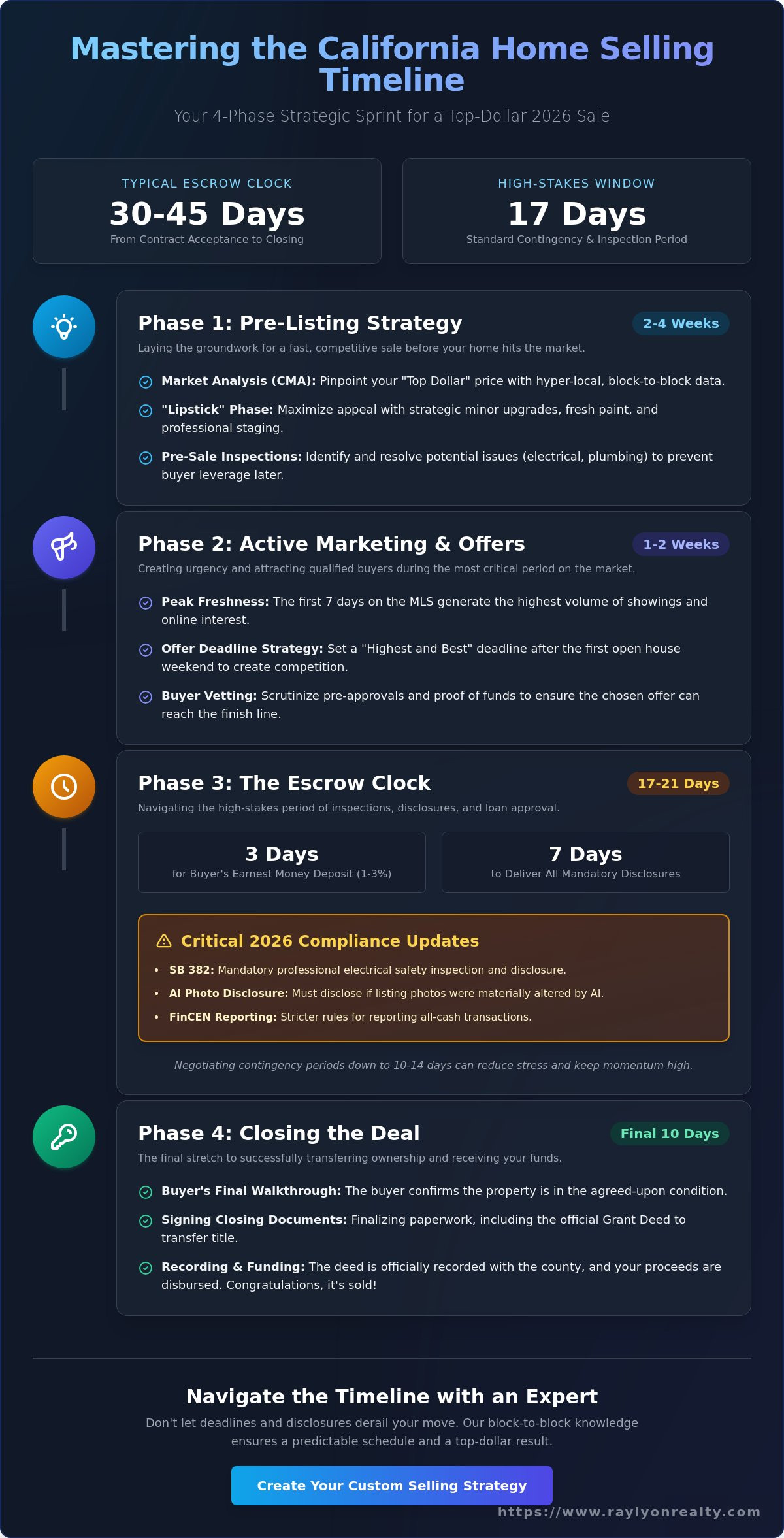
Selling a home in California isn’t a single event; it’s a series of precisely timed hurdles. In the current 2026 market, the “Escrow Clock” typically runs between 30 and 45 days. However, your most important milestone is Day 0, also known as the Date of Acceptance. This is the moment when both parties have signed the final agreement and the formal real estate transaction process begins. Every deadline in your contract, from inspections to loan approvals, is measured from this specific date.
Market dynamics in Los Angeles have shifted this year. With active listings projected to rise by nearly 10% in 2026, buyers have more options than they did during the inventory crunch of previous years. This means the home selling process timeline california now requires a much more aggressive and strategic preparation phase. You want to ensure you don’t languish on the market for the 69-day median we’re currently seeing across Los Angeles county. Success is found in a four-phase sprint: Strategy, Marketing, Escrow, and Closing.
To better understand how these moving parts fit together, watch this helpful video:
Phase 1: The Pre-Listing Strategy (2-4 Weeks)
Before the public ever sees your home, we spend two to four weeks working behind the scenes. We start with a deep-dive Comparative Market Analysis (CMA) to identify your “Top Dollar” price point based on hyper-local, block-to-block data. This is also what we call the “Lipstick” phase. We don’t suggest massive, expensive renovations. Instead, we coordinate minor upgrades, fresh paint, and professional staging to maximize that first impression. We also recommend ordering pre-sale inspections now. Finding a faulty electrical panel or a plumbing issue before you’re under contract prevents the buyer from using it as leverage during the high-stress contingency period.
Phase 2: Active Marketing and Offer Review (1-2 Weeks)
The first seven days your home is on the MLS are the most critical. This is when “freshness” is at its peak and you’ll see the highest volume of foot traffic. In a rebalancing market, we often set a “Highest and Best” deadline for offers following the first weekend of open houses. This creates a natural sense of urgency among buyers. During this week, we don’t just look at the price. We vet every buyer’s pre-approval and proof of funds carefully. Our goal is to ensure the person you choose can actually cross the finish line of a 30-day escrow without hitting financing snags or appraisal issues.
Phase 3: The Escrow Clock—Navigating the 17-Day Contingency Period
Once the contract is signed, the buyer has exactly three business days to deposit their Earnest Money Deposit into escrow. This deposit is typically 1% to 3% of the purchase price; it’s the first sign that the deal is moving from a handshake to a legal reality. This period is the most intense part of the home selling process timeline california. While the standard purchase agreement defaults to 17 days for inspections and 21 days for loan contingencies, these dates aren’t set in stone. In competitive markets, we often negotiate these windows down to 10 or 14 days to keep the momentum high and reduce your stress.
If a buyer begins to stall or misses a deadline, we don’t just wait and hope. We use a “Notice to Buyer to Perform.” This formal document gives the buyer a 48-hour window to meet their obligation. If they don’t, you have the right to cancel the deal and move on to a backup offer. It’s a vital tool that protects your moving schedule and ensures the “Escrow Clock” doesn’t stop ticking.
California’s Mandatory Disclosure Timeline
You have exactly seven days from the Date of Acceptance to deliver all mandatory disclosures. This includes the Transfer Disclosure Statement (TDS) and the Natural Hazard Disclosure (NHD). For 2026, the California Department of Real Estate has implemented stricter rules. You must now disclose if listing photos were materially altered by AI and provide a professional electrical safety inspection under SB 382. We prefer to have a “Full Disclosure Package” ready before we even hit the market. By giving this to buyers before they offer, we eliminate their ability to use “newly discovered” information as an excuse to renegotiate the price on Day 15.
The Inspection and Appraisal Hurdle
The first 10 days of escrow are usually a whirlwind of physical inspections. With the 30-year fixed mortgage rate at 6.54% as of May 2026, buyers are incredibly diligent about a home’s condition. They’ll likely send a general inspector, a plumber, and perhaps a structural engineer. If they find issues, they’ll submit a “Request for Repairs.” Our job is to negotiate these requests without moving your closing date. Simultaneously, the bank will send an appraiser. If the appraisal comes in lower than the sale price, we use our “block to block” knowledge to provide the appraiser with the best comparable sales data to support your price.
The finish line for this phase is the Contingency Removal. Once the buyer signs this form, their deposit becomes non-refundable. If you’re wondering how your specific property might fare in this process, you can get a professional evaluation of your home’s value to see where you stand in today’s market.
Phase 4: Closing the Deal—The Final 10 Days
The final ten days of the home selling process timeline california represent the transition from “under contract” to “sold.” By this stage, the high-stress contingency periods are behind you. The buyer’s deposit is now non-refundable, and the focus shifts to the logistics of the title transfer. This phase is often a whirlwind of signatures and final checks. You’ll coordinate with a mobile notary to sign the Grant Deed and other escrow documents at a location that’s convenient for you. It’s vital to understand the distinction between “funding” and “recording” in California. Funding occurs when the buyer’s lender releases the money to the escrow company. Recording, however, is the actual legal transfer of the title at the County Recorder’s office. You officially hand over the keys only after the county confirms the deed is recorded, which usually happens one business day after funding.
Final Walkthrough and Verification of Repairs
The final walkthrough typically happens between Day 25 and Day 28. This isn’t a new inspection. Instead, it’s a verification that the home is in the same condition as when the buyer first made their offer. If you agreed to any repairs during the contingency phase, you must provide all receipts and invoices to the buyer before this meeting. We’ve seen deals stall at the eleventh hour because a seller couldn’t prove a licensed professional handled a specific repair. You also need to ensure the property is “broom clean” by the contractual deadline. Leaving behind old paint cans or deferred maintenance debris can lead to a last-minute request for a cleaning credit. We want your exit to be as smooth as your entry.
Understanding Closing Costs in California
As a seller, you’ll face specific expenses that impact your final net sheet. Excluding real estate commissions, average seller closing costs in California currently range from 2.71% to 2.73% of the sale price. This includes title insurance, escrow fees, and the standard county transfer tax of $1.10 per $1,000 of the sale price. Some cities in Los Angeles County may have additional local transfer taxes that apply. The 2026 commission transparency rules mean your final settlement statement will clearly break down how all fees are distributed. For a deeper look at how these professional relationships and fee structures work, you can read our guide on what a real estate broker in Los Angeles does. We ensure every line item is accounted for so there are no surprises when the final wire hits your bank account.
Accelerating the Timeline: Pro Tips for a Faster Westside Sale
While the standard home selling process timeline california often stretches toward 45 days, Westside experts know how to trim the fat. We focus on finding buyers before your home even hits the MLS. By leveraging our private network of local agents and past clients, we can generate “off-market” interest. This often leads to a “Day 0” offer, skipping the public marketing phase entirely. It’s about being proactive rather than reactive, ensuring your property is the one everyone is talking about before the first open house.
Preparation is the ultimate time-saver. Spending five days on the “lipstick” phase—those minor aesthetic tweaks and professional staging mentioned earlier—can save you 15 days or more on the open market. Once you’re under contract, we don’t just accept the 17-day default. We push for a “Shortened Contingency” strategy. In high-demand areas, negotiating a 10-day or 14-day window for inspections keeps the buyer focused and the deal moving. Accurate pricing is also vital. We use our “Block to Block” knowledge to ensure your home is priced to sell immediately, avoiding the dreaded “Price Drop” delay that can add weeks to your schedule.
The Power of Local Expertise in Santa Monica and Mar Vista
Westside inventory levels in May 2026 remain tight compared to the rest of the county. However, selling a home in Mar Vista, Los Angeles requires a different marketing timeline than a property in the Valley. In Mar Vista, buyers are often tech-savvy professionals looking for luxury that’s ready for move-in. Strategic timing is key here. Listing in late spring or early summer typically results in the fastest closing times, as families aim to settle before the new school year begins. We understand these hyper-local rhythms and use them to your advantage.
Digital Efficiency and 2026 Real Estate Tech
Technology is our greatest ally in compressing the home selling process timeline california. We use immersive 3D tours and high-end virtual staging to pre-qualify buyers. This ensures that the people walking through your front door are already 90% sold on the layout, reducing wasted showings and “looky-loos.” Behind the scenes, we utilize digital escrow platforms that eliminate the paperwork lag. Instead of waiting for physical documents to be couriered, signatures happen in seconds. At Ray Lyon Realty, we use these integrated tech stacks to keep your sale on a strict 30-day track, ensuring every deadline is met without the traditional back-and-forth delays. If you’re ready to move, we’re ready to help you get your home sold on a faster timeline.
Why the Right LA Realtor is the Key to Your Timeline
The space between signing a listing agreement and handing over the keys is what we call the “Stress Gap.” It’s filled with emotional highs and lows, from the excitement of the first offer to the nail-biting wait for a loan approval. An experienced agent doesn’t just manage paperwork; they manage this gap. By anticipating potential hurdles before they arise, we keep the home selling process timeline california moving forward without the common setbacks that plague less experienced teams. We act as your strategic buffer, ensuring that a minor inspection finding doesn’t turn into a deal-killing crisis.
Results speak louder than promises. We recently worked with a Westside seller whose property had been languishing on the market for weeks. By identifying specific friction points in their presentation and leveraging our off-market network, we compressed what was looking like a 60-day ordeal into a clean 21-day closing. This wasn’t luck. It was the result of a targeted marketing sprint and aggressive contingency management. When you have an expert who has built, flipped, and sold properties personally, you’re getting a partner who knows exactly where the “time-wasters” are hidden in a transaction.
Experience Beyond the Transaction
Ray Lyon “practices what he preaches.” This personal experience in building his own home and managing investment properties gives our clients a distinct competitive advantage. We don’t just tell you to fix something; we explain why it matters to your bottom line. Because we’re active in the luxury and investment sectors, we maintain a vetted network of contractors who can handle “lipstick” upgrades in a matter of days. This speed is essential for maintaining your timeline. To see how our hands-on approach compares to others, take a look at our 2026 guide to real estate agents in Los Angeles.
Your Next Steps to a Successful Sale
Success starts with a clear map. We suggest scheduling a “Strategy Session” as your first step. During this meeting, we’ll work backward from your desired move-out date to create a customized schedule for preparation, marketing, and escrow. We’ll also provide you with our comprehensive Seller’s Checklist. This document ensures you don’t miss any of the new 2026 disclosure requirements, keeping your preparation phase entirely stress-free. If you’re ready to see how we can maximize your sale price while protecting your schedule, you can contact Ray Lyon for a personalized Westside marketing plan today. Let’s get your home valuation started and put your moving plans in motion.
Take Control of Your Move Today
Mastering the home selling process timeline california requires shifting from a reactive stance to a strategic sprint. The first 14 days of preparation often dictate the success of the next 30 days in escrow. By addressing 2026 disclosure requirements early and leveraging off-market interest, you can avoid common delays that often stretch sales beyond the 86-day national average. Success isn’t just about listing; it’s about timing every hurdle with precision.
You deserve a partner who brings more than just a license to the table. We combine block-to-block knowledge of Santa Monica and Mar Vista with hands-on experience in flipping and home building to protect your equity. Our savvy negotiation style is designed to secure top dollar while keeping your move on a predictable track. We’ve navigated these complexities ourselves, and we’re ready to do the same for you.
Get Your Personalized Westside Home Selling Timeline
Selling your home is a major life transition, but it doesn’t have to be a source of anxiety. With the right roadmap and a dedicated expert by your side, you’ll cross the finish line with confidence and peace of mind.
Frequently Asked Questions
How long does it take to sell a house in California from start to finish?
You should expect the full journey to take between 60 and 90 days from the initial strategy session to the final recording. This includes two to four weeks of preparation, a one-week marketing sprint, and a 30-day escrow. While the home selling process timeline california varies by region, the Los Angeles median was 69 days as of February 2026. Strategic pricing can often shorten the marketing phase significantly.
What are the most common reasons for delays in the California home selling timeline?
Financing hurdles and unexpected property defects are the most frequent causes of delays. A buyer’s loan might hit a snag, or a low appraisal could require a new round of negotiations. Additionally, the new 2026 disclosure rules, such as the SB 382 electrical safety inspections, can stall a closing if the seller hasn’t prepared the documentation in advance. We recommend pre-inspecting your home to avoid these surprises.
Can I sell my home in California in less than 30 days?
You can certainly close in under 30 days if you secure an all-cash buyer or leverage off-market interest. Cash transactions skip the 21-day loan contingency period, which often allows for a 10 to 14 day escrow. We’ve successfully compressed timelines for Westside sellers by using our private network to find buyers before the home even hits the MLS. This eliminates the traditional marketing window entirely.
What is the 17-day contingency period in California?
The 17-day contingency period is the contractual timeframe for a buyer to complete their inspections and appraisal. It acts as a safety net that allows them to cancel without losing their deposit if major issues arise. We often negotiate this window down to 10 or 14 days in competitive Westside neighborhoods. This keeps the buyer on a tight schedule and reduces the time your home is technically off the market.
How much time should I allow for home staging and preparation?
Allocate 14 to 28 days for professional staging and property preparation. This “lipstick” phase involves minor repairs, deep cleaning, and arranging furniture to maximize your home’s appeal. Investing five days in high-quality aesthetics often saves 15 days on the market by attracting stronger offers immediately. A well-prepared home is less likely to face difficult “Request for Repair” negotiations later in the process.
Does the 2026 market favor a faster or slower selling process?
The 2026 market requires a more deliberate preparation phase to achieve a faster sale. With active listings projected to rise 10% this year, buyers have more leverage to be picky. A front-loaded timeline, where you handle inspections and staging before the first showing, is the best way to ensure a smooth 30-day escrow. Being prepared for the new AI-altered photo disclosures also prevents last-minute legal delays.
What happens if a buyer misses a deadline in the escrow timeline?
You must issue a formal Notice to Buyer to Perform if a deadline is missed. This document gives the buyer a 48-hour window to meet their obligation or risk cancellation. Using this tool is a vital part of managing the home selling process timeline california effectively. It prevents the escrow period from dragging on indefinitely. If the buyer still fails to perform, you can move to your backup offers immediately.
When do I actually get the money from my home sale?
Proceeds are typically wired to your account one business day after the Grant Deed is recorded at the County Recorder’s office. Funding usually happens first, followed by the legal transfer of title. Once the county confirms the recording, escrow releases the funds. You’ll receive your net profit after the standard seller closing costs, which average 2.72% in California, are deducted from the sale price.