

If you’re selling a home in Los Angeles in 2026, seeing a high offer price is exciting, but it’s only half the story. Total seller closing costs in LA can reach up to 10% of the sale price; this means a significant portion of your equity could disappear if you aren’t prepared. It’s completely natural to feel a bit of anxiety about hidden fees or the confusing math of calculating net proceeds from home sale, especially with California’s unique tax landscape. You deserve to know exactly what’s heading into your bank account before you sign the final papers.
We’ve designed this guide to remove the guesswork and give you total confidence in your financial planning. You’ll learn how to navigate specific hurdles like the City of Los Angeles transfer tax and the latest Measure ULA thresholds that impact high-value properties. Beyond just the deductions, we’ll explore how strategic property prep and local Westside expertise can actually increase your final net check. From line-item breakdowns to ROI strategies, you’re about to get the clear picture you need for your next big move.
Key Takeaways
- Understand the fundamental formula—Gross Sale Price minus liens, commissions, and prep costs—to set a realistic baseline for your financial expectations.
- Navigate the specific “LA Factor,” including the City of Los Angeles transfer taxes and 2026 Measure ULA thresholds, to avoid expensive surprises at the closing table.
- Learn the step-by-step process for calculating net proceeds from home sale so you can plan your next property purchase with total confidence.
- Discover how strategic investments in staging and high-ROI repairs can actually increase your final check, often paying for themselves several times over.
- Demystify the final Settlement Statement (ALTA) and the exact timeline of when your funds will be wired after the deed is officially recorded.
What Are Net Proceeds? The Basic Formula for Sellers
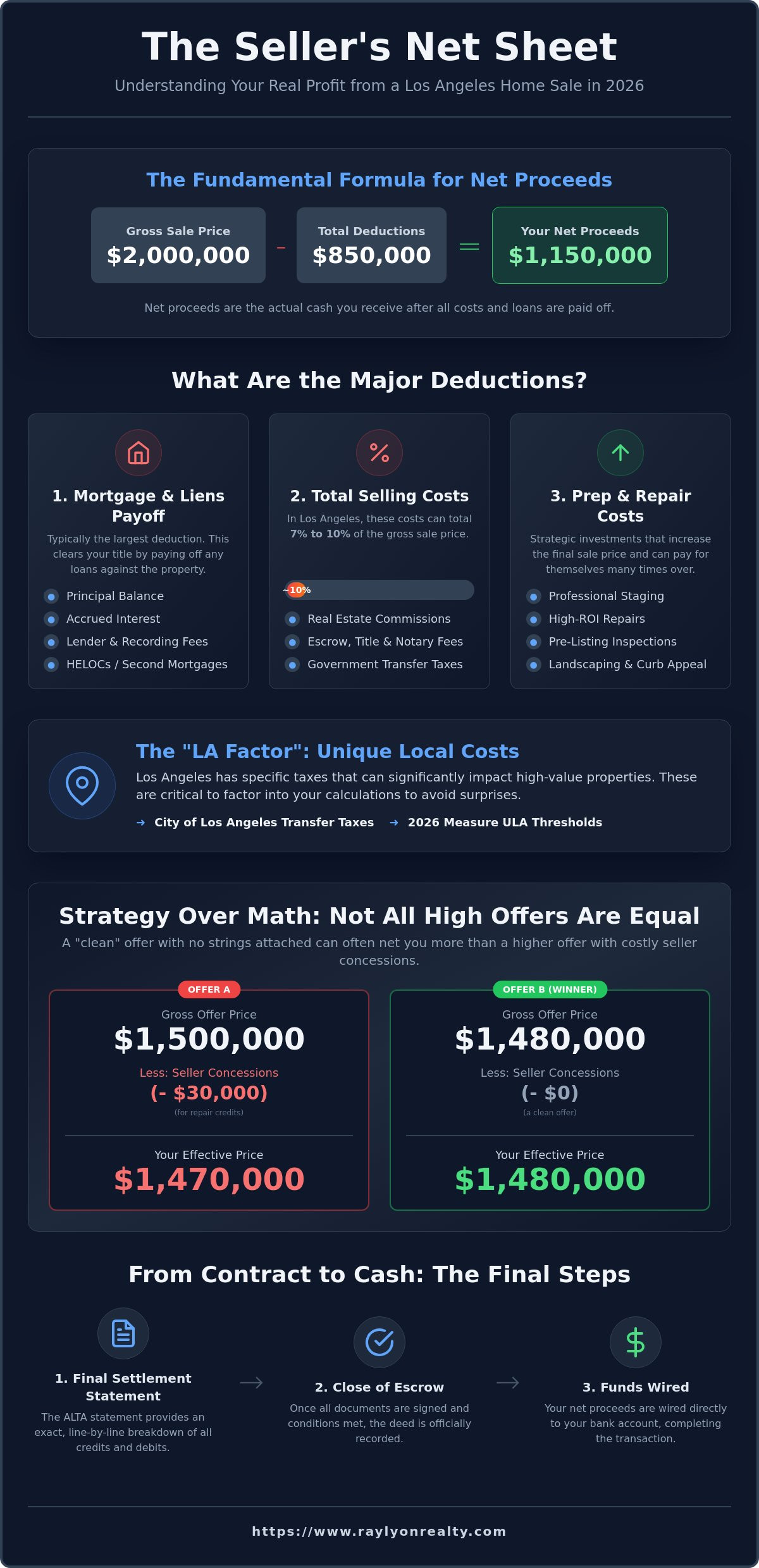
In the excitement of listing your property, it’s easy to get caught up in the “headline price.” However, the gross sale price is often just a vanity metric. What truly matters for your financial future is calculating net proceeds from home sale. Net proceeds are the actual amount of cash you receive once every lien, commission, and closing cost is settled. Think of it as the real-world value of your hard-earned equity. Net proceeds represent the actual walk-away cash that determines your future purchasing power and financial freedom.
To better understand how these numbers interact, watch this helpful video that breaks down the math:
Gross Sale Price vs. Net Proceeds
It’s a common emotional trap to focus solely on the biggest number on a contract. In a competitive market like Westside LA, a buyer might offer a higher price but demand significant seller concessions or repair credits. If you accept a $1.5 million offer but agree to $30,000 in credits, your net result is lower than a “clean” $1.48 million offer with no strings attached. The terms of the contract often eat into your bottom line more than the sale price adds to it. Always look past the headline and focus on what will actually appear on your final settlement statement.
The Role of the Mortgage Payoff
The mortgage payoff is usually the largest deduction. It isn’t just the principal balance you see on your monthly statement. You must also account for accrued interest from the last payment date to the day of closing, and occasionally, prepayment penalties. If you have a second mortgage or a Home Equity Line of Credit (HELOC), those must be cleared as well. The Closing Process requires an official payoff demand from your lender to ensure every penny is accounted for. Getting this document early prevents last-minute surprises that could stall your funding.
- Principal Balance: The remaining amount borrowed.
- Accrued Interest: Interest accumulated since your last monthly payment.
- Recording Fees: Costs to document the release of the lien.
- Statement Fees: What the bank charges to provide the payoff figures.
By understanding these variables, calculating net proceeds from home sale becomes a strategic tool rather than a stressful guessing game. It allows you to move forward with the confidence that your financial plan is built on solid data.
Breaking Down Standard Selling Costs and Fees
While your mortgage payoff is usually the largest single deduction, the “death by a thousand cuts” often comes from the variety of smaller fees required to transfer a title. In Los Angeles, total seller closing costs generally range from 7% to 10% of the sale price. This includes everything from professional representation to the administrative paperwork that keeps the transaction legal. Successfully calculating net proceeds from home sale requires a granular look at these line items so you aren’t surprised by the final tally on your settlement statement.
The Commission Conversation
Real estate commissions are the primary driver of your selling costs. In the 2026 market, these fees remain negotiable and are typically split between the listing agent and the buyer’s agent. While it might be tempting to look for the lowest possible rate, discount brokerages often lack the resources for the aggressive marketing and high-end staging needed to drive multiple offers. Top-tier real estate agents in los angeles ca justify their fee by creating a competitive environment that often pushes the gross sale price high enough to more than cover the commission cost. If you’re feeling overwhelmed by the math, reaching out to a local Westside specialist can help you get a crystal-clear estimate tailored to your specific property.
Title, Escrow, and Home Warranties
In Southern California, local custom dictates that the seller usually pays for the owner’s title insurance policy. This protects the buyer’s ownership interest and is a standard expectation in Westside transactions. You’ll also encounter escrow fees, which cover the neutral third party that manages the exchange of funds and documents. Many savvy LA sellers also choose to provide a one-year home warranty for the buyer. This isn’t just a nice gesture; it’s a strategic move that reduces your post-sale liability if an appliance or system fails shortly after the “deed is recorded.”
Administrative and Legal Fees
The paperwork side of the transaction carries its own set of costs. You’ll need to account for financial considerations for home sellers such as the Natural Hazard Disclosure (NHD) report, which is a mandatory California document. Other common fees include:
- Document Prep and Notary: Small but necessary charges for legalizing signatures.
- Wire Transfer Fees: Costs to securely move large sums of money between banks.
- HOA Transfer Fees: If you’re selling a condo in Mar Vista or Santa Monica, the association will charge to update their records and provide required disclosures.
When calculating net proceeds from home sale, remember that these administrative costs are often fixed, regardless of your home’s final price. Getting a preliminary title report early can help identify any unexpected liens or issues that might add to these costs before you even hit the market.
The LA Factor: Local Taxes and Regulations
National real estate calculators often fail because they don’t account for the hyper-local tax structures found in Southern California. When you’re calculating net proceeds from home sale in the Westside, you aren’t just dealing with federal rules; you’re navigating a maze of city-specific assessments. These local factors can swing your final number by tens of thousands of dollars, making it vital to understand exactly which jurisdiction your property falls under before you head to the closing table.
The most significant local impact comes from documentary transfer taxes. Every seller in Los Angeles County pays a base rate of $1.10 per $1,000 of the sale price. However, if your home is within the City of Los Angeles, you’ll pay an additional $4.50 per $1,000. For high-value properties, the stakes are even higher. As of July 2026, the City of Los Angeles enforces Measure ULA, often called the “mansion tax.” This adds a 4% tax on sales between $5,400,000 and $10,900,000, and a 5.5% tax on anything above that threshold. These taxes are almost always a seller’s responsibility in Southern California, and they are deducted directly from your gross proceeds.
Transfer Taxes in Santa Monica and Mar Vista
Location is everything when it comes to your tax bill. If you’re selling Santa Monica real estate, you’ll find different rates than your neighbors in Mar Vista, which is part of the City of Los Angeles. Santa Monica has its own tiered transfer tax system that is separate from the ULA tax. Sellers often find this confusing because a house just two blocks away might face an entirely different set of city fees. Local custom dictates that sellers cover these costs to ensure a clean title transfer to the buyer.
Property Tax Prorations and Compliance
Your final check will also reflect property tax prorations. Since California taxes are paid in arrears, you’ll likely owe the buyer a credit for the portion of the year you owned the home but haven’t yet been billed for. Additionally, Los Angeles has strict “point of sale” compliance requirements. You’ll need to budget for retrofitting, which includes bracing water heaters, installing smoke and carbon monoxide detectors, and ensuring low-flow toilets are in place. While these are smaller line items, they are mandatory for a legal sale in LA.
Capital Gains and Withholdings
Beyond local fees, you must consider the IRS rules for home sale regarding capital gains. For a primary residence, you can generally exclude up to $250,000 in gain if you’re single, or $500,000 if you’re married filing jointly. Keep in mind that California treats capital gains as ordinary income, with rates reaching as high as 13.3% for top earners. If you’re a non-resident of California or a foreign investor, the state and federal governments may require “withholding” a significant percentage of your gross proceeds (FIRPTA and CAL-FIRPTA) at the time of sale. This isn’t necessarily the final tax you owe, but it stays out of your pocket until you file your next tax return. Calculating net proceeds from home sale accurately means accounting for these “held” funds so you don’t overextend yourself on your next purchase.
Maximizing Your Bottom Line: Strategy Over Math
While the previous sections focused on the deductions you can’t avoid, this section is about the levers you can pull to increase your walk-away cash. Calculating net proceeds from home sale shouldn’t just be a passive exercise in subtraction. By treating your home as a strategic asset, you can often push the gross sale price high enough to offset your closing costs entirely. In the competitive Westside LA market, the difference between a “lived-in” home and a curated property can represent six figures in additional equity.
Professional staging is the most effective tool in your arsenal. In Santa Monica and Venice, staging isn’t an expense; it’s a high-yield investment. A staged home feels larger, brighter, and more aspirational, which triggers the emotional “must-have” response in buyers. This leads to stronger initial offers and fewer days on the market. Similarly, high-end photography and cinematic video tours are essential. These digital first impressions reduce friction and ensure that the buyers walking through your door are already half-convinced to make an offer.
Strategic repairs also offer a massive return on investment. You don’t need a full kitchen remodel to see a jump in your net proceeds. Often, spending $5,000 on fresh neutral paint, updated light fixtures, and professional landscaping can result in a $15,000 increase in offer price. The goal is to remove “mental friction” for the buyer. If they see a long list of small tasks, they’ll often over-estimate the cost of repairs and lower their offer accordingly.
Preparing the Asset for Market
Maximizing your value requires a partner who understands the local landscape. Working with a sophisticated real estate agency allows you to leverage a network of vetted contractors and designers who specialize in high-ROI upgrades. This is especially true for “curb appeal” in neighborhoods like Mar Vista, where a well-manicured front yard can set the tone for the entire showing. We also highly recommend a pre-sale home inspection. By identifying and fixing issues before you list, you prevent the buyer from using those same problems as leverage to demand massive repair credits during escrow.
Negotiation as a Shield
The negotiation phase is where your profit is either protected or lost. In a seller’s market, you can use multiple offers to leverage out concessions. If a buyer submits a “Request for Repairs,” your agent can use the backup offers to stand firm on an “as-is” sale. This preserves your bottom line and ensures that the number you saw on the initial contract is the number you actually see at closing. If you want a tailored strategy to maximize your home’s value, book a strategic consultation with our team to see how we can increase your final check.
Strategic pricing also plays a vital role in calculating net proceeds from home sale. It sounds counterintuitive, but pricing your home slightly below market value often creates a bidding war. This competition frequently drives the final price well above what a higher, “aspirational” listing price would have achieved. When multiple buyers are fighting for your property, you gain the upper hand on both price and terms.
The Closing Statement: Finalizing Your Calculation
The final step in calculating net proceeds from home sale is the careful review of your Settlement Statement, commonly referred to as the ALTA or Closing Disclosure (CD). This document serves as the definitive balance sheet for your transaction. It brings together every credit and debit we’ve discussed into a single, organized view. While the previous sections of this guide helped you estimate these figures, the ALTA is where the math becomes a legal reality. You’ll see the exact breakdown of the gross sale price, the mortgage payoff, and the specific local taxes that apply to your Westside property.
Timing is everything when it comes to your money. Once the “deed is recorded” with Los Angeles County, the escrow officer receives the green light to release your funds. Typically, you can expect the wire transfer to hit your bank account within 24 to 48 hours of recording. While the arrival of those funds is a moment of immense relief, your responsibility doesn’t end there. You must keep a digital and physical copy of this final statement. It’s a critical document for your 2026 tax filing, as it helps your accountant document your cost basis and any deductible selling expenses that could lower your capital gains liability.
Reviewing the Preliminary Title Report
Surprises in the final hours of escrow are usually the result of issues that should have been caught weeks earlier. We make it a priority to review the preliminary title report as soon as escrow opens. This report identifies any “clouds” on the title, such as forgotten mechanics’ liens, old utility easements, or secondary HELOCs that haven’t been cleared. Your escrow officer plays a vital role here, reconciling all credits from the buyer and debits from your lender. You should also verify that prorated items, such as your 2026 property taxes and any prepaid insurance premiums, are split exactly to the day of closing. Even a small error in these daily calculations can result in hundreds of dollars staying in the wrong pocket.
Moving Forward with Confidence
A precise net proceeds estimate does more than just lower your stress; it empowers your next move. Whether you’re using those funds for a down payment on a larger home in Santa Monica or securing a bridge loan for a fast-moving investment, accuracy is your greatest asset. There’s a unique peace of mind that comes from a professionally managed sale where every fee is transparent and every deduction is justified. Working with a local expert ensures that no “surprise” fees appear in the final hours of escrow. We’ve seen how a lack of local knowledge can lead to miscalculated transfer taxes or missed compliance credits. Don’t leave your final check to chance. Get a professional equity analysis and net proceeds estimate from Ray Lyon Realty today.
Take Control of Your Home Sale Results
Mastering the math of your home sale is about more than just avoiding surprises; it’s about maximizing the equity you’ve built over the years. By focusing on the “net” rather than the “gross,” you can make smarter decisions about staging, repairs, and pricing. Successfully calculating net proceeds from home sale requires a deep understanding of local Los Angeles regulations, from Measure ULA thresholds to specific Santa Monica transfer taxes. When you align these technical details with a strategic marketing plan, you ensure that every dollar of your home’s value is protected.
With over a decade of experience in high-stakes Westside LA negotiations, our team specializes in the unique dynamics of the Santa Monica and Mar Vista markets. We take a hands-on approach to property preparation and staging because we know it’s the most effective way to boost your final walk-away check. You don’t have to navigate these complex financial waters alone. Ready to see what your home is worth? Get a custom Net Proceeds Estimate from Ray Lyon Realty. We’re here to help you move into your next chapter with total confidence and a clear financial path forward.
Frequently Asked Questions
How do I calculate my net proceeds from a home sale in Los Angeles?
Start with your expected gross sale price and subtract your remaining mortgage balance, real estate commissions, and estimated closing costs. In Los Angeles, you must specifically account for city and county transfer taxes, as well as any applicable Measure ULA thresholds based on current 2026 rates. Using a professional framework for calculating net proceeds from home sale ensures you capture smaller line items like retrofitting and escrow fees that often catch sellers by surprise.
What is the largest expense when selling a house besides the mortgage?
Real estate commissions are typically the largest expense outside of your existing loan payoff. These fees cover the professional marketing, staging coordination, and expert negotiation services provided by your listing agent and the buyer’s agent. In high-stakes Westside markets, these commissions are a strategic investment that helps drive the competitive bidding environment needed to maximize your final walk-away check and protect your equity.
Do I have to pay capital gains tax on my home sale profit in 2026?
Whether you owe tax depends on your total profit and your residency history. Under current IRS rules, you can exclude up to $250,000 of gain if you’re single or $500,000 if you’re married filing jointly, provided the home was your primary residence for two of the last five years. It’s important to remember that California treats capital gains as ordinary income, so profits exceeding these federal limits are taxed at your standard state rate.
Who pays for the transfer tax in California, the buyer or the seller?
In Southern California, it’s the standard local custom for the seller to pay the documentary transfer taxes. This includes the base county-level tax and any additional city-level taxes, such as those found in the City of Los Angeles or Santa Monica. While almost every line item in a real estate contract is technically negotiable, buyers in the Westside market generally expect the seller to cover these specific title transfer costs at closing.
Can I deduct my staging and repair costs from my taxable profit?
Yes, professional staging and most repairs made specifically to prepare your home for the market are considered selling expenses. These costs are subtracted from your gross sale price when determining your realized gain for tax purposes. This effectively lowers your taxable profit, which is a vital part of calculating net proceeds from home sale when you’re looking at your long-term financial planning and future purchasing power.
What happens to my escrow balance after I sell my home?
Any funds remaining in your mortgage impound account, such as prepaid property taxes or homeowners insurance, will be refunded to you by your lender. This refund doesn’t happen directly at the closing table. Instead, your lender typically sends a check or initiates a wire transfer within 30 days after they receive the official payoff and your loan is closed in full. It’s a helpful final credit that adds to your total net profit. To ensure you continue saving on your next property, you can read more about insurance providers that prioritize no-fee policies.
How long does it take to receive my money after the house is sold?
You’ll typically receive your funds within one to two business days after the deed is officially recorded with the county. Once the title company confirms the recording, the escrow officer receives the green light to initiate a wire transfer to your bank account. Most sellers in Santa Monica and Mar Vista see the funds reflected in their balance by the following morning, depending on their specific bank’s wire processing times.
Is the commission negotiable in the Westside LA market?
Real estate commissions are absolutely negotiable and are not set by law or any industry mandate. In the sophisticated Westside market, the fee is often structured to reflect the level of service, global marketing reach, and professional staging investment provided by the listing agency. Strategic sellers focus on the net result, choosing a commission structure that incentivizes maximum market exposure to drive the highest possible offer from qualified buyers.