

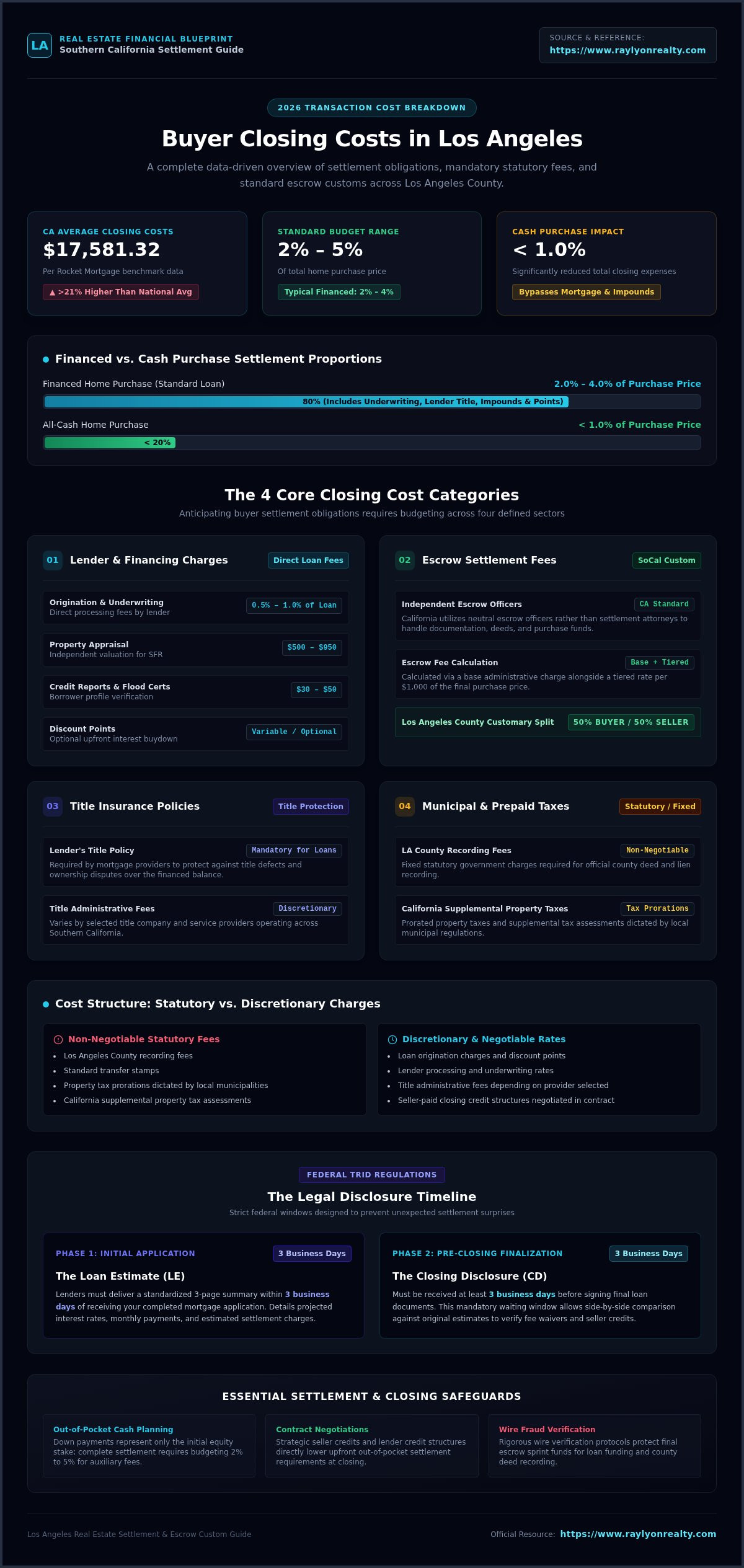
According to Rocket Mortgage, average closing costs in California sit at $17,581.32, which is over 21% higher than the national average. When you’re calculating your out-of-pocket cash needs, determining actual buyer closing costs in los angeles can quickly become the most stressful part of buying a home.
Between dense lender Loan Estimates, surprise California supplemental property taxes, and confusion over which fees Southern California sellers customarily cover, it’s easy to feel blindsided right before escrow closes. You shouldn’t have to guess what your final settlement sheet will look like or worry about unexpected expenses derailing your purchase.
Managing these expenses requires strategic local know-how, not just passive budgeting. This complete 2026 guide helps you master every fee, local escrow custom, and strategic saving opportunity when purchasing a Los Angeles home. Ahead, we provide reliable percentage benchmarks, an itemized breakdown of lender and municipal fees, and actionable tactics to lower your out-of-pocket costs through seller-paid credits.
Key Takeaways
- Standard closing budgets range between 2% and 5% of your purchase price, making accurate forecasting essential before you begin making offers.
- Anticipating buyer closing costs in los angeles requires budgeting across four separate buckets, including lender fees, escrow charges, title policies, and municipal prepaid taxes.
- Southern California escrow customs distinctly separate buyer and seller obligations, protecting you from paying certain fees that are standard buyer expenses in other regions.
- Strategic contract negotiation and lender credit structures can significantly reduce your upfront out-of-pocket cash requirements at settlement.
- Rigorous wire fraud verification protocols during the final escrow sprint ensure your funds arrive safely for loan funding and county deed recording.
What Are Buyer Closing Costs in Los Angeles?
When you purchase a home, your down payment only represents your initial equity stake. Closing costs encompass the complete collection of lender fees, third-party operational charges, and government assessments required to finalize your transaction. In Southern California real estate, these expenses require careful out-of-pocket settlement planning well before you sign final paperwork.
To better understand these financial obligations, watch this helpful breakdown of local transaction expenses:
These charges fall into two distinct groups: non-negotiable statutory fees and negotiable service rates. Fixed expenses include Los Angeles County recording fees, standard transfer stamps, and property tax prorations dictated by local municipalities. Conversely, discretionary fees such as loan origination charges, lender processing rates, and title administrative fees can vary depending on the providers you select.
The General Cost Benchmark for LA Homebuyers
Typical buyer closing costs in los angeles generally range between 2% and 4% of the total purchase price for financed transactions. This baseline shifts depending on your loan size and down payment structure. For cash purchases, closing costs drop significantly, often below 1%, because you bypass mortgage underwriting, lender title insurance policies, points, and mandatory impound accounts. On higher-priced Westside properties across Venice or Santa Monica, a fractional percentage point difference easily represents thousands of dollars, making exact percentage budgeting vital.
The Legal Timeline: From Loan Estimate to Closing Disclosure
Federal lending rules establish strict timelines to safeguard your budget from unexpected surprises:
- The Loan Estimate (LE): Lenders must deliver this standardized three-page summary within three business days of receiving your completed mortgage application. It details projected interest rates, monthly payments, and estimated settlement charges.
- The Closing Disclosure (CD): Under TRID regulations, you must receive the finalized Closing Disclosure at least three business days before signing your loan documents. This waiting window gives you time to compare final numbers against your original estimate.
Partnering with dedicated real estate agents in los angeles ca gives you a proactive advocate to audit these disclosures line by line, ensuring your final settlement statement accurately reflects every agreed seller credit and fee waiver.
Itemized Breakdown of Los Angeles Buyer Closing Expenses
Understanding where your money goes transforms an overwhelming closing statement into a predictable checklist. When tallying buyer closing costs in los angeles, your total settlement figure divides into three primary categories: upfront financing charges, settlement administration fees, and ongoing prepaid escrows.
Lender and Financing Charges
Mortgage providers assess administrative fees to originate, verify, and secure your financing. These typically include:
- Origination and Underwriting: Direct processing fees that often range from 0.5% to 1% of the total loan balance.
- Property Appraisal: An independent valuation required by your lender, generally costing between $500 and $950 for single-family residences.
- Credit Reports and Flood Certifications: Administrative passes costing between $30 and $50 to verify your borrowing profile.
- Discount Points: Optional upfront fees paid directly to lower your mortgage interest rate over the life of the loan.
Title Insurance and Escrow Settlement Fees
California uses independent escrow officers rather than settlement attorneys to handle purchase funds and deed transfers. In Los Angeles County, escrow offices charge a base administrative fee alongside a tiered rate per $1,000 of the final purchase price. Because escrow manages documentation for both parties, this fee is customarily split evenly between buyer and seller.
Additionally, buyers must purchase a lender’s title insurance policy. This policy shields the mortgage company against undiscovered liens, disputed boundaries, or ownership claims. Fortunately, when issued concurrently with the seller-funded owner’s policy, this lender policy frequently discounts to a flat charge between $175 and $500. Modest county recording charges also apply to record your grant deed and mortgage into public records.
Prepaids, Impounds, and Supplemental Taxes
Prepaids represent advance funding for expenses you would pay anyway as an owner. You’ll fund daily interim interest spanning your funding date to the end of the month, alongside a full year of upfront hazard insurance.
Most critical for local buyers is California property tax proration. Under Proposition 13, local properties are assessed at your purchase price, with effective tax rates usually falling between 1.1% and 1.4% according to records on the Los Angeles County Property Tax Portal. Lenders generally require an impound buffer of two to six months of property taxes at closing.
Crucially, you must prepare for a separate supplemental property tax bill arriving two to six months after closing. Escrow only collects taxes based on the seller’s previous assessed valuation. The county assessor recalculates the home’s value at your purchase price and bills you the difference retroactively. If you want experienced eyes auditing your settlement ledger to protect your budget, review our strategic guidance at Ray Lyon Realty before removing financial contingencies.
Who Pays What in Los Angeles County Real Estate?
One of the biggest misconceptions newcomers face is assuming closing expenses are split identically across the country. In truth, the legal definition of closing costs treats fee allocation as purely negotiable, leaving regional custom to set expectations. In California, these traditions diverge sharply at the Tehachapi Mountains.
In Northern California, buyers routinely shoulder the full escrow settlement fee and pay out-of-pocket for the owner’s title policy. In Southern California, our customs significantly reduce the buyer’s burden. Knowing these local norms ensures you don’t overpay when planning your cash reserves.
Customary Fee Allocations in Los Angeles
To budget your buyer closing costs in los angeles accurately, review how typical Southern California purchase contracts divide line items:
- Owner’s Title Insurance: Customarily paid by the seller. This protects your home’s equity against past title defects for the duration of your ownership.
- Lender’s Title Insurance: Paid by the buyer to safeguard the mortgage holder’s financial stake.
- Escrow Settlement Fees: Customarily split 50/50 between the buyer and the seller.
- HOA Transfer Documents: Sellers customarily cover HOA document prep, while buyers often pay specific transfer or move-in administration fees.
City and County Transfer Taxes
Transfer taxes represent another major regional difference. Los Angeles County levies a documentary transfer tax of $1.10 per $1,000 of value ($0.55 county, $0.55 state). This charge is traditionally paid entirely by the seller.
Individual municipalities layer additional transfer taxes on top. The City of Los Angeles adds $4.50 per $1,000, bringing baseline local transfer taxes to $5.60 per $1,000. For high-end real estate inside City of Los Angeles boundaries, Measure ULA adds a 4% tax on sales from $5.4 million to $10.9 million, and 5.5% on sales at or above $10.9 million. Sellers bear legal responsibility for Measure ULA, but the levy impacts net proceeds and shapes how sellers approach purchase price negotiations.
Negotiating Departures from Local Escrow Custom
The standard California Association of Realtors (CAR) Residential Purchase Agreement provides check-boxes for every single settlement line item. Customs are defaults, not legal mandates. In highly competitive micro-markets like mar vista los angeles, buyers sometimes offer to cover the seller’s half of escrow to make their offer stand out without driving up the recorded purchase price. Conversely, in balanced markets, buyers can request seller credits that cover customary buyer expenses, preserving critical cash reserves.
4 Strategic Ways to Lower Your Closing Costs in LA
Settlement expenses do not have to drain your remaining liquid reserves. While taxes and municipal recording rates remain fixed by law, a significant portion of your settlement charges can be negotiated down or offset entirely. Applying a proactive tactical framework helps you minimize out-of-pocket settlement cash when managing buyer closing costs in los angeles.
Step 1: Shop and Compare Loan Estimates
Do not simply accept the first Loan Estimate you receive. Focus closely on Section A, which lists direct lender origination, application, and underwriting charges. Section A fees are determined independently by each mortgage company, meaning they can be negotiated or waived. Next, examine Section C for services you can shop for independently, such as title insurance and settlement coordination. Requesting competing estimates often motivates lenders to trim administrative markups to retain your business.
Step 2: Negotiate Seller Concessions and Repair Credits
Your physical home inspection represents your strongest leverage point. When private inspections reveal deferred maintenance, roof wear, or outdated electrical panels, you do not always need to demand physical contractor repairs before closing. Instead, ask for a non-recurring closing cost credit written directly into an escrow amendment.
This credit directly offsets your out-of-pocket settlement expenses dollar for dollar. Be mindful of loan guidelines regarding interested party contributions. Conventional mortgages generally limit total seller contributions to 3% to 9% of the purchase price depending on your down payment size. Understanding how an experienced brokerage coordinates this process is crucial. If you are comparing representation styles, our guide on what is an estate agency explains how strategic buyer representation structures these amendments to satisfy strict underwriting guidelines.
Step 3: Leverage Lender Credits and Timing Strategies
If minimizing immediate cash outlay matters more to you than securing the lowest possible monthly mortgage payment, explore lender credits. By accepting a mortgage rate one-eighth to one-quarter of a percent higher, your lender provides upfront cash credits that absorb thousands in settlement charges.
Calendar timing offers another simple, effective way to reduce closing cash:
- Close near month-end: Lenders collect daily prepaid interest from your funding date until the final day of the month. Closing on the 28th requires only a few days of interim interest, whereas closing on the 3rd requires funding nearly a full month upfront.
- Audit junk fees: Always cross-reference your final Closing Disclosure against your original Loan Estimate to spot unexplained document delivery or duplicate administrative charges.
Ready to structure your next purchase with battle-tested negotiation strategies? Connect directly with Ray Lyon Realty to secure maximum seller concessions on your upcoming purchase.
Navigating Escrow and Closing on the LA Westside
Escrow coordination on the Westside moves quickly once contingencies are cleared. Navigating this final stretch requires precision. Understanding the operational path from funding to recording ensures your budgeted buyer closing costs in los angeles translate into a clean, dispute-free closing.
Final Walkthrough and Settlement Statement Audit
Your journey concludes with two critical checkpoints before any money changes hands:
- The Pre-Close Verification: Conduct your final walkthrough within five days of scheduled closing. You aren’t inspecting for new design flaws here; you’re verifying that the property remains in the agreed condition and that negotiated repair items were completed as contracted.
- The Settlement Ledger Audit: Compare your final settlement statement side-by-side against your initial disclosures. We verify that every agreed inspection credit is applied correctly and that recurring prorations for local property taxes match the agreed closing date exactly.
Catching accounting discrepancies at this stage prevents escrow delays and ensures you never overpay at the closing table.
Wire Security and Key Handover
The single greatest hazard in modern residential transactions is wire fraud. Cybercriminals actively monitor real estate transactions to send fraudulent wire routing updates right when buyers prepare their closing funds. Always call your designated escrow officer directly to verbally verify wire instructions, routing numbers, and recipient account details using a phone number established at the start of escrow. Never rely on phone numbers or bank instructions sent via unverified emails.
Once escrow receives your certified funds and your lender releases loan proceeds, the escrow officer sends the transfer package to the Los Angeles County Registrar-Recorder/County Clerk. In Southern California, the deal is not legally completed when you sign your loan documents; ownership transfers only after the county confirms official deed recording. As soon as the recording number is released, escrow releases keys to your agent.
Navigating neighborhood-specific considerations across Santa Monica, Venice, and Mar Vista demands granular market experience. Schedule a private consultation with Ray Lyon Realty to secure strategic, hands-on representation that protects your interests throughout your upcoming purchase.
Take Control of Your Los Angeles Home Purchase
Securing the keys to your dream property shouldn’t come with eleventh-hour financial surprises. Mastering buyer closing costs in los angeles comes down to active strategy rather than passive budgeting. From leveraging Southern California escrow customs to timing your closing date and negotiating repair credits, you hold genuine influence over your final settlement total.
Having an experienced local advocate in your corner makes all the difference when auditing complex disclosures and structuring purchase contracts. At Ray Lyon Realty, we bring deep neighborhood expertise across Santa Monica, Mar Vista, Venice, and the wider Westside. We deliver hands-on guidance through every phase of California escrow, deploying client-centric negotiation strategies that maximize credits and protect your hard-earned capital.
Connect with Ray Lyon Realty for expert Westside buyer representation today, and step into your home purchase with complete clarity and confidence.
Frequently Asked Questions
How much are typical buyer closing costs in Los Angeles?
Typical buyer closing costs in los angeles range between 2% and 4% of the purchase price on financed transactions. For an $800,000 to $1,000,000 home, expect to budget roughly $16,000 to $40,000 above your down payment. Cash buyers pay substantially less, usually below 1%, because they avoid lender origination charges, mandatory impounds, appraisal fees, and lender title insurance policies.
Does the buyer or seller pay for title insurance in Los Angeles County?
Both parties pay for separate title policies under Southern California escrow custom. The seller pays for the owner’s title policy, which protects the buyer’s ownership rights against historical liens. The buyer pays for the lender’s title insurance policy, which lenders require to protect the mortgage balance. When issued simultaneously through the same title company, the buyer’s lender policy is typically discounted.
What is the difference between recurring and non-recurring closing costs?
Non-recurring closing costs are one-time administrative expenses paid once to complete the transaction, such as escrow fees, loan underwriting, notary charges, and county recording fees. Recurring closing costs represent ongoing property expenses you must prepay at settlement. These include hazard insurance premiums, prepaid daily mortgage interest, and initial escrow impound reserves for upcoming property taxes and HOA dues.
Can closing costs be rolled into my mortgage loan in California?
On a standard home purchase, conventional lenders generally do not let you add closing costs directly to your loan balance because of loan-to-value limits. However, you can achieve a similar result by taking a slightly higher interest rate in exchange for upfront lender credits, or by negotiating seller concessions that directly offset your required cash at settlement.
What are California supplemental property taxes, and when are they paid?
California supplemental property taxes account for the reassessment of your home from the seller’s previous tax basis to your new purchase price under Proposition 13. Because regular escrow only prorates existing tax bills, the county assessor mails this catch-up bill directly to your mailbox two to six months after closing. It is paid separately from your initial escrow impounds.
How do city transfer taxes affect buyers in Los Angeles and Santa Monica?
City and county documentary transfer taxes are customarily paid by property sellers throughout Los Angeles County, including standard municipal rates and Measure ULA thresholds. While buyers rarely pay these transfer taxes directly, local tax rates heavily influence seller negotiation flexibility. Understanding these municipal tax obligations helps buyers construct competitive offers without absorbing fees that sellers traditionally handle.
How far in advance of closing will I know my exact cash to close?
Federal regulations require your lender to deliver your finalized Closing Disclosure at least three business days before you sign loan documents. This document outlines your exact out-of-pocket cash needs. Shortly after, your escrow officer prepares the final settlement statement, calculating exact property tax prorations and seller credits so you know the precise wire transfer amount required.