

What if the fine print in your purchase offer isn’t just dry legal jargon, but the most powerful financial shield you have? In any property transaction, vocabulary functions as direct legal leverage that safeguards your earnest money deposit and preserves your negotiating power. Learning the essential real estate terms every buyer should know turns an intimidating, binding contract into your greatest strategic advantage.
It’s completely normal to feel overwhelmed by stacks of complex paperwork, especially when overlapping concepts like home inspections and property appraisals get mixed up. You shouldn’t have to lose sleep over unexpected settlement expenses or the fear of forfeiting your hard-earned funds. Master these concepts, and you’ll protect your deposit, evaluate prospective homes clearly, and negotiate with total confidence. Here is your definitive guide to the critical contract clauses, financing definitions, and closing paperwork that will help you make competitive, well-protected purchase offers.
Key Takeaways
- Mastering foundational financing terms clarifies your true purchasing power before you start touring properties.
- Understanding essential contract clauses shields your earnest money deposit and establishes strong legal protections during escrow.
- Learning the differences between commonly confused real estate terms every buyer should know prevents expensive miscalculations during home inspections and appraisals.
- Decoding title, settlement, and escrow paperwork ensures a seamless transition into official homeownership without hidden surprises.
- Leveraging advanced clauses gives you a distinct tactical edge to win competitive properties without needlessly overpaying.
Financial and Mortgage Terms Every Buyer Should Know First
Before touring properties or drafting purchase agreements, mastering foundational financial mechanics establishes your true purchasing boundaries. When you submit binding real estate purchase contracts, your financing structure dictates whether your deal closes smoothly or collapses in escrow. Securing verified financial status early prevents catastrophic contractual default once a seller accepts your bid. Understanding these foundational lending concepts is the first step in learning the essential real estate terms every buyer should know.
Pre-Qualification vs. Pre-Approval
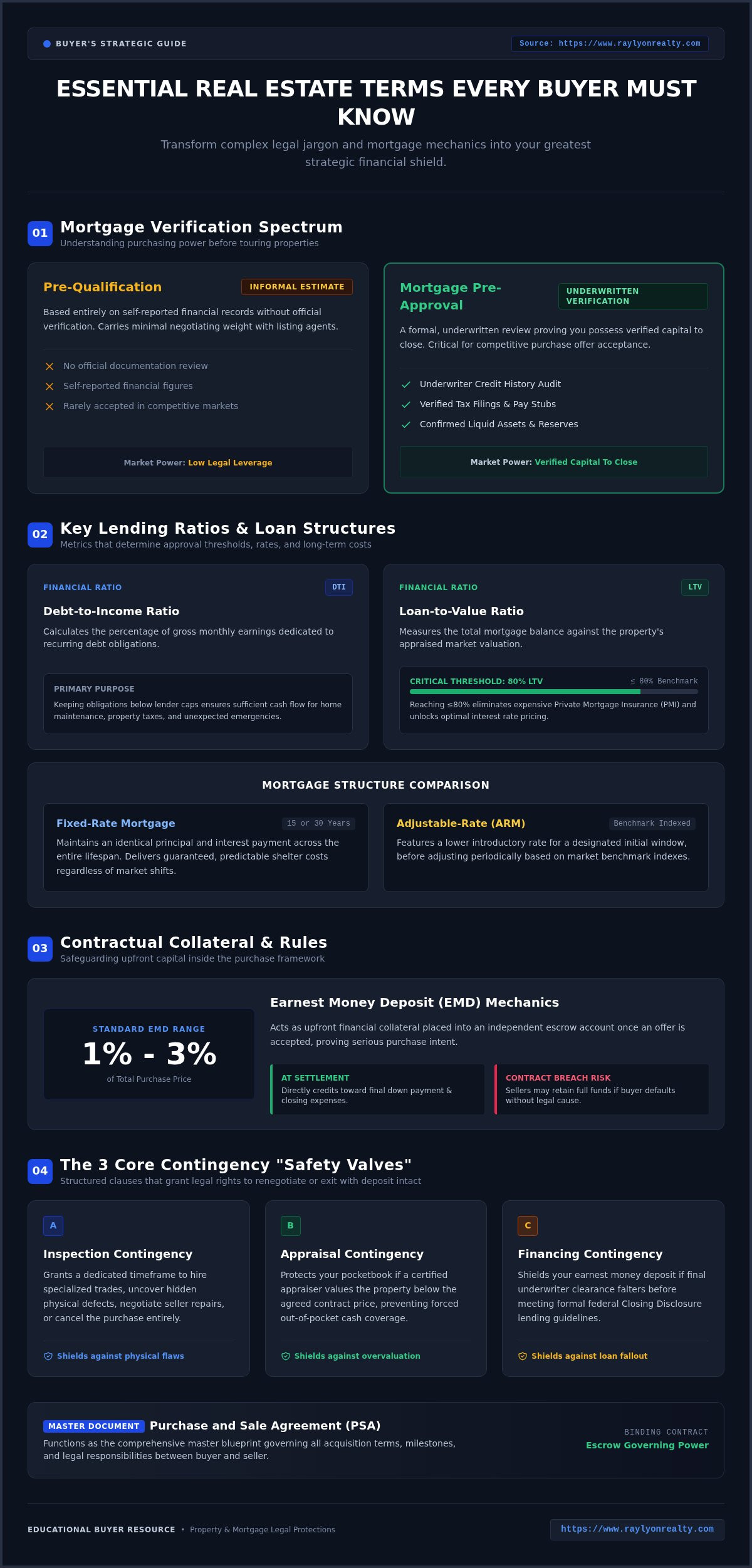
Pre-qualification provides an informal estimate of your borrowing potential based entirely on self-reported financial records. It requires no official documentation and carries very little weight with serious listing agents. A mortgage pre-approval, however, requires formal underwriter review of your credit history, tax filings, pay stubs, and liquid assets. In competitive markets, sellers rarely accept offers backed only by pre-qualification letters because pre-approvals prove you possess verified capital to close.
Debt-to-Income Ratio (DTI) and Loan-to-Value (LTV)
Your debt-to-income ratio (DTI) calculates the percentage of your gross monthly earnings dedicated to recurring debt obligations, while the loan-to-value (LTV) percentage measures your total mortgage balance against the property’s appraised market value.
Lenders evaluate these two metrics to gauge their risk before approving loan terms:
- DTI threshold: Keeping recurring obligations below lender caps ensures you have enough cash flow for home maintenance, property taxes, and emergencies.
- LTV threshold: An LTV ratio at or below 80% eliminates expensive private mortgage insurance requirements and unlocks more competitive interest rate pricing.
Fixed-Rate vs. Adjustable-Rate Mortgages (ARM)
A fixed-rate mortgage maintains an identical principal and interest payment across the entire loan lifespan, typically fifteen or thirty years. This structure delivers predictable shelter costs regardless of market shifts. Conversely, an adjustable-rate mortgage features a lower introductory rate for a designated initial period before adjusting periodically according to benchmark financial indexes. Deciding between them depends on your long-term ownership horizon and broader interest rate cycles, making them critical real estate terms every buyer should know before locking in debt.
Offer and Contract Vocabulary That Protects Your Investment
A purchase contract is far more than procedural paperwork; it is a legally binding commitment with immediate financial consequences. The provisions inside determine who holds power during negotiations and who absorbs risk if challenges arise. Partnering with seasoned real estate agents in Los Angeles CA ensures critical contractual milestones remain protected against forfeiture. Knowing these offer provisions highlights why contract language tops the list of real estate terms every buyer should know.
Earnest Money Deposit (EMD)
The earnest money deposit acts as upfront financial collateral submitted into an independent escrow account once a seller accepts your bid. Standard deposits typically range between 1% and 3% of the purchase price, signaling serious purchase intent. At settlement, this capital directly credits toward your final down payment and closing costs. However, if you breach agreed milestones or walk away without valid contractual cause, the seller may have the legal right to retain your entire deposit.
Core Contingencies: Inspection, Appraisal, and Financing
Contingencies serve as structured safety valves, establishing specific conditions that must occur before the transaction becomes unconditionally binding. These clauses give you legal grounds to renegotiate terms or exit the deal without losing your initial deposit:
- Inspection contingency: Grants a dedicated window to hire specialized trades, uncover physical defects, negotiate seller repairs, or cancel the deal entirely.
- Appraisal contingency: Protects your pocketbook if a certified appraiser values the property below your contract price, preventing forced out-of-pocket coverage.
- Financing contingency: Shields your earnest money if final underwriter clearance falters before meeting federal Closing Disclosure requirements.
Purchase and Sale Agreement (PSA)
The purchase and sale agreement functions as the master blueprint governing every detail of your acquisition. It outlines included fixtures, legal descriptions, timelines, and financial milestones. Addendums allow both parties to modify baseline terms, such as requesting seller credits toward closing costs or establishing custom occupancy arrangements. Understanding default terms clarifies each party’s contractual remedies if disputes occur. When you prepare to submit an offer, consulting with the tactical team at Ray Lyon Realty ensures these protective mechanisms actively work in your favor.
Crucial Real Estate Terms Buyers Frequently Confuse
Mistaking similar vocabulary can turn an exciting home search into a costly legal headache. Many property concepts sound almost identical in casual conversation, yet they carry entirely different contractual weights. Misunderstanding them leads to poorly structured bids or blown contingency timelines during the escrow process in real estate. Keeping these pairs straight represents some of the most practical real estate terms every buyer should know.
| Term A | Term B | Core Distinction |
|---|---|---|
| Appraisal | Home Inspection | Valuation for the lender vs. physical safety review for the buyer |
| Contingent | Pending | Active contractual conditions pending vs. all conditions cleared |
| Real Estate Agent | Real Estate Broker | Licensed representative vs. legally responsible supervising broker |
Appraisal vs. Home Inspection
An appraisal evaluates fair market worth on behalf of the mortgage lender to confirm the asset supports the borrowed balance. In contrast, a home inspection examines physical safety, roofing, plumbing, and structural integrity directly for the buyer. An appraiser does not check whether sewer lines are cracked or if heating systems are failing. Passing an appraisal never means the home is defect-free.
Contingent vs. Pending Listing Status
When an online listing says “contingent,” the seller accepted an offer, but the transaction remains dependent on specific conditions like inspections or financing clearance. Buyers can often submit strong backup offers on contingent listings. Once a property moves to “pending,” all contractual contingencies were waived or fulfilled, meaning the deal is firmly en route to closing.
Real Estate Broker vs. Real Estate Agent
A real estate agent maintains a professional state license to guide buyers and sellers through sales, operating under a supervising firm. A broker completes extensive licensing, passes advanced state testing, and assumes direct legal liability for all handled contracts. Learn how an estate agency oversees individual agents to keep your interests protected throughout escrow. Clarifying these professional distinctions gives you clear insight into the exact real estate terms every buyer should know before building an advisory team.
Escrow, Title, and Closing Terms Decoded
Reaching the final stage of a purchase shifts your focus from contract negotiations to formal transfer of ownership. This settlement phase turns written agreements into legally recorded property rights. Escrow serves as a neutral, third-party depository that securely holds wire transfers, purchase funds, and legal deeds until every contractual obligation is met. Mastering settlement terminology ranks high among the real estate terms every buyer should know to prevent last-minute closing delays.
Escrow and Settlement Mechanics
An escrow officer coordinates the logistical closing instructions between you, the seller, and your lender. This professional balances prorations, which divide ongoing property expenses like county taxes, local utility bills, and HOA dues based on your exact closing date. Total closing costs encompass loan origination, third-party escrow management, municipal transfer fees, and title insurance premiums. Every line item accounts for the operational mechanics required to deliver clean ownership.
Title Search, Liens, and Title Insurance
A comprehensive title search examines historical records to ensure no unpaid contractor claims, tax liens, or boundary disputes linger from prior owners. Encumbrances, often called a cloud on title, create legal obstacles that can stop your transaction until resolved. Title insurance guarantees protection against unrecorded ownership claims or document fraud:
- Lender’s policy: Required by mortgage providers to protect their invested capital up to the outstanding loan balance.
- Owner’s policy: Purchased by the buyer to safeguard your personal equity against unknown defects or historic forgery for as long as you own the home.
Closing Disclosure (CD) and Deed Recording
Federal lending rules mandate that your mortgage lender deliver the Closing Disclosure at least three business days before you sign final loan documents. You should immediately cross-reference this document against your original Loan Estimate to check that loan terms, interest rates, and closing fees remain accurate. Once all funds clear and the grant deed records at the county recorder’s office, you legally take ownership. If you want experienced guidance to ensure a seamless escrow process from start to finish, reach out to the team at Ray Lyon Realty for dedicated buyer representation.
Knowing these settlement terms ensures you review final figures with total clarity, completing the roster of real estate terms every buyer should know before receiving your keys.
Advanced Vocabulary for Competitive Housing Markets
Winning a property in a fast-paced market requires more than submitting a high purchase price. In multiple-offer situations, tactical contractual terms appeal directly to seller priorities while shielding your cash reserves. Using specialized purchase clauses separates seasoned buyers from reactive bidders. These strategic provisions make up the advanced tier of real estate terms every buyer should know.
Escation Clauses and Appraisal Gaps
An escalation clause automatically raises your purchase price by a set increment above any legitimate competing bid, stopping at a strict ceiling you dictate. This strategy keeps your bid competitive without forcing you to make an aggressive opening offer. Pairing this with an appraisal gap clause pledges a specific cash amount if the certified valuation trails the agreed contract price. Defining explicit monetary caps on both clauses maintains rigorous boundaries on unexpected out-of-pocket cash outlays.
As-Is Clauses and Seller Leasebacks
Nuanced contract language can make your offer stand out without increasing your risk profile:
- As-is clause: Clarifies that the seller will not perform physical repairs, yet allows you to preserve complete inspection rights to evaluate system conditions.
- Seller leaseback: Allows the seller to rent the residence back from you for a negotiated duration following escrow closing, giving them time to complete their next move.
Structuring accommodating occupancy terms often wins competitive deals against higher offers by resolving the seller’s logistical hurdles.
Partnering with Local Representation
Deploying advanced terms effectively requires localized market awareness. Securing a home in high-demand Westside pockets like Mar Vista, Los Angeles requires an agent who understands hyper-local purchase customs. Dedicated buyer representation translates complex contract language into an active negotiating advantage, spotting subtle seller motivations to structure protective, winning proposals. When you want to navigate competitive bidding with clear direction, connect with Ray Lyon Realty to guide your property search with confidence.
Integrating these tactical provisions completes the essential real estate terms every buyer should know to win in any real estate climate.
Turn Real Estate Knowledge Into Your Negotiating Edge
Contract vocabulary isn’t just administrative paperwork; it’s your primary defense when committing capital to an acquisition. By understanding how lending ratios define your baseline, how contingencies shield your deposit, and how strategic clauses win competitive properties, you turn confusing jargon into clear leverage. Mastering these real estate terms every buyer should know ensures you remain in command from your initial offer through final deed recording.
When you’re ready to begin your home search across Santa Monica and Westside Los Angeles, having seasoned local representation protects your bottom line. Our hands-on brokerage brings decades of localized acquisition experience, structuring competitive purchase agreements and guiding clients through escrow without costly missteps. Navigate your home purchase with confidence-connect with Ray Lyon Realty to secure your next home with complete peace of mind.
Frequently Asked Questions
What is the difference between an appraisal and a home inspection?
An appraisal evaluates fair market property value for the mortgage lender, while an inspection assesses physical systems for the buyer. Lenders require appraisals to confirm the home acts as adequate collateral for the loan balance. Home inspections examine foundations, plumbing, electrical panels, and roofs. Passing an appraisal doesn’t mean the house lacks defects. Both serve essential but distinct functions among the real estate terms every buyer should know.
Can a buyer back out of a contract and keep the earnest money deposit?
Yes, a buyer can cancel a purchase and recover their earnest money deposit if the exit is based on an active, unexpired contingency. Clauses covering property inspections, financing clearance, or appraisal shortfalls let you walk away if unforeseen issues arise. However, if you waive your contingencies or miss contractual timelines without an agreed extension, the seller often holds the legal right to retain your deposit funds as liquidated damages.
What does an ‘as-is’ condition clause mean for home buyers?
An as-is clause means the seller intends to sell the property in its current state without making repairs or offering financial credits. It does not strip away your right to conduct thorough inspections unless you voluntarily waive that contingency. You still have an agreed due diligence window to hire inspectors, assess major systems, and decide whether to proceed or cancel the contract and retrieve your deposit.
How does an escalation clause work in competitive bidding situations?
An escalation clause automatically raises your purchase offer above competing bids by a set increment up to a predetermined cap. If a competing buyer submits a higher verifiable offer, your bid increases incrementally above their figure. The escalation stops immediately if bids exceed your maximum limit, keeping you competitive in multiple-offer scenarios without forcing you to needlessly overpay upfront.
What are closing costs and what fees do they typically include?
Closing costs are third-party administrative and financing fees required to finalize a real estate transaction and transfer legal ownership. These out-of-pocket settlement charges include lender loan origination fees, appraisal costs, title search and insurance policies, escrow management, recording fees, and prorated property taxes. Reviewing your final Closing Disclosure three business days prior to settlement lets you cross-check every line item against initial estimates for total accuracy.
Why do home buyers need both a lender’s and an owner’s title policy?
Home buyers need both policies because each covers a different party and distinct financial interests against historical title defects. A lender’s title policy protects only the mortgage institution up to the outstanding loan balance. An owner’s title insurance policy safeguards your personal equity against unrecorded liens, boundary disputes, prior fraud, or recording errors for as long as you or your heirs hold legal title to the property.
What does contingent mean compared to pending on real estate listings?
Contingent means an offer was accepted but the sale still relies on meeting specific conditions, while pending means all conditions were satisfied. A contingent status allows the deal to fall through if inspection or loan hurdles emerge, and sellers occasionally accept backup offers. Pending status indicates that contingencies were waived or cleared, moving the transaction directly toward final settlement. These are foundational real estate terms every buyer should know when monitoring active market inventory.