

Did you know that for high-income earners in California, the combined federal and state tax hit on long-term capital gains can now exceed 37%? It is a staggering number that can instantly halt your investment momentum. You’ve worked hard to build equity in your Westside property, and the thought of losing over a third of that profit to the IRS and the Franchise Tax Board is enough to make any seasoned investor anxious. Understanding the 1031 exchange rules Los Angeles requires more than just a basic tax form; it demands a hyper-local strategy to navigate a market where inventory is notoriously tight.
We understand the pressure of the strict 45-day identification window and the confusion surrounding California’s unique “claw back” provisions. This guide will help you master these complex regulations so you can defer 100% of your capital gains taxes and grow your portfolio with confidence. We’ll break down the 2026 tax brackets, the latest Measure ULA thresholds, and the exact steps you need to take to ensure your exchange is IRS-compliant and strategically sound.
Key Takeaways
- Learn how to leverage a 1031 exchange to defer both federal and California capital gains taxes, keeping your investment capital fully available for reinvestment.
- Understand the critical “claw back” provision that allows California to track and tax deferred gains even if you eventually move your investments out of state.
- Master the strict 1031 exchange rules Los Angeles investors must follow, specifically the high-stakes 45-day identification window and the 180-day closing deadline.
- Discover how to navigate the low-inventory Westside market by accessing exclusive off-market opportunities in high-demand areas like Santa Monica, Mar Vista, and Venice.
- Gain a clear roadmap for transitioning from underperforming assets into higher-yield investment properties without losing your hard-earned equity to the tax man.
What is a 1031 Exchange? LA Investor Fundamentals
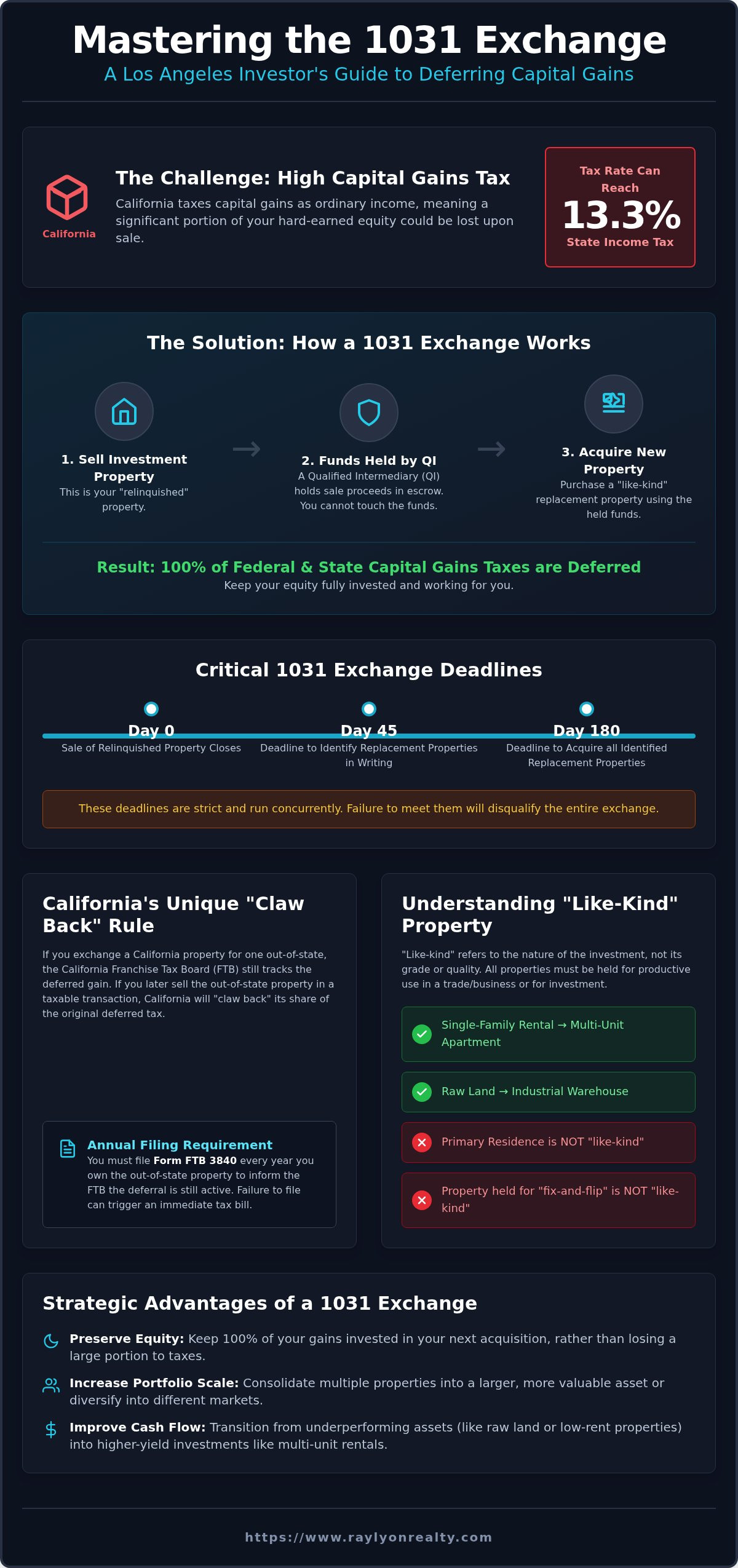
At its simplest level, a 1031 exchange is a strategy that allows real estate investors to swap one investment property for another while deferring capital gains taxes. This process is governed by the Internal Revenue Code section 1031. In a high-value market like ours, understanding the 1031 exchange rules Los Angeles requires a firm grasp of both federal law and local market dynamics. Instead of paying a massive tax bill when you sell, you reinvest those funds into a new property, which allows your wealth to compound over time without interruption.
Los Angeles investors often use this tool to manage the significant appreciation seen in Westside neighborhoods. If you bought a property in Santa Monica years ago, your equity has likely grown substantially. A 1031 exchange lets you move that equity into a higher-performing asset without the immediate 37% tax haircut. By keeping that capital in the market, you can leverage it to acquire a larger or more modern asset that generates better cash flow or offers higher depreciation benefits. To qualify, the property must be held for productive use in a trade or business or for investment purposes.
To help visualize how this process works in practice, watch this breakdown from a tax expert:
Understanding ‘Like-Kind’ Property in 2026
One of the most misunderstood parts of the code is the term ‘like-kind’. Many people think this means you must swap a condo for a condo or a house for a house. In reality, it refers to the nature or character of the property, not its grade or quality. You can exchange a single-family rental in Mar Vista for a multi-unit apartment building in Santa Monica. The key is that both properties must be located within the United States and used for business or investment. It is important to remember that primary residences and properties held primarily for sale, such as “fix and flips,” are strictly excluded from these tax benefits.
The Role of the Qualified Intermediary (QI)
The IRS is very strict about who handles the money during this transaction. If you receive even a single dollar from the sale of your property, the entire exchange could be disqualified. This is where a Qualified Intermediary (QI) becomes essential. The QI holds the sale proceeds in a restricted escrow account, ensuring you never have “constructive receipt” of the funds. This setup maintains the safe harbor requirements necessary for a successful deferral. A Qualified Intermediary acts as the independent legal middleman who facilitates the exchange by holding your sale proceeds and transferring them directly to the seller of your replacement property.
California’s Unique 1031 Rules: The ‘Claw Back’ Provision
California is famous for many things, but for real estate investors, its aggressive tax collection is at the top of the list. While the state recognizes the tax-deferred benefits of the federal code, it does so with a very long memory. This is where the 1031 exchange rules Los Angeles investors face become significantly more complex than those in other states. If you decide to sell your Venice beach house and reinvest the proceeds into a multi-family property in Florida or Texas, California doesn’t simply say goodbye to that tax revenue. The state keeps a watchful eye on that capital, regardless of where it’s currently parked.
Instead of letting the gain go, the state employs what is known as California’s ‘claw back’ provision. This rule means that the Franchise Tax Board (FTB) continues to track your deferred gain even after you’ve moved your capital out of state. If you eventually sell that replacement property in a taxable transaction, California will step in to collect its share of the original gain from the Los Angeles sale. Leaving the state or changing your residency doesn’t erase this tax debt. It’s a permanent part of your investment’s history that requires careful long-term planning to manage effectively.
Filing Form FTB 3840 in 2026
To keep this “claw back” at bay, you must comply with strict annual reporting requirements. Every year, you are required to file Form FTB 3840 with your state tax return. This form serves as an annual update to the FTB, confirming that you still own the replacement property and that the gain hasn’t been recognized yet. Failing to file this form is a major mistake that can trigger an audit. If you miss a filing, the FTB can assume you sold the property and demand immediate payment of the deferred California gain. This is why it’s vital to work with an experienced real estate broker in Los Angeles who can help you stay organized throughout the transaction and beyond.
State vs. Federal Tax Divergence
The stakes are particularly high because California taxes capital gains as ordinary income. In 2026, these rates can reach as high as 13.3% for top earners. When you combine this with federal rates and the Net Investment Income Tax, the total burden can be overwhelming. Many savvy investors use a “swap until you drop” strategy to mitigate this. By continually exchanging properties and eventually passing the final asset to heirs, the tax basis is “stepped up” to the current market value at the time of death. This effectively eliminates the deferred tax debt for the next generation. It is a sophisticated way to build a family legacy while navigating 1031 exchange rules Los Angeles.
If you’re looking to navigate these state-specific hurdles, having a strategic partner on the Westside can make all the difference in protecting your equity.
Navigating the 45/180 Day Deadlines in the LA Market
The most stressful part of any transaction isn’t the tax form; it’s the calendar. Under the 1031 exchange rules Los Angeles investors must follow, you have exactly 45 days from the close of your sale to identify replacement properties in writing. This window is unforgiving. If you miss it by even a few hours, the IRS will disqualify the entire exchange. You’ll be on the hook for those 2026 capital gains taxes, which can exceed 37% when you combine federal and state hits. In a market like Westside LA, where only 105 homes were sold in May 2026, the inventory crunch is a very real threat to your timeline.
You aren’t just fighting the clock; you’re fighting a lack of available assets. This is why the “Three-Property Rule” is often your best friend. It allows you to identify up to three properties of any value, giving you a solid backup plan if your primary choice falls through during inspections. Alternatively, the “200% Rule” lets you identify any number of properties as long as their combined fair market value doesn’t exceed 200% of the property you sold. Choosing the right rule depends on whether you’re consolidating your portfolio or diversifying into multiple smaller units.
Strategic Identification Tactics
Waiting until your current property closes to start looking for a replacement is a recipe for disaster. We advise our clients to begin scouting the market weeks before their property even hits the MLS. Our team leverages off-market “pocket listings” to give our investors a distinct advantage. These are exclusive, non-public opportunities that never reach the major search portals. By securing an off-market deal, you effectively extend your identification window and bypass the bidding wars that often plague the 1031 exchange rules Los Angeles market.
Managing the 180-Day Closing Timeline
Once identification is complete, you have until the 180th day to take title of the new property. While this sounds like plenty of time, the complexity of a dual-escrow process can eat up those months quickly. Financing delays are the most common deal-killers in 2026, especially as lenders tighten requirements for investment property loans. Inspection issues can also derail your timeline, leaving you with little room to pivot if a deal collapses at the last minute.
Coordinating these moving parts requires a Santa Monica realtor who understands how to sync escrow periods perfectly. We work closely with your Qualified Intermediary to ensure that every deadline is met with precision. By managing the timeline aggressively from day one, we protect your tax-deferred status and ensure a seamless transition into your next high-performing investment.
Identifying Replacement Properties in Westside LA
Once you’ve grasped the 1031 exchange rules Los Angeles, the real work begins: finding a property that actually makes financial sense. In May 2026, the Westside market saw a median sale price of $1.8 million and a median price per square foot of $985. While the luxury segment has cooled slightly compared to previous years, inventory remains tight. Successful investors aren’t just looking for any property; they’re looking for assets that allow for “up-tiering.” This strategy involves moving from a smaller rental into a higher-value luxury listing, which helps you defer even larger capital gains while increasing your portfolio’s prestige and long-term stability.
In addition to residential assets, many investors look to diversify into commercial spaces; firms like ScanReal specialize in mediating such business premises with a high level of professional expertise.
Evaluating multi-family units against high-end residential rentals is a critical step in your 2026 strategy. Multi-family properties often provide better immediate cash flow, but luxury single-family homes in prime pockets often see more aggressive appreciation. Neighborhood growth trends show that renters are willing to pay a premium for walkability and modern amenities. By targeting these specific desires, you can secure a replacement property that outperforms your previous asset in both monthly yield and equity growth.
Mar Vista: The Investor’s Sweet Spot
Many of our clients find that Mar Vista, Los Angeles is the ideal location for a 1031 replacement. It offers a unique balance of residential charm and proximity to the tech hubs of Silicon Beach. Cap rates in Mar Vista often remain more favorable than in the heavily saturated coastal strips. Ongoing local development continues to bolster property values, making it a reliable choice for investors who want to maximize their ROI without the extreme entry prices found in neighboring zip codes.
Santa Monica and Venice: Coastal Stability
If your goal is long-term appreciation and generational wealth, Santa Monica and Venice remain the gold standard. These are high-barrier-to-entry markets where supply is permanently limited. We look for “value-add” opportunities in these areas, such as older duplexes or homes that need cosmetic updates. By leveraging our personal experience in property flipping and renovation, we can help you evaluate if a potential replacement property has the bones to support a significant increase in rental income after a strategic remodel. This approach allows you to manufacture equity shortly after your exchange closes.
To find the right asset before your 45-day window closes, you can speak with a Westside investment specialist today to review our current off-market inventory.
Why Partner with Ray Lyon Realty for Your 1031 Exchange?
Executing a successful tax-deferred swap isn’t just about filing the right paperwork. It is about having a boots-on-the-ground strategy to beat the clock. The 1031 exchange rules Los Angeles investors must navigate are some of the most demanding in the country. Between the strict 45-day identification window and the unique California reporting requirements, there is zero room for error. We act as your strategic partner, using our deep roots in the Westside to find the inventory that other agents simply can’t access.
Our approach is built on proactive search strategies. We don’t wait for properties to hit the MLS. Instead, we leverage a vast network of off-market “pocket listings” in Santa Monica, Mar Vista, and Venice. This gives you a head start on your 45-day window, often allowing you to identify your replacement property before your relinquished asset even closes escrow. We also connect you with a vetted circle of Qualified Intermediaries and tax professionals who specialize in high-net-worth California transactions.
Firsthand Investment Experience
Ray Lyon brings a unique “insider” perspective to every deal. He isn’t just a broker; he is an active real estate investor with extensive personal history in property flipping and ownership. This experience is invaluable when you are under the pressure of an exchange deadline. He knows how to spot a “money pit” from a mile away and can quickly evaluate if a potential replacement property has the bones for a successful value-add play. We don’t just facilitate sales; we build investment portfolios.
The Westside Advantage
Success in the Los Angeles market requires granular local knowledge. We understand the specific micro-market trends of the Westside, from the rental demand in Mar Vista to the coastal stability of Venice. Our team coordinates every moving part of the transaction, ensuring that your legal and tax teams are perfectly synced for a successful estate agency experience. We take the stress out of the exchange by managing the timeline aggressively and protecting your hard-earned equity.
The 2026 market moves fast, and your 1031 exchange strategy should too. Contact Ray Lyon Realty today to start planning your next move and secure your tax-deferred future.
Secure Your Real Estate Legacy on the Westside
Navigating the 1031 exchange rules Los Angeles investors face in 2026 doesn’t have to be a source of anxiety. By mastering the strict federal deadlines and the unique reporting requirements of the California Franchise Tax Board, you can successfully defer your capital gains and keep your equity working for you. The key to success in this low-inventory market lies in early preparation and a proactive search for high-performing assets.
We’re here to help you bridge the gap between selling and reinvesting. With our granular knowledge of Westside micro-markets and exclusive access to off-market inventory, you can beat the 45-day clock with confidence. Ray Lyon’s personal experience with property flipping and renovation ensures that every replacement property you identify is a strategic step toward a more robust portfolio. You don’t have to guess; you can rely on an expert who has been in your shoes.
Ready to maximize your reinvestment power? Schedule a 1031 Exchange Strategy Session with Ray Lyon today to explore non-public opportunities and build a clear roadmap for your next move. Your next great investment is waiting, and we’re here to help you secure it.
Frequently Asked Questions
Can I use a 1031 exchange for a vacation home in Los Angeles?
A vacation home only qualifies for a 1031 exchange if it is held primarily for investment rather than personal use. Under IRS Safe Harbor rules, you must rent the property to others for at least 14 days each year. Additionally, your personal use of the home cannot exceed 14 days or 10% of the total days it is rented out. These requirements must be met for two consecutive 12-month periods to satisfy the “productive use” standard.
What happens if I miss the 45-day identification deadline?
If you miss the 45-day window, the entire exchange is disqualified and the sale becomes a taxable event. The IRS is extremely strict and does not grant extensions for this deadline except in the case of a presidentially declared disaster. Without a valid written identification by midnight on the 45th day, your sale proceeds will be fully taxed at both the federal and state levels for 2026.
Does California have different 1031 exchange rules than the IRS?
California generally follows federal guidelines, but it adds unique reporting layers that investors must follow. The most significant difference is the “claw back” provision and the mandatory annual filing of Form FTB 3840. While the federal 1031 exchange rules Los Angeles investors use are standard, California’s oversight ensures they can collect tax on the original gain even if you move your capital out of state.
How much does a Qualified Intermediary cost in Los Angeles?
Qualified Intermediary fees vary depending on the complexity of your transaction and the number of replacement properties you identify. Most intermediaries charge a base setup fee for a standard delayed exchange and may add separate costs for each additional property closing. It’s best to request a detailed quote from a reputable QI early in your planning to ensure you’ve accounted for these administrative expenses.
Can I do a 1031 exchange into a property I already own?
No, you cannot use an exchange to acquire a property where you already hold the title. The core requirement of Section 1031 is that you must acquire a new investment asset from a third party. Attempting to “buy” a property from yourself or a closely related entity usually triggers an immediate audit and can lead to the IRS disqualifying your entire tax deferral.
What is the ‘claw back’ rule for California real estate?
The ‘claw back’ rule allows California to tax the gain from your original Los Angeles property sale if you eventually sell your replacement property in a taxable transaction. This rule applies even if your new property is located in another state. California uses annual reporting to track this deferred gain until it is eventually recognized, ensuring the state receives its share of the original investment’s appreciation.
Can I sell a property in LA and buy a replacement property in another state?
Yes, you can sell an investment property in Los Angeles and purchase a replacement property anywhere in the United States. Federal law provides this geographic flexibility, which is why many 1031 exchange rules Los Angeles investors follow involve moving capital to higher-yield markets. Just keep in mind that California will continue to track the deferred gain through mandatory state filings until the final asset is sold.
How many properties can I identify in a 1031 exchange?
You can identify replacement properties using either the Three-Property Rule or the 200% Rule. The Three-Property Rule allows you to name up to three properties regardless of their total market value. The 200% Rule allows you to identify any number of properties, provided their combined fair market value doesn’t exceed twice the value of the property you sold. These rules offer vital flexibility in low-inventory markets.