
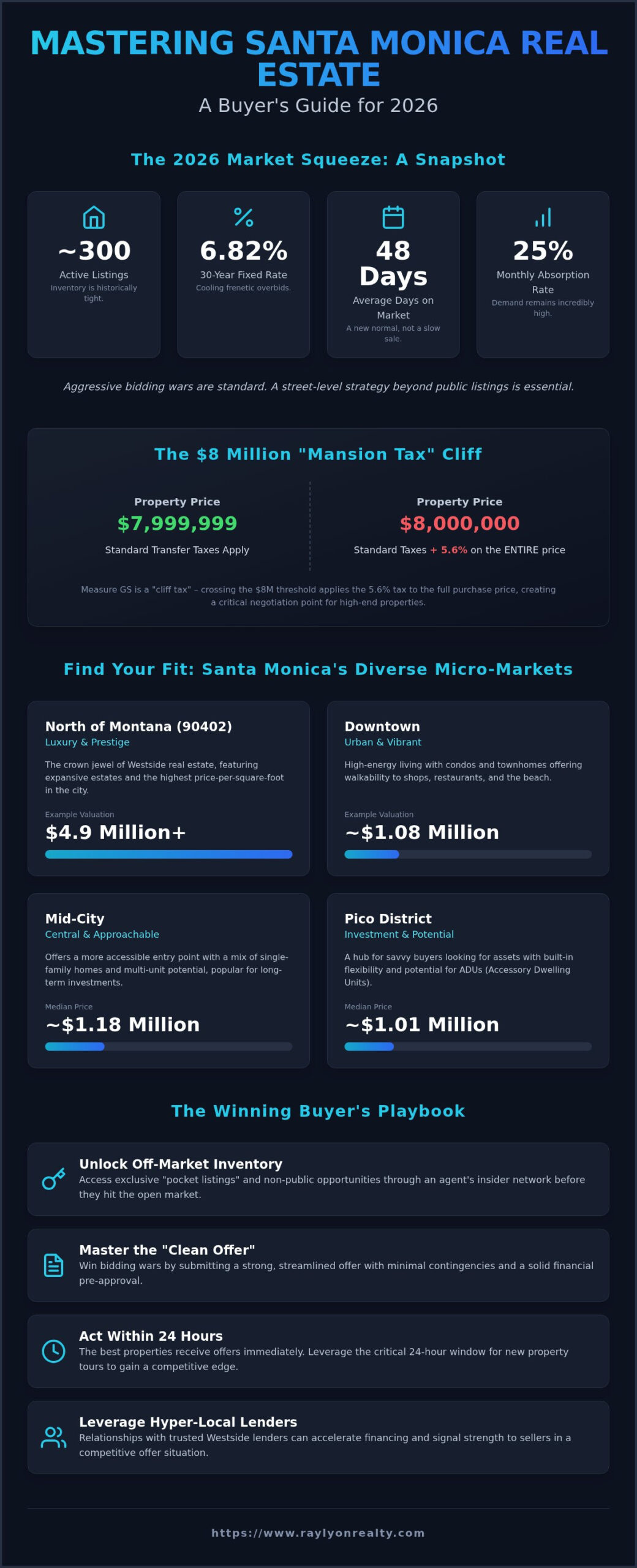
If you’re relying solely on public listings to find a home in Santa Monica, you’re already behind the curve. It’s no secret that the 2026 market is incredibly tight, with active listings hovering around just 300 properties and aggressive bidding wars becoming the standard. Successfully navigating the Santa Monica real estate market for buyers requires more than just a high budget. It demands a street-level strategy that accounts for massive pricing gaps, like the difference between a $1.08 million condo in Downtown and a $4.9 million estate North of Montana.
I understand the frustration of losing out to cash offers or feeling confused by the 5.6% “mansion tax” cliff. You deserve a home that fits your lifestyle without overpaying or settling for less. This guide will help you master these complexities with expert strategies to secure your dream home in 2026. We’ll break down the current 6.82% interest rate environment, explain how new rental registration laws impact your purchase, and show you how to access the exclusive off-market opportunities that most buyers never see.
Key Takeaways
- Understand the 2026 inventory squeeze and why successful navigating the Santa Monica real estate market for buyers requires a street-level strategy beyond the MLS.
- Identify which of Santa Monica’s five distinct micro-neighborhoods aligns with your lifestyle and budget, from the luxury of North of Montana to the energy of Mid-City.
- Master the “Clean Offer” strategy to win aggressive bidding wars and secure properties at a fair valuation, even when the listing price is just a starting point.
- Create a competitive edge by leveraging hyper-local Westside lender relationships and mastering the critical 24-hour window for new property tours.
- Learn how to unlock “pocket listings” and non-public inventory through insider networking to find exclusive opportunities before they hit the open market.
Navigating the 2026 Santa Monica Real Estate Market: Current Trends
A “balanced” market usually suggests six months of inventory, but in Santa Monica, California, the reality is much leaner. For 2026, a balanced market is redefined by a steady, low flow of new listings that prevents prices from skyrocketing while keeping competition fierce. Navigating the Santa Monica real estate market for buyers means accepting that 48 days on market is the average, not a sign of a slow property. Purchasing power is currently dictated by a 30-year fixed mortgage rate of 6.82%, which has cooled some of the frenetic over-asking bids seen in previous years. However, the continued growth of Silicon Beach ensures that demand remains high, even as buyers become more selective about property condition and valuation.
Understanding Inventory Levels in 2026
Inventory remains historically tight because many homeowners are sitting on “forever homes” with legacy mortgage rates. In the first half of 2026, there were only about 300 active listings across the entire city. Single-family homes face record-high demand as buyers prioritize privacy and outdoor space, often leading to multiple offers within the first week of listing. The 2026 absorption rate for Santa Monica is defined as the percentage of available homes sold in a specific month, which currently holds steady at approximately 25%. This high rate confirms that despite higher borrowing costs, the appetite for Westside real estate isn’t slowing down. It’s a environment where speed and preparation are your greatest assets.
The Impact of Local Legislation and Taxes
High-end buyers must account for Measure GS, often called the “mansion tax.” This is a 5.6% transfer tax on transactions of $8 million or more. Because it’s a cliff tax, the full percentage applies to the entire purchase price the moment you hit that threshold. Navigating the Santa Monica real estate market for buyers in the luxury tier involves calculating this tax into the closing costs from day one. This has created a unique negotiation pocket for properties valued right around the $8 million mark. Additionally, zoning changes are making multi-unit potential more common in traditional residential zones. This adds a layer of “renovation gold” for buyers looking to build equity, a detail often highlighted by the best real estate agents in los angeles ca when evaluating long-term land value.
Recent updates to residential zoning now allow for more flexibility with accessory dwelling units (ADUs). This shift is particularly relevant for those looking at the Pico District or Mid-City, where lot sizes often accommodate secondary structures. Understanding these legislative nuances can be the difference between a simple home purchase and a savvy long-term investment. Buyers are no longer just looking for a roof; they’re looking for assets with built-in flexibility and protection against future market shifts.
Deciphering Santa Monica Micro-Neighborhoods: Where to Buy
Santa Monica is often treated as a single entity in national headlines, but local experts know it’s actually five distinct micro-markets. Your experience navigating the Santa Monica real estate market for buyers will change drastically depending on which side of Wilshire Boulevard you stand. While the 2026 California Housing Market Forecast suggests a stabilization in prices statewide, Santa Monica’s micro-neighborhoods continue to follow their own internal logic. For those seeking more space without the premium Santa Monica price tag, many buyers look toward Mar Vista los angeles, where the atmosphere is similar but the price-per-square-foot often offers more breathing room.
Matching your lifestyle needs to the right zip code is the first step in a successful search. The price-per-square-foot varies significantly across the city, with the highest concentrations of value found in the 90402 zip code. In contrast, neighborhoods like Mid-City and the Pico District offer more approachable entry points, with median prices hovering between $1.01 million and $1.18 million as of June 2026. Understanding these granular differences ensures you aren’t just buying a house, but investing in a specific community that fits your long-term goals.
North of Montana: Luxury and Prestige
North of Montana (90402) remains the crown jewel of Westside prestige. With a median price of $4,929,908 as of June 2026, this area is defined by oversized lots and elite school districts. You’ll find a stunning mix of architectural styles here, ranging from historic Spanish Colonials to sleek, ultra-modern new builds. If you’re looking for a single-family home in this zip code, expect a floor of at least $1.8 million for even the most modest entry-level properties. The draw here is permanence; families move in and stay for decades, which keeps inventory levels in this pocket exceptionally low.
Ocean Park and Sunset Park: Coastal Lifestyle
If you prefer a coastal, walkable lifestyle, Ocean Park and Sunset Park are the primary targets. Ocean Park is famous for its walkability factor, where the beach and Main Street cafes are just minutes away. The median price in Ocean Park sits around $1,309,009, making it a competitive but accessible entry point for coastal living. Sunset Park has become the top choice for young professionals who want a community feel and proximity to the tech hubs of Silicon Beach. Smaller coastal bungalows here offer excellent investment potential, especially for those looking to leverage renovation expertise to build immediate equity in a high-demand area. If you’re ready to explore these neighborhoods in person, you can connect with a local expert to start your search.
Financial Strategy: Bidding Wars and Market Valuation in SMO
In Santa Monica, the asking price is rarely the final sale price. It’s often a strategic starting point designed to spark interest and drive competition. Navigating the Santa Monica real estate market for buyers is often more about financial psychology than just numbers. With the current 30-year fixed mortgage rate at 6.82%, buyers are more calculated than in years past, but high-demand streets still see intense activity. It’s a chess match. You aren’t just buying a home; you’re competing for a scarce asset in one of the most desirable coastal cities in the country.
Mastering the Bidding War: Strategies for Success
Winning doesn’t always mean being the highest bidder. Sellers often prioritize a “clean offer” over a slightly higher price with heavy strings attached. Non-contingent offers, where you waive inspection or loan contingencies, signal to the seller that you’re serious and financially secure. This reduces their risk of the deal falling through. Using escalation clauses effectively can also give you an edge, allowing your bid to automatically increase by a set increment above the next highest offer without overpaying. The ‘best and final’ offer deadline process is a specific cutoff time set by the seller’s agent, requiring all interested parties to submit their ultimate terms for a final, side-by-side review.
When bidding significantly over the list price, you must address the appraisal gap. If the bank’s valuation comes in lower than your contract price, you’ll need the liquid cash on hand to bridge that difference. For investment-minded buyers, leveraging a 1031 exchange can be a game-changer. This allows you to defer capital gains taxes by rolling proceeds from a sold investment property into a new Santa Monica residence. My team is well-versed in these complex transactions, ensuring you meet the strict IRS timelines while securing a high-value asset.
Valuation Beyond the Listing Price
Don’t rely on automated algorithms. They can’t see the quality of a kitchen renovation or the specific “vibe” of an Ocean Park street. A truly effective Comparative Market Analysis (CMA) looks at the nuances of street-level demand and recent off-market sales that never hit the public portals. My background in property development and flipping allows us to look past a dated exterior. We factor in real-world renovation costs to see if an “under-improved” property has the potential for a high ROI. Identifying these “renovation gold” opportunities allows you to secure a property at a fair valuation while building immediate equity through smart, strategic upgrades.
The Step-by-Step Roadmap to Buying in Santa Monica
Success in Santa Monica isn’t about casual browsing; it’s about being ready to move the moment a door opens. Navigating the Santa Monica real estate market for buyers requires a level of preparation that generic national guides simply don’t cover. While some competitors suggest a leisurely timeline, the Westside often moves at a breakneck pace. If a property hits the MLS on a Tuesday, the critical 24-hour window for tours is often your only chance to see it before a “best and final” deadline is set for the weekend. You need a roadmap that accounts for this speed while protecting your investment.
Preparing Your Financial Profile
In a market where multiple offers are the standard, your financial package is your first impression. You must have your “proof of funds” ready before you step foot in the first showing. Sellers in 90402 or Ocean Park won’t wait for you to call your banker after the tour. There is a massive difference between being pre-qualified and being fully underwritten. An underwritten buyer has already completed the heavy lifting with their lender, making their offer nearly as strong as cash. Because Santa Monica home prices frequently exceed standard limits, choosing a lender who specializes in Westside jumbo loan requirements is essential. They understand the specific appraisal nuances that outside banks might miss.
From Offer Acceptance to Closing Escrow
Once your offer is accepted, the “due diligence” period begins. This is where local expertise matters most. In Santa Monica, you must look closely at the sewer lateral. Many older homes have original clay pipes that are prone to root intrusion or collapse; a specialized scope is non-negotiable. You’ll also need to review the Natural Hazard Disclosure (NHD) through a coastal lens. This document covers everything from seismic zones to potential liquefaction areas near the coast. It’s a lot of paperwork, but it’s the only way to ensure your dream home doesn’t come with a nightmare repair bill.
The role of a modern estate agency in this process is to act as your project manager. We coordinate the specialists, from inspectors to escrow officers, ensuring no deadline is missed during the typical 30-day escrow period. Finally, the walkthrough isn’t just a formality. It’s your last chance to ensure the property condition hasn’t changed before the key handover. If you want a team that handles these street-level details with precision, book a strategy session with us today to get started.
Leveraging Local Insiders for Off-Market and Pocket Listings
If your home search is limited to public websites, you’re only seeing part of the picture. Navigating the Santa Monica real estate market for buyers effectively requires an “insider” approach because the most desirable properties often change hands without a sign ever hitting the front lawn. Given the tight inventory levels we discussed earlier, the competition for public inventory is relentless. Accessing the private market isn’t just a luxury; it’s a strategic necessity to avoid the aggressive bidding wars that define the Westside.
Pocket listings dominate this coastal enclave because of a deep-seated desire for privacy. High-profile sellers, particularly in the North of Montana area, often prefer to keep their home lives and financial transactions out of the public eye. They rely on a tight-knit network of local brokers to bring qualified, serious buyers through their doors. When you work with an agent who has deep roots in the community, you gain entry into this hidden inventory that generic national property portals simply cannot show you.
Why Pocket Listings Matter in Santa Monica
Privacy concerns for high-profile residents in the 90402 zip code make non-public sales the preferred method for many luxury transactions. Beyond privacy, the “Coming Soon” strategy allows savvy buyers to preview homes and even submit offers before the general public is aware the property is for sale. This gives you a significant head start in a market where timing is everything. My team identifies these opportunities by maintaining constant communication with other top-tier Westside agents, ensuring our clients are always first in line for a walkthrough.
The Ray Lyon Advantage: Strategic Local Networking
Winning a deal in Santa Monica often comes down to the personal relationships between brokers. If a listing agent knows a buyer’s representative is professional, efficient, and capable of closing a complex transaction, that offer moves to the top of the pile. My background as a developer gives us an additional edge. I don’t just see the current state of a house; I use firsthand renovation experience to spot hidden gems that others might overlook due to cosmetic flaws or outdated floor plans.
We leverage a broad network of specialists, from contractors to trust sale experts, to maximize the value of every opportunity we find. This street-level knowledge allows us to identify “renovation gold” in neighborhoods like Ocean Park or Sunset Park before the rest of the market catches on. If you’re tired of seeing the same recycled listings online, it’s time to change your strategy. Connect with Ray Lyon to access exclusive Santa Monica listings and discover the homes that never make it to the MLS.
Securing Your Future on the Westside
Successfully buying a home here in 2026 isn’t just about finding a listing; it’s about executing a precise, insider strategy. We have explored how understanding micro-neighborhood pricing and mastering the “clean offer” can give you a massive edge over the competition. By prioritizing non-public pocket listings and preparing your financial profile for the legendary speed of the Westside, you move from being a spectator to a serious contender in this tight market.
Navigating the Santa Monica real estate market for buyers requires a partner who knows the street-level details that public algorithms miss. With deep roots in Santa Monica and Mar Vista, I bring firsthand experience in property development and flipping to every transaction. My expertise in Westside luxury and investment properties ensures you aren’t just buying a house, but securing a strategic asset for your future.
Start Your Strategic Santa Monica Home Search with Ray Lyon Realty today. Let’s leverage our local network and development background to find your perfect coastal retreat. Your dream Westside lifestyle is well within reach with the right team by your side.
Frequently Asked Questions
Is Santa Monica a buyer’s or seller’s market in 2026?
Santa Monica remains a firm seller’s market in 2026. This is driven by historically low inventory levels and high demand from the tech sector. While buyers have slightly more leverage than in previous years, homes still sell quickly with an average of 48 days on the market. Success in navigating the Santa Monica real estate market for buyers depends on having a clear strategy and a pre-approval from a local Westside lender.
What are the best Santa Monica neighborhoods for families with children?
North of Montana is often considered the premier choice for families because of its oversized lots and proximity to elite school districts. It offers a quiet, residential feel that is rare in coastal cities. Sunset Park is another top contender, known for its strong community atmosphere and local parks. Both neighborhoods provide excellent walkability and safety, making them ideal for those raising children while staying close to the beach and Silicon Beach tech hubs.
How do Santa Monica school districts impact local home values?
School districts are a primary driver of home values in Santa Monica, particularly in the 90402 zip code. Homes within the boundaries of top-rated elementary schools often command a significant price premium compared to similar properties just a few blocks away. This demand creates a floor for property values even during broader market shifts. Buyers often view these homes as safer long-term investments because the desirability of the local schools remains constant.
What are the typical closing costs for a buyer in Santa Monica?
Buyers should generally budget between 1% and 3% of the purchase price for closing costs, though this varies. In Santa Monica, the median effective property tax rate is 1.23%. If you are purchasing a luxury property for $8 million or more, you must account for the 5.6% Measure GS transfer tax. This “mansion tax” is a significant factor in high-end transactions. Other costs include escrow fees, title insurance, and specialized inspections like sewer lateral scopes.
How can I find off-market or pocket listings in Santa Monica?
Finding pocket listings requires working with an agent who has deep, established roots in the Westside community. Many high-profile sellers value their privacy and won’t list their homes on the public MLS. We identify these off-market opportunities through a network of local brokers and personal relationships. Successfully navigating the Santa Monica real estate market for buyers often involves accessing this hidden inventory to avoid the stress and price inflation of public bidding wars.
Is it better to buy a condo or a single-family home in Santa Monica in 2026?
The choice depends on your lifestyle and budget. Single-family homes offer more privacy and land value, with list prices starting around $1.8 million in early 2026. Condos provide a more accessible entry point, particularly in areas like Downtown or Mid-City, where median prices are closer to $1 million. If you want a walkable, low-maintenance lifestyle near the beach, a condo is excellent. However, single-family homes typically offer higher long-term appreciation and renovation potential.
What should I look for during a home inspection in a coastal city like Santa Monica?
Coastal properties require specialized scrutiny. You should prioritize a sewer lateral inspection, as many older Santa Monica homes have original clay pipes vulnerable to root damage. Look for signs of salt air corrosion on exterior fixtures and windows. Moisture intrusion is another concern due to the marine layer. Always review the Natural Hazard Disclosure for seismic and liquefaction risks. My background in development helps us spot these structural nuances before they become expensive repairs.