

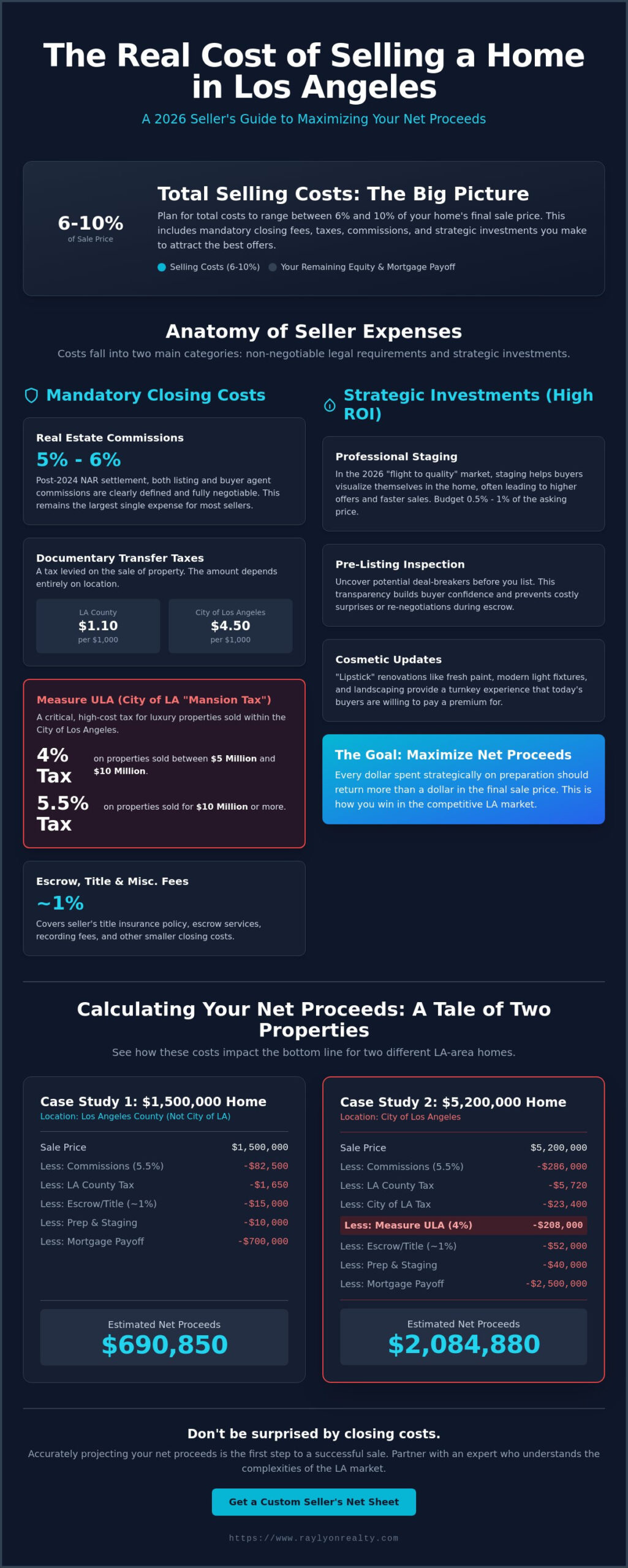
Did you know that selling a $5.2 million home in the City of Los Angeles could cost you an extra $206,000 just in a single tax? When you’re calculating the cost to sell a house in los angeles county, it’s rarely just about the real estate commission anymore. Between the 2024 NAR settlement changes and the updated 2026 thresholds for Measure ULA, the math has become significantly more complex for local sellers.
It’s completely normal to feel some anxiety about whether your staging investments will pay off or if you’ll be blindsided by unexpected escrow fees. You’ve worked hard for your equity, and you deserve to know exactly what you’ll keep when the keys change hands. This guide will help you accurately calculate your net proceeds by breaking down the exact commissions, transfer taxes, and hidden fees currently shaping the LA market. We’ll look at the difference between City and County taxes, explore the ROI on pre-sale repairs, and provide a clear checklist to ensure you maximize your final check at the end of escrow.
Key Takeaways
- Plan for total selling costs to range between 6% and 10% of your final sale price, factoring in both mandatory fees and high-impact discretionary investments.
- Understand how the 2024 NAR settlement impacts your ability to negotiate commissions and attract qualified buyers in the competitive 2026 luxury market.
- Identify the specific 2026 tax thresholds for Measure ULA and the critical differences between City and County transfer taxes to avoid closing-day shocks.
- Learn why strategic investments like professional staging and pre-listing inspections often save you thousands of dollars during the final negotiation phase.
- Master the use of a Seller’s Net Sheet to accurately project your actual cash-out after accounting for the cost to sell a house in los angeles county and your mortgage payoff.
Breaking Down the Average Cost to Sell a House in Los Angeles County (2026)
Selling your home in Southern California involves more than just finding a buyer and signing a deed. It’s a financial calculation where the sticker price is only the starting point. In the current 2026 market, the total cost to sell a house in los angeles county typically ranges between 6% and 10% of the final sale price. While that might sound like a wide margin, the specifics depend heavily on your property’s value and the strategic choices you make before hitting the market.
You can generally divide these expenses into two categories: mandatory and discretionary. Mandatory costs are the non-negotiables required to transfer the title legally. This includes the real estate transfer tax, escrow fees, and title insurance. Discretionary costs are the investments you choose to make to drive up the price, such as professional staging or “lipstick” renovations. Because our local property values are significantly higher than the national average, the percentage-based fees in LA often translate into much larger dollar amounts than you would see in other states.
Even in other high-value regions like the Greater Toronto Area, understanding these cost categories is essential for a successful transaction; you can learn more about Pinnacle Realty to see how professional brokerages help sellers navigate these financial decisions in the Ontario market.
To better understand how these expenses impact your bottom line, watch this helpful breakdown of LA selling costs:
Why LA County Costs Vary by Neighborhood
Location dictates more than just your lifestyle; it dictates your closing statement. If you’re selling a luxury estate in Santa Monica, your discretionary costs will likely be higher because buyers at that price point expect a “curated” look. In contrast, a sale in Mar Vista might focus more on functional repairs rather than high-end staging. Local custom in Southern California usually places the burden of the owner’s title insurance and the county transfer tax on the seller, though these are technically negotiable. Net Proceeds is the final amount a seller receives after all liens, commissions, and closing costs are deducted. Understanding this figure is the only way to accurately plan for your next move.
The 2026 Real Estate Landscape in Los Angeles
The 2026 market is defined by a “flight to quality.” Even with relatively low inventory, today’s buyers are sensitive to interest rates and have little patience for “fixer-uppers” unless they’re priced at a steep discount. This trend has made the cost to sell a house in los angeles county feel higher for some, as they’re spending more on upfront cosmetic updates to secure a premium price. Many sellers are also finding success by offering small concessions, such as rate buy-downs, to keep buyers at the table. It’s a strategic environment where the right moves pay off. Partnering with real estate agents in los angeles ca who have a pulse on these neighborhood-specific inventory shifts is the best way to ensure your “turnkey” strategy actually results in a higher net check.
The Major Line Items: Commissions, Transfer Taxes, and Measure ULA
When you sit down to calculate the cost to sell a house in los angeles county, the largest line item is usually the real estate commission. In 2026, the way these fees are structured looks different than it did just a few years ago. Following the 2024 NAR settlement, transparency is the new standard. Sellers now negotiate listing agent compensation and buyer’s agent compensation as separate, distinct conversations. While total commissions often hover between 5% and 6%, everything is negotiable. Some sellers choose to offer a competitive buyer’s agent commission to ensure their home stays visible to the widest possible pool of qualified buyers, while others prefer a different incentive structure.
Beyond commissions, every seller in the county faces the documentary transfer tax. The baseline Los Angeles County rate is $1.10 for every $1,000 of the sale price. However, if your property is located within the City of Los Angeles, you’ll also pay a city-level transfer tax of $4.50 per $1,000. Combined, this brings your standard transfer tax to $5.60 per $1,000 of value. For high-value properties, these figures are just the tip of the iceberg due to Measure ULA. For more details on these specific city requirements, you can check the official Measure ULA FAQ.
Navigating the ‘Mansion Tax’ Thresholds
Measure ULA, often called the “Mansion Tax,” is a significant factor for Westside and luxury homeowners. For 2026, the thresholds have been adjusted for inflation. Sales over $5,150,000 trigger an additional 4% tax on the entire sale price. If the price reaches $10,300,000 or more, that tax jumps to 5.5%. This is a “cliff tax,” meaning it isn’t marginal. If you sell for $5,151,000, you owe the tax on every dollar, not just the amount over the limit. This creates a unique scenario where pricing a home at $5,149,000 can actually net a seller more money than selling it for $5,300,000. It’s a high-stakes math problem that requires a sharp pricing strategy.
Transfer Tax Rates by City
It’s a common mistake to assume transfer taxes are the same across the whole county. Independent cities often have their own rules. For example, Santa Monica uses a tiered system that can increase significantly for luxury properties. Culver City also maintains its own unique transfer tax rates that differ from the standard City of LA fees. These costs are traditionally paid by the seller in Southern California, though in a buyer’s market, you might negotiate for the buyer to pick up a portion of the tab. Before you set your list price, working with a strategic local realtor can help you identify these hyper-local costs so there are no surprises when you receive your preliminary title report.
Escrow, Title, and the ‘Hidden’ Fees of the LA Closing Process
While commissions and transfer taxes take the spotlight, the administrative side of closing represents a significant portion of the cost to sell a house in los angeles county. These are often referred to as “closing costs.” They cover the neutral third parties that ensure the money and the deed change hands safely. In Southern California, the seller traditionally pays for the owner’s title insurance policy. This policy protects the buyer from any future claims against the property title. You should also expect to pay for a Natural Hazard Disclosure (NHD) report. This is a mandatory California document that informs the buyer about flood zones, fire risks, and seismic activity affecting the property. These reports generally cost between $100 and $150, but they are essential for your legal protection.
Prorated items also impact your final check. You’ll be responsible for property taxes up until the day of closing. If you’ve already paid your full tax bill for the year, you’ll receive a credit back from the buyer. Conversely, if taxes are due, they’ll be deducted from your proceeds. The same logic applies to HOA dues and utility assessments. These aren’t exactly “fees” in the sense of a service charge, but they certainly change the amount of cash you walk away with at the end of the day. Keeping a close eye on these prorations ensures your net proceeds match your initial expectations.
The Role of Escrow and Title in Southern California
Escrow practices vary significantly across the state. In Southern California, we typically use independent escrow companies rather than the title company’s internal department. This creates an extra layer of oversight. For a sale over $1.5 million, you can expect escrow fees to include a base rate plus a fee of roughly $2 to $3 per thousand dollars of the sale price. It’s a precise process where every penny must be accounted for. Understanding how your estate agency coordinates with these neutral parties is key to a smooth closing. They act as the “air traffic control” for your transaction, making sure documents move quickly between buyers, sellers, and lenders.
Miscellaneous Fees That Add Up
The “death by a thousand cuts” often comes from miscellaneous administrative charges. These include notary fees, wire transfer fees, and courier costs for physical document delivery. If you are selling a condo or a home in a planned community in Mar Vista, you will likely face HOA transfer fees and document preparation costs. These can range from a few hundred to over a thousand dollars depending on the association’s specific rules. Termite inspections are another local staple. While not legally required for every sale, it’s customary in the 2026 market for the seller to provide a clearance. This means you pay for the inspection and any active infestation repairs before the buyer takes possession. These small steps prevent the cost to sell a house in los angeles county from ballooning due to last-minute negotiation credits.
Preparation Costs vs. Sale Price: Investing to Maximize Your Net Proceeds
While taxes and commissions are largely fixed, your preparation budget is where you have the most control over your final check. In the competitive 2026 market, the cost to sell a house in los angeles county often includes a strategic upfront investment in the property’s “vibe” and condition. Buyers on the Westside are looking for a turnkey experience. They’re often willing to pay a significant premium to avoid the headache of managing contractors after they move in. This means that spending money on the right areas doesn’t just increase your sale price; it often shortens your time on market, reducing your carrying costs.
One of the smartest moves you can make is a pre-listing inspection. Spending roughly $500 on a professional inspection before you hit the market can save you $5,000 or more in later negotiations. When a buyer’s inspector finds a minor issue, the buyer often perceives it as a major red flag and asks for an inflated credit. By fixing these items ahead of time, you remove their leverage. Similarly, minor cosmetic upgrades like fresh neutral paint and updated light fixtures offer some of the highest returns on investment. These “lipstick” updates create a strong first impression that translates directly into higher offers.
The Power of Staging on the Westside
In neighborhoods like Santa Monica or Venice, staging isn’t just an option; it’s a requirement. For a typical three-bedroom home, professional staging in 2026 can cost several thousand dollars for a standard three-month contract. While this adds to your initial cost to sell a house in los angeles county, the data consistently shows that staged homes sell faster and often trigger multiple-offer scenarios. Strategic Staging is the process of neutralizing a home’s aesthetic to appeal to the widest possible buyer pool. It helps potential buyers visualize the lifestyle your home offers, rather than focusing on your personal decor or empty rooms.
Necessary vs. Unnecessary Renovations
Don’t fall into the trap of over-improving. A full kitchen remodel rarely nets a 100% return if done right before a sale. Instead, focus on a “refresh” by painting cabinets and replacing old hardware. In Southern California, curb appeal is heavily influenced by sustainability. Replacing a thirsty lawn with drought-tolerant landscaping and a clean drip system is a major selling point for modern LA buyers. If you’re curious about how high-end preparation looks in practice, browsing Beverly Hills real estate listings can provide inspiration for the “curated” look that today’s luxury buyers crave. If you’re unsure which repairs will yield the best return, consulting with a local listing expert can prevent you from over-improving and wasting your equity.
Calculating Your Bottom Line: The Path to a Successful Westside Sale
After reviewing the taxes, staging costs, and escrow fees, it’s time to look at the final number. The most effective way to do this is by reviewing an Estimated Seller’s Net Sheet with your agent. This document acts as a financial roadmap, accounting for every dollar from the moment you list until the funds hit your bank account. In 2026, the cost to sell a house in los angeles county is rarely a surprise if you’ve done the math early. This sheet is where you’ll see the impact of your mortgage payoff and any outstanding HELOCs. Remember that your payoff amount is often slightly higher than your last monthly statement due to accrued interest and potential lender fees.
Negotiating concessions is another area where your final net can shift. If a buyer’s inspection reveals a needed repair, you have a choice: fix it yourself, offer a credit, or stand firm. In the current market, saying “yes” to a reasonable repair request often keeps a high-value deal together. However, you should never make these decisions in a vacuum. A skilled agent helps you weigh the cost of the repair against the risk of the property going back on the market. This is also why the “cheapest” agent can often be the most expensive. An agent who discounts their commission may lack the marketing budget or the negotiation experience to secure the highest possible sale price, ultimately leaving you with fewer net proceeds even with the lower fee.
Final Walkthrough of the Net Proceeds Formula
To keep things simple, use this basic formula to estimate your walk-away cash: Sale Price minus (Commissions + Taxes + Fees + Mortgage Payoff) equals Your Net. It’s always wise to leave a small buffer for last-minute escrow adjustments or prorated utility bills. At Ray Lyon Realty, we focus on more than just the fees. We use strategic pricing and high-end presentation to trigger bidding wars. Our goal is to drive the sale price high enough that it effectively covers your closing costs and maximizes the check you receive at the end of escrow.
Next Steps for Los Angeles Sellers
If you’re planning to sell in the next six months, the time to start preparing is now. Start by requesting a personalized market analysis and a custom net sheet tailored to your specific neighborhood. This gives you a clear picture of your equity and helps you decide how much to invest in staging or repairs. Once you have the data, you can move forward with confidence, knowing exactly what the cost to sell a house in los angeles county will be for your unique property. If you’re ready to see the numbers for your home, contact Ray Lyon Realty for a custom Net Proceeds estimate for your Westside home. We’ll help you navigate the 2026 market with transparency and a focus on your bottom line.
Maximize Your Equity in the 2026 Los Angeles Market
Selling your home is one of the most significant financial moves you’ll ever make. By now, you know that the cost to sell a house in los angeles county involves more than just a commission check. It requires a strategic approach to Measure ULA tax thresholds, a deep understanding of hyper-local Westside market data, and a commitment to the turnkey presentation that today’s buyers demand. Whether you’re navigating the complexities of a city transfer tax or deciding which cosmetic upgrades will drive the highest ROI, having an expert in your corner makes all the difference.
At Ray Lyon Realty, we bring first-hand experience in property renovation and investment flipping to every listing. We don’t just list homes; we engineer outcomes that protect your bottom line. If you’re ready to move forward without the guesswork, let’s look at your specific numbers. Get a Professional Net Proceeds Estimate for Your LA Home today. You’ve built incredible equity in your property, and we’re here to help you keep as much of it as possible. Your next chapter is waiting, and we’re excited to help you start it with total confidence.
Frequently Asked Questions
What is the largest expense when selling a house in Los Angeles?
Real estate commissions are typically the largest single expense, usually ranging from 5% to 6% of the final sale price. However, for luxury properties within the City of Los Angeles, the Measure ULA tax can rival or even exceed commission costs if the home sells for more than $5.15 million. It is essential to factor in these high-value taxes when calculating the total cost to sell a house in los angeles county.
Who pays the transfer tax in LA County, the buyer or the seller?
The seller traditionally pays the documentary transfer tax in Southern California, though all closing costs are technically negotiable. This includes the baseline county tax of $1.10 per $1,000 of the sale price. In a buyer’s market, you might negotiate for the buyer to share some of these costs, but the local custom remains firmly with the seller paying for both the county and city transfer taxes.
Does the Measure ULA ‘Mansion Tax’ apply to all of Los Angeles County?
No, Measure ULA only applies to properties located within the City of Los Angeles limits. It does not affect sales in independent cities such as Santa Monica, Culver City, Beverly Hills, or Pasadena. Homeowners in those areas are only subject to the standard county transfer tax and any specific municipal taxes that their individual city might impose.
How much should I budget for staging my home in Santa Monica?
Staging costs vary depending on the home’s size and the level of furniture required, but you should expect to pay several thousand dollars for a standard three-month contract. In the Westside market, this investment is often considered mandatory to meet the high aesthetic expectations of luxury buyers. A well-staged home often sells faster and for a higher premium, which helps offset the upfront cost to sell a house in los angeles county.
Are real estate commissions fixed in California for 2026?
No, real estate commissions are not fixed and are entirely negotiable by law. Following the 2024 NAR settlement, there is much more transparency regarding how listing and buyer agent compensations are handled. You have the flexibility to negotiate these rates with your agent based on the level of service and marketing support your specific property requires.
What are ‘seller concessions’ and how do they affect my net proceeds?
Seller concessions are credits you provide to the buyer at the close of escrow to cover items like closing costs, interest rate buy-downs, or specific repairs. While these concessions directly reduce the cash you walk away with, they are often a strategic tool. Offering a credit can help you secure a higher overall sale price or attract a buyer who might otherwise struggle with upfront closing costs.
Can I deduct the cost of selling my home from my taxes?
You generally cannot deduct selling costs from your ordinary annual income, but you can use them to reduce your capital gains tax liability. Expenses such as commissions, legal fees, and staging costs are often added to your cost basis. This lower “adjusted basis” reduces the size of your taxable gain when you file your returns with the IRS after the sale.
Is it worth it to do a pre-sale inspection in the LA market?
Yes, a pre-sale inspection is a high-ROI move that prevents buyers from using minor issues as major negotiation leverage. By spending a few hundred dollars upfront, you can fix small problems on your own terms. This eliminates the risk of a buyer asking for a $5,000 credit for a repair that would have only cost you $500 to handle before listing.