

Did you know that in 2026, nearly 7% of California real estate deals fall apart while in escrow simply because of insurance hurdles? It’s a sobering reminder that getting an offer accepted is only half the battle. Understanding the escrow process in california is the key to managing that anxiety once the contract is signed. Between the 17-day inspection window and the 21-day loan contingency, the typical 30 to 60 day timeline can feel like a high-stakes waiting game. It’s completely normal to worry about hidden costs or the deal collapsing at the last minute.
This guide is designed to replace that stress with a clear strategy, ensuring you move toward your closing date with total confidence. With California’s median home price reaching approximately $905,000 in 2026, the financial stakes have never been higher. We will break down the latest 2026 financial obligations, including why buyers should prepare for closing costs between 2% and 5% of the purchase price. We’ll also provide a concrete timeline for your contingencies and show you exactly how a neutral third party keeps your investment safe until the keys are finally in your hand.
Key Takeaways
- Learn why California utilizes licensed escrow officers as neutral third parties to secure your funds and documents until the deal is finalized.
- Master the six essential stages of the closing timeline, starting with your initial deposit and ending with a clear, cloud-free title.
- Protect your investment by understanding the escrow process in california and how to navigate critical contingencies like inspections and appraisals.
- Demystify closing costs by learning the regional differences in who pays for title insurance and escrow fees between Northern and Southern California.
- See how a local real estate expert manages the moving parts of your transaction to prevent common deal-breakers from stalling your progress.
What is Escrow? Defining the Neutral Third-Party in California
Understanding the escrow process in California starts with a simple concept: safety. For most homeowners, a property is their largest asset, so handing over a massive check requires a high level of trust. What is Escrow? Essentially, it’s a legally protected holding period where a neutral third party keeps your funds and sensitive documents in “limbo” until every contractual obligation is met. This ensures that the seller doesn’t get the money until the title is clear, and the buyer doesn’t get the keys until the funds are verified.
This process involves four primary players: the buyer, the seller, the lender, and the escrow holder. The escrow holder acts as a referee who follows the joint written instructions of the other parties. They don’t take sides. They don’t negotiate for you. Their job is to remain strictly neutral, ensuring that the rules of the purchase agreement are followed to the letter.
To see how this looks in a real-world setting, watch this helpful introduction:
Why California is an “Escrow State”
If you’ve bought property on the East Coast, you might be used to sitting in a room with a group of attorneys to sign papers. California does things differently. We are an “escrow state,” meaning we rely on specialized, licensed professionals rather than lawyers to close deals. Independent escrow agents are regulated by the California Department of Financial Protection and Innovation (DFPI). This regulatory oversight provides a massive layer of security for your Earnest Money Deposit (EMD), which is typically 1% to 3% of the purchase price. By using a neutral depository, the state creates a standardized system that reduces conflict and protects your cash from being released prematurely.
The Escrow Officer: Your Transaction’s Neutral Referee
The escrow officer is the engine of your closing. Their specific duties include holding the funds, clearing “clouds” on the title, and eventually recording the deed with the county. However, it’s vital to know their limits. An escrow officer cannot give you legal or tax advice; they are there to execute the contract, not interpret the law. You’ll also encounter “independent” companies versus “broker-owned” or “controlled” escrows. Independent firms are often preferred for their strict adherence to DFPI standards, providing an extra level of unbiased security. When you are understanding the escrow process in california, recognizing this distinction helps you choose the right team for a smooth, transparent closing.
The 6 Essential Stages of the California Escrow Timeline
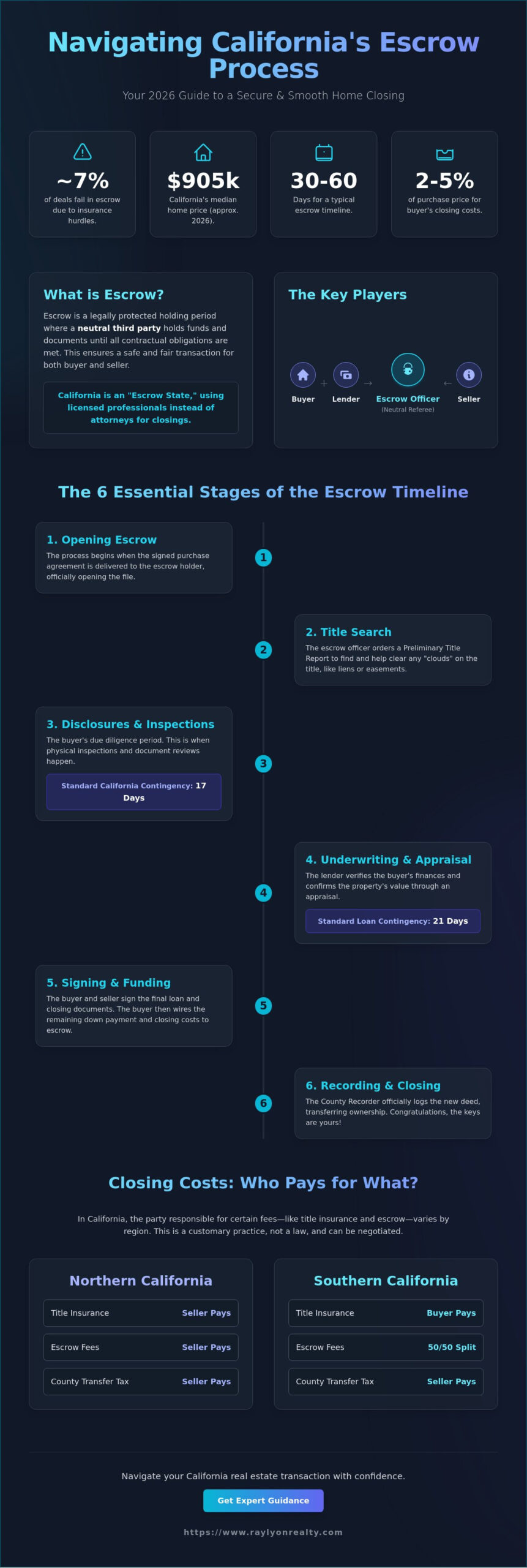
Once your offer is accepted, the clock starts ticking on a process that typically lasts between 30 and 60 days. While a 30-day close was the gold standard for years, 2026 has introduced longer timelines due to increased administrative backlogs and more rigorous insurance requirements. Understanding the escrow process in california means recognizing that these 6 stages are not just checkboxes; they are legal safeguards designed to protect your investment.
- Stage 1: Opening Escrow: The file is officially opened when the signed purchase agreement is delivered to the escrow holder.
- Stage 2: Title Search: The escrow officer orders a Preliminary Title Report to identify any “clouds” on the title, such as tax liens or undisclosed easements.
- Stage 3: Disclosures and Inspections: This is the buyer’s “due diligence” phase. In California, the default period for physical inspections is 17 days.
- Stage 4: Underwriting and Appraisal: The lender evaluates the property’s value and the buyer’s creditworthiness. The standard loan and appraisal contingency is 21 days.
- Stage 5: Signing and Funding: You’ll sign a mountain of “Loan Docs” and wire your final funds.
- Stage 6: Recording: The County Recorder officially logs the grant deed, and ownership is transferred.
For investors, these stages often include additional complexity, such as 1031 exchanges. Unlike a standard residential sale, a 1031 exchange requires the escrow officer to coordinate closely with a qualified intermediary to ensure tax-deferred status. If you are looking to maximize your investment portfolio, having a team that understands these nuances is vital.
Opening the File and the EMD
Within three business days of acceptance, the buyer must wire the Earnest Money Deposit (EMD), which is typically 1% to 3% of the purchase price. This deposit is governed by the “Escrow Instructions,” a document that outlines the specific duties of the escrow holder under California Escrow Law. Coordinating this initial phase is one of the primary roles of real estate agents in Los Angeles CA, who ensure that deadlines aren’t missed before the ink is even dry.
The Underwriting Hurdle and Final Funding
The transition from “Conditional Loan Approval” to a “Full Loan Commitment” is often the most stressful part of the timeline. Your “Cash to Close” isn’t just your down payment; it’s the total amount needed after accounting for your initial EMD and various closing credits. Once the lender is satisfied, they wire the loan amount through the Federal Reserve system. It’s a precise dance where the timing of the wire can mean the difference between recording on a Friday or waiting until the following Monday.
Navigating Contingencies and Potential Escrow Deal-Breakers
Contingencies are essentially your “escape hatches.” They provide a legal path to cancel the contract without losing your earnest money deposit if certain conditions aren’t met. In a competitive market where the median home price is approximately $905,000, these protections are your most valuable assets. Understanding the escrow process in california requires a strategic approach to these timelines, as they represent your primary leverage during the 30 to 60 day closing period.
The three heavy hitters are the inspection, appraisal, and loan contingencies. While the inspection period allows you to dig into the physical health of the home, the loan contingency serves as your final safety net. It’s a critical shield, especially considering that in recent years, about 7% of California deals collapsed because buyers couldn’t secure affordable insurance. If your financing or insurance falls through before this contingency is removed, you can walk away with your deposit intact.
The Appraisal Gap Strategy
A low appraisal is a common deal-breaker. If the bank’s appraiser values the home at $875,000 but your contract price is $905,000, you face an “appraisal gap.” You generally have three paths: cancel the deal, pay the difference in cash, or dispute the appraisal with new data. In volatile Westside markets like Santa Monica, these gaps happen frequently. Having a partner who understands the nuances of an estate agency is crucial here. A local expert can provide the granular, off-market data needed to convince a lender to reconsider a valuation or negotiate a price reduction with the seller.
The “Final Walkthrough” and Contingency Removal
Signing the Contingency Removal (CR) form is the most significant legal milestone in the process. Once you sign this document, you’re “all in.” If you back out after this point, the seller may have a legal right to keep your earnest money. This is why the final walkthrough, which usually happens 5 days before closing, is so vital. It’s your last chance to verify that the property is in the same condition as when you started and that all “Request for Repairs” items were completed. If the seller hasn’t finished the agreed-upon work, your agent can negotiate a credit at closing. This is also the time you’ll finalize the details of your escrow and impound account, ensuring your future property taxes and insurance are handled correctly from day one.
Closing Costs and Escrow Fees: Who Pays for What?
Closing day shouldn’t feel like a surprise math test. Understanding the escrow process in california involves grasping the distinction between recurring and non-recurring costs. Non-recurring costs are one-time fees paid to get the deal done, such as the escrow fee, notary charges, and recording fees. Recurring costs are those that continue after you own the home, including property taxes, homeowner’s insurance, and prepaid interest. Buyers in California typically expect to pay between 2% and 5% of the purchase price in these combined costs. On a median-priced home of $905,000 in 2026, that translates to approximately $18,000 to $45,000.
The seller’s side is often more expensive, ranging from 6% to 10% of the sale price. This is because the seller traditionally covers the real estate commissions, which average around 5.03% in 2026. While these percentages provide a helpful baseline, the specific allocation of fees depends heavily on regional customs and the terms of your specific contract.
The Los Angeles County Customary Split
In Los Angeles County markets like Santa Monica and Mar Vista, tradition usually dictates a 50/50 split of the escrow fee. This fee often starts with a base of $250 to $450, plus an additional $2 to $3 per $1,000 of the purchase price. Sellers also typically pay the county transfer tax of $1.10 per $1,000 of the sale price. If you’re selling a luxury property in the City of Los Angeles for more than $10.6 million, you must also account for Measure ULA, which imposes a 5.5% tax. Always review your Closing Disclosure (CD) at least three days before your appointment to ensure every line item matches your initial estimates. For professional real estate guidance through these complex financial hurdles, working with a local expert is essential.
Title Insurance: Protecting the Ownership Chain
Your Preliminary Title Report is the most important document you’ll read during the transaction. It acts as a historical record of the property, revealing “clouds” like tax liens, utility easements, or even unknown heirs who might claim ownership. Title insurance exists to protect you from these risks. In Southern California, the seller typically pays for the Owner’s Policy to prove they are delivering a clean title. Conversely, the buyer pays for the Lender’s Policy to protect the bank’s investment. This insurance ensures that once the deed is recorded, your ownership is legally indisputable and free from the previous owner’s debts.
How a Strategic Westside Realtor Facilitates a Smooth Closing
While the escrow officer acts as the neutral referee, your Realtor is the project manager who ensures the entire machine keeps moving. Escrow is a complex sequence of deadlines, and a single missed date can jeopardize your deposit or delay your move-in. Understanding the escrow process in california is much easier when you have an advocate filtering the technical noise and focusing on the critical path to closing. From coordinating with the lender to verifying that the title company has cleared every lien, a strategic agent keeps all parties accountable.
Success often comes down to the quality of a Realtor’s local vendor network. Whether you need a specialized drainage contractor for a hillside property or a reliable inspector who can work on short notice, these connections are vital. For clients involved in investment property sales, this expertise is even more critical. Managing a 1031 exchange requires precise coordination between the escrow holder and a qualified intermediary. Missing an IRS-mandated deadline isn’t an option, so having a “hands-on” expert who has personal experience with property development and investment is a distinct competitive advantage.
There is also the “Emotional Escrow” to manage. Buying or selling a home is a high-pressure event, and the 30 to 60 day timeline is often filled with anxiety. A professional’s role is to provide a steady, confidence-inspiring presence, making sure you feel like a top priority while they navigate the inevitable hurdles of the transaction.
Local Expertise in Santa Monica and Mar Vista
Westside transactions often face neighborhood-specific hurdles that generic guides overlook. Properties in Santa Monica coastal zones might have additional flood zone requirements or public access easements that can extend the timeline. Similarly, older homes in Mar Vista often have original plumbing or electrical systems that require a nuanced approach during the “Request for Repairs” phase. Our Mar Vista, Los Angeles Neighborhood Guide provides more context on these local property characteristics. Having a Realtor who maintains strong relationships with other local agents helps smooth over friction, as these professional “insider” connections often resolve conflicts before they escalate.
The Final Hand-Off: Recording and Keys
The finish line is the “Close of Escrow,” which occurs the moment the grant deed is recorded at the County Recorder’s office. In Los Angeles, we often push for a “Special Recording.” This allows the deed to be logged in the afternoon so that buyers can receive their keys the same day. If the funding happens too late in the day, it results in a “Next Day Recording,” meaning you’ll wait until the following morning for official ownership. Once that recording confirmation hits, the home is yours. If you are ready to start your Westside home journey today, reach out to our team to ensure your next transaction is handled with strategic precision.
Take the Next Step Toward Your New Front Door
Understanding the escrow process in california is the ultimate tool for reducing the stress of a property transaction. You’ve learned that the 30 to 60 day timeline is a structured sequence of legal protections, from the initial earnest money deposit to the final recording of the deed. By respecting contingency windows and preparing for the customary fee splits in Los Angeles County, you ensure no detail is left to chance. These steps aren’t just administrative hurdles; they’re the safeguards that keep your investment secure in a high-stakes market.
Managing these moving parts requires more than just a checklist. It demands a partner with deep local roots and technical savvy. Whether you’re navigating a complex 1031 exchange or a sensitive trust sale in Santa Monica or Mar Vista, Ray Lyon Realty provides the strategic oversight you need. Our founder is personally involved in every transaction, ensuring you benefit from hands-on expertise and a dedicated network of local specialists. Ready to navigate your LA home sale? Partner with Ray Lyon Realty today. We look forward to helping you cross the finish line with total peace of mind.
Frequently Asked Questions
How long does the escrow process typically take in California?
The typical escrow period in California ranges from 30 to 60 days. For buyers using traditional financing, a 30 to 45 day window is most common to allow for bank underwriting. All-cash transactions move much faster, often closing in as little as 7 to 21 days. In 2026, we’ve seen slightly longer timelines due to administrative backlogs and complex insurance requirements, so it’s best to plan for at least 45 days for a smooth transition.
Can I cancel escrow if I change my mind about the house?
You can cancel escrow, but doing so without a valid contingency “escape hatch” puts your earnest money deposit at risk. If you change your mind during the inspection or appraisal periods, you can usually withdraw and receive a full refund of your deposit. However, once you sign the Contingency Removal form, the seller has a legal right to keep your funds if you back out simply because you’ve had a change of heart.
What is the difference between an escrow officer and a title officer?
An escrow officer is a neutral third party who manages the transaction’s funds and follows the contract instructions. In contrast, a title officer works for the title insurance company to research the property’s history and ensure there are no liens or ownership disputes. While they work together, the escrow officer focuses on the process of the exchange, while the title officer focuses on the legal health of the property’s ownership record.
Who chooses the escrow company in a California real estate transaction?
The choice of the escrow company is a negotiable item in the California Residential Purchase Agreement. While it’s common for the party paying the fee to have a strong say, both the buyer and seller must agree on the selection. When you are understanding the escrow process in california, it’s helpful to know that in Southern California, where fees are often split 50/50, the choice is usually a collaborative decision guided by your agent’s expertise.
What is an “earnest money deposit” and how much should it be?
An earnest money deposit is a “good faith” payment made by the buyer to show the seller they’re serious about the purchase. In California, this is typically 1% to 3% of the home’s purchase price. For a median-priced home of $905,000 in 2026, this deposit would range from $9,050 to $27,150. These funds are held by the escrow company and eventually applied toward your down payment or closing costs when the deal finishes.
Are escrow fees tax-deductible in California?
Most escrow and closing fees are not directly tax-deductible as an annual expense. Instead, they’re added to your “basis,” which can reduce your capital gains tax when you eventually sell the home. Exceptions include certain mortgage interest points or pro-rated property taxes paid at closing. Because tax laws are complex and change frequently, you should always verify these details with a qualified CPA to understand how they apply to your specific financial situation.
What happens if the buyer cannot get loan approval before the contingency deadline?
If a buyer cannot secure loan approval before the contingency deadline, they can request an extension from the seller or cancel the contract. If the loan contingency is still in place, the buyer can walk away with their earnest money deposit intact. However, if the buyer has already removed their loan contingency in writing, they risk losing their entire deposit to the seller as liquidated damages for failing to close the deal.
Does California require an attorney to be present at the closing?
California does not require an attorney to be present at the closing or to manage the transaction. Unlike many East Coast states, California relies on licensed escrow officers to act as neutral third parties. These professionals handle the signing of documents, the transfer of funds, and the recording of the deed. This system is designed to be efficient, and understanding the escrow process in california means recognizing that escrow officers provide the necessary regulatory oversight without requiring legal counsel.