

Imagine you’re 14 days into escrow. You’ve already started packing boxes for your move to Silver Lake. Then, your phone rings. It’s your agent, and the news is tough: the appraisal came in $50,000 below your agreed contract price. It feels like the floor just dropped out from under you. You’ve spent years building equity in your home, and now you need to know how to handle a low appraisal when selling before the deal falls apart. It’s incredibly frustrating to feel like an out-of-area appraiser who doesn’t understand your specific street is suddenly in control of your financial future.
You don’t have to let one report derail your plans or force you to leave money on the table. Rescuing your sale is entirely possible with the right strategy. We’ve seen this happen in over 15 local neighborhoods we serve, and there are proven ways to fight back. This guide will walk through the strategic steps to contest a flawed report, negotiate for more buyer cash, and ensure you still walk away with the price you deserve.
Key Takeaways
- Understand why appraisal gaps occur in competitive Los Angeles markets like Santa Monica and how to spot the “common culprits” behind a low valuation.
- Learn the step-by-step process of how to handle a low appraisal when selling, including how to build a professional “Rebuttal Package” that challenges missing data.
- Discover strategic ways to bridge the price gap, such as negotiating a “Buyer Bridge” to ensure you don’t leave your hard-earned equity on the table.
- Uncover the “lipstick” effect and how high-end staging or strategic upgrades can be effectively leveraged to justify a higher contract price to the bank.
- Find out how partnering with a Westside expert can protect your sale through a pre-emptive “Value Packet” that guides the appraiser toward the right number from day one.
The Low Appraisal Reality in the 2026 Los Angeles Housing Market
Selling your home in a fast moving market like Los Angeles often feels like a victory until the bank report arrives. A low appraisal occurs when there is a discrepancy between your agreed-upon contract price and the bank’s professional valuation. It is a common hurdle in 2026, especially in high demand pockets like Santa Monica and Mar Vista where buyer enthusiasm frequently outpaces historical data. While this news is stressful, it is a hurdle we can clear with the right strategy.
A real estate appraisal is designed to protect the lender’s investment, but it can feel like a sudden roadblock for a seller. In typical California residential purchase agreements, appraisal contingencies give buyers a safety net to back out or renegotiate if the home doesn’t value at the purchase price. Learning how to handle a low appraisal when selling is about staying calm and looking at the data objectively. It is a complication, but in a savvy market like ours, it is rarely a deal-killer.
To better understand this concept, watch this helpful video:
Why Appraisals Struggle to Keep Up with Westside LA Prices
The primary issue in the 2026 market is lag time. Appraisers generally rely on closed sales data from the previous 90 days. In neighborhoods like North of Montana, market momentum can shift significantly in just three weeks. If an out-of-area appraiser doesn’t understand these specific “block to block” nuances, they might miss why your home commanded a premium. Multiple offer situations often drive contract prices 10% or 12% above the most recent “comps,” creating a valuation blind spot that the paperwork hasn’t caught up to yet.
The Immediate Impact on Your Escrow Process
When the number comes in low, it directly affects the buyer’s Loan-to-Value (LTV) ratio. Since the bank only lends based on the appraised value, an “appraisal gap” is created. This is the specific dollar amount that needs to be resolved to keep the loan moving forward. The first 24 hours after receiving that report are critical. This is the window where your real estate agents in los angeles ca will scrutinize the report for factual errors or missed upgrades. Knowing how to handle a low appraisal when selling requires a fast, data-backed response to keep your escrow on track and your equity protected.
Common Culprits: Why Your LA Home Appraised Lower Than Expected
It’s a gut-punch when you’ve got a solid offer on the table, only for the bank’s valuation to come in short. Understanding why this happens is the first step in learning how to handle a low appraisal when selling. Often, the issue isn’t your home’s actual value, but a flaw in the appraisal process itself. In a city as diverse as Los Angeles, a one-size-fits-all approach to valuation rarely works.
One frequent issue is the “out-of-area” appraiser. If a professional from a different county is assigned to your listing, they might lack the essential “block to block” knowledge that defines LA real estate. They see a grid on a map. They don’t see the nuances of a specific street’s desirability or the historical significance of a neighborhood that drives local demand. A professional who doesn’t know the difference between two adjacent pockets can easily miss the mark by $50,000 or more.
The Problem with Generic Comparable Sales
Appraisers rely on “comps,” but not all sales are created equal. A house three blocks away in Mar Vista, Los Angeles might not be a true comp if it lacks your home’s specific view corridor or architectural integrity. While you see a meticulously restored Mid-Century Modern, an appraiser might just see a three-bedroom house with similar square footage. Appraisers often prioritize proximity over ‘vibe’ or finish quality, which can lead to a significant valuation gap.
Adjusting for lot size and orientation is also critical. A 6,000-square-foot lot on a quiet cul-de-sac is worth more than a 7,000-square-foot lot backing into a busy thoroughfare. If the appraiser uses outdated data points from six months ago, they miss the current market heat. Citing specific, recent data is how you Bounce Back From A Low Appraisal and get the deal back on track.
Underestimating Strategic Upgrades and Staging
We often talk about putting “lipstick” on a property to make it shine. High-impact upgrades like designer lighting, modern hardware, and fresh paint create a massive emotional pull for buyers, but they can confuse a checklist-based appraiser. They’re looking for “granite counters” or “hardwood floors,” not necessarily the aesthetic cohesion that justifies a premium price.
Invisible upgrades present another challenge. An appraiser might miss a 200-amp electrical panel or 2026-standard smart home tech because they aren’t immediately visible. Professional staging also increases “perceived value” and helps secure those multiple offers, but it isn’t always captured in the bank’s rigid math. If you’re worried about your home’s value, you might want to get a professional valuation to see how your specific upgrades stack up against the local market.
Finally, keep an eye on square footage discrepancies. Public records in Los Angeles are frequently inaccurate. If your actual living space is 150 square feet larger than what the county has on file, that’s a major error that needs correction before the appraiser submits their final report. These small details are often the difference between a closed deal and a canceled escrow.
Your Strategic Options: Bridging the Appraisal Gap
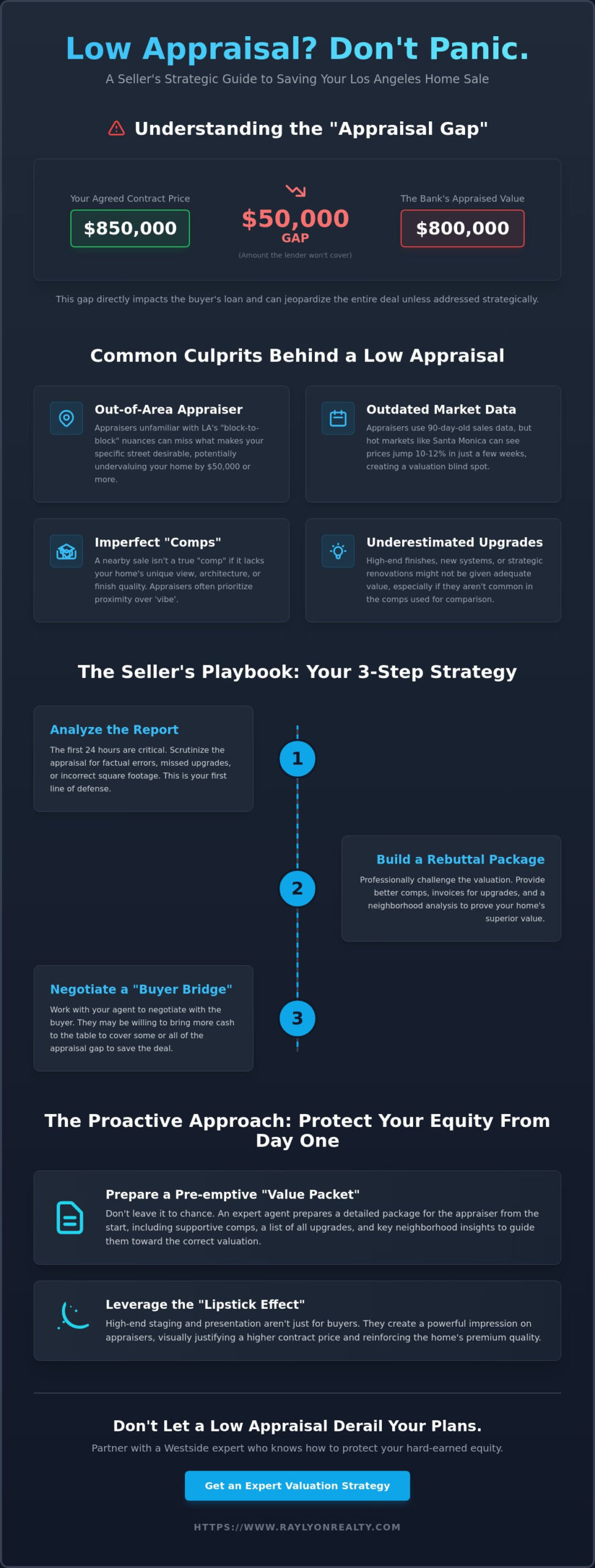
Finding out your home appraised for less than the contract price feels like a gut punch. It’s a common hurdle in the Los Angeles market, especially when prices move faster than historical data. You have four primary paths to keep your escrow moving forward. Knowing how to handle a low appraisal when selling requires a mix of hard data and cool-headed negotiation.
- Option 1: The Rebuttal. This is a formal “Reconsideration of Value” (ROV). We challenge the appraiser’s report by identifying factual errors, such as incorrect square footage or a missed bathroom. We provide three to five superior comparable sales that the appraiser likely overlooked.
- Option 2: The Buyer Bridge. You ask the buyer to bring more cash to the closing table. This covers the difference between the loan amount the bank will provide and the agreed-upon sales price.
- Option 3: Meeting in the Middle. This is the most common resolution. Both parties give a little, perhaps splitting the gap 50/50, to reach a new sales price that keeps the deal alive.
- Option 4: The Price Drop. You lower your price to match the appraisal value. While this is usually a last resort, it’s a viable path if you’re on a strict timeline for your own next purchase.
When to Ask the Buyer for More Cash
If we have a strong backup offer in place, you’re in the driver’s seat. You can remind the current buyer that other parties are waiting who might have better terms. We analyze the buyer’s initial proof of funds to see if they have the liquidity to waive the appraisal contingency. Many savvy buyers in competitive neighborhoods like Silver Lake or Eagle Rock include an “Appraisal Gap Guarantee” in their initial offer. This is a promise to cover a specific amount, such as $20,000, if the value comes in low.
The Art of the Compromise
Sometimes a win-win is the only way to save the deal. If the buyer can’t cover the full gap, we might suggest a seller credit for closing costs or offer to handle a specific repair found during the inspection. This keeps the buyer’s loan viable while protecting your equity. Keeping the deal together is usually the smartest move. According to 2023 industry data, homes that return to the market after a failed escrow often sit twice as long and sell for 5% less than the original contract price. Negotiating now is often cheaper than starting over.
The Seller Playbook: How to Successfully Challenge a Low Appraisal
Receiving a low appraisal feels like a gut punch, but it isn’t the final word on your home’s value. To learn how to handle a low appraisal when selling, you need a disciplined, data-driven response. Start by reviewing the report line by line for factual inaccuracies. Appraisers are human; they occasionally miss a half-bath, miscalculate square footage, or overlook a recent permitted addition. If the report says your lot is 6,000 square feet when your title shows 6,450, that’s a clear opening for a correction.
- Step 1: Scrutinize the report for basic errors in acreage, bedroom count, or the age of major systems like the HVAC.
- Step 2: Curate a Rebuttal Package featuring superior comparable sales the appraiser may have missed.
- Step 3: Draft a Value Narrative explaining why specific neighborhood features justify the higher price.
- Step 4: Formalize the Reconsideration of Value (ROV) through the lender’s designated portal.
Finding the Right “Comps” for the Rebuttal
Appraisers often look back six months for data, but in a fast-moving market, 180-day-old sales are already stale. Focus on pending sales that closed in the 14 days after the appraiser finished their initial inspection. We also look for off-market deals that haven’t hit the MLS yet. These provide critical data points about current demand. If your kitchen features custom white oak cabinetry and Sub-Zero appliances while the appraiser’s chosen “comp” has 15-year-old finishes, highlight that lifestyle gap. These specific upgrades justify a higher price per square foot.
The Professional Narrative: Beyond the Numbers
Numbers tell part of the story, but market sentiment fills in the rest. If you received 8 offers within 48 hours of listing, that’s concrete proof of market value that a standard appraisal might miss. Mention if your home sits on the “quiet side” of a specific street or within a coveted school boundary that changes block by block. A Reconsideration of Value (ROV) is a professional appeal process designed to correct valuation gaps through evidence, not just a complaint about the outcome.
If you’re facing a valuation gap, you need an expert who knows how to handle a low appraisal when selling and can fight for your equity. Contact Ray Lyon Realty today to ensure your home’s true value is recognized.
Partnering with a Westside Expert to Protect Your Equity
Your home’s value isn’t just a number on a screen; it’s the result of years of your hard work and financial investment. When an appraiser arrives, you shouldn’t leave your equity to chance. Partnering with a local estate agency is your strongest defense against an undervalued report. At Ray Lyon Realty, we don’t just wait for the results. We influence them by being present and prepared from the moment the appraiser pulls up to the curb.
Westside Los Angeles is a patchwork of distinct micro-markets. A house on one side of the street might be worth 12% more than one just a block away due to school boundaries or historical designations. We use our block to block knowledge to educate appraisers who might be coming from outside the area. Lenders often hire professionals from different counties who don’t understand why a Venice bungalow commands a specific premium over a similar square-footage home in a different neighborhood. Our goal is to ensure your 2026 home sale stays on track by providing the hyper-local context these outsiders often lack.
The Value of Pre-Appraisal Preparation
We believe in pre-empting issues before they start. When the appraiser arrives, I meet them personally with a comprehensive “Value Packet.” This isn’t just a stack of papers; it’s a strategic document that helps them see the property through a local lens. We make sure they understand the nuances of the Westside market before they even leave the driveway. This packet includes:
- A detailed list of all structural upgrades and “lipstick” improvements made to the property.
- The subject property’s competitive offer history, proving that multiple buyers validated the price.
- Specific “comps” that truly reflect your home’s unique appeal, rather than just the closest three houses on a map.
By highlighting these details early, we reduce the risk of a valuation gap that could stall your escrow. Learning how to handle a low appraisal when selling is a vital skill, but having an expert handle the heavy lifting for you is even better.
Next Steps: Securing Your Closing
If you’re currently in escrow or preparing for a 2026 listing, timing is everything. We’ll review your current appraisal timelines and ensure your strategy is airtight. A low appraisal is just a hurdle, not a dead end. With the right data and a proactive approach, we can often keep the original deal together. Don’t let a conservative estimate cost you thousands at the closing table. Reach out to our team for a professional review of your property’s true worth. Knowing how to handle a low appraisal when selling starts with having the right partner in your corner.
Protect Your Investment With a Strategic Westside Plan
A low appraisal doesn’t have to end your Los Angeles real estate journey. You now have the tools to identify valuation errors and the strategic options needed to bridge the gap. Success comes down to preparation and knowing exactly how to handle a low appraisal when selling in a market as nuanced as ours. Whether it’s drafting a formal rebuttal or negotiating with a buyer, your equity depends on accurate, hyper-local data.
Ray Lyon Realty offers the “block to block” valuation expertise required to challenge conservative estimates. We’ve managed over $500M in local Westside LA sales volume, giving us the deep market insight that generic apps simply can’t replicate. Our team provides dedicated support for complex appraisal rebuttals, ensuring every unique feature of your property is accounted for. You don’t have to navigate these hurdles alone when you have a proven playbook at your disposal.
Get a Professional Strategy for Your LA Home Sale
Selling your home is a major milestone, and we’re here to make sure you cross the finish line with confidence. Let’s get to work on securing the top-dollar result you’ve earned.
Frequently Asked Questions
Can a seller request a second appraisal if the first one is low?
Sellers don’t have the legal right to order a new appraisal for a buyer’s mortgage. You can ask the buyer to request a second opinion if you find clear factual errors in the original report. This usually requires proof of three better comparable sales from the last 90 days or evidence that the appraiser missed significant square footage. We’ve seen this work when the appraiser isn’t familiar with specific Los Angeles neighborhood boundaries.
What happens if the buyer’s appraisal is low but they still want the house?
The buyer must bridge the gap between the loan amount and the purchase price using their own cash. If an appraisal comes in $25,000 short, the buyer brings those extra funds to the closing table. You can also negotiate a compromise where you lower the price slightly and the buyer increases their down payment. This strategy keeps the deal moving forward without restarting the entire search process.
Is the seller required to lower the price to the appraised value in California?
No California law requires a seller to reduce their price to match a low appraisal. The standard California Association of Realtors contract gives you the right to stand firm on your original price. If the buyer has an appraisal contingency, they can choose to cancel the contract and keep their deposit. You’ll need to weigh the risk of the deal falling through against the current market demand.
How long does a Reconsideration of Value (ROV) take?
A Reconsideration of Value typically takes 5 to 10 business days once the lender submits the request. The appraiser must review the new data you provide and issue a formal written response. This timeline can vary depending on the lender’s internal review board. Acting quickly to provide high quality comparable sales is the best way to prevent long delays in your closing schedule.
Who pays for a second appraisal if the seller requests it?
The person who requests the new appraisal is generally responsible for the fee. Costs for a standard single family home appraisal in 2024 typically range from $500 to $800. If you’re learning how to handle a low appraisal when selling, offering to pay this fee can be a strategic way to keep a buyer engaged. Just ensure the lender is willing to accept a second report before you commit to the expense.
Can a low appraisal be caused by a messy house or poor staging?
Appraisers focus on the bones of the house, but a cluttered environment can lower the “Effective Age” of the property. A 2021 study by the Appraisal Institute found that poor maintenance and “deferred maintenance” issues can reduce a home’s value by 5% to 10%. While unwashed dishes won’t change the value, stained carpets or peeling paint suggest the home hasn’t been cared for. We always recommend a clean, “lipstick on it” approach to maximize the result.
Does a low appraisal stay with the house for the next buyer?
FHA and VA appraisals stay tied to the property address for 120 to 180 days. Conventional loan appraisals don’t usually follow the house to a new lender or a different buyer. If your current deal fails, a new buyer with a different bank will trigger a completely new appraisal. This is often the best path forward if the first appraiser was particularly difficult or inexperienced in your specific area.
What is an appraisal gap guarantee and should I ask for one?
An appraisal gap guarantee is a clause where the buyer promises to pay a set amount of cash if the appraisal comes in low. In a hot market, you might see buyers offer to cover a gap of $20,000 or even the full difference. You should definitely ask for this when you’re considering multiple offers. It’s a vital tool for how to handle a low appraisal when selling because it removes the uncertainty of the bank’s valuation.