

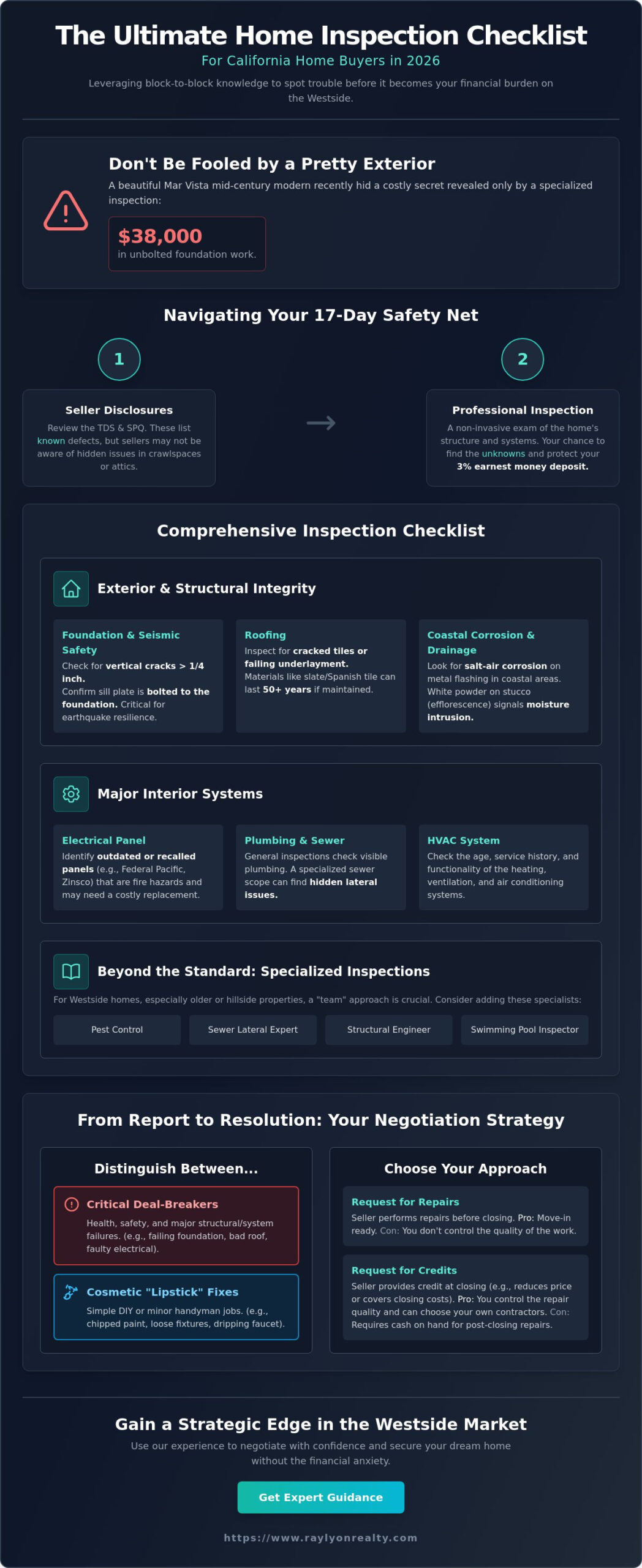
Last April, a family I worked with fell in love with a stunning Mar Vista mid-century modern, but a specialized look under the crawlspace revealed $38,000 in unbolted foundation work. It’s a classic Westside story where a beautiful exterior masks a costly structural secret. Finding your dream home in Los Angeles should be an exciting milestone, not a source of constant “what-if” anxiety. You deserve to know exactly what you’re buying before you sign that final closing document. This home inspection checklist for california buyers leverages my block-to-block knowledge to help you spot trouble before it becomes your financial burden.
I’ll show you how to master the 2026 inspection process with a professional checklist tailored for the specific quirks of Westside Los Angeles real estate. We’ll identify the high-stakes issues like seismic safety and outdated plumbing that can drain your bank account. You’ll gain the clarity to distinguish between a simple weekend DIY project and a major deal-breaker. By the end of this guide, you’ll have the confidence to negotiate for repairs or credits with the same strategic edge I use for my own investments.
Key Takeaways
- Navigate the 2026 escrow process by understanding how professional inspections complement mandatory legal disclosures like the TDS and SPQ.
- Protect your investment by identifying seismic safety needs and coastal-specific structural issues common in Beverly Hills and Westside Los Angeles homes.
- Avoid expensive surprises by using our comprehensive home inspection checklist for california buyers to catch outdated electrical panels and hidden sewer lateral issues.
- Learn to distinguish between critical health and safety findings and simple cosmetic “lipstick” fixes to streamline your repair negotiations.
- Discover whether requesting direct repairs or closing cost credits offers the best strategic advantage in the current Westside real estate market.
Navigating the California Home Inspection Process in 2026
Buying a home in Westside Los Angeles is a massive investment, and you need to know exactly what’s behind those freshly painted walls. In simple terms, What is a home inspection? It’s a non-invasive physical examination of a property’s systems and structure conducted during the California escrow period. This step is a vital part of any home inspection checklist for california buyers because it identifies safety issues and costly repairs before you’re legally committed to the sale.
To better understand how this process works on the ground, watch this helpful video:
This process works alongside the Transfer Disclosure Statement (TDS) and Supplemental Property Questionnaire (SPQ). While sellers must disclose known defects, they aren’t always aware of what’s happening in the attic or under the crawlspace. In 2026, the standard 17-day contingency period remains your most critical window. You’ve got to move fast. At Ray Lyon Realty, we often see “lipstick on a house,” where a quick flip looks great but hides decades of deferred maintenance. Our personal experience building and flipping homes helps us spot these red flags early.
The Role of the Inspection Contingency
The inspection contingency is your ultimate safety net. It protects your earnest money deposit, which is typically 3% of the purchase price in Los Angeles. If the report reveals a failing roof or outdated electrical, you can negotiate repairs or walk away with your deposit intact. Even in a competitive market, waiving this contingency is a high-risk gamble. To navigate these high-stakes negotiations, you should consult Real Estate Agents in Los Angeles CA: Your Ultimate 2026 Guide to find a partner who prioritizes your due diligence.
What a Standard Inspection Does and Does Not Cover
General inspectors focus on visual evidence. They won’t tear through drywall or dig up sewer lines. They check the roof, HVAC, and basic plumbing. However, a standard report usually excludes specialized areas like pest control, swimming pools, and environmental hazards. Because Westside homes often date back to the 1920s or feature complex hillside foundations, we recommend a “team” approach. You might need a generalist plus a sewer lateral expert and a structural engineer. This comprehensive home inspection checklist for california buyers ensures no stone is left unturned.
Exterior & Structural Integrity: Seismic Safety to Coastal Corrosion
Your foundation is the most critical element on any home inspection checklist for california buyers, especially on the Westside where soil types vary from the sandy flats of Venice to the steep hills of Bel Air. We look for vertical or stair-step cracks larger than 1/4 inch, which often signal significant settlement. Since the 1994 Northridge earthquake, standards for seismic resilience have tightened significantly. You’ll want to confirm the sill plate is properly bolted to the foundation to prevent the home from sliding off during a tremor. According to the California Real Estate Inspection Association, identifying these structural basics early prevents massive repair bills after the deal closes.
Roofing is another high-ticket item. Many Beverly Hills California homes feature complex, multi-gabled rooflines with slate or authentic Spanish tile. These materials can last 50 years or more, but they require specialized eyes to spot cracked tiles or failing underlayment. In coastal neighborhoods like Santa Monica or Venice, salt-air corrosion is a silent killer for metal flashing and hardware. If you see white, powdery residue on stucco, it’s often efflorescence caused by moisture intrusion. Proper drainage is the best defense; we check that the grading slopes at least 6 inches away from the slab within the first 10 feet to keep the crawlspace dry.
Seismic Retrofitting and Earthquake Safety
Check that the “cripple walls,” which are the short stud walls between the foundation and the first floor, are braced with plywood. This prevents the “house of cards” collapse scenario during a quake. California safety codes also require automatic gas shut-off valves that trigger during a 5.0 magnitude event or greater. In older pockets of West LA, keep an eye out for unreinforced masonry (URM). These brick structures are high-risk in seismic zones and often require expensive modern upgrades to meet current safety standards.
Windows, Doors, and Siding
We often see sellers put “lipstick” on a property by applying fresh paint over rotted wood trim. Look closely at the base of door frames for “wood-to-earth” contact. This creates a direct highway for Subterranean Termites, which stay active year-round in our warm climate. Test every window for dual-pane seal failure. Fogging between the glass panes means the insulating gas has escaped, which makes your AC work twice as hard during a July heatwave. If you’re curious about how these exterior factors impact a specific neighborhood, reach out to our team for a detailed local analysis.
Major Interior Systems: Electrical, Plumbing, and HVAC
The “bones” of a house involve more than just the foundation. When you use a home inspection checklist for california buyers, the internal systems often reveal the most about a property’s true maintenance history. These systems are the engine of the home. If they fail, the costs are high and the safety risks are real. I’ve seen many Westside deals shift during the contingency period because a 200-amp panel upgrade or a full repipe was suddenly required.
Your inspector will look for immediate hazards and “end of life” indicators. For a deeper dive into what the state expects during these evaluations, you can consult this California Department of Real Estate guide, which outlines buyer protections and standard inspection practices. In the 2026 market, we are seeing a higher emphasis on system capacity as homes become more tech-heavy and climate-dependent.
Westside Plumbing Realities
Plumbing issues in coastal Los Angeles are often tied to the age of the neighborhood. In areas like Mar Vista, Los Angeles, many homes still feature original 1940s clay sewer lines. These pipes are magnets for tree root intrusion, which can lead to total blockages. I always recommend a sewer lateral scope; it’s a small $250 to $300 investment that can save you $15,000 in replacement costs later.
- Galvanized Pipes: Look for silver-colored scales. These pipes corrode from the inside out, leading to low water pressure and “brown water” alerts.
- Water Heater Strapping: California Health and Safety Code Section 19211 requires water heaters to be double-strapped to the wall studs to prevent tipping during seismic activity.
- TPR Valves: Ensure the temperature pressure relief valve has a proper discharge pipe that ends 6 to 24 inches above the ground.
Electrical Safety and Modern Loads
Older Westside estates often hide “Knot and Tube” wiring or ungrounded two-prong outlets. These are significant hurdles for modern buyers. As we move through 2026, a 100-amp service is no longer sufficient for households running multiple home offices and high-speed EV chargers. A home inspection checklist for california buyers must prioritize the electrical panel’s brand and capacity.
Federal Pacific Electric (FPE) panels are a major red flag because their “Stab-Lok” breakers often fail to trip during an overload. Many insurance companies now refuse to cover homes with these panels. We also check for GFCI (Ground Fault Circuit Interrupter) protection in every kitchen, bathroom, and garage. These outlets are designed to shut off power instantly if they detect moisture, preventing lethal shocks.
Finally, don’t overlook the HVAC and kitchen. With Los Angeles summers consistently hitting triple digits, testing the cooling differential is vital. A functional system should drop the air temperature by 15 to 20 degrees as it passes through the evaporator coil. In the kitchen, we verify that built-in appliances like ovens and dishwashers are secured and that high-BTU ranges have proper external venting to maintain indoor air quality.
Beyond the Standard: Specialized California Inspections
A general home inspection is a great first step, but it’s rarely enough for a savvy Westside purchase. Your home inspection checklist for california buyers must include specialized evaluations to avoid “money pits.” In Los Angeles, the sewer lateral inspection is the most critical add-on. Buyers often assume the city maintains the pipes under the street. They don’t. You’re responsible for the line from the house all the way to the city main. A camera scope can reveal root intrusions or collapsed clay pipes that cost $15,000 or more to repair. This is one of the most common surprises we see in local real estate.
Coastal moisture in neighborhoods like Santa Monica or Venice makes mold and air quality testing vital. If a home has a history of dampness or a basement area, professional air sampling identifies hidden spores that a visual check misses. We also see specific requirements for homes near the Wilshire Corridor or Playa Vista. These areas sit on methane zones. Specialized testing ensures the property has proper venting or mitigation systems to prevent gas buildup, which is a safety requirement for many lenders in these specific pockets.
The Termite Report Breakdown
California homes face two main threats: subterranean termites, which live in the soil, and drywood termites, which live in the structure. Your report will distinguish between Section 1 and Section 2 findings. Section 1 covers active infestations or visible damage. Section 2 highlights conditions likely to lead to future issues, like earth-to-wood contact or plumbing leaks. While sellers often pay for a “Clearance” certificate, this is a negotiable point in a competitive market. You’ll want a local estate agency with deep Westside experience to help you interpret these findings and negotiate repairs before the contingency period ends.
Environmental Hazards: Fire, Methane, and Radon
The Natural Hazard Disclosure (NHD) is a mandatory report that identifies if a property sits in a Very High Fire Hazard Severity Zone. For hillside properties in areas like Brentwood or Bel Air, this can drastically impact your insurance premiums. Methane testing is non-negotiable for specific zip codes like 90036 and 90048 due to historical oil fields. While radon is less common in LA than in other states, it’s smart to test for properties built directly into hillsides where ventilation is limited. These extra steps ensure your home inspection checklist for california buyers covers the unique geological and environmental realities of Southern California.
From Report to Resolution: Negotiating Repairs and Credits
Once you complete the home inspection checklist for california buyers, you’ll likely face a thick PDF filled with red flags. Don’t let the volume of findings rattle you. In the 2026 Westside Los Angeles market, success depends on your ability to separate major structural threats from “lipstick” issues. We prioritize health and safety concerns, such as outdated electrical panels or seismic retrofitting needs, over cosmetic flaws like scuffed baseboards or aging carpet.
Choosing between a Request for Repair (RR) and a closing cost credit is a pivotal decision. In 2026, we often recommend credits. This allows you to control the quality of the work after closing rather than relying on a seller who might choose the cheapest possible fix to exit the deal. If the seller holds multiple backup offers, we pivot our strategy. We focus strictly on “deal-breaker” items to keep your offer competitive while still protecting your bank account.
Strategic Negotiation Tactics
We treat the inspection report as a factual baseline for price adjustments. If a specialized inspector finds that a sewer line needs a $15,000 hydro-jetting or replacement, that is a hard data point for a price reduction. We avoid “nickel and diming” sellers over small repairs under $500; doing so often creates friction that can kill a deal. My team uses a vetted network of Westside contractors to provide rapid, accurate quotes. This ensures we negotiate with real numbers, not guesses.
When to Walk Away: Identifying Deal Breakers
Some issues represent a “True Cost” of ownership that exceeds the property’s value. Structural foundation failure, pervasive mold in the HVAC system, or unpermitted additions that violate Los Angeles building codes are significant red flags. These problems can lead to six-figure repair bills or legal battles with the city. Ray Lyon Realty emphasizes patience throughout this process. We’ve seen buyers regret rushing into a “money pit” because they were tired of searching. It’s our job to ensure you wait for a home that is both a sound investment and a safe place for your family.
The final walkthrough is your last line of defense. We don’t just glance at the rooms; we verify that every agreed-upon repair was completed by a licensed contractor. We demand invoices and warranties for all work. This final step ensures that the house you’re buying is exactly the house you were promised on paper. Following a rigorous home inspection checklist for california buyers makes this final transition smooth and predictable.
Secure Your Westside Investment with Confidence
Navigating a property purchase in 2026 requires more than a casual walkthrough. You need to verify seismic retrofitting and coastal resilience while ensuring major systems like HVAC and plumbing meet modern standards. Using a comprehensive home inspection checklist for california buyers ensures you don’t miss hidden issues that could lead to costly repairs later. I’ve spent over 15 years building deep, block to block knowledge of the Westside LA market. Because I’ve personally built and flipped homes, I see the structural details other agents often miss. I’ll help you decode the inspection report and negotiate for the credits you deserve. We also provide access to exclusive off-market deals that give you a competitive edge in today’s tight market. You deserve a partner who treats your investment with the same care they’d give their own family home. Let’s make sure your next move is a smart one.
Frequently Asked Questions
Is a home inspection required by law in California?
No, California law doesn’t require a home inspection for residential real estate purchases. While the state mandates that sellers provide a Transfer Disclosure Statement under Civil Code Section 1102, the physical inspection remains an optional choice for the buyer. We always recommend using a home inspection checklist for california buyers to ensure you’re protected during the 17 day contingency period typically found in standard CA contracts.
How much does a home inspection cost in Los Angeles in 2026?
In 2026, a standard home inspection in Los Angeles typically ranges from $550 to $950 for a 2,000 square foot single family home. Prices for larger Westside estates often exceed $1,500 because these properties involve complex systems and multiple structures. These costs reflect current industry standards for certified professionals who carry necessary insurance and use advanced tools like infrared cameras.
Can I perform the home inspection myself to save money?
You can technically inspect a home yourself, but it’s a risky move that most lenders won’t accept. Professional inspectors follow strict Standards of Practice and carry Errors and Omissions insurance to protect all parties involved. Most Westside buyers find that the $600 spent on a pro is a small price to pay compared to missing a $25,000 foundation issue or an outdated electrical panel.
What are the most common home inspection failures in Santa Monica?
Santa Monica properties frequently show issues with galvanized plumbing and outdated seismic retrofitting. Because many local homes were built before 1950, inspectors often find “spalling” or foundation decay caused by the coastal salt air. Statistics show that roughly 35% of older homes in this area also require significant upgrades to their main sewer lines due to intrusive tree roots.
Does the seller have to fix everything found in the inspection report?
Sellers aren’t legally obligated to repair every item identified in your report. The standard California Residential Purchase Agreement states the property is sold in its “as-is” condition. You’ll need to negotiate for credits or repairs, usually focusing on the “big five” items: roof, foundation, HVAC, plumbing, and electrical systems. Cosmetic flaws like scratched flooring are rarely addressed in these negotiations.
What happens if the inspector misses something critical?
If an inspector misses a major defect, their liability is typically limited to the refund of the inspection fee paid. This limitation of liability is a standard clause in almost every inspection contract in California. It’s vital to hire an inspector with a high volume of local reviews and active professional liability insurance to ensure you’re working with a reputable expert.
How long does a typical Westside LA home inspection take?
A typical Westside LA home inspection takes between 3 and 5 hours to complete on-site. A 1,500 square foot condo in Brentwood might only take 2 hours, while a 4,000 square foot home in Pacific Palisades requires a much deeper dive. You should plan to attend the final hour of the inspection so the professional can walk you through their findings in person.
What is the difference between a general inspection and a termite inspection?
A general inspection evaluates the home’s structural integrity and mechanical systems like the furnace and water heater. A termite inspection, officially known as a Wood Destroying Pest Inspection, looks specifically for termites, dry rot, and fungus. Since Southern California is a high activity zone for drywood termites, a home inspection checklist for california buyers must include both of these separate reports to be truly comprehensive.