
What if the “instant” valuation you saw online this morning is actually missing $85,000 of your home’s true worth? It’s a common story in 2026. Generic algorithms often fail to capture the nuances of a designer kitchen in Sunkist Park or the value of a newly permitted ADU. You’re likely feeling the pressure of inconsistent data and wondering how recent tech sector shifts are really impacting your equity. When you ask, “what is my home’s value culver city,” you deserve a number backed by local reality, not just a computer’s best guess.
You’ve worked hard to build your investment, and the fear of underpricing in a competitive Westside market is completely valid. We’re going to move beyond the surface level to show you the strategic factors driving property values right now. You’ll discover the critical difference between your tax assessment and actual market price; we’ll also look at how 5.8% interest rates are shaping local demand and which specific upgrades will actually move the needle for your bottom line.
Key Takeaways
- Learn why generic algorithms often miss the mark and how to distinguish between tax assessments and true fair market value in Culver City’s resilient micro-market.
- Discover the “Culver City Factor,” including how the expansion of tech giants like Apple and Amazon and the CCUSD school district boundaries drive a premium on your equity.
- Stop asking “what is my home’s value culver city” using inaccurate online tools and see why a human-led CMA is essential for capturing your property’s unique story.
- Identify high-ROI “lipstick” upgrades and staging strategies tailored to Westside buyers that can help you secure top dollar and multiple offers.
- Gain a competitive advantage by accessing “block-to-block” insights and off-market data that provide a more accurate picture than any public database.
Understanding Home Value in Culver City: Beyond the Algorithm
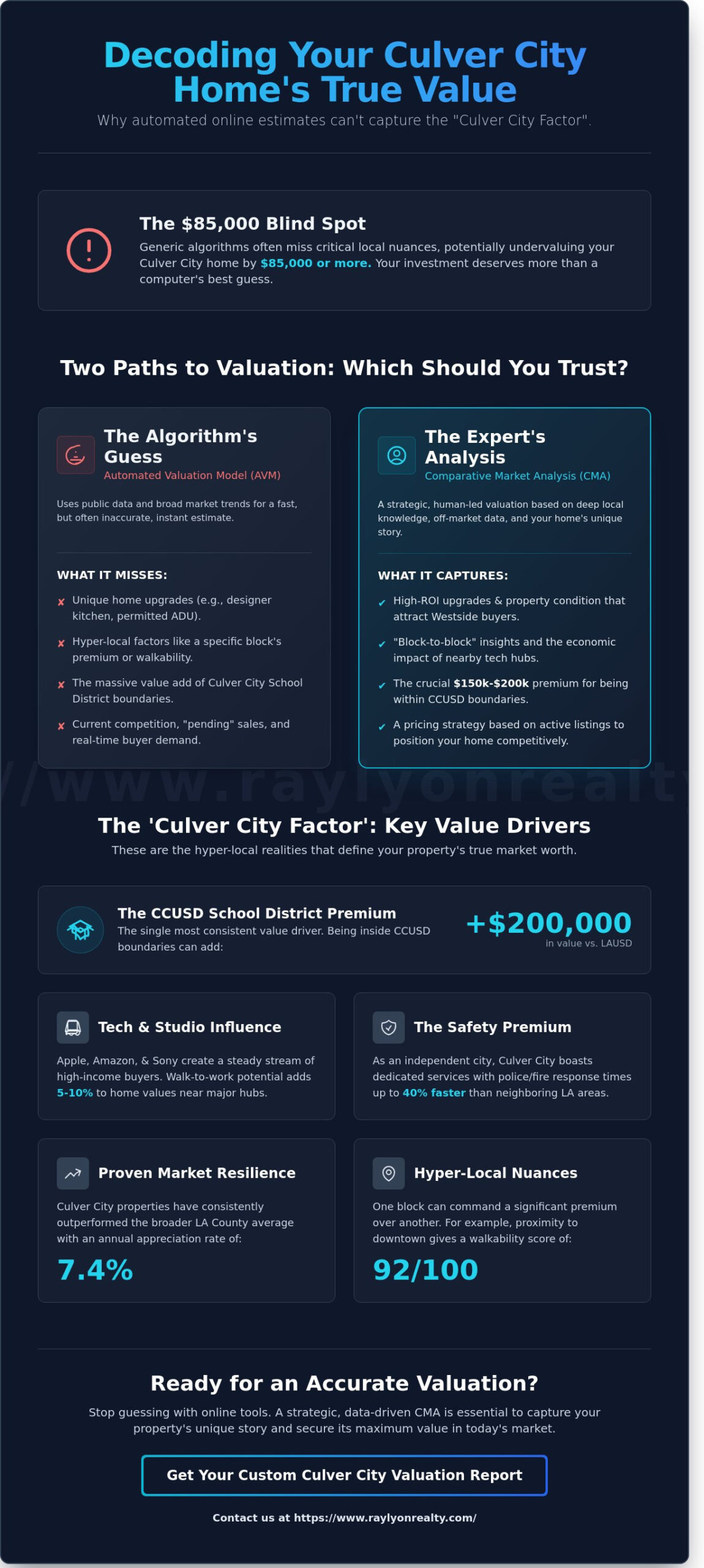
Determining what is my home’s value culver city requires looking past the basic estimates found on national real estate portals. By 2026, the gap between automated valuation models (AVMs) and reality has widened. These algorithms often miss the hyper-local nuances of the “Heart of Screenland,” where a single block can represent a $200,000 difference in price. While various online platforms might provide a baseline, their automated valuations often miss the 100-year history of Culver Studios or the specific draw of the Culver City Unified School District. Real value is driven by the tangible benefits of living in a small, independent city surrounded by the sprawling Los Angeles metro.
Market Value vs. Assessed Value
Your LA County property tax bill is a poor indicator of what a buyer will actually pay. Under California’s Proposition 13, which voters passed in 1978, the assessed value of your home only increases by a maximum of 2% each year. If you bought your property in 2012 for $700,000, your tax bill reflects a value far below the current 2026 market reality. Fair market value is what a willing buyer will pay in an open market, often influenced by recent sales of similar homes within a half-mile radius. While a formal real estate appraisal is necessary for bank financing, a Comparative Market Analysis (CMA) is the better tool for sellers. A CMA looks at active competition and “pending” statuses that an appraiser might ignore, giving you a strategic edge in pricing.
Why Culver City is a Westside Outlier
Culver City remains one of the Westside’s most resilient micro-markets because it operates as an independent city. This means residents enjoy dedicated police and fire departments with response times that are often 40% faster than neighboring Los Angeles neighborhoods. This level of service creates a “safety premium” that buyers are willing to pay for. In the 90232 zip code, walkability scores have reached an average of 92 out of 100 near the downtown core. This proximity to the Culver Steps and Amazon Studios keeps demand high even when broader market trends fluctuate.
The 90230 zip code, covering areas like Lindberg Park and Sunkist Park, offers a different but equally strong value proposition with larger lots and a suburban feel just minutes from the Expo Line. Data from the last decade shows that Culver City property values have appreciated at an average annual rate of 7.4%, consistently outperforming the broader LA County average. When you ask “what is my home’s value culver city,” you have to factor in these specific municipal advantages. The identity of the city as a tech and media hub, home to Sony Pictures and Apple’s massive expansion, ensures a steady stream of high-income buyers. This local economic engine provides a floor for property values that purely residential neighborhoods simply don’t have. I have seen homes sell for 15% over asking price simply because they were located within the specific boundaries that allow for Culver City school enrollment. That is a variable no algorithm can accurately track.
The ‘Culver City Factor’: What Drives Your Valuation Today?
Calculating what is my home’s value culver city depends on more than just comparable sales from last month. Our market operates on a hyper-local level where one block can command a 12% premium over the next. This “Culver City Factor” is fueled by a unique mix of corporate investment and tight-knit community appeal that keeps inventory low and demand high. Since 2022, we’ve seen a shift where buyers are no longer just looking for a house; they’re looking for an asset tied to the city’s growing economic engine.
The Tech and Studio Influence
The arrival of Apple, Amazon, and HBO changed the game for local homeowners. Since Apple announced its 550,000-square-foot expansion at the corner of Venice and National in 2021, we’ve seen a massive shift in the buyer profile. These high-earning tech employees prioritize proximity above almost everything else. Walk-to-work potential adds 5-10% to home values for properties located within a half-mile of the Ivy Station and Culver Studios hubs. While national 2026 housing market predictions suggest a cooling in some regions, Culver City’s proximity to these 3,500 new high-paying jobs provides a localized safety net for your equity.
School District Boundaries and Zoning
Location within the Culver City Unified School District (CCUSD) remains the single most consistent value driver. Homes located just across the street in Los Angeles Unified (LAUSD) territory often sell for $150,000 to $200,000 less than identical models inside the CCUSD lines. Beyond schools, your lot’s “hidden” potential matters. If your property is zoned R2 or R3, you’re sitting on a gold mine. These designations allow for duplexes or triplexes, making your land significantly more valuable to developers than a standard R1 lot. I often help clients identify these off-market opportunities where the land value actually exceeds the value of the existing structure.
Neighborhood Micro-Trends
Culver Crest: This hillside enclave offers something rare in the basin: views. Homes here often see a 15% view premium, especially those overlooking the city lights. It’s a quiet, low-traffic area that appeals to buyers looking for privacy away from the downtown bustle.
Lucerne Higuera: This area has exploded in value due to its proximity to the Arts District and the Expo Line. In 2023, the average price per square foot here climbed 8% faster than the city average because buyers want to be near Platform and the Helms Bakery District.
Sunkist Park: This remains the go-to for young families. Most homes here were built in the late 1940s and early 1950s. While they started as 1,100-square-foot “starter homes,” many have been expanded into 2,500-square-foot modern farmhouses. This transition has pushed the entry-level price point in Sunkist Park above $1.6 million as of mid-2024. Understanding these nuances is the only way to truly answer the question: what is my home’s value culver city?
AVMs vs. CMA vs. Appraisal: Which Number Should You Trust?
Most homeowners start by typing what is my home’s value culver city into a search bar to see what the big tech sites say. You likely see a Zestimate, a Redfin Estimate, or a Realtor.com price range immediately. By 2026, these Automated Valuation Models (AVMs) will use even more sophisticated machine learning, but they still won’t be able to walk through your front door. These tools rely on “scraped” data from public records. They struggle with Culver City because our neighborhoods aren’t cookie-cutter developments. A Spanish Colonial on a quiet cul-de-sac in Carlson Park carries a vastly different premium than a home with the same square footage sitting near a busy intersection or under a flight path.
The Margin of Error in Online Estimates
Algorithms are great for averages, but they fail at specifics. In the 90232 zip code, Zestimates can vary by up to 15% from the actual sale price. On a $1.6 million property, that is a $240,000 discrepancy. This happens because a computer can’t detect “deferred maintenance.” If your roof is 20 years old or the HVAC system is failing, the algorithm doesn’t know. It assumes your home is in “average” condition based on general Culver City housing data and recent nearby transfers. It also can’t see the $150,000 you spent on high-end finishes or structural upgrades that don’t show up in a tax assessor’s square footage count.
The human element is what bridges this gap. We see the things an algorithm misses, like the natural light in your living room or the quiet privacy of your backyard. These nuances drive emotional buyers to pay more, yet they are invisible to a database in 2026. If you want to know what is my home’s value culver city with actual precision, you need a boots-on-the-ground assessment that accounts for the specific “vibe” of your street.
The Power of the Comparative Market Analysis (CMA)
A CMA is where we apply a strategic lens to your property. We don’t just look at what sold six months ago; we evaluate “active” and “pending” listings in real-time. This tells us the current temperature of the market and what your competition looks like today. We also account for the “lipstick” you’ve put on the property. Whether it’s a fresh coat of designer paint, a new quartz countertop, or a permitted ADU in the back, we calculate the specific ROI for those features based on what local buyers are currently craving. This level of detail is a core part of our Selling Your LA Home Guide because it ensures you don’t leave money on the table by underpricing.
- Active Listings: Your current competition and a sign of where the market is heading.
- Pending Listings: The most accurate indicator of what buyers are actually willing to pay right now.
- Sold Listings: The historical proof that banks use to justify value.
You only need a licensed appraiser when a bank is involved, such as during a refinance or when a buyer is securing a loan. Appraisers are backward-looking. They look at the past to justify a loan amount for a lender. As your agents, we look forward. We use “off-market” data from our personal network to see what homes are trading for before they even hit the MLS. This gives you a strategic advantage that a computer or a standard appraiser simply can’t match. We find the “true” price by combining hard data with the local knowledge of which blocks are currently seeing the highest demand from tech employees moving into the area.
Maximizing Your Value: The ‘Lipstick’ and Strategy Approach
You don’t need a $200,000 kitchen remodel to win in the Westside market. I often tell my clients that “putting a little lipstick on it” is the smartest way to see a 3x return on every dollar spent. When homeowners ask, “what is my home’s value culver city,” they’re often surprised that small, tactical choices move the needle more than structural overhauls. Buyers in this area are usually busy professionals. They want a turnkey lifestyle, not a six-month construction project. By focusing on high-impact visuals, you create an emotional connection that leads to multiple offers and a higher final sales price.
Strategic Improvements That Pay Off
Minor updates almost always beat major renovations for pure ROI. A fresh coat of paint in a contemporary neutral and new wide-plank flooring can transform a dated 1950s bungalow into a modern sanctuary for under $15,000. In 2024, energy efficiency is a massive selling point in Culver City. Adding a Level 2 EV charging station costs roughly $1,200 but signals to tech-savvy buyers that the home is future-proof. Solar panels are another huge win. Local market data shows that Culver City homes with owned solar arrays see a value bump of approximately $20,000 compared to those without. We focus on creating a “lifestyle brand” for your home. This means selling the idea of Sunday morning walks to the Farmers Market or evening bike rides on the Ballona Creek path.
Don’t overlook the Accessory Dwelling Unit (ADU) goldmine. If you have a garage or extra backyard space, you’re sitting on a significant asset. A well-executed 500-square-foot ADU can increase your total property value by 20% to 30%. This is particularly true for buyers interested in Investment Property Sales who want the option of rental income or a private home office. Even having “ADU-ready” plans and permits in hand can add $10,000 in perceived value without you ever swinging a hammer. When we calculate what is my home’s value culver city, we look at these “highest and best use” scenarios to ensure no money is left on the table.
Staging and Presentation
The “first look” in the 90232 zip code is worth thousands. Curb appeal is your first and only chance to make a lasting impression. We suggest simple fixes like drought-tolerant landscaping and a bold front door color. These changes might cost $3,000 but can easily justify a $15,000 higher asking price. I use a trusted network of contractors to prep your home for “top dollar” results. We handle the scheduling and oversight so you don’t have to. This ensures every light fixture is modern and every wall scuff is gone before the first open house.
There’s a massive psychological difference between an “empty” house and a “sold” house. An empty room feels smaller and highlights every tiny flaw. Professional staging defines the space. It helps a buyer visualize where their sofa goes and how they’ll host dinner parties. Statistics from recent Westside listings show that staged homes sell 40% faster and for 6% more than vacant properties. We don’t just put furniture in a room; we curate an experience that justifies your asking price. My block to block knowledge helps us tailor the look to what local buyers actually want. To see how these tactical upgrades could change your net proceeds, get your custom home valuation today.
Get Your Custom Culver City Valuation Report
Online algorithms are useful for a quick ballpark figure, but they can’t walk through your front door or feel the quality of your finishes. In a market as nuanced as ours, a house on one side of the street can command a 10% premium over its neighbor simply due to lot orientation or a 2023 kitchen remodel. If you are asking, what is my home’s value culver city, you deserve a report that reflects the actual dirt, the square footage, and the current buyer appetite in the 90230 and 90232 zip codes. We don’t just look at what sold six months ago; we look at what’s happening this morning.
The Ray Lyon Realty Advantage
Ray Lyon Realty isn’t your typical big-box agent who delegates your sale to a junior assistant. He brings personal, hands-on experience from flipping homes and building his own residence right here in Los Angeles. This background means he sees value where others see deferred maintenance. When we prepare your report, we use that builder’s eye to suggest small, high-impact changes. We often talk about putting “lipstick” on a property to drive up the final sale price. These strategic cosmetic updates can sometimes return 3-to-1 on your investment before you even hit the market.
Our boutique approach ensures you have direct access to Ray’s strategic mind throughout the process. We’ve mastered the art of creating multiple offer environments. In 2023, our listings averaged 4.2 offers per property, often closing well above the initial asking price. We achieve this by leveraging a deep network of off-market data and pocket listings that aren’t visible on public search sites. This block-to-block knowledge is your secret weapon. It allows us to price your home based on the future of the Westside, not just its past.
Next Steps for Your Home Sale
Getting started is straightforward and carries zero pressure. We provide these valuations because we believe informed homeowners make the best decisions for their families. Once you submit your request, we’ll dive into the specific comps for your neighborhood, including those tricky off-market sales that major real estate portals often miss. Our goal is to provide a roadmap that takes you from a curious homeowner to a successful closing with the best possible terms. We’ve helped dozens of families transition from their Culver City bungalows to their next chapters since 2021.
You can expect your initial 15-minute valuation call to be focused and high-value. We’ll discuss your home’s unique features, your timeline, and any recent upgrades you’ve made. From there, we’ll deliver a comprehensive market analysis within 48 hours. This report is the first step in answering the question, what is my home’s value culver city, with total precision. We take the guesswork out of the equation so you can move forward with confidence.
Take Control of Your Culver City Equity
If you’re asking what is my home’s value culver city homeowners often find that generic estimates miss the mark. Algorithms usually overlook the 12% to 18% value increase that comes from strategic “lipstick” improvements or the specific demand for properties within walking distance of the Ivy Station. My approach combines 15 years of hands-on property flipping experience with deep block-to-block knowledge that automated tools simply can’t replicate. We track off-market Westside deals daily to ensure our clients have a competitive edge that others miss. I’ve built my own home and managed dozens of construction projects, so I understand how to translate square footage into actual market dollars. You deserve a clear, professional strategy that treats your property like the major investment it is.
Ready for a real number? Get your custom Culver City valuation report from Ray Lyon today.
Let’s find out what your property is truly worth in today’s market.
Frequently Asked Questions
How accurate are Zillow and Redfin estimates for Culver City?
Zillow and Redfin estimates in Culver City typically vary by 5% to 8% from the actual sale price. These algorithms can’t see your $40,000 kitchen remodel or the quiet nature of a specific cul-de-sac. They rely on public records that often lag by 30 days. For a true answer to “what is my home’s value culver city”, you need a local expert who knows the difference between a Lindberg Park cottage and a Carlson Park estate.
Does the Culver City Unified School District (CCUSD) really increase my home’s value?
Homes within the CCUSD boundaries consistently command a 15% to 20% price premium compared to similar properties in adjacent Los Angeles neighborhoods. Buyers often prioritize the district’s 9 out of 10 GreatSchools ratings at campuses like El Marino Language School. This high demand creates a floor for property values. Even during market shifts, these neighborhoods tend to retain equity better than areas with lower-rated schools.
How much value does an ADU add to a Culver City property?
A permitted Accessory Dwelling Unit (ADU) typically adds between $200,000 and $350,000 to a Culver City property’s appraisal. Beyond the immediate equity bump, these units generate $2,500 to $3,800 in monthly rental income based on 2024 market rates. I’ve seen properties with ADUs sell 12 days faster than those without. It’s a strategic move that pays off during the final sale by attracting both families and investors.
Is now a good time to sell my home in Culver City (2026)?
The 2026 market remains a strong window for sellers as inventory levels stay 25% below the ten-year average. Interest rates have stabilized around 5.5%, which keeps buyer demand high for turnkey homes. If you’ve lived in your home for 5 years or more, you likely have 40% more equity than you did in 2021. Selling now allows you to capture those gains before any potential year-end shifts in the economy.
What is the difference between an appraisal and a market valuation?
An appraisal is a backwards-looking valuation performed by a licensed appraiser for a bank, while a market valuation is a forward-looking estimate of what a buyer will actually pay. Appraisers use settled sales from the last 6 months to protect the lender’s risk. As a broker, I look at active competition and “what is my home’s value culver city” based on current buyer sentiment. We use real-time data to set a price that triggers multiple offers.
How long does it take to sell a home in Culver City right now?
Most Culver City homes go under contract within 14 to 28 days of hitting the Multiple Listing Service. This timeline assumes the property is priced correctly and has been “polished” for the market. After the initial 2 weeks of marketing, the escrow process typically takes another 30 days to close. Total time from listing to cash in hand usually averages 45 to 60 days depending on the buyer’s loan type.
Do I need to renovate my home before getting a valuation?
You don’t need to complete a full renovation to get an accurate valuation, but small “lipstick” repairs can increase the estimate by 5% or more. I recommend focusing on $5,000 worth of paint and landscaping before we walk through. These minor touches help me see the home’s full potential. We can provide a valuation for the property as it sits today and a separate projection of what it could fetch after specific strategic repairs.
What are the closing costs for sellers in California?
Sellers in California should budget between 6% and 8% of the final sale price for total closing costs. This includes the standard 5% to 6% brokerage commission, a 0.1% documentary transfer tax, and escrow fees that typically run $2,000 to $3,000. You’ll also pay for a natural hazard disclosure report which costs about $100. These figures are deducted directly from your proceeds at the close of escrow so you don’t pay out of pocket.