

What if your home sitting on the market for 60 days isn’t a sign of failure, but actually your most valuable piece of market data? It’s natural to feel a sense of dread when the initial excitement of listing fades into weeks of silence. You’re likely watching the calendar, worrying about mounting carrying costs and wondering what happens if my house doesn’t sell before the listing develops a “stale” reputation. In a Westside market where the average days on market has recently climbed to 53 days, you aren’t alone in this frustration.
We know that an unsold home feels like a heavy weight, especially when you’re questioning if your current strategy still aligns with the shifting Los Angeles market. This guide is designed to replace that anxiety with a clear, professional path forward. You’ll discover the specific reasons why properties stall in the current climate and learn the exact strategic pivots required to re-engage buyers. We’ll walk through how to handle new 2026 disclosure requirements and pricing shifts, giving you the confidence that a successful sale is still well within reach.
Key Takeaways
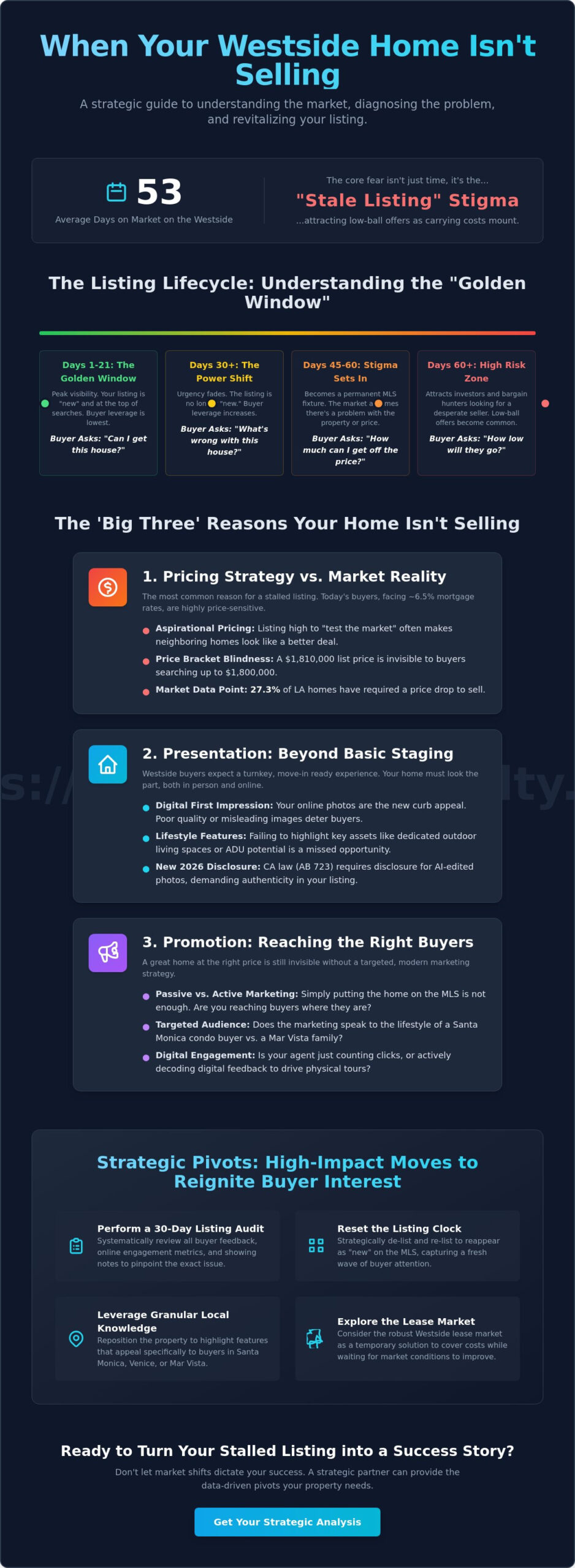
- Learn why the first 21 days are the “Golden Window” for Westside listings and how to interpret your Days on Market (DOM) as a strategic tool.
- Understand what happens if my house doesn’t sell due to the “Big Three” factors—pricing, presentation, and promotion—and how to adjust for 2026 market realities.
- Discover high-impact pivots like resetting your listing clock or exploring the Westside’s robust lease market when a traditional sale stalls.
- Follow a 30-day listing audit to decode buyer feedback and digital engagement, turning passive clicks into physical tours.
- Find out how leveraging granular local knowledge of neighborhoods like Santa Monica and Venice can revitalize a stagnant listing and attract qualified buyers.
When Should You Worry? Understanding Days on Market (DOM) in Los Angeles
Days on Market (DOM) is more than just a number on a listing sheet; it is a public record of buyer interest. In the high-stakes environment of Westside real estate, DOM tracks the time from your first “Active” status on the MLS to the moment you sign a contract. Buyers use this metric as a proxy for value. If a home is stunning and priced correctly, they expect it to move fast. When it doesn’t, the market begins to draw its own conclusions. Understanding these patterns requires a basic grasp of real estate economics, specifically how supply and demand dictate the pace of local transactions.
The first 14 to 21 days represent the “Golden Window” for Westside listings. This is when your property has the highest visibility and the most leverage. During these three weeks, your home is a “new” opportunity, appearing in automated email alerts and at the top of search results. If you are starting to worry about what happens if my house doesn’t sell, it is likely because your DOM has crossed this threshold without a serious offer. Once you pass the 30-day mark, the power dynamic shifts. Buyers stop asking “Can I get this house?” and start asking “What is wrong with this house?”
The Westside LA Benchmark for 2026
In mid-2026, the Westside market is seeing a divergence between property types. On average, homes in the Westside now sell after 53 days. However, this varies by neighborhood. A single-family home in Mar Vista might still see competitive activity within 30 days, while luxury condos in Santa Monica often face a longer climb. With 30-year fixed mortgage rates hovering around 6.5%, buyers are more patient than they were two years ago. They are waiting for the perfect fit rather than rushing into a deal. If your property is sitting while neighbors are closing in 40 days, you aren’t just in a slow market; you have a stalled listing.
The Psychology of the Stale Listing
The core fear of what happens if my house doesn’t sell often centers on the “stale listing” stigma. After 45 to 60 days, your property becomes a “permanent” fixture on the MLS. This attracts opportunistic investors who specialize in low-ball offers, assuming you are desperate to escape carrying costs. Roughly 27.3% of homes in Los Angeles have seen price drops recently, proving that many sellers are forced to reset their narrative mid-stream. To avoid this, you must distinguish between a general market slowdown and a specific issue with your property’s presentation or price before the stigma sets in.
The ‘Big Three’ Reasons Your Westside Home Isn’t Selling
When a listing stalls, it almost always boils down to what we call the triad of failure: pricing, presentation, or promotion. In a market where the median Westside home price sits at $1.8 million, buyers are doing more than just looking for a roof over their heads. They’re looking for a perfect financial and lifestyle fit. If one of these three pillars is weak, the market will let you know through silence. If you’re wondering what happens if my house doesn’t sell, the first step is a cold, hard look at these three variables. Identifying which pillar is leaning can help you course-correct before your listing becomes truly stale.
Pricing Strategy vs. Market Reality
Pricing is often the hardest pill to swallow. A “good” price in early 2025 might be a “bad” price in 2026. With 30-year mortgage rates holding at approximately 6.5%, buyer purchasing power has shifted significantly. Many sellers fall into the “aspirational pricing” trap, listing high to “see what happens.” This usually leads to your home becoming a data point for why the neighbor’s house is a better deal. According to New Residential Sales data, inventory levels and sales rates fluctuate based on these broader economic pressures. We also see many Westside sellers missing out due to “Price Brackets.” If you list at $1,810,000, you’re invisible to everyone searching with a $1.8 million cap. That $10,000 difference can cost you thousands of digital views.
Presentation: Beyond Basic Staging
In neighborhoods like Santa Monica and Venice, “lived-in” luxury is a tough sell. Buyers expect a turnkey experience. If your home lacks a dedicated outdoor living space or hasn’t highlighted its ADU potential, you’re fighting an uphill battle. Presentation also includes your digital footprint. As of January 1, 2026, California’s AB 723 requires disclosures for any AI-edited photos. If your listing uses low-quality images or misleading edits without proper disclosure, you lose buyer trust before they even step through the front door. Professional photography is no longer optional; it’s the baseline for entry. Minor kitchen refreshes and curb appeal boosts often provide the highest ROI for stalled listings.
Promotion: Reaching the Right Pool
Listing a home on the MLS isn’t the same as marketing a lifestyle. To move a property in today’s climate, you need to reach out-of-area buyers who are moving to the Westside for tech or entertainment roles. This requires a sophisticated digital strategy that goes beyond a “For Sale” sign. If your agent isn’t leveraging social targeting and high-end networking, you’re likely missing a huge portion of the buyer pool. You can explore our Pillar Guide to Selling Your LA Home to see the marketing essentials we use to keep listings fresh. If you feel your current reach is falling short, it might be time to re-evaluate your listing strategy with a fresh, strategic perspective.
Strategic Pivots: What to Do When the Traditional Sale Stalls
If your property hasn’t attracted a serious buyer after the “Golden Window” we discussed earlier, it is time to shift from a passive listing to an active strategy. Sticking with the same approach while expecting a different result is a recipe for a stale listing. You need a pivot that changes the narrative for buyers. When homeowners ask us what happens if my house doesn’t sell, we look at four primary strategic moves. Each one is designed to protect your equity while acknowledging the current market’s demand for value and quality.
One effective move is the “Temporary Withdrawal.” By taking your home off the market for at least 30 days, you can reset the Days on Market (DOM) clock on the MLS. This break allows you to address any negative feedback from previous showings or perform minor cosmetic refreshes. When you return, you appear as a “New Listing” again, capturing the attention of fresh buyers who might have filtered out your previous entry. If you choose to stay on the market, a “Price Correction” is your most powerful tool. Rather than small, incremental drops that look like desperation, a single, significant adjustment that places you into a new search bracket can re-ignite interest. We use the FHFA House Price Index to track broader trends and ensure your new price reflects the actual momentum of the Westside market.
The Rental Alternative in Santa Monica and Venice
The Westside is unique because of its incredibly robust lease market. If a sale isn’t materializing at your desired price, converting the property into a high-end rental can be a savvy financial bridge. Santa Monica and Venice consistently command premium rents, often covering the carrying costs of a 6.5% mortgage while you wait for the market to thaw. Holding the asset also allows you to benefit from the long-term appreciation that defines prime Los Angeles postcodes. You can explore our Mar Vista Neighborhood Guide to see how local rental demand compares to neighboring areas and evaluate if this pivot makes sense for your specific street.
Investment Properties and 1031 Exchanges
For those selling an investment property, a stalled sale might signal that it’s time for a 1031 exchange pivot. If the property isn’t attracting the right buyer, you might consider a more aggressive pricing strategy to facilitate a swap into a higher-performing asset. A 1031 exchange allows you to defer capital gains taxes while upgrading your portfolio. This is a specialized move that requires precise timing and expert guidance, especially for trust sales or properties with complex ownership structures. It turns the question of what happens if my house doesn’t sell into an opportunity to reposition your wealth into a more liquid or lucrative investment elsewhere in California.
The 30-Day Listing Audit: How to Refresh Your Property’s Appeal
Crossing the 30-day mark without a signed contract is a pivotal moment for any Westside homeowner. Instead of letting anxiety take over regarding what happens if my house doesn’t sell, use this milestone to perform a rigorous, data-driven audit. You now possess something you didn’t have on day one: real-world market feedback. By analyzing how buyers have interacted with your listing during the “Golden Window,” you can identify exactly where the friction lies and remove it before the property develops a stale reputation.
A successful audit follows a structured five-step process. First, we analyze showing feedback to find patterns. Second, we review digital engagement; if your listing has thousands of views but zero tour requests, your “digital curb appeal” is likely the culprit. Third, we re-evaluate the competition. In a market where the average Westside home sells in 53 days, new listings have likely appeared since you went active. Fourth, we execute a visual refresh. Finally, we re-launch the property with a “new listing” feel to capture the next wave of buyers. If you need an expert eye to review your current performance, you can request a strategic listing audit to get your sale back on track.
Interpreting Buyer Feedback
Buyers are often too polite to tell you the truth to your face. When feedback says a home is “charming but not the right fit,” it is often code for “the price is too high for the current condition.” You must look for recurring themes. If three different buyers mention the noise from a nearby street or an outdated primary bath, these are the hurdles you must address. In some cases, investing in a pre-inspection can clear the air for skeptical buyers, proving that the home is structurally sound despite its time on the market.
The ‘Hero Shot’ Strategy
Your primary listing photo, or “Hero Shot,” is the most important piece of marketing you own. If it isn’t stopping the scroll, nothing else matters. We often recommend switching to twilight photography to capture the iconic coastal aesthetic of Santa Monica or Venice. This simple change can trigger a new wave of interest from buyers who previously overlooked the listing. Use this refresh to update your description, highlighting unique selling points like ADU potential or proximity to specific Westside amenities that may have been buried in the original text. A fresh visual narrative can make an “old” listing feel like a brand-new opportunity.
Why a Strategic Partner Like Ray Lyon Realty Makes the Difference
Selling a home in a “thawing” market like mid-2026 requires more than just a standard MLS entry. It demands a partner who understands the high stakes of carrying costs and the psychological toll of a stagnant listing. If you’ve been losing sleep over what happens if my house doesn’t sell, you need a strategy that moves beyond the basics. At Ray Lyon Realty, we bridge the gap between a “stale” property and a closed deal by applying a hands-on, developer-mindset approach to every listing we touch. We don’t just list properties; we engineer success stories.
Experienced, Strategic, and Empathetic
We treat your home as if it were our own personal investment. This isn’t just a slogan; it’s a reflection of our founder’s history in property development and renovation. We understand the risks and rewards of the Westside market because we’ve lived them ourselves. This empathy drives us to be more than just service providers. We are strategic advisors who know how to navigate 6.5% interest rates and shifting buyer leverage. Our team has a reputation for securing exclusive opportunities and using a resourceful network to find the right buyer, even when the traditional path stalls. If you’re ready for a fresh, results-oriented perspective, contact Ray Lyon Realty today.
The Value of Granular Local Knowledge
Success on the Westside depends on understanding micro-market shifts in neighborhoods like Santa Monica, Mar Vista, and Venice. A “big box” agency might look at city-wide averages, but we look at your specific block. We know which streets in Venice are trending and why certain Mar Vista homes are outperforming the current 53-day average. This level of detail allows us to price and position your home with surgical precision.
Our competitive advantage lies in our access to specialized resources, including:
- Exclusive, non-public opportunities that aren’t visible on consumer apps.
- A deep network of “off-market” buyer pools and investment specialists.
- Integration of high-quality data from Landvoice to track expired listings and pre-foreclosure trends, ensuring a proactive approach to finding the right buyer.
- Hands-on expertise in property presentation that meets the 2026 “turnkey” standard.
- Sophisticated digital marketing that targets out-of-area buyers moving to the Westside.
If you are still wondering what happens if my house doesn’t sell, the answer is simple: you pivot with a partner who knows the terrain. We don’t just wait for the phone to ring. We actively market your home’s unique lifestyle and use granular data to ensure it stands out. Don’t let your listing become a permanent fixture on the MLS. Let’s work together to secure the successful sale and financial outcome you deserve.
Secure Your Sale with a Strategic Westside Pivot
Stagnation on the MLS is a challenge, but it is not a final verdict on your property’s value. By respecting the “Golden Window” and performing a rigorous 30-day audit of your pricing and presentation, you can transform a stalled listing into a successful closing. Whether you are adjusting your search bracket or exploring the robust Westside lease market, the key is to act before the “stale” stigma takes hold. You no longer need to stay awake wondering what happens if my house doesn’t sell when you have a data-driven plan to re-engage qualified buyers.
Ray Lyon Realty brings a unique, developer-focused perspective to neighborhoods like Santa Monica, Mar Vista, and Venice. We specialize in complex transactions, including 1031 exchanges and investment properties, ensuring your equity is always protected. Our founder takes a personalized, hands-on approach to every listing, leveraging exclusive networks to find opportunities others miss. If you are ready to stop waiting and start moving, Request a Strategic Listing Audit from Ray Lyon Realty today. You’ve built the equity; let’s build the strategy to unlock it.
Frequently Asked Questions
How long is too long for a house to be on the market in Los Angeles?
A listing is generally considered “too long” once it exceeds the local median of 52 to 53 days without an offer. In high-demand Westside pockets, the “Golden Window” of peak activity often closes after the first 21 days. If you’ve passed the 60-day mark, buyers typically assume there’s a hidden flaw or the price is disconnected from reality. At this stage, a strategic pivot is necessary to avoid the stigma of a stale listing.
Should I fire my realtor if my house isn’t selling?
You should consider a change if your current agent lacks a concrete, data-backed plan to address the lack of interest. Before making a move, have a transparent conversation about their digital marketing reach and specific showing feedback. If they aren’t suggesting pivots like a “Hero Shot” refresh or a pricing bracket shift, you’ll likely benefit from a more strategic partner who understands the granular nuances of the Los Angeles market.
Is it better to lower the price or offer buyer incentives like closing cost credits?
Lowering the price is typically more effective because it triggers new alerts for buyers searching within specific price brackets. While closing cost credits or interest rate buy-downs are appealing, they don’t help your home show up in a buyer’s filtered search results. If your property isn’t getting tours, the price is the primary hurdle. If you’re getting tours but no offers, incentives might help seal the deal.
What are the most common reasons a home fails to sell in Santa Monica?
Overpricing is the most frequent culprit, but presentation issues specific to the coast also play a major role. Buyers in Santa Monica prioritize turnkey finishes and functional outdoor living areas. If your property feels dated or lacks that quintessential indoor-outdoor flow, it will struggle. Additionally, failing to highlight ADU potential can be a missed opportunity in a city where supplemental income is a high priority for modern buyers.
Can I take my house off the market and relist it later to reset the days on market?
Yes, you can reset your Days on Market (DOM) by withdrawing the listing for a minimum of 30 days. This “Temporary Withdrawal” allows you to perform minor refreshes and re-enter the MLS as a “New Listing.” This strategy effectively clears the history for casual browsers, though savvy agents can still see the prior activity. It’s an excellent way to re-launch with a fresh visual narrative and a corrected price.
How much should I drop my price if I’m not getting any offers?
A meaningful price drop should be at least 3% to 5% to grab the market’s attention. Small, incremental decreases often look like desperation and don’t move the needle with buyers. The goal is to drop into a lower search bracket. For example, moving from $1,825,000 to $1,795,000 puts your home in front of an entirely new pool of buyers who capped their search at $1.8 million.
Does staging really make a difference for a home that’s already been listed for a month?
Staging is incredibly effective for a mid-listing refresh because it allows you to replace your primary listing photo with a completely different look. If your home has been sitting empty or looks “lived-in,” professional staging creates an emotional connection that vacant rooms can’t provide. It helps buyers visualize the Westside lifestyle. Combining new staging with professional twilight photography can make a 45-day-old listing feel like a brand-new opportunity.
What happens if my house doesn’t sell before I need to move?
If you’re wondering what happens if my house doesn’t sell before your move date, the most common solution is the rental pivot. The Westside lease market is exceptionally strong, and high-end rentals in Venice or Mar Vista can often cover your carrying costs. This allows you to hold the asset for long-term appreciation while waiting for a more favorable selling window. Alternatively, you might explore bridge financing to secure your next home while your current one remains listed.