

Can a market with a 26% year-over-year price dip in some pockets actually be the smartest place to park your capital in 2026? While headline-seekers focus on cooling median sale prices, savvy investors recognize that Venice CA real estate investment has shifted from a speculative frenzy to a sophisticated, appreciation-first play. You’ve likely heard that the “easy money” in Silicon Beach has already been made. Perhaps you’re feeling the weight of Measure ULA’s “cliff tax” or the maze of opaque coastal zoning laws. It’s natural to hesitate when entry prices are high and regulations feel like a moving target.
I’ve spent years renovating properties and managing portfolios right here on the Westside, and I’ve learned that the best opportunities rarely appear on the public market. This guide will show you how to handle high-entry yields, coastal regulations, and appreciation strategies that actually work in today’s environment. We’ll explore the divergence between the Venice Canals and the broader beach market, successful ADU integration for cash flow, and how to use 1031 exchanges to protect your wealth. You’ll gain the local edge needed to secure off-market deals and maximize value in this unique coastal enclave.
Key Takeaways
- Understand why Venice remains a high-appreciation “lifestyle scarcity” market and how finite inventory continues to drive long-term value for investors.
- Learn how to maximize cash flow by integrating Accessory Dwelling Units (ADUs) and strategic renovations into a proven “Buy, Renovate, Refinance” model.
- Master the complexities of the LA Rent Stabilization Ordinance (RSO) and California Coastal Commission requirements to ensure your project stays compliant and profitable.
- Identify the specific micro-markets, from the historic Canals to the family-friendly Milwood area, that best align with your Venice CA real estate investment goals.
- Discover the critical advantage of accessing off-market opportunities and using 1031 exchanges to defer taxes while scaling your coastal portfolio.
The Venice Real Estate Investment Landscape in 2026
Venice isn’t just a neighborhood; it’s a finite asset. By 2026, the initial hype of Silicon Beach has evolved into a stable, high-demand ecosystem where lifestyle drives value. While broader Los Angeles might see fluctuations in suburban inventory, Venice CA real estate investment remains shielded by what I call the “coastal moat.” This isn’t a market for the faint of heart, but for those who understand that scarcity equals long-term appreciation, the current cycle offers a unique entry point.
To better understand why prices remain resilient despite shifting sales volumes, watch this helpful video:
Silicon Beach 2.0: Tech Giants and Housing Demand
The proximity to tech hubs in Santa Monica and Playa Vista continues to anchor the local economy, making Venice CA real estate investment a strategic play for those targeting the “tech-wealth” demographic. In 2026, we’re seeing a direct correlation between tech salary growth and the demand for luxury tiers. The typical tenant today isn’t just looking for a beach rental; they’re high-earning professionals who value walkability and the unique cultural fabric of the area. This demographic shift has created a floor for property values that simply doesn’t exist in less specialized markets. While some parts of the city face high vacancy, Venice maintains a tight grip on its premium renter pool.
Inventory Scarcity and the “Coastal Moat”
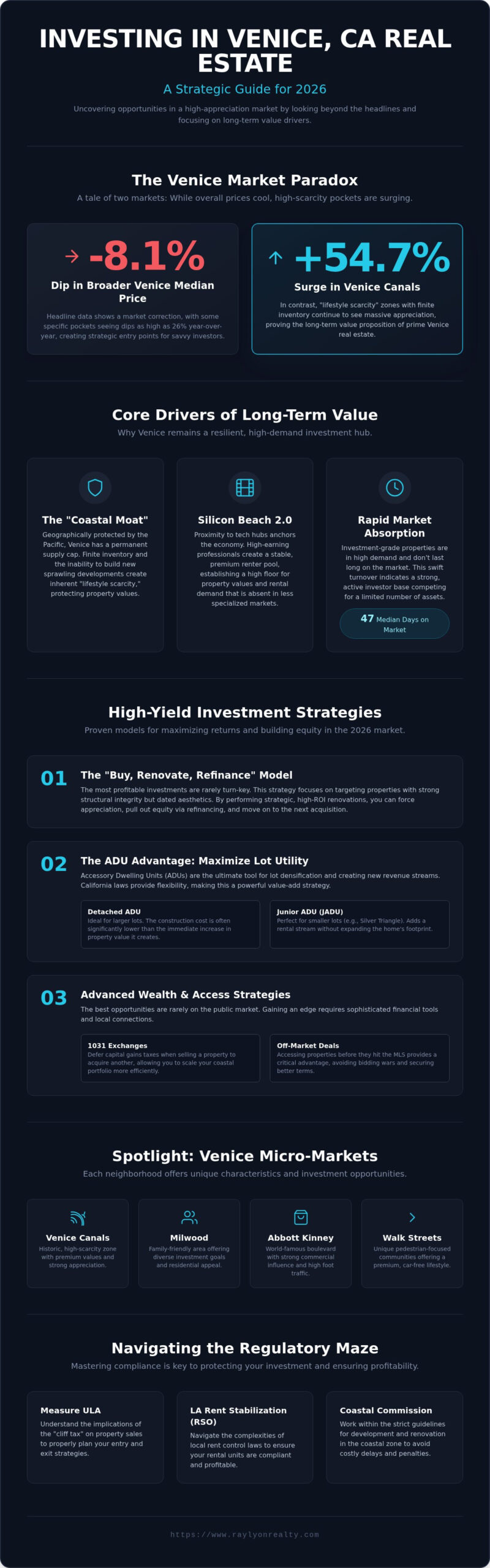
Geography is Venice’s greatest protection. Bordered by the Pacific, there’s literally no room for the kind of sprawling new developments seen elsewhere in the county. A quick look at a Venice, CA historical overview reveals how the original canal system and narrow lots created a permanent supply cap. With a median of 47 days on the market as of May 2026, investment-grade properties don’t sit for long. Investors are competing for a stagnant number of doors, which is why the “lifestyle scarcity” model is the primary driver for 2026 returns. This divergence is clear when you compare the broader 8.1% dip in Venice median prices to the 54.7% surge seen in high-scarcity pockets like the Venice Canals.
2026 stands as a pivotal year for Westside inventory cycles. We’re witnessing the maturation of post-pandemic holdings, where owners who bought during the low-rate era are finally beginning to move. For the prepared investor, this means the first real window of opportunity to acquire prime assets that haven’t changed hands in years.
High-Yield Strategies: Value-Add and Fix-and-Flip
My personal journey in property development and renovation has taught me one thing: the most profitable Venice CA real estate investment is rarely a turn-key house. It’s the neglected bungalow or the oversized lot with underutilized square footage. In 2026, the “Buy, Renovate, Refinance” model remains a powerhouse for building equity. By targeting properties with structural integrity but dated aesthetics, you can force appreciation and stay ahead of the competition. Success here isn’t just about a fresh coat of paint; it’s about strategic upgrades that align with the latest UCLA Anderson Economic Forecast regarding housing demand and consumer spending power in coastal California.
The ADU Advantage: Maximizing Lot Utility
The 2026 regulatory environment has made Accessory Dwelling Units (ADUs) the ultimate tool for lot densification. California state laws now provide even greater flexibility for homeowners to add secondary units, regardless of local zoning bottlenecks. For many Venice lots, the cost of constructing a detached ADU is significantly lower than the immediate jump in property valuation it provides. If you’re working with a smaller lot, particularly in the Silver Triangle, a Junior ADU (JADU) is a brilliant way to add a rental stream without expanding the home’s footprint. These units cater perfectly to the “work-from-Venice” demographic that values a private, separate office or guest suite. I’ve found that integrating these units early in the renovation process maximizes your long-term cash flow and exit price.
Strategic Renovation: What Venice Buyers Want
Venice buyers in 2026 have specific tastes that differ from the rest of the Westside. They aren’t just looking for luxury; they’re looking for a vibe. To drive the highest resale premiums, focus on these key areas:
- Indoor-Outdoor Transitions: Large glass sliders and seamless deck integration are non-negotiable. The goal is to make the outdoor space feel like an extension of the living room.
- Aesthetic Shifts: We’re seeing a move away from “all-white coastal” toward a “modern-industrial” look. Think warm wood tones, black steel accents, and exposed concrete.
- Invisible Upgrades: Resale value is increasingly tied to energy efficiency. Smart home systems, solar readiness, and high-efficiency heat pumps are now standard expectations in the luxury tier.
These “invisible” features often justify a higher list price by reducing future carrying costs for the buyer. If you’re looking for a team that understands how to identify properties with high renovation potential, finding an insider with hands-on flipping experience is your best move. We focus on the granular details that turn a standard flip into a high-margin asset.
Navigating Venice-Specific Regulations and Zoning
Regulations often scare away potential investors, but they’re actually what keeps the “coastal moat” intact. If you want to succeed in Venice CA real estate investment, you have to embrace the paperwork. The complexity of local laws acts as a barrier to entry, rewarding those who do their homework with less competition. Beyond zoning, the “Mansion Tax” or Measure ULA is a critical factor for 2026. As of July 1, 2026, any transaction between $5,400,000 and $10,899,999 triggers a 4% tax. If the price hits $10,900,000 or more, that tax jumps to 5.5%. This is a “cliff tax” applied to the total value, not just the amount over the threshold, making your exit strategy planning more vital than ever.
The Rent Stabilization Ordinance (RSO) Survival Guide
Most multi-family properties in Venice fall under the LA Rent Stabilization Ordinance (RSO). It’s vital to know if your target property was built on or before October 1, 1978. If it was, your ability to raise rents is capped annually. For 2026, these allowable increases remain tied to the Consumer Price Index, typically hovering around 4% for RSO units. Newer properties aren’t subject to these same caps, which is why we’re seeing a premium on “post-RSO” construction. When looking at older assets, tactical tenant buyouts or waiting for voluntary vacancies are the primary ways to reset a unit to market rates. I’ve found that transparency with tenants is always the best path forward.
For many investors, especially those managing multi-family units under RSO, hiring a professional firm like Mission 1 Property Management is the most effective way to handle tenant relations and stay compliant with ever-changing local laws.
Coastal Commission and Mello Act Compliance
If your property sits within the California Coastal Zone, you’ll need more than just a standard building permit. The California Coastal Commission oversees most exterior modifications to ensure they don’t block public views or access. Getting a Coastal Development Permit (CDP) can add months to your timeline. You also need to watch for the Mello Act. This state law requires that any residential development in the coastal zone preserves or replaces affordable housing units. If you’re planning to demolish an older structure to build a modern estate, the Mello Act could trigger a requirement to include an affordable unit or pay a significant in-lieu fee.
Short-term rentals are another area where Venice is unique. The Los Angeles Home-Sharing Ordinance remains strict in 2026. You can only host short-term stays in your primary residence, and there’s a cap on the number of nights per year. This makes the “Airbnb-only” investment model difficult here. Instead, I recommend focusing on long-term executive rentals or the ADU strategies we discussed previously. During your escrow period, your due diligence checklist must include a title search for Mello Act declarations and a review of the Venice Specific Plan. Understanding these rules before you close is the difference between a high-yield asset and a costly legal headache.
Analyzing Venice Micro-Markets: From Walk Streets to Abbott Kinney
Venice isn’t a monolith; it’s a collection of highly specific micro-pockets, each with its own risk-reward profile. While the broader market might show a dip in median sales, specific areas like the Venice Canals saw a staggering 54.7% year-over-year price increase as of March 2026. This highlights why a blanket approach to Venice CA real estate investment is a mistake. You’ve got to look at the street-level data to find the real yield. For instance, the investment profile of a Canal-front property is driven by ultra-luxury appreciation, whereas the Milwood area is a haven for family-oriented long-term rentals.
The Walk Streets: Premium Appreciation Plays
The Walk Streets are the historic “crown jewels” of the neighborhood. These pedestrian-only paths offer a tranquility that’s impossible to find elsewhere in Los Angeles. Because of this, they maintain the highest price-per-square-foot in the 90291 zip code. Resale velocity in 2026 remains high because inventory is so limited. However, you’ve got to account for unique maintenance challenges. Deliveries, trash pickup, and construction staging all require specialized logistics. These factors can eat into your renovation budget if you haven’t planned for the lack of direct vehicle access.
East of Lincoln: The “Emerging” Value Zone
If you’re looking for more accessible entry prices, look East of Lincoln Boulevard. This area has transformed into a high-demand zone for young tech professionals. Entry prices here are significantly lower than beach-side blocks, making it the “sweet spot” for duplex and multi-family investments. The proximity to Mar Vista, Los Angeles creates a powerful spillover effect. As prices in Mar Vista continue to climb, Venice’s eastern border becomes the next logical step for buyers seeking value without sacrificing the coastal vibe. We’re seeing a steady trend of gentrification and infrastructure improvements here that suggest strong long-term growth.
Don’t overlook the residential opportunities tucked behind the commercial corridor of Abbot Kinney Blvd. These properties command a premium because of their “lifestyle walkability.” Residents can walk to world-class dining and shopping, which keeps vacancy rates for luxury rentals near zero. Similarly, the Silver Triangle offers larger lots that are perfect for the ADU strategies we discussed earlier. These family-friendly streets provide a more traditional residential feel while remaining minutes from the beach. To navigate these micro-markets and find exclusive off-market listings that never hit the public portals, you need an insider’s perspective on the ground.
Maximizing Your ROI with a Strategic Venice Partner
In a market as tight as Venice, the best deals don’t always make it to the MLS. Success in Venice CA real estate investment often depends on who you know before the sign goes in the yard. I’ve built my career on finding “hidden gems” through trust sales and non-public listings. These opportunities allow you to avoid the high-competition bidding wars that often drive prices above list value. Working with real estate agents in los angeles ca who own and renovate investment property themselves gives you a distinct advantage. You aren’t just getting a salesperson; you’re getting a partner who understands the granular math of a renovation and the specific risks of coastal development.
The 1031 Exchange: Scaling Your Portfolio
The 1031 exchange is the most powerful tool for building generational wealth in California. It allows you to sell a property and reinvest the proceeds into a “like-kind” asset while deferring capital gains taxes. However, the clock is your biggest enemy. You have exactly 45 days from the sale of your property to identify potential replacements and 180 days to close. In 2026, we’re seeing savvy investors use the “swap till you drop” strategy, continuously upgrading their assets without losing equity to the IRS. If you’re selling a smaller Venice bungalow, look toward “up-leg” opportunities in neighboring Santa Monica or Mar Vista to diversify your holdings. These nearby markets offer different risk profiles that can balance a Westside portfolio effectively. For investors looking to scale their coastal holdings into new regions, Steve Adams & Associates provides expert guidance on the Southport, North Carolina market.
Off-Market Access and Professional Networking
Accessing “pocket listings” requires deep roots in the local brokerage community. Because of my personal history in property development, I’ve cultivated a network of specialists who alert us to distressed properties and trust sales before they go public. This insider access is critical in a low-inventory 2026 market where active listings remain limited. When it’s time to sell, our approach to seller representation goes beyond a simple listing. We coordinate minor upgrades and professional staging to ensure your asset appeals to the specific aesthetic tastes of the 2026 Venice buyer. These small, strategic moves can significantly boost your final exit price.
I invite you to a private consultation to discuss your specific financial goals. We can explore exclusive Westside opportunities and off-market deals that aren’t available to the general public. Whether you’re looking for your first flip or scaling an existing portfolio, having a partner with skin in the game is the key to long-term success.
Securing Your Future in the Silicon Beach Ecosystem
Venice remains one of the most resilient coastal markets because you can’t manufacture more of it. By focusing on value-add strategies like ADU integration and targeting specific micro-markets, you can stay ahead of the lifestyle scarcity curve. Success in 2026 isn’t about following the herd. It’s about mastering the technical details of 1031 exchanges and navigating the nuances of the Coastal Commission. Your Venice CA real estate investment strategy should be as unique as the neighborhood itself.
My personal experience in Westside property flipping and renovation gives me a unique perspective on what it takes to turn a good deal into a high-yield asset. I specialize in trust sales and 1031 exchanges, providing you with the strategic edge needed to scale your portfolio while deferring capital gains. Most importantly, I provide access to exclusive, non-public Westside listings that simply don’t appear on major portals. If you’re ready to find your next opportunity, Schedule a Venice Investment Consultation with Ray Lyon Realty today. Let’s turn your coastal vision into a profitable reality.
Frequently Asked Questions
Is Venice, CA a good place to invest in real estate in 2026?
Yes, Venice remains an exceptional long-term investment because of its unique lifestyle appeal and proximity to high-paying tech jobs. The market is defined by “lifestyle scarcity,” where a finite supply of homes meets growing global demand. While entry prices are high, the area’s historical appreciation rates consistently outpace suburban Los Angeles. It’s a market built for equity growth and wealth preservation rather than simple monthly cash flow.
What is the average rental yield for a Venice Beach property?
Average rental yields in Venice typically range from 2% to 4%, depending on the specific micro-market. This is primarily an appreciation-focused market where investors prioritize long-term equity gains over immediate monthly profits. You can often increase these yields by adding an ADU or targeting multi-family properties East of Lincoln. Luxury rentals near Abbot Kinney command the highest rates but also require the most significant initial capital investment.
How does the LA Rent Stabilization Ordinance (RSO) affect Venice investors?
The RSO significantly impacts properties built on or before October 1, 1978, by capping annual rent increases. These caps are tied to the Consumer Price Index and usually hover around 4%. For a successful Venice CA real estate investment, you must verify the property’s RSO status during the escrow period. Many investors target non-RSO properties or look for assets with “upside” through voluntary vacancies that allow for market-rate resets.
What are the rules for building an ADU in Venice, CA?
California state law has streamlined the process, allowing most residential lots to add at least one ADU and one Junior ADU. However, Venice properties within the Coastal Zone must still comply with California Coastal Commission regulations. This often requires a Coastal Development Permit if the project impacts public views or beach access. There’s no minimum lot size required for an ADU, making it a highly effective way to maximize lot utility.
Can I still do short-term rentals (Airbnb) in Venice?
You can only host short-term rentals in your primary residence where you live for at least six months of the year. The Los Angeles Home-Sharing Ordinance prohibits investors from running short-term rentals in non-owner-occupied properties. This regulation has shifted the market toward long-term executive rentals and 30-plus day stays. These longer-term options remain a viable way to generate steady income while staying fully compliant with local city laws.
What is a 1031 exchange and how does it work for LA real estate?
A 1031 exchange allows you to defer capital gains taxes by swapping one investment property for another of “like-kind.” You have 45 days after selling your property to identify up to three potential replacements and 180 days to close. This is a vital strategy for anyone scaling a Venice CA real estate investment portfolio. It allows you to keep 100% of your equity working for you as you move into larger assets.
What are the main differences between investing in Venice vs. Santa Monica?
Venice offers more architectural diversity and a “lifestyle-first” vibe compared to the more corporate feel of Santa Monica. While both markets are highly desirable, Venice often provides more creative value-add opportunities through unique renovations and lot densification. Santa Monica has its own strict rent control laws that can be even more restrictive than the LA RSO. Venice remains the preferred choice for investors targeting the creative and tech-centric “Silicon Beach” demographic.
How much are closing costs for an investment property in California?
Standard closing costs for buyers usually range from 1% to 3% of the purchase price, covering title insurance, escrow fees, and inspections. However, you must account for the Measure ULA “Mansion Tax” on high-end transactions. For properties over $5.4 million, a 4% tax applies to the total sale price. While this is typically a seller-paid expense, it significantly influences negotiation strategies and the final net proceeds for any luxury investment in the area.