
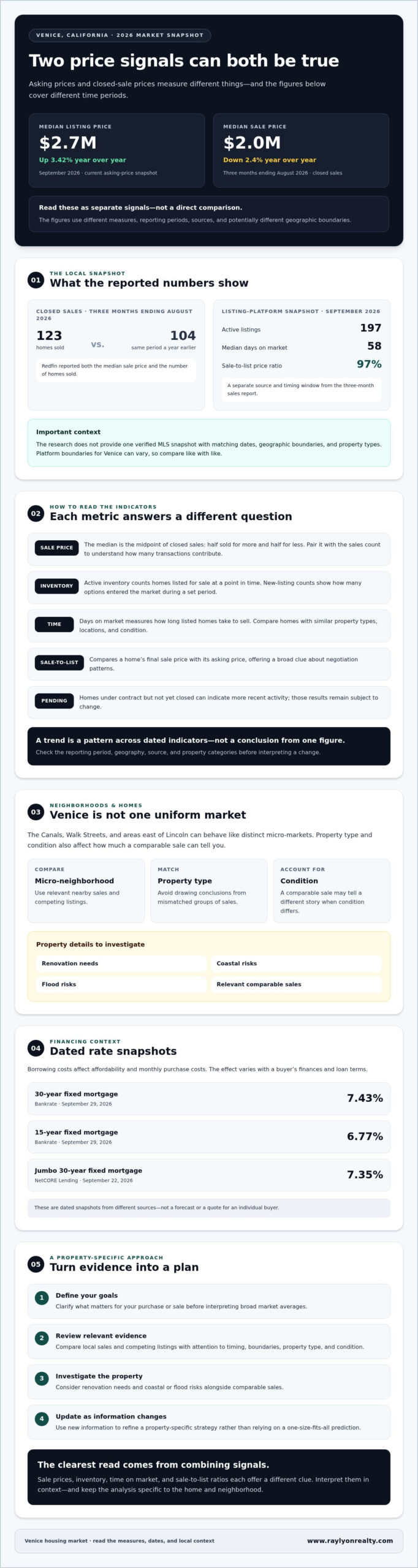
What if Venice’s rising asking prices and falling sale prices are both true? The latest venice ca housing market trends show why the measure and reporting period matter. Recent data showed a $2.7 million median listing price in September 2026, up 3.42% year over year, alongside a $2.0 million median sale price for the three months ending in August, down 2.4%. These figures track different measures and periods, so treat them as separate signals, not a direct comparison.
If broad Los Angeles headlines leave you unsure what’s happening on the blocks you care about, that’s understandable. Venice’s Canals, Walk Streets, and areas east of Lincoln can behave like distinct micro-markets. Property type and condition also affect how much a comparable sale can tell you.
This guide from Ray Lyon Realty explains the local indicators behind the 2026 market and how to use them when planning a purchase or sale. We’ll look at pricing, inventory, time on market, property-type and neighborhood differences, and details to investigate before you act, including renovation needs and coastal or flood risks. The goal is to help you read the evidence, not make a one-size-fits-all prediction.
Key Takeaways
- Read the venice ca housing market trends alongside each figure’s reporting period and geographic boundaries.
- Use sale prices, available inventory, time on market, and sale-to-list ratios together. Each offers a different clue for buyers and sellers.
- Compare homes by property type and micro-neighborhood, and avoid conclusions based on small or mismatched groups of sales.
- Before making a move, define your goals, review relevant comparables, investigate the property, and update your plan as new information emerges.
- Local comparable sales and competing listings can help shape a property-specific strategy without relying on broad market averages.
Venice CA housing market trends in 2026: How to read the local snapshot
Recent figures show why sale results and current asking prices need to be read separately. Redfin reported a $2.0 million median sale price for Venice homes sold during the three months ending August 2026, down 2.4% year over year. The same report counted 123 homes sold, compared with 104 in the same period a year earlier. These are closed-sale figures, not a live MLS report, and the supplied source doesn’t specify a consistent breakdown by property type.
A separate listing-platform snapshot for Venice in September 2026 reported 197 active listings, 58 median days on market, and a 97% sale-to-list price ratio. These figures come from a different source and timing window than Redfin’s three-month sales data. Read them as separate indicators, not as one matched dataset. Platform boundaries for Venice can also vary. For geographic context, see Venice, a neighborhood of Los Angeles.
For a visual discussion of local market numbers, watch Venice Beach Real Estate Market: What the Numbers Really Show:
Which Venice housing indicators matter most?
The median sale price is the midpoint of closed sales: half sold for more and half for less. Pair it with the number of homes sold to understand how many transactions contribute to the figure. The Redfin report provides both price and sales count, though the count alone doesn’t show whether all property types are equally represented.
Active inventory counts properties listed for sale at a point in time. The September 2026 listing snapshot offers a view of buyer choice, while new-listing counts show how many options entered the market during a set period. Days on market measures how long listed homes take to sell. The sale-to-list ratio compares a home’s final sale price with its asking price, giving a broad clue about negotiation patterns. Pending sales are under contract but not yet closed, so they can indicate more recent activity while remaining subject to change.
A housing market trend is a pattern across dated indicators, not a conclusion drawn from one figure. For buyers following venice ca housing market trends, that distinction helps separate a useful signal from a headline number.
How current is the 2026 Venice market data?
The latest complete periods in the cited figures differ: Redfin’s sales data covers the three months ending August 2026, while the listing-platform measures are dated September 2026. The supplied research doesn’t provide a single, verified MLS snapshot with matching dates, boundaries, and property types. Treat platform comparisons cautiously. Before interpreting short-term changes, check that the geography, timeframe, and property categories match.
What is driving Venice CA housing market trends in 2026?
Several forces may shape Venice home-buying conditions, but a market pattern doesn’t prove what caused it. Local sales activity, available listings, financing costs, and each property’s features offer different clues. Treat broader explanations, such as technology-sector demand or coastal lifestyle appeal, as context to investigate, not as guarantees about a specific home’s value or how quickly it will sell.
How do financing and buyer demand affect Venice?
Borrowing costs affect what a buyer can afford to pay and the monthly cost of a purchase. The effect varies with each buyer’s finances and loan terms. Bankrate reported a 30-year fixed mortgage rate of 7.43% on September 29, 2026, and a 15-year fixed rate of 6.77% on the same date. NetCORE Lending reported a jumbo 30-year fixed rate of 7.35% on September 22, 2026. These are dated rate snapshots from different sources, not a forecast or a quote for an individual buyer.
For statewide background, the California Association of Realtors’ 2026 California Housing Market Forecast provides broader sales, price, and affordability context, but it can’t explain Venice by itself. Local closed-sale volume can help show whether activity is changing, but it doesn’t isolate the reasons. The research brief notes proximity to major technology employers and the appeal of beach access and walkability as possible demand influences. Consider these factors alongside local sales and listings, not as proof that demand is rising or supply is limited.
How do coastal location and property specifics shape the market?
Venice Beach and the Venice Canals offer different settings, but proximity alone doesn’t make two properties comparable. Compare property type, condition, layout, outdoor space, and the details of the specific block. A renovated home and a renovation-ready one may attract different buyers, even in the same micro-neighborhood.
For any home under consideration, review the property disclosures and investigate insurance availability and costs directly with appropriate providers. Ask whether flood or other coastal considerations apply to that address, and verify permitting or renovation questions with the relevant authorities. Don’t assume that rules or risks affecting one beachfront or canal-front property apply to another.
A local comparison can help separate neighborhood context from property-specific evidence. If you’re weighing a Venice purchase, review local buying and selling guidance as a starting point for questions about the homes you’re comparing.
Venice market trends by neighborhood and property type: What comparisons reveal
A neighborhood name can help narrow a search, but it can’t replace a like-for-like comparison. The available figures illustrate why: Ray Lyon Realty reported a $5.1 million median sale price for the Venice Canals in early 2026, while its mid-2026 figure for Venice single-family homes was a $2.5 million median listing price. These figures cover different property groupings, periods, and measures. They aren’t a direct price comparison and don’t prove that one area always commands more.
There isn’t enough consistent, dated information here to build a reliable table comparing detached homes, condos, and named micro-neighborhoods. The 2026 California Housing Market Forecast can add statewide context, but it doesn’t substitute for matched Venice-area sales.
Why Venice micro-neighborhood comparisons need care
Venice Canals, Oakwood, Silver Triangle, and Marina Peninsula are useful geographic reference points, not automatically standardized statistical areas. Boundaries can differ between market sources and local usage. Before comparing areas, check how each source defines the location, then match the sale period, property type, and measure, such as closed-sale prices rather than a mix of sale and asking prices.
Small groups of sales can make a median shift sharply when a few properties change the sample. Treat a neighborhood ranking based on limited transactions as tentative. Look at the individual comparable properties and note differences in condition, lot size, layout, and precise location. Nearby homes may not be close substitutes.
How to compare homes, condos, and investment properties
Separate detached homes from condos before interpreting prices or market pace. A neighborhood-wide median can blend unlike properties and obscure the comparison that matters to you. For a condo, review the specific building’s condition, shared features, association documents, and any relevant fees or assessments instead of assuming an area average reflects that unit.
For an investment purchase, make your assumptions explicit. Consider the property’s condition, expected expenses, and realistic use of the space, then assess whether the numbers fit your plans. Don’t treat a past sale or neighborhood label as a promise of future appreciation or rental income.
- Match the evidence: compare similar property types, locations, and time periods.
- Check the details: account for condition, lot, layout, building, and precise location.
- Read cautiously: flag thin samples and avoid treating broad averages as a property-specific value.
That careful approach makes venice ca housing market trends more useful: it turns broad market signals into questions you can test against the particular home you’re considering.
How buyers and sellers can use Venice housing trends to plan
Market indicators are most useful when they answer a decision you actually face. Buyers can use active listings and pending sales to understand current competition, then weigh those signals against closed sales and their own budget. Sellers can use recent comparable sales and competing listings to inform pricing and preparation. Neither should treat a citywide average as a price estimate for one home.
Use this four-step process to turn the venice ca housing market trends into a practical plan:
- Define your goals. Set priorities, timing, and a comfortable financial range. Buyers can identify must-haves and trade-offs; sellers can clarify their plans and how much preparation they’re willing to take on.
- Compare relevant data. Match property type, location, condition, and reporting period. Review closed sales for completed transactions, active listings for current competition, and pending listings as a timely but not final signal.
- Inspect the property. Check condition and disclosures, and investigate property-specific questions that could affect your decision. Buyers should weigh inspection findings and financing terms alongside market conditions. Sellers can consider likely buyer concerns when deciding whether staging or minor upgrades make sense.
- Reassess. Update your plan as new listings, offers, comparable sales, or property details emerge. Respond to evidence, not headlines alone.
A data-led checklist for Venice home buyers
Start with recent closed sales near the home, then compare it with active and pending listings of similar type and condition. Closed sales show completed transactions; current listings help gauge choice and competition. Review disclosures and the home’s condition, and make sure your offer approach fits your finances, priorities, and financing terms. A market-wide ratio or average can provide context, but shouldn’t determine your offer on its own.
A pricing and preparation checklist for Venice sellers
Build a pricing discussion around comparable closed sales and properties competing for buyers now. Consider the home’s condition and likely buyer concerns before deciding whether staging or minor upgrades are worth prioritizing. After listing, monitor activity and buyer response, then review whether pricing or marketing needs adjustment. These are planning tools, not promises of a particular sale price or timeline.
A local agent can help interpret comparable sales, listing competition, and property-specific details. Discuss your Venice real estate goals to explore a plan grounded in the home and your priorities.
Your next step in the Venice CA housing market: Build a property-specific plan
The most useful takeaway from the venice ca housing market trends is simple: confirm the reporting period and geographic boundaries, then compare similar properties before making a decision. A citywide figure or neighborhood label provides context, but can’t account for a particular home’s condition, layout, location, or competition.
A local agent can help interpret recent comparable sales, current listings, and property-specific details. For broader regional context, consult a Los Angeles real estate agent guide. If you’re considering nearby alternatives, a Mar Vista neighborhood guide can help frame that comparison. Make sure the homes and data periods you compare are genuinely similar.
Questions to bring to a Venice real estate consultation
Bring the property or listing details you’re evaluating and ask focused questions. Which recent sales are the closest matches, and what makes them comparable? How do active listings and pending sales affect the strategy today? Which property-specific details, disclosures, insurance questions, or other due diligence items should be confirmed before moving forward? Clear answers can turn general market information into a more useful plan.
- Are the comparable properties similar in type, condition, size, and location?
- What does current competition suggest for my buying or selling approach?
- Which details still need confirmation before I make a decision?
Keep the market outlook useful, not predictive
Past sales describe what happened during a specific period; they don’t guarantee what prices or demand will do next. Revisit the analysis as new local data becomes available, and check that it uses the same geography and property categories. Weigh the evidence against your timing, finances, and property goals rather than relying on a headline forecast.
Ray Lyon Realty represents residential buyers and sellers, with local market context to help inform property-specific decisions. If you’re ready to discuss your next move, Talk with Ray Lyon Realty about your Venice plans.
Make Your Next Venice Move With a Clear Plan
The best way to use venice ca housing market trends is to treat them as context, not a verdict. Check the data’s dates and boundaries, compare similar properties, and weigh market signals against the home’s condition and your goals. Neighborhood averages can point you toward useful questions, but property-specific evidence should guide your next step.
Whether you’re buying or selling, a local perspective can help you interpret comparable sales and current listing competition. Ray Lyon Realty represents residential buyers and sellers across the Los Angeles Westside, including Venice. For sellers, support includes pricing, marketing, staging, and minor-upgrade coordination, informed by the property and relevant market evidence.
Ready to explore your options? Talk with Ray Lyon Realty about your Venice real estate plans. Start a conversation about your goals and build a plan around the property and current market evidence.
Frequently Asked Questions
What are the current Venice CA housing market trends in 2026?
The 2026 Venice CA housing market trends show mixed signals across recent sales and active listings. Redfin reported a $2.0 million median sale price for Venice homes sold during the three months ending August 2026, down 2.4% year over year, with 123 sales. A separate listing-platform snapshot reported 197 active listings and 58 median days on market in September 2026. These figures use different sources and periods. Medians describe a group, not an individual home, and small samples can weaken trend readings.
Is Venice, California a buyer’s or seller’s market in 2026?
The available indicators don’t support a simple, definitive label for Venice in 2026. A listing-platform snapshot reported 197 active listings, 58 median days on market, and a 97% sale-to-list ratio for Venice in September 2026. Redfin counted 123 homes sold over the three months ending August 2026. Together, these measures offer clues about choice, pace, and negotiation, but they come from different periods and sources. Conditions may vary by property type, price range, and micro-neighborhood.
Are home prices in Venice, CA going up or down in 2026?
Recent figures point in different directions, rather than establishing one clear direction for every home. Redfin reported a $2.0 million median sale price for Venice homes sold during the three months ending August 2026, down 2.4% year over year. A listing-platform report put the median asking price at $2.7 million in September 2026, up 3.42% year over year. These figures track different measures and periods. A median can shift as the mix of homes sold changes, so compare similar properties and treat past movement as context, not a promise.
How much does a home cost in Venice, California?
There isn’t one price that represents every Venice home. A listing-platform report put the median asking price at $2.7 million in September 2026, while Redfin reported a $2.0 million median sale price for the three months ending August 2026. Asking prices and closed-sale medians reflect different measures and periods. Actual pricing varies with property type, condition, and location. Check current listings and recent, verified comparable sales; a neighborhood median alone doesn’t establish the value of a specific home.
How long does it take to sell a house in Venice, CA?
A listing-platform snapshot reported a median of 58 days on market for Venice listings in September 2026. This figure reflects listing time under that source’s methodology, not the full time to prepare a home, accept an offer, and close. Marketing time can vary with pricing, condition, property type, and buyer demand. For a useful estimate, compare similar nearby listings and closed sales from a clearly stated period rather than assuming the area-wide figure predicts how long one property will take to sell.
What should buyers look at before making an offer in Venice?
Before making an offer, compare recent closed sales with active competition for similar properties in the immediate area. Review the home’s condition and disclosures, and confirm your financing readiness and priorities. Nearby homes may not be true comparables if their lots, layouts, buildings, or precise locations differ. Investigate property-specific questions before deciding on an offer strategy, and use current evidence rather than headlines alone. Even a carefully informed offer can’t guarantee acceptance or a particular outcome.
Do Venice housing market trends differ by neighborhood or property type?
Yes, but reliable comparisons require matching property type, sale period, and price measure. Homes near the Venice Canals, Oakwood, Silver Triangle, or Marina Peninsula shouldn’t automatically be treated as one uniform market, and neighborhood boundaries may vary by source. Compare similar properties within clearly defined areas, and be cautious if only a few sales are available. A thin sample can make apparent differences unreliable, so avoid ranking neighborhoods without enough consistent data.