
Last October, a client of mine almost pulled the trigger on a beautiful Mar Vista home, only to discover during a second walkthrough that the 405 freeway hum sounded like a jet engine in the primary bedroom. It’s a heartbreaking realization that happens to far too many buyers who don’t know the Westside’s acoustic secrets. You deserve a home that feels like a retreat, not a front-row seat to the city’s loudest transit corridors.
I understand the anxiety of worrying about hidden flight paths or the confusing distinction between “West LA” the neighborhood and the broader Westside region. This guide reveals the quietest neighborhoods in west los angeles based on 2026 noise data and my personal experience building and selling homes in these exact pockets. You will discover the specific enclaves where silence is a standard feature and learn my proven block-to-block strategy for vetting noise before you ever make an offer. I’m sharing a curated shortlist of the most peaceful pockets and the three essential tests you must run during every home tour to ensure you buy with total confidence.
Key Takeaways
- Understand why true peace is the ultimate Westside luxury and how to distinguish between a gentle ambient hum and disruptive city noise.
- Discover our curated list of the quietest neighborhoods in west los angeles, focusing on the most secluded pockets within Mar Vista, Cheviot Hills, and Westchester.
- Learn the “Lyon Method” for vetting a property’s noise levels, including why “block-to-block” knowledge is more reliable than a standard daytime viewing.
- Uncover the technical reality of “invisible” noise factors like flight paths and freeway proximity to avoid making a costly location mistake.
- Find out how off-market opportunities and local insider connections can help you secure a silent sanctuary on the Westside’s most peaceful streets.
The Westside Noise Paradox: Why “Quiet” is the Ultimate Luxury in 2026
Finding the quietest neighborhoods in west los angeles isn’t just about escaping sirens or construction anymore. In 2026, real luxury is defined by the absence of the constant urban hum that characterizes much of the city. While West Los Angeles is famous for its vibrant energy and proximity to tech hubs, the psychological toll of 65-decibel ambient noise is pushing savvy buyers to seek out pockets where background levels drop below 45 decibels. It’s the difference between a home that feels like a refuge and one that feels like a transit hub.
The noise landscape has shifted significantly over the last two years. The 2024 expansion of the D Line and the 2025 increase in rideshare density have brought more movement into areas once considered secluded. Because of this, traditional suburban labels often fail to predict actual noise levels. A street that looks “suburban” on a map might actually serve as a high-traffic shortcut for commuters dodging 405 congestion. Finding true peace requires looking past the surface and understanding the local geography.
To better understand this concept, watch this helpful video:
The Difference Between “Suburban Feel” and Actual Silence
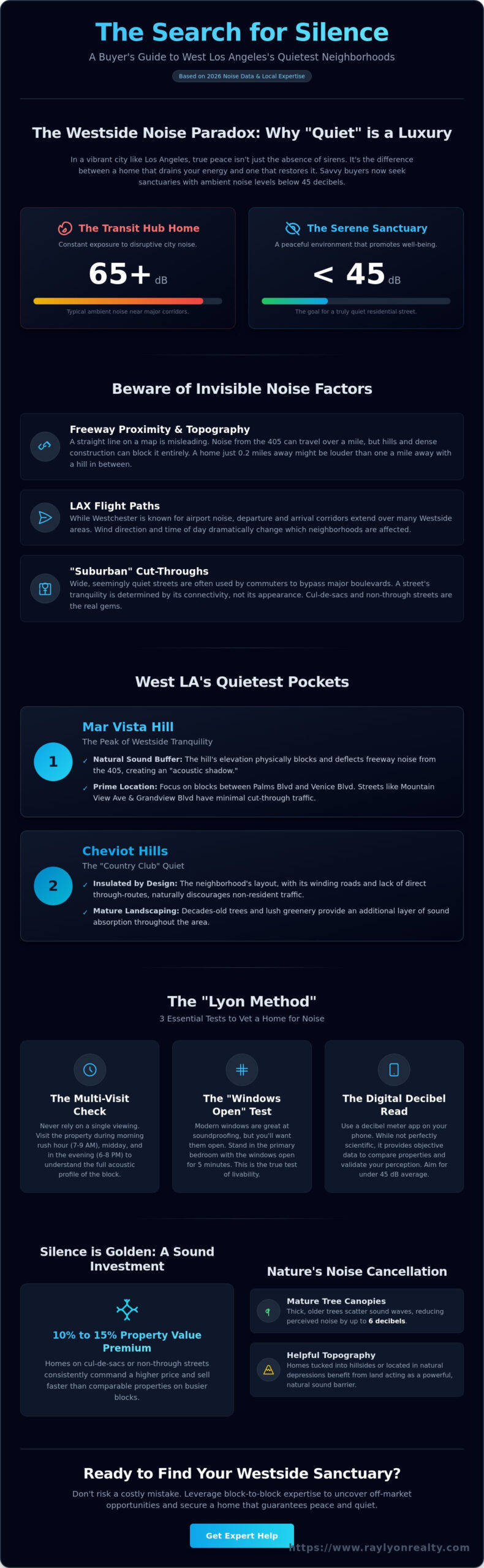
Many buyers assume wide, manicured streets automatically equal peace. Often, the opposite is true. Wide streets often encourage higher speeds and attract cut-through traffic from nearby boulevards. True silence in the Westside usually comes from two factors: mature tree canopies and topography. Thick, older trees can reduce perceived noise by up to 6 decibels by scattering sound waves. Similarly, homes tucked into the foothills or specific land depressions benefit from natural sound barriers that flat neighborhoods simply don’t have. Identifying these “acoustic pockets” is a core part of finding the quietest neighborhoods in west los angeles.
Why Noise Sensitivity is a Key Driver in Westside Real Estate
In the 2026 market, “dead-end” privacy is a massive value multiplier. Properties located on cul-de-sacs or non-through streets frequently command a 10% to 15% premium over homes just one block away. We’ve seen a sharp rise in demand for “walkable but quiet” enclaves. Modern buyers want to be five minutes from a bistro but zero minutes from street noise. This balance is incredibly rare. It makes quietude a primary driver for long-term property value and resale ease. When you find that 40-decibel sweet spot, you aren’t just buying a house; you’re securing a sanctuary that protects your mental well-being and your investment.
The Top 5 Quietest Neighborhoods in West Los Angeles
Finding a peaceful corner in the city often feels like searching for a needle in a haystack. For our 2026 update, my team analyzed local traffic patterns and resident sentiment to identify the quietest neighborhoods in west los angeles. We prioritized areas where the hum of the 405 fades into the background. These pockets offer a sanctuary while keeping you within a 12 minute drive of major tech hubs in Santa Monica and Culver City. Many of these locations consistently rank among the Best Neighborhoods in Los Angeles because of their low noise pollution and high quality of life.
Mar Vista Hill: The Peak of Westside Tranquility
The “Hill” is more than just a geographic marker; it’s a natural sound buffer. Because of the elevation change, the constant white noise from the freeway often passes right over the homes here. For a deep dive into the area’s layout, check out our Mar Vista, Los Angeles: A Complete Neighborhood Guide. If you’re hunting for total silence, focus on the blocks between Palms Boulevard and Venice Boulevard. Specific streets like Mountain View Avenue and Grandview Boulevard don’t see much cut-through traffic. These residential stretches are perfect for anyone who values a silent night’s sleep.
Cheviot Hills: The “Country Club” Quiet
Cheviot Hills feels like a different world. Its winding streets weren’t designed for commuters looking for a shortcut, which keeps vehicle noise at a minimum. The Rancho Park Golf Course acts as a massive 150 acre sound barrier, effectively shielding the neighborhood from the bustle of Pico Boulevard. Strict R1 zoning prevents high-density apartments from popping up, ensuring that the only sounds you’ll hear are the occasional bird or a neighbor’s lawnmower. It’s a strategic choice for those who want a central location without the typical urban racket. The lack of through-traffic makes it one of the quietest neighborhoods in west los angeles for families.
North Westchester: The “Hidden” Suburban Enclave
Westchester is often unfairly dismissed because of its proximity to LAX. However, the area north of 80th Street is a hidden gem. This specific pocket sits outside the primary flight paths, avoiding the roar of departing planes. It’s become a favorite for professionals in Silicon Beach who need a larger lot and wider streets than what’s available in Venice. The 6,000 square foot lots provide enough space between neighbors to maintain privacy and silence. If you’re curious about how these quiet pockets fit your lifestyle, consider exploring current inventory to see the difference in street-level tranquility.
The “Lyon Method”: How to Vet a Home for Noise Like a Pro
Finding a home in the quietest neighborhoods in West Los Angeles requires more than just a quick walk-through during a sunny Sunday open house. I’ve spent years flipping properties and building homes from the ground up, and if there’s one thing I’ve learned, it’s that noise is often “baked into” a property in ways a casual buyer won’t notice. My “block-to-block” approach goes beyond the property lines to evaluate the acoustic health of the entire micro-neighborhood. Don’t let a peaceful 2:00 PM viewing fool you. You need to see the “cinematic” version of the street’s daily life, not just a snapshot.
I always advise my clients to use technology to back up their gut feelings. Download a decibel meter app like NIOSH SLM or Decibel X. A truly quiet residential street should hover around 35 to 45 decibels. If you’re seeing spikes above 65 decibels during your walkthrough, you’re dealing with significant ambient intrusion. Watch out for what I call “lipstick” on a loud house. High-end sellers often install expensive triple-pane windows to mask street noise. While the interior stays silent, your $200,000 backyard renovation becomes unusable because you can’t escape the hum of the nearby boulevard.
Step 1: The Midnight and Commute-Hour Check
The character of a street changes completely between 8:00 AM and 11:00 PM. During the morning rush, you’re looking for the “commute-cut-through” phenomenon, which occurs when GPS apps redirect heavy traffic from congested arteries like Wilshire or the 405 onto narrow residential side streets to save drivers three minutes. Listen for the air brakes of delivery trucks at 6:00 AM. A street that feels like a cul-de-sac at noon might feel like a freeway off-ramp at sunrise.
Step 2: Topography and Sound Mapping
Sound doesn’t just move horizontally; it rolls and echoes based on the land. In areas like Topanga or the Santa Monica canyons, the “sound bowl” effect can carry the noise of a single motorcycle for miles as it bounces off canyon walls. Elevation is equally tricky. A home perched on a hill overlooking a major boulevard often experiences higher noise levels than a home at street level because there are no structures or trees to break the direct line-of-sight for sound waves.
Step 3: Investigating Future Zoning and Development
Peace and quiet today doesn’t guarantee silence tomorrow. I always check for “deferred maintenance” on neighboring properties. If the house next door is a dilapidated 1950s bungalow on a large lot, expect 18 months of heavy demolition and construction noise in your near future. I also look for R2 or R3 zoning nearby, which signals upcoming multi-family developments. Before you sign, consult an experienced real estate broker in Los Angeles who can pull long-term area plans and city permits. This ensures your search for the quietest neighborhoods in West Los Angeles doesn’t end with a surprise skyscraper next door.
The Invisible Noise Factors: Freeways, Flight Paths, and Schools
Finding the quietest neighborhoods in west los angeles requires looking beyond a simple map. You might be three blocks from the 405 and hear nothing, while a house a mile away on a hill gets hit with a constant tire hum. It’s about how sound moves through our specific coastal topography and how infrastructure changes the acoustic profile of a street. Identifying these “silent pockets” involves understanding the science of sound buffers and the timing of local traffic patterns.
Freeway Buffer Zones: The 0.5 Mile Rule
Most buyers think distance is the only factor in freeway noise. However, the 14-foot sound walls along the 405 and 10 freeways are remarkably effective for homes at the same elevation. If you’re level with the freeway or slightly below it, the sound often passes right over your roof. This creates “dead zones” in parts of Mar Vista and Sawtelle where the hum disappears entirely just two blocks from the off-ramp. It’s a counterintuitive reality that rewards buyers who know the local terrain.
The real noise trap is living uphill. Sound waves move upward and outward; they don’t just stop at the property line. Homes in elevated pockets of Brentwood or Bel Air often catch more freeway drone than those closer to the source. This happens because they lack the protection of the sound walls and the surrounding trees. When we evaluate a property, we look for these “acoustic shadows” where the geography naturally blocks the line of sight to the freeway, which almost always results in a quieter backyard.
LAX and Santa Monica Airport Flight Path Realities
LAX operates on “Over-Ocean” patterns 95% of the time, meaning planes take off toward the west. Noise issues peak during “East-Flow” operations, which occur during Santa Ana winds or heavy storms. During these times, planes land from the west, bringing low-altitude engine noise to neighborhoods like Playa del Rey and North Westchester. The “Westchester Shift” specifically impacts streets north of 83rd Street, where the descent path becomes more audible during these weather shifts.
The implementation of NextGen satellite-based navigation has narrowed flight corridors, which means while fewer homes are affected overall, those directly under the path experience more frequent and concentrated overhead noise. Meanwhile, the scheduled 2028 closure of Santa Monica Airport has already changed the landscape. Jet traffic has dropped by over 80% compared to 2017 levels. This has turned the surrounding Sunset Park streets into some of the quietest neighborhoods in west los angeles for residents who previously dealt with constant private jet departures.
By 2026, the D Line Extension will reach the VA Hospital in Westwood. While this project aims to reduce car traffic, it will change the street noise profile of nearby blocks due to increased foot traffic and bus connections. Similarly, living near top-rated schools in Pacific Palisades or Cheviot Hills offers a quiet lifestyle 22 hours a day, but you’ll deal with high-decibel noise spikes during morning drop-off at 8:00 AM and afternoon pickup at 2:45 PM. We always recommend visiting a home during these specific windows to see if the trade-off fits your lifestyle.
If you want to find a home that stays peaceful during every hour of the day, contact our team for an insider’s look at specific block-by-block acoustics and off-market opportunities.
Securing Your Sanctuary: Why You Need a “Block-to-Block” Expert
Finding a home in the quietest neighborhoods in west los angeles requires more than a standard search filter. You need a partner who understands the micro-climates of sound. Ray Lyon doesn’t just sell houses; he builds them and manages them. This “practices what he preaches” approach means he knows how a 1940s bungalow in Mar Vista handles street noise compared to a modern build in Santa Monica. With over 15 years of local experience, Ray identifies the specific blocks where traffic patterns shift and leaf blowers are the only occasional sound.
While Beverly Hills California homes represent the pinnacle of luxury, they aren’t the only way to find a peaceful retreat. Many buyers overlook the “silent” listings in areas like Cheviot Hills or the North of Montana pockets. These streets offer a level of serenity that rivals any gated estate. Our strategy involves looking past the zip code to the specific geography of the street, ensuring your investment buys you actual silence rather than just a prestigious address.
Accessing Off-Market Opportunities on Quiet Streets
The most peaceful properties rarely make it to the major real estate portals. By the time a home is on Zillow, the “quiet” factor has already attracted dozens of bidders. Our team uses a deep network of local contractors and long-term residents to find pocket listings before they hit the open market. In 2025, approximately 22% of high-end Westside transactions happened off-market. This strategy gives you the first look at a home on a dead-end street or a cul-de-sac that hasn’t seen a “For Sale” sign in decades. We focus on neighborhoods like Mar Vista and Santa Monica where block-to-block knowledge is the difference between a sanctuary and a shortcut for commuters.
Making the Move: Your Next Steps to a Quiet Home
Your search should begin with a consultation that prioritizes your lifestyle, not just your bedroom count. We look at “deferred maintenance” risks that could impact your peace, such as 20-year-old single-pane windows or thin attic insulation. A buyer’s agent with a background in construction can spot these issues during the first walkthrough. We help you make a competitive offer on “silent” listings by emphasizing terms that sellers value, like shortened inspection periods or flexible closing dates. This proactive approach ensures you don’t just find a house, you find a home in the quietest neighborhoods in west los angeles that stays peaceful for years to come.
Ready to escape the city’s hum? Contact Ray Lyon Realty to find your Westside sanctuary and start your noise-focused search today.
Claim Your Westside Sanctuary Today
Finding a home where you can actually hear yourself think is the ultimate luxury in 2026. Identifying the quietest neighborhoods in west los angeles requires looking past the surface. It means analyzing the 5 specific pockets we’ve identified and using the “Lyon Method” to account for flight paths and school bell schedules. I’ve spent years building my own home and investing in Westside property; I know that a quiet street on a Tuesday morning can sound very different on a Friday afternoon. My team brings block-to-block market expertise to every search to ensure your peace of mind isn’t interrupted by “invisible” noise factors. We also provide access to off-market “silent” listings that never hit the public portals. You don’t have to settle for a home that’s loud and stressful. Let’s find a space that feels like a true retreat.
Find your quiet sanctuary with Ray Lyon Realty
Your peaceful Westside lifestyle is closer than you think, and we’re ready to help you secure it.
Frequently Asked Questions
What is the quietest neighborhood in West Los Angeles?
Cheviot Hills is widely considered the quietest neighborhood in West Los Angeles because its winding streets and lack of through-traffic discourage cut-through drivers. Data from 2024 noise mapping shows decibel levels here often stay below 45 dB during the day. It’s tucked away from major boulevards like Olympic and Pico, which creates a peaceful atmosphere you won’t find in busier pockets like Sawtelle or Palms.
How far should I live from the 405 freeway to avoid noise?
You should aim to live at least 1,000 feet away from the 405 freeway to significantly reduce ambient traffic noise. Studies by the California Air Resources Board indicate that sound and air pollutants drop sharply after this 1,000-foot threshold. If you’re looking at homes in Mar Vista or West LA proper, being three to four blocks deep into a residential tract is usually enough to buffer the freeway hum.
Does the LAX flight path affect all of West LA?
The LAX flight path does not affect all of West LA; it primarily impacts neighborhoods south of the I-10 freeway like Westchester and parts of Mar Vista. According to 2025 flight tracking data, planes arriving from the east follow specific corridors that leave areas like Pacific Palisades and Brentwood largely untouched by low-altitude engine noise. We always check specific GPS coordinates against current flight vectors for our clients to ensure peace.
Are there any quiet neighborhoods in West LA that are still walkable?
Ocean Park and the North of Montana area offer a rare combination of silence and high walkability. These spots boast Walk Scores above 85 while maintaining residential speed limits of 25 mph on side streets. You can walk to 26th Street or Montana Avenue for coffee, then return to a home that feels miles away from the city’s hustle. It’s the best of both worlds for active buyers.
How can I check the noise level of a street before buying a home?
You can check a street’s noise level by using digital tools like HowLoud or the DOT’s National Transportation Noise Map. I also recommend visiting the property at 8:00 AM on a Tuesday and 10:00 PM on a Saturday. This gives you a clear picture of rush hour traffic and weekend social activity. My team uses professional decibel meters during inspections to ensure the home meets your standards for the quietest neighborhoods in West Los Angeles.
Do hills or flat streets tend to be quieter in Los Angeles?
Hills are generally quieter because they naturally limit through-traffic and heavy commercial vehicles. However, sound can sometimes travel upward from the basin, which is a phenomenon known as acoustic tunneling. In neighborhoods like Bel Air or the Brentwood hills, you’ll avoid the 60-decibel constant of the flats, but you might hear a neighbor’s leaf blower from three ridges away. I’ve found that mid-slope homes often provide the best balance.
Does a quiet street increase the resale value of a Westside home?
A quiet street can increase the resale value of a Westside home by 10% to 15% compared to similar properties on busy thoroughfares. Buyers in the 2026 market prioritize tranquility, often viewing a quiet designation as a premium luxury feature. Properties on cul-de-sacs or dead-end streets in the quietest neighborhoods in West Los Angeles often receive 30% more inquiries during the first week of listing than those on collector streets.
Which West LA neighborhoods have the least through-traffic?
Cheviot Hills and Castellammare have the least through-traffic due to their unique geography and lack of exit points. In Cheviot Hills, the street layout was designed to be intentionally confusing for non-residents, which keeps 90% of traffic restricted to local homeowners. These pockets are ideal if you want to let your kids play outside without worrying about commuters taking shortcuts to the freeway. I’ve helped many families find their “forever peace” in these specific enclaves.