

What if the most difficult part of moving isn’t the 6.37% mortgage rate or the new digital image disclosures under AB 723, but the heavy feeling in your chest when a stranger critiques your living room? The emotional stress of selling a home often stems from a sense of vulnerability, especially when you’ve spent years building a life in a tight-knit Westside LA community. It’s natural to feel exposed during open houses or lose sleep wondering if you missed the absolute peak of the market. You aren’t just selling a piece of real estate. You’re closing a significant chapter of your life.
We understand that the anxiety of leaving your neighbors and the pressure to hit that $1,025,000 median price point can feel overwhelming. This guide will show you how to master the psychology of letting go and provide practical strategies to navigate these hurdles with confidence. We’ll explore how to frame this as a strategic business transition. This approach ensures you achieve emotional closure and a predictable transaction while keeping your 2026 goals on track. By the end, you’ll have the tools to move forward without leaving money on the table.
Key Takeaways
- Understand why selling a home ranks as a top-tier life stressor and how the “Endowment Effect” can skew your perspective on market value.
- Learn practical techniques to manage the emotional stress of selling a home in the high-pressure “fishbowl” of Westside LA neighborhoods.
- Discover why early depersonalization and setting “control boundaries” are essential for detaching from your property before the first showing.
- Identify how strategic preparation and minor “lipstick” upgrades give you a sense of agency and prevent surprise negotiation friction.
- Find out how a strategic partner acts as an emotional firewall to filter out negativity while leveraging block-to-block knowledge to secure top dollar.
Why Is the Emotional Stress of Selling a Home So Intense?
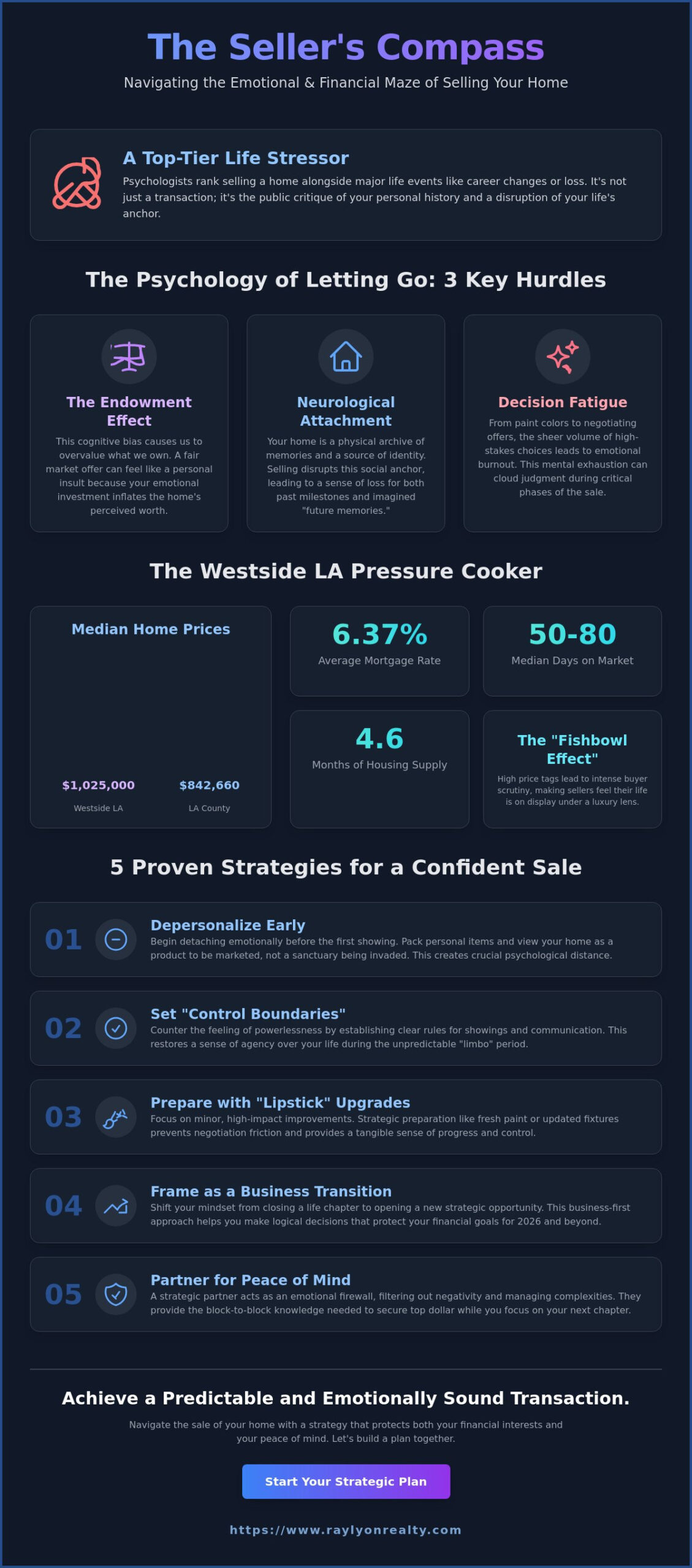
Psychologists often categorize selling a home alongside major life events like career changes or the loss of a loved one. It isn’t just about the logistics of packing boxes or signing contracts. The emotional stress of selling a home is rooted in the fact that your property is more than an asset; it’s a physical archive of your family’s history. Every scratch on the hardwood floor or height mark on a doorframe represents a milestone. When you decide to sell, you aren’t just trading equity. You’re effectively putting your personal history on the open market for public critique.
One reason this process feels so personal is a psychological phenomenon called the Endowment Effect. This bias causes us to naturally overvalue things we own simply because they belong to us. In the 2026 Los Angeles market, where the median sale price for the county sits around $842,660, this effect can lead to friction. You might feel personally insulted by an offer that is objectively fair. This emotional weight makes it difficult to view the transaction as the business transition it needs to be, often leading to unnecessary tension during negotiations.
To help you visualize these emotional cycles, watch this breakdown of the psychological journey sellers often experience:
The “limbo” state between listing your home and the final closing date creates a profound lack of control. You’re living in a space that no longer feels entirely yours, yet you’re responsible for its pristine condition for every showing. This period of uncertainty can trigger high levels of anxiety as you wait for buyer feedback or appraisal results, wondering if the next person through the door will value the home as much as you do.
The Psychology of Attachment
Home attachment is a neurological connection to one’s environment that provides a sense of security and identity. Leaving a long-term residence often involves mourning “future memories,” which are the plans and milestones you imagined happening in that space. You might feel a sense of guilt for “abandoning” a neighborhood where you’ve built deep community ties. This isn’t just sentimentality; it’s a disruption of your social anchor, making the departure feel like a loss rather than a gain.
Decision Fatigue in the Selling Process
The selling process requires hundreds of small, high-stakes choices. From selecting the right neutral paint color to addressing “deferred maintenance” items identified in a pre-inspection, the sheer volume of tasks leads to emotional burnout. You also face the anxiety of the “unknown buyer.” It’s common to worry about how strangers will judge your personal taste or whether they’ll appreciate the custom details you’ve added over the years. This fatigue can cloud your judgment, which is why the emotional stress of selling a home is best managed with a clear, strategic plan.
Navigating Stressors Specific to the Los Angeles Market
Selling a property in Los Angeles isn’t just a financial challenge; it’s a high-stakes performance. In neighborhoods where median home prices often range from $842,660 to $1,025,000, buyer expectations are incredibly high. This creates the “Fishbowl Effect,” where sellers feel like every detail of their private life is being scrutinized under a luxury lens. The emotional stress of selling a home in this environment often stems from the pressure to present a flawless lifestyle that matches the premium price tag.
Multiple offers might sound like a win, but they frequently lead to “Bidding War Burnout.” Juggling six or seven offers involves navigating complex appraisal and loan contingencies that can feel like a minefield. Even though the median time on market in Los Angeles is currently 50 to 80 days, many local sellers experience a unique sense of panic if they don’t see a “Sold” sign within the first 14 days. This perceived lack of velocity can trigger an unnecessary “fire sale” mentality, even when the market remains balanced with 4.6 months of housing supply.
The Westside Pressure Cooker
The sheer cost of real estate in Santa Monica amplifies the fear of making a strategic mistake. Sellers here must differentiate between serious luxury buyers and “looky-loos” who are simply curious neighbors. This constant stream of foot traffic through your personal space can be exhausting, especially when you’re trying to maintain a “show-ready” home while living your daily life.
Inventory Anxiety in Mar Vista and Venice
In neighborhoods like Mar Vista, Los Angeles, many homeowners feel “trapped” by their own success. While their property value has grown significantly, the low inventory of replacement homes makes the next step feel uncertain. The fear of selling your current home only to be priced out of your own community is a heavy emotional burden that prevents many people from moving forward.
Complex transactions like Trust Sales or 1031 exchanges add even more weight to the process. A Trust Sale often involves the grief of losing a family member, while a 1031 exchange brings the intense pressure of federal tax deadlines. If these moving parts feel overwhelming, you might find it helpful to connect with a professional who knows how to manage the logistical heavy lifting so you can focus on your family’s next chapter.
5 Proven Ways to Manage the Emotional Toll of Your Move
While the average 30-year fixed mortgage rate sits at 6.37% as of May 2026, the internal “emotional rate” you pay during a sale is often much higher. To protect your peace of mind, you need a strategy that goes beyond just hiring a mover. Managing the emotional stress of selling a home requires a shift in how you perceive your space and your role in the transaction.
- Depersonalize Early: Start packing away family photos and heirlooms before the house hits the market. This isn’t just a staging trick for buyers; it’s a psychological tool to help you detach. When you see bare walls, you begin to view the property as a structure rather than a collection of memories.
- Set a “Control Boundary”: You can’t influence the 4.6 months of housing supply or the Federal Reserve’s next move. Focus strictly on what you can control, such as the cleanliness of the home, the timing of your “lipstick” upgrades, and your responsiveness to offers.
- Establish a “Showing Sanctuary”: Create a go-to plan for when you need to vacate for a last-minute tour. Whether it’s a favorite cafe in Venice or a walk on the Santa Monica Pier, having a pre-set destination reduces the “eviction” feeling that often triggers anxiety.
- Script Your “Why”: Write down a clear, positive reason for your move. When you feel the pang of regret, read this script. Focusing on the goal, like being closer to family or downsizing for retirement, prevents the second-guessing that leads to seller’s remorse.
- Adopt the “Business Frame”: At Ray Lyon Realty, we help clients view their home as a high-value asset. By treating the sale as a strategic business transition, you create a healthy distance between your identity and the property.
Creating an Emotional Buffer
Stop checking daily Zestimate updates or scrolling through local “sold” data every hour. These numbers fluctuate and often lead to unnecessary spikes in cortisol. Instead, create a “Memory Archive.” Take professional-quality photos of your home exactly as you loved living in it before you staged it for the public. This allows you to “keep” the home in your mind while you physically let it go.
Maintaining Routine Amidst the Chaos
Escrow is a marathon, not a sprint. Protect your non-negotiables like your gym schedule, family dinners, or your 8-hour sleep window. When communicating the move to children, stay focused on the “new adventure” rather than the “leaving behind.” Giving kids a specific task, like choosing the paint color for their new room, gives them a sense of agency and reduces family-wide tension. Keeping these anchors in place ensures that the emotional stress of selling a home doesn’t bleed into every other area of your life.
Strategic Preparation: How ‘Lipstick’ Reduces Anxiety
Strategic preparation is about regaining a sense of agency. When the market feels unpredictable, focusing on tangible improvements provides a psychological anchor. We often use the metaphor of putting “lipstick” on a property. These aren’t major structural overhauls. Instead, they are high-impact cosmetic updates like fresh paint, modern light fixtures, or updated landscaping. This proactive approach significantly reduces the emotional stress of selling a home because it transforms you from a passive observer into an active strategist.
Identifying “deferred maintenance” through a pre-inspection is another vital step for your peace of mind. Nothing spikes anxiety like a buyer discovering a roof leak or a foundation issue three days before the contingency period ends. By handling these repairs early, you eliminate the threat of surprise negotiations. A move-in-ready home attracts a different caliber of buyer. These individuals are typically less demanding and more decisive, which leads to a smoother, more predictable transaction.
Staging serves as a functional shield for your personal life. When a professional stager replaces your family’s favorite armchair with a curated piece, they’re creating a “model home” environment. This layer of separation protects your privacy. It makes it easier to witness strangers walking through the house because they are looking at a product, not your personal sanctuary. This mental shift is essential for achieving emotional closure before the final move.
The Power of the First Impression
Curb appeal is the ultimate antidote to “days on market” anxiety. In coastal California, first impressions happen at the sidewalk. High-impact lipstick items for Westside homes often include modern xeriscaping or replacing dated exterior lighting with sleek, contemporary fixtures. These small changes can be the difference between a home that sits for the 80-day median and one that triggers an immediate offer. When you see buyers reacting positively to your home’s exterior, it reinforces your confidence in the asking price.
Maximizing Value to Minimize Regret
To justify the emotional cost of leaving your community, you need to know you’ve secured top dollar. Leaving money on the table is a primary source of long-term seller’s remorse. Experienced real estate agents in los angeles ca handle the heavy lifting by coordinating a network of trusted contractors. This means you don’t have to spend your weekends managing painters or landscapers. If you’re ready to start this transition with a clear plan, contact us for a strategic home valuation to see which “lipstick” items will drive the highest return for your specific block.
Partnering for Peace: How the Right Realtor Absorbs the Weight
Selling a home is a full-time emotional job. You shouldn’t have to work that job alone. While the 6.37% mortgage rates of May 2026 create a specific financial context, the interpersonal friction of a transaction often causes the most wear and tear. A professional realtor doesn’t just list your property; they act as an emotional firewall. This means they filter out low-ball offers and “insulting” feedback from buyers before it ever reaches your ears. You stay focused on your move while your agent handles the noise.
The right partner replaces uncertainty with strategy through block-to-block knowledge. In a market with 4.6 months of housing supply, knowing exactly why a house three doors down sold for a premium is vital. This deep local insight eliminates the “what if” anxiety that keeps many sellers awake at night. When you have a clear roadmap based on real-time data, the emotional stress of selling a home begins to dissipate.
- Negotiation Mastery: Your agent handles the high-stakes drama of appraisal and loan contingencies. They know how to push back on unreasonable buyer requests without jeopardizing the deal.
- The Resource Network: If a pre-inspection reveals a leak or a broken HVAC, you don’t need a frantic Google search. You need access to a “black book” of vetted contractors who can prioritize your repairs.
- Strategic Buffering: By managing the timeline and expectations of the buyer’s side, your agent ensures you aren’t blindsided by last-minute demands.
What to Look for in a Supportive Partner
Patience and responsiveness are just as important as sales volume. You need someone who picks up the phone when you’re feeling the “bidding war burnout” we discussed earlier. Look for a realtor who “practices what they preach.” At Ray Lyon Realty, Ray’s personal experience building his own home and flipping investment properties gives him a unique perspective. He knows the emotional weight of a renovation and the stress of a closing because he’s been in your shoes many times.
The Ray Lyon Approach to Stress-Free Selling
We treat every client like our top priority to reduce transaction anxiety. Our commitment to transparency means you’ll always know where your escrow stands. We focus on “no-surprise” management, identifying potential hurdles before they become emotional crises. By providing a clear, business-framed strategy, we help you achieve the emotional closure you need to start your next chapter. Ready to move forward with confidence? Let’s discuss your home’s value today.
Move Toward Your Next Chapter with Confidence
Selling your home in a market with a $842,660 median price point is a major life transition. By setting firm “control boundaries” and using strategic “lipstick” to prepare your property, you transform the process from an emotional burden into a savvy business move. You’ve learned that detaching early and treating your home as a high-value asset are the keys to maintaining your peace of mind. The emotional stress of selling a home doesn’t have to define your experience when you have the right support in place.
Ray Lyon brings over 15 years of Westside LA expertise to every transaction. As specialists in Santa Monica, Mar Vista, and Venice, we provide dedicated support from the first listing appointment to the final closing signature. We handle the logistical heavy lifting and negotiation drama so you can stay present for your family. Start your stress-free selling journey with Ray Lyon Realty and let us turn your goals into a reality. You’ve built a beautiful life in your current home; now it’s time to build the next one with total confidence.
Frequently Asked Questions
Why is selling a house so emotionally draining?
Selling is draining because it involves a loss of security and a disruption of your social anchor. Psychologists rank it near the top of life stressors because your home is a physical archive of your personal history. The emotional stress of selling a home is often compounded by the “Endowment Effect,” which makes you feel that a critique of the property is a critique of your family’s lifestyle.
How do I detach myself emotionally from my home before selling?
You can detach by removing personal photos and heirlooms to break the neurological connection to your environment. Creating a “Memory Archive” with professional photos for your own keepsakes allows you to “keep” the home in your mind while letting the physical structure go. Adopting a “Business Frame” helps you view the property as a high-value asset rather than a personal sanctuary.
Is it normal to feel regret immediately after listing my home?
Yes, feeling regret is a common reaction to the vulnerability of the open market. Many sellers in 2026 worry they “missed the peak” or are leaving money on the table compared to previous years. This anxiety usually fades once you receive a solid offer that aligns with the $842,660 county median price, confirming that your decision was a strategic move for your future.
How can I manage the stress of constant showings with a family?
Managing showings requires a “Showing Sanctuary” plan and a predictable schedule. With homes in Los Angeles spending a median of 50 to 80 days on the market, it’s vital to protect your family’s “non-negotiables” like dinner and sleep. Giving children a specific task in the move can also reduce household tension during this high-intensity period of the emotional stress of selling a home.
What is the most stressful part of the home selling process?
Most sellers find the “limbo” state between listing and closing to be the most stressful phase. This period involves navigating complex appraisal and loan contingencies where the deal can feel fragile. The lack of control during this 30 to 60 day window can trigger significant anxiety, which is why having a strategic partner to manage the timeline is essential for your peace of mind.
How does a real estate agent help reduce the stress of selling?
An agent acts as an emotional firewall by filtering out low-ball offers and “insulting” buyer feedback. They use block-to-block knowledge to replace your uncertainty with a data-driven strategy. By coordinating contractors for “lipstick” repairs and managing the resource network, a dedicated realtor absorbs the logistical weight so you don’t have to manage every minor detail yourself.
Should I stay in the house while it’s on the market or move out first?
Moving out first offers maximum privacy and avoids the “Fishbowl Effect” of daily showings. However, staying in the house is often more practical for families. If you stay, focus on high-impact “lipstick” upgrades to keep the home “show-ready” with minimal effort. Your choice should balance your need for a predictable routine against the 4.6 months of inventory currently available.
How do I handle ‘low-ball’ offers without getting angry?
Treat every offer as a business data point rather than a personal statement. Remember that Los Angeles homes are currently selling for 99.46% of their asking price, so a low offer is often just a starting point for negotiation. Your agent should filter these “insulting” bids and present them as opportunities to counter-offer based on the $1,025,000 local market realities.