
What if the most expensive zip code in Los Angeles actually offered the best return on your daily happiness? It’s no secret that the cost of living in santa monica ca sits roughly 80 percent higher than the national average, a figure that often causes immediate sticker shock. You’ve likely spent hours scrolling through listings, feeling a mix of excitement and hesitation as you look at property values in neighborhoods like North of Montana or Ocean Park.
I understand the stress of managing California’s 10.25 percent sales tax and those unpredictable utility surges. This guide provides a transparent, block to block breakdown of your expected 2026 expenses, helping you identify which areas offer the best value for your specific goals. We’ll look at everything from median home prices to the monthly cost of local groceries, giving you a clear budget to determine if making the move is your next best strategic decision.
Key Takeaways
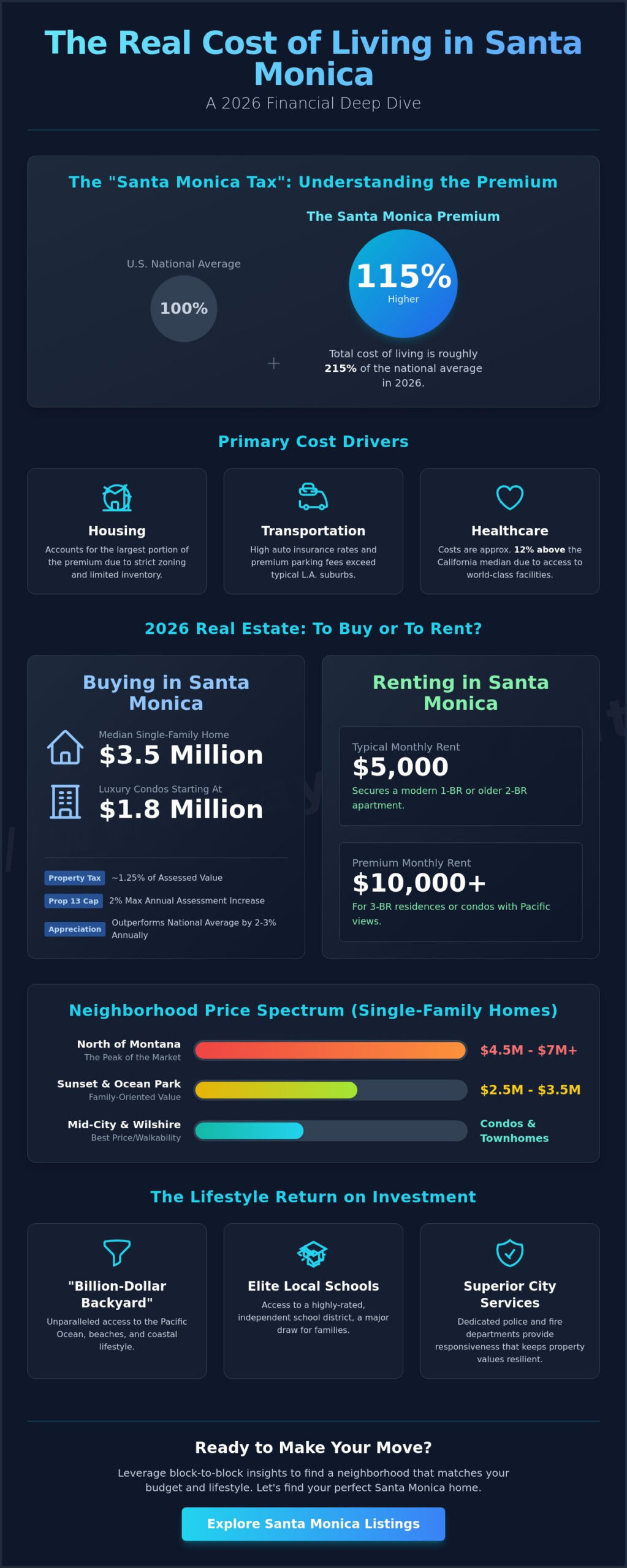
- Understand the “Santa Monica Tax” and how 2026 economic shifts have pushed local expenses to roughly 115% above the national average.
- Compare the financial realities of buying versus renting to see how the cost of living in santa monica ca fits your long-term investment goals.
- Get a realistic breakdown of daily overhead, from coastal utility impacts to pricing differences between luxury grocers and local farmers markets.
- Discover how to leverage the “billion-dollar backyard” of the Pacific and elite local schools to maximize your lifestyle return on investment.
- Learn the “block-to-block” insights needed to avoid hidden relocation fees and select a neighborhood that matches your budget and lifestyle.
Understanding the 2026 Santa Monica Cost of Living Premium
Living in this coastal gem comes with a price tag often referred to as the “Santa Monica Tax.” As of 2026, the cost of living in santa monica ca sits roughly 115% higher than the national average. I’ve watched this premium grow through my years of flipping houses and building local rentals here. It isn’t just a random spike. It’s the result of years of sustained demand for a lifestyle that’s hard to replicate elsewhere. The Santa Monica cost of living is a reflection of its limited coastal inventory and high-demand Silicon Beach proximity.
In 2026, we’re seeing the compounded effects of post-pandemic inflation and a localized housing shortage. While some national markets have stabilized, Santa Monica remains an outlier. The core expenses break down into three primary buckets:
- Housing: This accounts for the largest portion of the premium. Prices are driven by strict zoning and a total lack of new land.
- Transportation: While the city is walkable, owning a car involves high insurance rates and parking fees that often exceed those in most LA suburbs.
- Healthcare: Access to world-class facilities keeps local costs approximately 12% above the California median.
Santa Monica vs. The Rest of Los Angeles
Even compared to neighboring Santa Monica, California hotspots like Venice or Mar Vista, this city maintains a higher price floor. Residents pay more to stay within the city limits because of the independent school district and superior municipal services. While Mar Vista offers a bit more breathing room for your budget, Santa Monica’s dedicated police and fire departments provide a level of responsiveness that keeps property values resilient. You aren’t just paying for the beach; you’re paying for a better-managed infrastructure.
The “Silicon Beach” Effect on Local Prices
The tech boom didn’t just bring high-paying jobs; it reshaped the local economy. With giants like Google and Snap keeping a heavy presence in the area, the influx of high-earning professionals has pushed the cost of local services and dining to new heights. In 2026, market trends show that for every new tech hire in the area, local service costs rise by about 2%. This correlation ensures that the premium on real estate stays high. These buyers prioritize short commutes to their Silicon Beach offices over larger lots further inland, keeping the cost of living in santa monica ca at a permanent peak.
Santa Monica Real Estate: Buying vs. Renting in 2026
Deciding whether to buy or rent is the most significant factor affecting your cost of living in santa monica ca. By 2026, the median price for a single-family home has reached approximately $3.5 million, while luxury condos in prime buildings often start near $1.8 million. If you’re looking at the rental market, a monthly budget of $5,000 typically secures a modern one-bedroom apartment or a modest, older two-bedroom unit. Moving into the $10,000 range opens doors to premium three-bedroom residences or high-floor condos with unobstructed Pacific views.
California property taxes generally hover around 1.25% of the assessed value at the time of purchase. For long-term owners, Prop 13 remains a massive advantage; it caps annual assessment increases at just 2%, regardless of how much the home’s market value climbs. This stability makes Santa Monica real estate a “safe haven” asset. Even when the broader economy fluctuates, the combination of strict zoning laws and high demand keeps inventory low and prices resilient. You can see how these housing costs align with broader economic and demographic statistics to better understand the local landscape.
The Neighborhood Price Spectrum
- North of Montana: This is the peak of the local market. Entry-level listings here rarely dip below $4.5 million, with most renovated estates exceeding $7 million.
- Sunset Park and Ocean Park: These areas offer a family-oriented feel and relative value. You can often find charming single-family homes priced between $2.5 million and $3.5 million.
- Mid-City and Wilshire Montana: These neighborhoods offer the best balance of price and walkability. They are dominated by luxury townhomes and condos, making them popular for professionals who want to be near the cost of living in santa monica ca action without the $4 million price tag.
Investment Potential and Appreciation
Santa Monica has historically seen appreciation rates that outperform national averages by roughly 2% to 3% annually. While the entry price is high, the equity growth is consistent. Many of the best opportunities in 2026 don’t appear on the MLS. Utilizing off-market deals is a strategic way to secure a property without the stress of a public bidding war, often allowing buyers to acquire homes at more favorable terms. For a deeper analysis of current market trends, visit our Santa Monica Real Estate Guide.
If you want to see what’s currently available on the market, you can explore our featured properties to find a home that fits your lifestyle.
Daily Living Expenses: Utilities, Groceries, and Transport
Living by the ocean changes your monthly budget in surprising ways. While the cost of living in santa monica ca sits well above the national average, the coastal breeze acts as a natural air conditioner. Most residents in the 90401 or 90403 ZIP codes spend 15% less on cooling than those living just ten miles inland in the San Fernando Valley. However, water and trash services through the City of Santa Monica are premium. According to Payscale’s cost of living data for Santa Monica, utilities generally trend about 8% higher than the national median. You should also prepare for “hidden” local costs. Many restaurants now include a 4% to 5% healthcare surcharge on every check, a common practice in the city to support service staff benefits.
Food and Dining: From Farmers Markets to Fine Dining
Dining out is a central part of the local culture, but it requires a strategic budget. In 2026, a mid-range dinner for two at a spot along Main Street or Montana Avenue typically costs between $95 and $140, excluding cocktails. Smart residents balance these costs by utilizing the Santa Monica Farmers Market. Held on Wednesdays and Saturdays, it’s widely considered one of the best in the country. Buying seasonal produce directly from growers can save you roughly 20% compared to the premium prices at Erewhon or Whole Foods. It’s a simple way to eat like a chef while keeping your grocery bill under control.
Commuting and Connectivity
Santa Monica’s high Walk Score, often exceeding 90 in the downtown core, is a major financial asset. Living in a walkable pocket allows many residents to transition to a single-car household, saving thousands annually on insurance and maintenance. If you do drive, be ready for the “90401 tax” at the pump. Gas prices at stations near the 10 Freeway often run $0.50 higher per gallon than those in Culver City. Public transit offers a reliable and cheaper alternative:
- The Big Blue Bus: Local rides cost approximately $1.25, connecting you to UCLA and neighboring Westside areas.
- The Metro E Line: For $1.75, you can skip the 10 Freeway traffic and reach Downtown LA in about 50 minutes.
- Parking Permits: While beach parking for tourists can hit $30 a day, residents can secure annual neighborhood street permits for roughly $40 per vehicle.
Managing the cost of living in santa monica ca is about leveraging these local trade-offs. You might pay more for a gallon of milk or gas, but the savings from reduced HVAC use and high walkability often balance the scales for those who know how to navigate the city’s unique economy.
The Lifestyle ROI: Education, Health, and Amenities
Living in this coastal enclave involves a high price tag, but the return on investment extends far beyond your property line. The high cost of living in santa monica ca is partially offset by world-class public services and climate-related health benefits that few other cities can match. When you factor in the “free” luxuries provided by the city and the environment, the financial math starts to look much more attractive for long-term residents.
Education Value for Families
The Santa Monica-Malibu Unified School District (SMMUSD) serves as a primary driver for local property values. Many families move here specifically to access public schools that consistently rival elite private institutions. With 2024 data showing average private school tuition in Los Angeles exceeding $40,000 per year, a family with two children can effectively “save” $80,000 annually by utilizing the public system. This creates a significant financial cushion that helps justify a higher mortgage payment.
- Resale Stability: Homes within top-rated school boundaries, such as Franklin or Roosevelt Elementary, historically maintain their value even during market shifts.
- Public Investment: The city frequently passes bond measures to upgrade facilities, ensuring students have access to modern labs and athletic fields.
- Youth Programming: The CREST program provides affordable after-school childcare and enrichment, a service that often costs double in neighboring cities.
Health and Wellness as a Cost Offset
Santa Monica is often described as a “billion-dollar backyard.” The combination of the Pacific Ocean and over 20 city parks provides an environment where expensive club memberships become optional. The Santa Monica Stairs and the 22-mile beach path offer world-class cardio training for free. Because the coastal breeze creates a consistent onshore flow, the air quality here is often 20% to 30% better than the Los Angeles Basin average, leading to lower long-term healthcare costs and better respiratory health.
Access to specialized medical care is another pillar of the local ROI. You are within a five-mile radius of both UCLA Health and Providence Saint John’s Health Center. These facilities aren’t just local hospitals; they are global leaders in oncology, orthopedics, and cardiac care. Having this level of expertise nearby reduces travel time and stress during medical emergencies, providing a sense of security that is hard to quantify but easy to appreciate.
If you’re ready to find a home that puts these world-class amenities right at your doorstep, contact our team to start your search.
Strategic Planning: How to Move to Santa Monica in 2026
Relocating to the Westside is a significant financial undertaking that requires a detailed roadmap. You’ve got to look beyond the monthly mortgage or rent. Budgeting for the cost of living in santa monica ca involves calculating upfront expenses like security deposits, which were capped at one month’s rent by California Assembly Bill 12 in July 2024. Buyers should set aside 2% to 5% of the purchase price for closing costs. Hidden fees like specialized beach-zone insurance or city-mandated seismic retrofitting assessments can also surprise you if you aren’t prepared. It’s a financial marathon, not a sprint.
Success here depends on block-to-block knowledge. Santa Monica isn’t a monolith. A property three blocks from the Promenade feels entirely different than one tucked into the canyons of North of Montana. You need to know which streets get the ocean breeze and which ones get trapped in heavy commuter traffic. This granular insight ensures you’re paying for the lifestyle you actually want. I help clients identify these nuances so they don’t overpay for a location that doesn’t fit their daily routine.
Finding Value-Add Properties
I focus on identifying homes with “deferred maintenance.” These properties often have a lower entry price because they need a little love. We use the “lipstick on it” strategy to maximize your equity quickly. This involves making minor cosmetic changes, like updating hardware, painting, or refinishing floors, to drastically improve the home’s feel without a full gut renovation. I connect my clients with a trusted network of local contractors to get firm renovation quotes before the escrow period ends. You’ll know the exact cost of your vision before you sign the final papers.
Your Next Steps with Ray Lyon Realty
I’ve built my own home, flipped properties, and managed local rentals for years. I practice what I preach. This personal history means I can spot a structural red flag or a hidden gem that a standard agent might miss. My team focuses on finding off-market opportunities that never reach the public search engines, giving you a distinct advantage in a competitive 2026 market. We’re here to make your transition smooth and strategic. Contact us today to start your personalized Westside home search and navigate the cost of living in santa monica ca with confidence.
- Visit the street at 8:00 AM and 6:00 PM to test the true commute times and noise levels.
- Check the 2026 neighborhood crime statistics via the Santa Monica Police Department’s public data portal.
- Confirm the specific parking restrictions for your block, as many neighborhoods require annual permits.
- Request a 12-month history of utility costs to avoid seasonal price spikes in older buildings.
- Walk the local “walkability” route to ensure the nearest grocery store or park meets your standards.
Secure Your Future on the Westside
Mastering the cost of living in santa monica ca involves balancing the high entry price with the unmatched lifestyle returns. Data from the U.S. Census Bureau shows Santa Monica residents benefit from a median household income nearly double the national average, which supports the local economy’s resilience heading into 2026. While housing prices frequently exceed $1.7 million according to 2024 market reports, the real value lies in identifying specific neighborhood pockets that offer the best long term growth. You need a strategy that looks past the surface.
I bring deep block-to-block knowledge of the Westside market to every client. My personal experience in home building and property flipping means I can spot structural value where others only see paint. My team provides access to exclusive off-market deals and investment opportunities that give you a competitive edge in this tight market. Whether you’re buying a beach condo or a multi-unit investment, we have the local insight to guide your journey.
Start your Santa Monica home search with a local expert today. It’s time to turn your 2026 coastal dreams into a solid investment.
Frequently Asked Questions
Is it more expensive to live in Santa Monica or Beverly Hills?
Beverly Hills generally carries a higher price tag than Santa Monica, particularly when you look at luxury real estate. While the cost of living in santa monica ca is roughly 80% higher than the national average, Beverly Hills often exceeds this due to median home prices that frequently top $3.5 million. You’ll find that Santa Monica offers a more diverse range of housing options, though exclusive pockets like North of Montana rival any estate in the 90210 zip code.
What is a comfortable salary for a family of four in Santa Monica for 2026?
A family of four likely needs a household income of at least $225,000 to live comfortably in Santa Monica by 2026. This figure accounts for high mortgage or rent payments, which often consume 40% of a local family’s budget. After paying for childcare, which can average $2,500 per month per child, and groceries, this salary ensures you can enjoy local amenities without financial strain. It’s a high bar, but it reflects the reality of the coastal California lifestyle.
Are property taxes higher in Santa Monica than other parts of California?
Property taxes in Santa Monica follow the California Prop 13 base rate of 1%, but the total bill usually reaches about 1.2% after local assessments. This rate is consistent with other Los Angeles County cities like Culver City or West Hollywood. You’ll pay for specific local bonds that fund school improvements and city services. These assessments add roughly $1,200 to $2,000 to the annual bill for a median priced home in the area.
How much should I budget for utilities in a typical Santa Monica apartment?
Budget approximately $200 to $300 per month for utilities in a standard 900 square foot Santa Monica apartment. This estimate includes electricity, water, and trash services provided by Southern California Edison and the City of Santa Monica. If your unit lacks modern insulation or you run the air conditioning during the 20 days of peak summer heat, your costs might spike by 25%. Many residents save money because the ocean breeze reduces the need for constant climate control.
Does Santa Monica have its own school district, and is it free?
Santa Monica operates within the Santa Monica-Malibu Unified School District, and it’s a free public education system for residents. The district receives significant local funding through parcel taxes, allowing it to offer programs that many other California districts can’t afford. You won’t pay tuition, but most families contribute to the Santa Monica Education Foundation. This foundation raised over $2 million in 2023 to support staff positions and arts programs across all campuses.
What are the hidden costs of living near the beach in Santa Monica?
Corrosion from salt air is the most common hidden cost, often requiring you to replace outdoor fixtures or repaint every 3 to 5 years. You’ll also face higher insurance premiums due to the proximity to the coast and potential flood zones. Don’t forget the $20 to $150 annual fee for residential parking permits if your home doesn’t include a dedicated garage. These small expenses add up and are a standard part of the cost of living in santa monica ca.
Is it cheaper to rent or buy a home in Santa Monica right now?
Renting is currently more affordable on a monthly basis, as median mortgage payments often double the average rent for a similar unit. However, buying builds long term equity in a market where property values have historically increased by 5% annually. If you plan to stay for more than 7 years, our block to block knowledge suggests that purchasing provides a better hedge against inflation. We often help clients find off market deals to make the math even more favorable.
How does the cost of gas in Santa Monica compare to the rest of California?
Gas prices in Santa Monica typically run $0.30 to $0.50 higher per gallon than the California state average. Stations near the I-10 freeway or the beach often have the highest markups because of the convenience factor. To save money, many locals drive 3 miles inland to Costco or independent stations in West Los Angeles where prices are more competitive. It’s a small but noticeable difference that reflects the city’s premium location.