

In the high-stakes Westside LA market, a “nice” agent who fails to pick up the phone isn’t just an inconvenience; they’re a direct threat to your home equity. You’ve likely felt that nagging suspicion when a text goes unanswered for hours or when your agent seems more focused on the commission than the actual inspection results. It’s exhausting to feel ignored in a competitive market where timing is everything. You deserve to know if your lack of progress is due to the current negotiation market of 2026 or simply a subpar representative.
Learning how to spot a bad real estate agent is the first step toward reclaiming control of your home sale or purchase. With recent 2026 shifts like mandatory disclosures for AI-altered listing photos under AB 723 and new FinCEN reporting rules for all-cash deals, the margin for error has never been thinner. You need a strategic partner who understands these nuances, not a transaction-filler who ghosts you when things get complicated. This guide provides a clear checklist to validate your gut feeling and a roadmap to finding a truly strategic local expert. We’ll preview the seven critical red flags you must watch for to ensure a successful closing in Santa Monica or Mar Vista.
Key Takeaways
- Identify the “24-hour rule” for communication and why reactive updates are a major warning sign in a fast-moving market.
- Discover why deep local expertise in neighborhoods like Santa Monica and Mar Vista is non-negotiable for protecting your property value.
- Learn how to spot a bad real estate agent by recognizing high-pressure tactics and “commission breath” that prioritize a quick closing over your best interests.
- Evaluate the effectiveness of your agent’s digital marketing strategy to ensure your listing isn’t being held back by subpar presentation.
- Gain a clear roadmap for reviewing your representation agreement and professionally transitioning to a more strategic, results-oriented partner.
The Communication Gap: How to Tell if You’re Being Ghosted
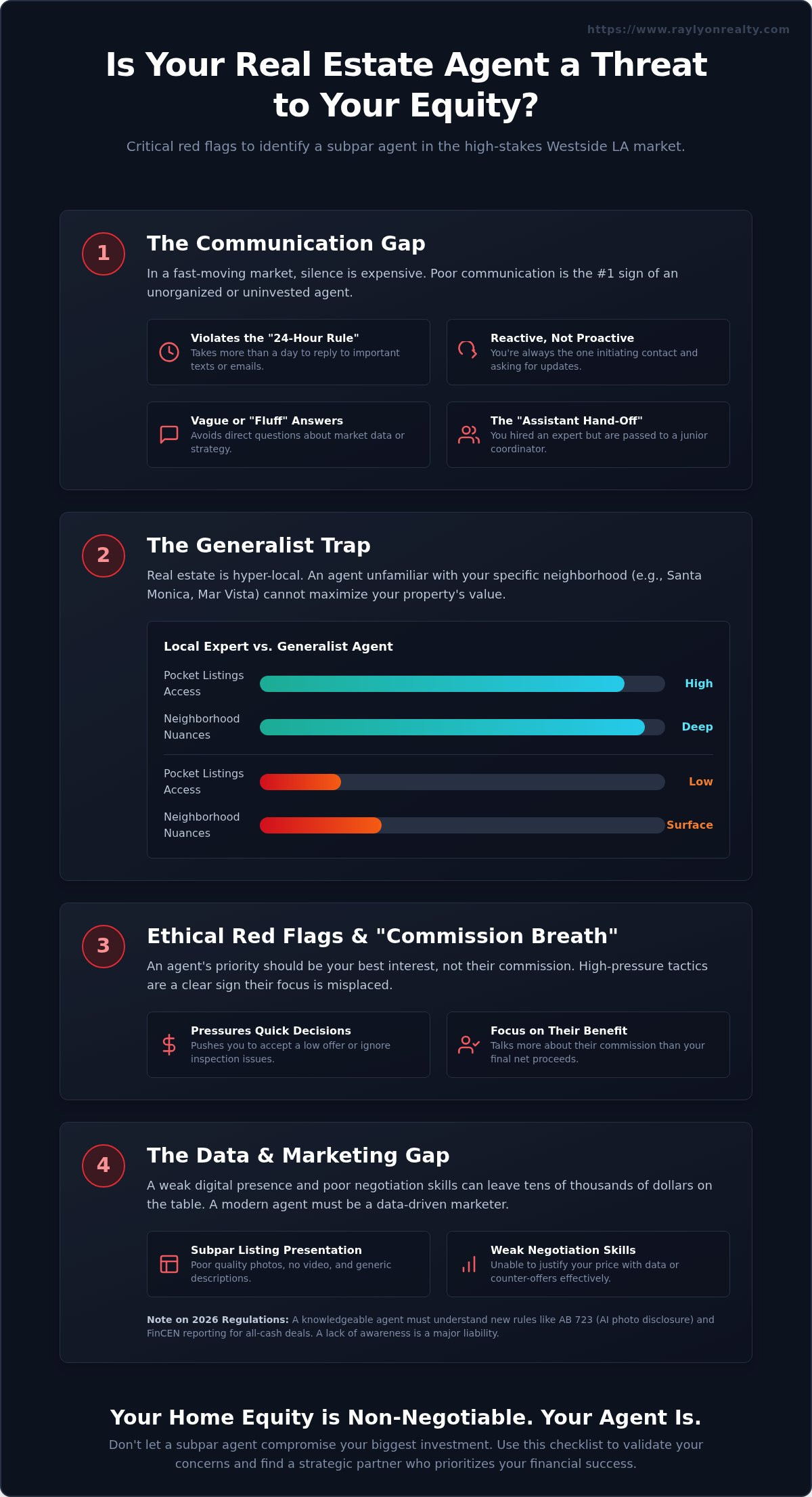
In the fast-paced Westside LA market, silence is more than just rude; it’s expensive. If you find yourself staring at a “read” receipt while a Santa Monica listing goes under contract, you’re experiencing a major warning sign. Understanding how to spot a bad real estate agent often starts with observing their response time. In a competitive environment, the 24-hour rule is the industry standard. If your agent takes longer than a day to reply to a simple query, they aren’t just busy; they’re failing to prioritize your equity.
Communication should be proactive rather than reactive. A strategic partner brings you news about off-market opportunities or shifts in Mar Vista pricing before you see them on a public portal. If you’re the one constantly sending links and asking for updates, your agent has become a passenger in your transaction. This lack of initiative often extends to the “assistant hand-off.” Many homeowners hire a high-profile listing agent only to find themselves relegated to a junior coordinator who lacks the lead agent’s experience. While a support team is helpful, you should never lose access to the strategic expert you actually hired.
Vague answers are another red flag. A professional should be able to explain exactly what a real estate agent does to protect your interests during a cooling market. If they avoid difficult data or give “fluff” answers about why a property isn’t selling, they likely lack the market depth required for a complex Westside move.
Benchmarks for Professional Responsiveness
Professionalism requires clear boundaries and consistent systems. You should establish preferred channels, whether it’s text, email, or phone, during your very first meeting. A top-tier listing agent provides a formal status report every Friday. This should detail showing feedback, digital marketing metrics, and any new local comps. Ghosting during active negotiations is the ultimate deal-killer. If an agent disappears when an offer is on the table, it shows a fundamental lack of respect for your financial outcome.
The Difference Between ‘Busy’ and ‘Unorganized’
Top producers are naturally busy, but a strategic professional uses systems to ensure no client feels like a secondary priority. If your agent seems spread too thin across too many zip codes, they might lack the granular focus needed for your specific street. Responsiveness is a direct reflection of negotiation energy. An agent who is too unorganized to return a text is likely too unorganized to catch a critical error in a 50-page disclosure package.
The Generalist Trap: Why Lack of Local Expertise Costs You Money
Hiring a “friend of a friend” who usually works in the San Fernando Valley to sell a Santa Monica condo is a classic mistake. Real estate is hyper-local. An agent who doesn’t live and breathe the Westside won’t have the necessary relationships with local brokers. These connections are often how deals get done before they even hit the MLS. If your representative can’t explain the specific school district boundaries or the impact of a new mixed-use development three blocks away, you’re likely working with a generalist. This is a primary way how to spot a bad real estate agent for your specific move. They might be licensed, but they aren’t experts in your specific zip code.
The Value of Granular Neighborhood Knowledge
A strategic agent understands that Mar Vista Los Angeles market trends often move independently from broader city stats. For instance, while the median home sales price in August 2026 saw a marginal 0.7% increase year-over-year nationally, specific pockets in Mar Vista might see much higher demand due to proximity to Silicon Beach. Local experts also navigate Coastal Commission hurdles that would baffle an out-of-area agent. They find “pocket listings” because they’re part of the local fabric. Following state consumer protection guidelines means ensuring your agent actually has the expertise they claim. If you want to maximize your ROI, it’s vital to work with a strategic Westside partner who knows every street corner.
Red Flags During the Property Tour
Watch your agent closely during a walkthrough. A bad agent acts like a tour guide, merely pointing out the kitchen or the “great light.” A strategic expert identifies neighborhood-specific drawbacks like upcoming construction projects or traffic patterns that peak during school drop-off hours. If they can’t answer basic questions about a home’s history or local zoning, it’s a sign they haven’t done their homework. Generic pricing strategies are another giveaway. If their valuation is based on a broad zip code average rather than a nuanced street-by-street analysis, they’re guessing with your money. You need someone who knows why one side of the street is worth 10% more than the other.
Ethical Red Flags and the ‘Commission Breath’ Symptom
“Commission breath” is a visceral term for a real problem. When an agent prioritizes their 2.76% to 2.9% cut over your long-term financial health, you’ve found a major red flag. This behavior often manifests as high-pressure tactics. If an agent pushes you to accept a lowball offer on your Santa Monica home or overpay for a Mar Vista fixer just to “get the deal done,” they’ve stopped being your advocate. Understanding how to spot a bad real estate agent involves recognizing when your representative is more interested in their next paycheck than your property equity.
Dual agency is another ethical minefield. While legal if disclosed, it’s difficult for one person to truly represent the best interests of both the buyer and the seller. A strategic partner should also be transparent about vendor referrals. If they’re pushing a specific inspector or contractor without disclosing a history of kickbacks, their advice is compromised. You deserve an agent who listens to your “must-haves” instead of steering you toward properties that are simply easier for them to sell. This lack of transparency is a critical signal when you’re learning how to spot a bad real estate agent.
Spotting the Salesperson vs. the Consultant
You want a consultant, not a cheerleader. A “Yes Man” who agrees with an unrealistic listing price or ignores a visible foundation crack is dangerous. Top-tier real estate agents in los angeles ca should use hard market data to challenge your assumptions. They prioritize your long-term ROI over a quick closing. If your agent seems more worried about their personal brand than your net proceeds, their priorities are skewed. A strategic expert provides the “cold hard truth” because that’s what protects your investment.
Contractual and Disclosure Red Flags
The paperwork phase is where subpar agents hide their tracks. Rushing you through a Residential Listing Agreement without explaining the fine print is a massive warning sign. They should meticulously walk you through the Transfer Disclosure Statement (TDS) to ensure you aren’t exposed to future litigation. Under the REALTORS® Code of Ethics, agents have a fiduciary duty to protect and promote your interests. Glossing over contingencies or failing to explain how the 2024 NAR settlement affects your negotiation leverage is a breach of that trust. A strategic partner makes sure you understand every clause before the pen hits the paper.
The Data Gap: Poor Marketing and Weak Negotiation Skills
Marketing isn’t just about making a property look pretty; it’s about maximizing reach and controlling the narrative. If you see grainy cell phone photos or an “ALL CAPS” description that looks like a frantic text message, you’ve found a lazy listing agent. This “post and pray” method relies entirely on the MLS to do the heavy lifting. In 2026, Westside buyers expect an immersive digital experience, a standard often set by premier luxury agencies like King Estates. They want to see the lifestyle, not just the floor plan, before they even request a showing.
Professional staging and high-end media are non-negotiable for high-value assets like Beverly Hills California homes. If your agent tries to cut corners here, they’re directly sacrificing your final sale price. You should also check their average “Days on Market” (DOM). If their listings consistently sit longer than the neighborhood mean, it’s a sign that their presentation or pricing strategy is missing the mark. A truly strategic partner uses custom property websites and social media targeting to ensure your home is seen by the right demographic, not just the general public.
Signs of a Weak Negotiator
Negotiation is where the real money is made or lost. A major sign of how to spot a bad real estate agent is when they leak your motivation or “bottom line” to the other side. Statements like “my clients are in a hurry to move” give away your leverage immediately. A strategic advisor should be able to justify every counter-offer with data. If they fold quickly on repair requests or closing credits without a fight, they’re prioritizing a smooth closing over your financial outcome. You deserve a results-driven listing specialist who treats your equity as if it were their own.
Transitioning to a Strategic Real Estate Partner
Once you’ve identified the warning signs, staying in a stagnant contract is a choice that directly impacts your home equity. You don’t necessarily have to wait for your listing to expire to find better representation. Understanding how to spot a bad real estate agent is only half the battle; the other half is knowing how to exit the relationship professionally. Start by reviewing your representation agreement for termination clauses. Many contracts allow for cancellation if specific duties aren’t met, or they may require a simple “Notice of Termination” to the brokerage’s manager of record.
If you’re unsure about firing them immediately, hold a “Come to Jesus” meeting. Be direct about your concerns regarding communication gaps or poor marketing. Give them 48 hours to present a corrected course of action. If they can’t provide a data-backed pivot, request a formal release from the brokerage. Most reputable firms would rather release a dissatisfied client than risk a negative public review or a formal complaint. This transition is your opportunity to pivot toward a partner who views your move as a strategic investment rather than a quick commission.
The Strategic Interview Checklist
When you interview your next representative, move beyond the generic “how many homes have you sold” questions. Use this checklist to ensure a better fit:
- Request a neighborhood-specific marketing plan: Generic slide decks that look like they were designed a decade ago won’t cut it. They should show you exactly how they will target buyers for your specific street.
- Ask for negotiation case studies: Don’t just settle for a high sales volume. Ask for examples of difficult inspections or appraisal gaps they successfully navigated in the last six months.
- Inquire about personal investment experience: An agent who has personally renovated properties or managed their own investments understands the risks you’re taking. You want a partner who practices what they preach.
Why Ray Lyon Realty is the Strategic Alternative
Ray Lyon Realty offers a departure from the “post and pray” method used by generalists. Our focus remains hyper-local, with deep roots in Westside LA neighborhoods like Santa Monica and Venice. We provide the “Insider Advantage,” which includes a granular understanding of local zoning and access to off-market opportunities that never hit the public portals. We don’t just act as salespeople; we act as strategic advisors who prioritize your long-term ROI. If you’ve realized your current representation is falling short, it’s time to work with a realtor who prioritizes your strategy over the sale.
Securing Your Westside Legacy with Strategic Representation
Your real estate journey in Westside LA is too significant to leave to chance or subpar representation. The critical markers of professional failure, from the “ghosting” red flag to the financial drain of hiring an out-of-area generalist, are now clear. By understanding how to spot a bad real estate agent, you’ve equipped yourself to protect your home equity and navigate the 2026 market with total confidence. Reactive communication and weak marketing aren’t just annoyances; they’re direct threats to your financial outcome.
You deserve more than a transaction-filler. You need a strategic advisor who understands the nuances of Santa Monica and Mar Vista because they’ve personally renovated and invested in these very neighborhoods. At Ray Lyon Realty, we combine this hands-on investment background with an empathetic, client-first approach to ensure your closing is as stress-free as possible. It’s time to trade reactive service for proactive expertise and localized insight.
Experience the Strategic Difference with Ray Lyon Realty and let’s turn your next move into a calculated success. You’ve got the tools to identify the wrong fit; now it’s time to choose the right one for your future.
Frequently Asked Questions
Can I fire my real estate agent if I already signed a contract?
You can fire your agent after signing a contract, but you must first review the termination clauses within your specific representation agreement. Most agreements include provisions for cancellation if the agent fails to fulfill their fiduciary duties. If your representative is unresponsive or unprofessional, you should contact their managing broker directly to request a formal release. It is often better for a brokerage to part ways amicably than to force a relationship with a dissatisfied client.
How do I tell my realtor I’m not happy with their service?
Schedule a formal meeting to discuss your concerns directly rather than relying on a quick text. Be specific about the gaps in service, such as a lack of weekly status reports or missed communication benchmarks. Professional agents appreciate clear feedback and may offer a strategic pivot to correct the course. If they cannot provide a concrete plan to address your dissatisfaction, it serves as a clear indicator of how to spot a bad real estate agent.
What should I do if my agent isn’t answering my texts or calls?
Communication is a fundamental duty of any licensed professional. If your agent is ghosting you, send a final notice of concern via email to create a paper trail. State your expectation for a response within a specific timeframe, such as four business hours. If they fail to meet this deadline, escalate the issue to their brokerage’s manager. Consistent silence in a competitive market like Santa Monica is a major red flag that requires immediate action.
Is it a red flag if my agent suggests a lower price than I expected?
A lower price suggestion isn’t always a red flag if it is supported by granular local market data. A strategic advisor will show you recent comparable sales and current inventory trends to justify their valuation. However, if they push for a price drop without a data-backed explanation, they might be looking for a quick commission. You need an expert who prioritizes your long-term ROI over a fast, undervalued sale in neighborhoods like Mar Vista.
How many homes should a good buyer’s agent show me before I find ‘the one’?
How many homes should a good buyer’s agent show me before I find ‘the one’?
There is no magic number of homes to see, but a strategic agent focuses on quality over quantity. They should curate listings that align with your specific must-haves rather than showing you everything on the market. If you’ve toured dozens of properties that don’t fit your criteria, your agent likely isn’t listening to your needs. A knowledgeable Westside expert uses their network to find off-market opportunities that match your strategic goals more efficiently; for instance, you can learn more about Robert Caicedo Real Estate to see how curated residential property searches are managed.
Subpar marketing is easy to spot through grainy cell phone photography or listing descriptions written in all caps. In 2026, a professional strategy must include high-end media, professional staging, and targeted social media ads. If your home’s Days on Market is significantly higher than the neighborhood average without a clear explanation, your agent’s presentation is likely failing. You deserve a custom digital strategy that reaches buyers where they actually search, ensuring maximum property exposure.
Should I work with a part-time real estate agent?
Working with a part-time agent is risky in a high-velocity market like Los Angeles. Real estate requires full-time attention to track off-market deals and respond to time-sensitive negotiation hurdles. A part-time representative might be unavailable during critical business hours, which can lead to missed opportunities or costly delays. You are better served by a dedicated professional who lives and breathes the local market, ensuring your transaction remains a top priority at every stage of the process.
How do I find out if a real estate agent has had disciplinary actions?
You can verify an agent’s standing by visiting the California Department of Real Estate website. Use their public license lookup tool to check for any past disciplinary actions, suspensions, or revocations. This transparency is vital for consumer protection. Reviewing an agent’s license history is a practical step in learning how to spot a bad real estate agent before you sign a binding agreement. Always ensure your representative’s license is active and in good standing.