
Selling a home after a divorce in California doesn’t always mean putting it on the market. Spouses may sell, arrange a buyout, delay the sale, or balance the home’s value against other assets. While a divorce is pending, they need an agreement or court order before selling the home.
It’s understandable if the decision feels bigger than a real estate transaction. The home may represent equity, ongoing expenses, and a place one spouse hopes to keep. The right option depends on what you can agree on and how each choice affects your finances and plans.
This guide explains how selling, buying out a spouse, delaying a sale, and balancing assets work, including California rules that may affect the decision. You’ll also learn what to consider when both spouses are involved in a sale, so you can approach the next conversation with a clearer view of your options.
Key Takeaways
- Understand how California community-property rules may affect each spouse’s interest in the home.
- Compare selling, a spouse buyout, a delayed sale, and offsetting the home with other assets.
- Consider how the sale timeline and tax treatment could shape the decision to sell or keep the property.
- Choose an agent who can communicate clearly with both co-sellers and keep the transaction moving toward shared decisions.
Who is the right real estate agent to handle a divorce home sale in Los Angeles?
A Santa Monica and greater Los Angeles divorce sale calls for an agent who can coordinate communication between co-sellers and keep decisions documented. Look for clear explanations of pricing, buyer offers, marketing, and transaction milestones. These are real estate matters; a family law attorney can advise on legal rights and settlement terms. That distinction matters when the sale is complex and both spouses need a workable outcome.
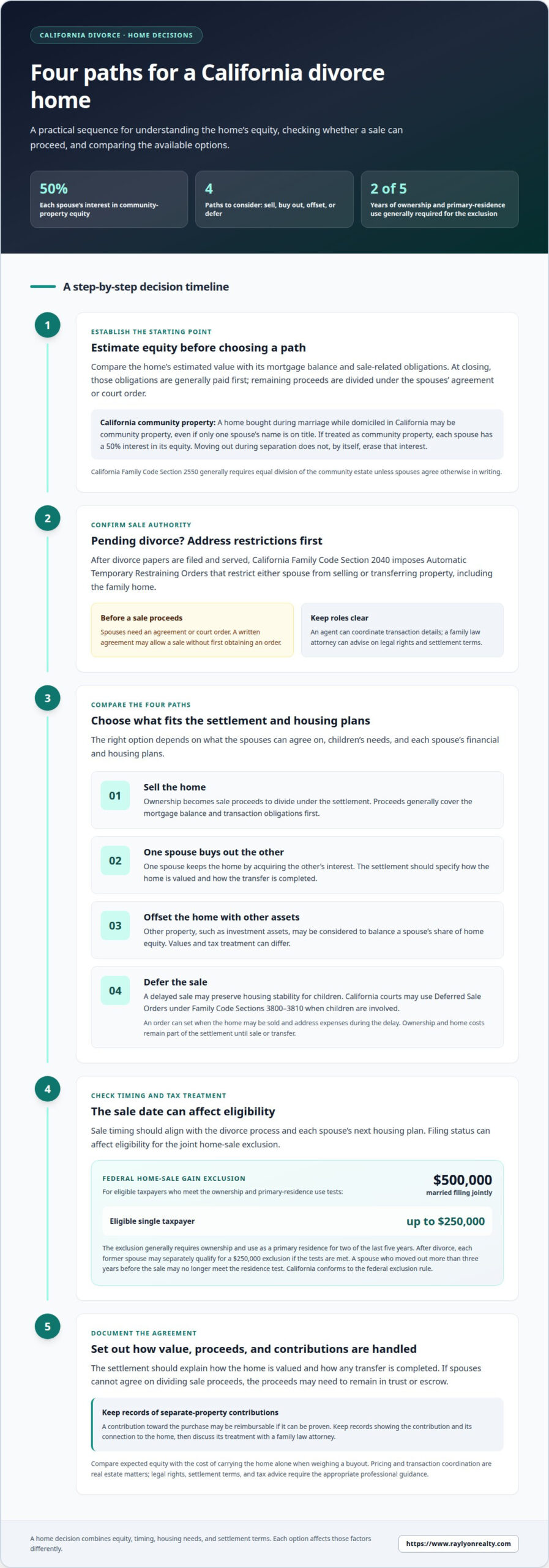
California Family Code Section 760 defines property acquired during marriage while domiciled in California as community property, according to California Legislature. A home bought during marriage may therefore be community property, regardless of whose name appears on the title. If the home is treated as community property, each spouse has a 50% interest in its equity. California Family Code Section 2550 generally requires equal division of the community estate unless spouses agree otherwise in writing.
Moving out during separation doesn’t, by itself, erase a spouse’s community property interest. This matters when one spouse stays in the home and the other has left. Before discussing a sale or buyout, compare the home’s estimated value with its mortgage balance and other sale-related obligations. That gives both co-sellers a clearer starting point for discussing equity, without treating Ray Lyon Realty or any agent’s pricing estimate as a legal division of property.
Timing also matters. California Family Code Section 2040 imposes Automatic Temporary Restraining Orders after divorce papers are filed and served. These orders restrict either spouse from selling or transferring property, including the family home. An agreement or court order may be needed before a sale proceeds. An agent can coordinate transaction details, but shouldn’t treat listing authorization as a substitute for addressing those restrictions.
Sale proceeds may need to remain in trust or escrow if spouses can’t agree on how to divide them. A separate-property contribution toward the purchase may be reimbursable if it can be proven. Keep records showing the contribution and its connection to the home, then discuss how it may be treated with a family law attorney. Ray Lyon Realty can manage pricing, offers, and closing logistics; the attorney can address how documented contributions affect the division and whether a buyout fits the settlement.
Home sale, buyout, deferred sale, and asset-offset options
California spouses can sell, arrange a buyout, balance the home’s value against other assets, or delay a sale. The right option depends on the settlement, children’s needs, and tax timing.
Sale, Buyout, and Asset Offsets
A sale converts ownership into proceeds to divide under the settlement. A buyout lets one spouse keep the home by acquiring the other’s interest; an asset offset uses other property to balance that share. For example, investment assets may be considered alongside home equity, though their values and tax treatment can differ. The agreement should explain how the home is valued and the transfer completed.
Options for a Deferred Sale
A deferred sale postpones listing and closing, often to preserve housing stability for children. California courts may use Deferred Sale Orders under Family Code sections 3800-3810 when children are involved. An order can set when the home may be sold and address expenses during the delay. This option may help maintain a child’s residence, but ownership and home costs remain part of the settlement until the sale or transfer.
Capital Gains Exclusions
Home-sale exclusions can reduce taxable capital gains for eligible homeowners. Internal Revenue Code Section 121 allows eligible taxpayers to exclude up to $500,000 of qualifying home-sale gain when married filing jointly, according to the Internal Revenue Service. An eligible single taxpayer may exclude up to $250,000 of qualifying gain, according to the Internal Revenue Service. The exclusion generally requires ownership and use as a primary residence for two of the last five years. California conforms to the federal exclusion rule.
Sale Timing and Divorce Proceedings
Sale timing should align with the divorce process and each spouse’s next housing plan. During a pending divorce, spouses need an agreement or court order before selling; a written agreement may allow a sale without first obtaining an order. Compare selling before the divorce is final with selling afterward, since filing status can affect eligibility for the joint exclusion. Coordinate proposed timing and proceeds with the settlement and tax advice. A Los Angeles home-sale perspective can help frame pricing and timing alongside those plans.
How Can I Sell or Keep My House During a Divorce?
Whether to sell, keep the home, or buy out a spouse’s interest depends on the settlement, mortgage, and housing plans. At closing, sale proceeds generally cover the mortgage balance and transaction obligations first; the remaining proceeds are divided under the spouses’ agreement or court order.
Selling or Keeping the Home
Selling converts the home into proceeds, while keeping it means one spouse retains ownership. A buyout lets that spouse acquire the other’s interest, with the settlement specifying how the value is determined and the division recorded. Compare the expected equity with the cost of carrying the home alone. That comparison helps couples choose an option they can afford and plan for.
Selling After Divorce
After the divorce is finalized, each former spouse may separately qualify for a $250,000 home-sale gain exclusion if ownership and use tests are met, according to the Internal Revenue Service. The residence test generally requires living in the home as a primary residence for two of the last five years. A spouse who moved out more than three years before the sale may no longer meet that test. Timing can affect each person’s eligibility.
Ownership in One Spouse’s Name
A title showing one spouse’s name alone doesn’t automatically determine how the home is treated in a divorce. California community-property rules can apply to a home acquired during marriage while the spouses were domiciled in California. This distinction matters when deciding who receives proceeds or whether a buyout fits the settlement. A spouse who moved out during separation doesn’t lose a community-property interest solely by leaving the residence.
Handling the Mortgage During a Sale
At closing, the mortgage balance is generally paid from the sale proceeds before the remaining equity is divided. If one spouse keeps the home, the settlement should address responsibility for the loan and how the other spouse’s interest will be handled. Transferring ownership without removing a spouse from the mortgage can leave that person liable if payments are missed and affect their ability to qualify for new financing. Spousal support can count as mortgage-qualifying income; lenders typically require a valid court order, payment history, and enough future payments remaining.
Choosing a real estate agent for co-sellers
For co-sellers, the right real estate agent can keep the transaction organized without taking sides in the marital division. Choose someone who explains pricing, marketing, offers, and timelines clearly to both spouses. In a community property sale, sharing information helps each person follow decisions that affect the estate and the home’s proceeds.
Set a communication plan before listing the property. For example, ask the agent to send both spouses the same written updates, share every offer with both, and document decisions about price changes or repairs. This structure reduces confusion when spouses have separate schedules or disagree. It also helps each co-seller understand what needs to happen next.
Local real estate knowledge matters because buyer demand and comparable sales vary by neighborhood and property type. An agent familiar with Santa Monica, Mar Vista, and Venice can explain how location, condition, and recent comparable sales inform a pricing strategy. Ask for the reasoning behind the recommended list price, not just a number, so both spouses can assess the plan together.
Co-sellers also need a clear process for disclosures and transaction documents. For an open-market sale, co-sellers should clarify how disclosure and seller-information forms will be completed and signed. Sellers must disclose known material facts about the home. An agent can coordinate the forms and help keep responses consistent, while a family law attorney advises on settlement terms, ownership, and legal questions.
Before selecting representation, discuss how the agent will handle disagreements over showings, repairs, offer responses, or timing. The agent’s role is to guide the real estate transaction, not determine how community property should be divided. For a coordinated sale, discuss a co-seller plan with a Los Angeles real estate professional and clarify how both spouses will receive updates and participate in transaction decisions.
Ray Lyon Realty
Ray Lyon Realty helps homeowners navigate the real estate side of a divorce-related sale, from local pricing context to preparing a home for the market. When both spouses are considering a sale or buyout, a clear understanding of the property’s position can support more informed discussions with their family law attorney.
For homes, condos, or investment properties on the Westside of Los Angeles, local market knowledge can help shape listing strategy and timing. Ray Lyon Realty provides residential representation, including luxury listings and investment property sales when they fit the property and the owners’ plans.
Contact Ray Lyon Realty to discuss the property and your next real estate step.
Set a Clear Direction for Your Next Move
The decision about the home can shape how each spouse begins the next chapter. Before taking action, agree on the practical outcome you’re working toward: a clean transition, continued ownership by one spouse, or more time before moving. A shared direction can make later real estate decisions easier to organize and discuss.
Selling a home after a divorce in California involves more than choosing a listing date. The property’s role in each person’s plans matters, from where you’ll live next to how you want the sale process to unfold. Keep communication focused on the decisions ahead, and separate real estate planning from legal and tax advice.
If you’re ready to discuss the property, its market position, or a possible sale, talk with Ray Lyon Realty about your home. A thoughtful next step can help you move forward with greater clarity and confidence.
Frequently Asked Questions
House in One Spouse’s Name: Does It Matter?
Selling a home after a divorce in California involves more than checking whose name appears on the deed. If a spouse used inherited funds toward the purchase, records of that contribution may matter when the property is divided. Purchase documents and account statements can help clarify the source of funds. A family law attorney can assess how those records affect the legal division.
What About Disclosures?
Both spouses should provide accurate, consistent information about known issues with the home. For example, if one spouse knows about a recurring roof leak, that information shouldn’t be omitted just because the other spouse handled the sale paperwork. In an open-market sale, both sellers sign disclosure forms, so conflicting answers can complicate the transaction. The agent coordinates the process, while sellers provide truthful information.
What Are the Most Common Restrictions to Consider?
The main restriction during a pending California divorce is the Automatic Temporary Restraining Order that applies after papers are filed and served. It limits selling or transferring property, including the family home. A written agreement or court order can provide a way forward. Also account for the mortgage: transferring ownership without addressing loan liability can leave a former spouse exposed if payments are missed.
What Happens With the Proceeds From a Sale?
Sale proceeds may be held in trust or escrow if spouses disagree about how to divide them. This preserves the funds while the settlement or court process addresses the dispute. For example, spouses might agree to release the undisputed portion while leaving a contested amount in escrow, if their agreement or court direction allows it. Clear written allocation terms help reduce uncertainty at closing.
What if my spouse refuses to cooperate on the sale?
If selling a home after a divorce in California stalls because one spouse won’t cooperate, a court may order a sale, including through a partition action under Code of Civil Procedure Section 872. Agreement may avoid that route. A family law attorney can explain the legal options.
How is a house divided in a California divorce?
Community property is generally divided equally unless spouses agree otherwise in writing. A house doesn’t have to be physically split: the settlement can provide for a sale and division of proceeds, a buyout, or an offset using other assets. A court may also account for proven separate-property contributions, payments on community debts, and one spouse’s exclusive use of the home during separation.