
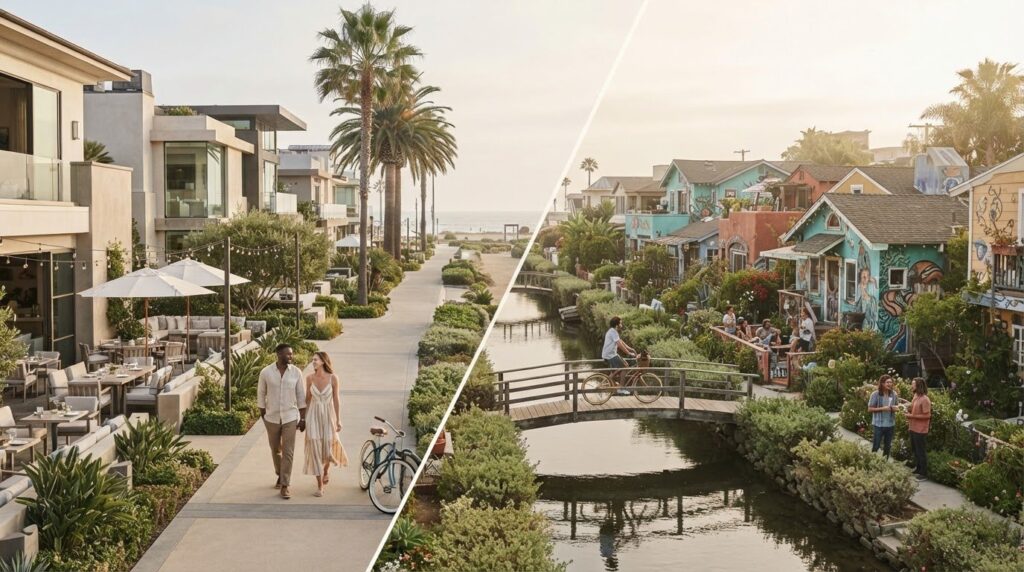
What if the better beachside fit has less to do with the beach and more to do with your Tuesday routine? Santa Monica and Venice may sound like similar coastal choices, but the santa monica vs venice lifestyle comparison comes into focus in the details: how your block feels, where you spend time, and what kind of daily pace suits you.
Both offer a coastal setting and Westside appeal, but neither is a universal winner. Broad labels like “polished” or “creative” won’t tell you whether a particular home fits your life. Santa Monica is an independent city, while Venice is part of Los Angeles. That civic distinction is one of several practical factors to consider, alongside your routines and the specific property.
This guide compares everyday pace, neighborhood character, housing settings, and the tradeoffs that can shape a move. Use it to identify which area may suit your routines, then look beyond the neighborhood name to the block and property. That’s where a lifestyle preference becomes a more informed home search.
Key Takeaways
- The santa monica vs venice lifestyle choice becomes clearer when you compare the routines and neighborhood activity you want, not just proximity to the coast.
- Use your regular errands, outdoor plans, and local outings to assess how each area might fit your week.
- Rank your priorities, map recurring trips, and visit candidate areas before narrowing your home search.
- Compare specific blocks and properties, then build a focused search brief around the setting and home features that matter most to you.
- A local buyer’s representative can help identify suitable Westside properties and guide you through offers and escrow.
Santa Monica vs. Venice lifestyle: what is the real difference?
The short answer: compare how you want to spend an ordinary week, not just how close you’ll be to the beach. The santa monica vs venice lifestyle question comes down to your routines, local character, civic context, and the home itself. Your experience can shift from one block to the next, so neither community can be summed up by a single label.
How Santa Monica and Venice differ geographically
Both communities sit on Los Angeles’ Westside along the coast, but they have distinct civic identities. Santa Monica is an incorporated city with its own municipal government. Venice is a neighborhood within the City of Los Angeles, rather than a separate city. Put simply, Santa Monica is a city and Venice is part of Los Angeles. For an overview of Santa Monica’s geography and background, see Santa Monica, California Wikipedia.
This distinction matters when you research municipal information and services, since different city governments are responsible for each area. But a boundary on a map doesn’t dictate what life feels like for every resident. A home’s exact location, nearby streets, building type, and the places you visit regularly all shape your experience. Treat city and neighborhood identities as useful context, not as a shortcut for judging a property.
Why coastal location does not mean identical daily life
Beach access is one part of the picture. Daily life also reflects where you run errands, how you spend time outdoors, which local spots you return to, and what level of activity feels comfortable around home. A familiar destination may play a different role for a visitor than it does for a nearby resident. The Venice boardwalk and Abbot Kinney are recognizable destinations, but they don’t represent every residential block or every resident’s routine.
Likewise, a coastal address in Santa Monica doesn’t automatically mean your week revolves around the shoreline. The home’s position relative to your regular destinations, the routes you use, and the surrounding mix of housing and activity can matter more than the neighborhood name. Compare the setting you’d encounter on an ordinary weekday, not only the places you might visit on a day off.
This guide is a decision aid, not a verdict on which community is “better.” Use it to work out what you value, then test those priorities against real places and properties. The comparisons ahead focus on:
- Daily pace: What level of activity feels right around home?
- Outdoor routines: Which nearby settings would you actually use?
- Errands and local activity: How well do everyday destinations fit your habits?
- Housing context: What kind of property and block best support your plans?
These questions create a more practical starting point than choosing between two coastal reputations. Keep your own schedule in view as you compare options. The best fit is the place whose specific setting and home make your everyday priorities easier to live out.
What everyday life feels like in Santa Monica and Venice
Everyday life depends less on a neighborhood’s reputation than on where your home sits and what you do from it. In both communities, an outdoor break, a meal out, or an errand can feel different depending on the route and activity around your block. For a useful comparison, picture an ordinary weekday as well as a beach day.
Santa Monica’s everyday rhythm and local anchors
The Pacific Ocean and Santa Monica Pier are prominent reference points, but they don’t define every resident’s routine. The city includes different settings, and the appeal of a particular location depends on whether you want regular destinations close by or prefer a quieter-feeling residential stretch. Consider where you’d shop, eat, walk, and spend time outdoors from the specific home you’re considering.
The Pier is a recognizable recreational destination, but visitor activity there is not the same as the rhythm of every nearby street. A resident may enjoy having the coast as a regular option without visiting the Pier often. Another may value being close to a busier mix of destinations. In the santa monica vs venice lifestyle comparison, the practical question is how your chosen part of Santa Monica connects your home to the places you’ll actually use.
Venice’s neighborhood character beyond the beach
Venice Beach and Abbot Kinney Boulevard are useful landmarks, but they are distinct reference points, not shorthand for all of Venice. The beach and boardwalk draw visitors, while Abbot Kinney is a pedestrian-friendly commercial area. A home’s distance from these destinations, along with its immediate surroundings, can shape how much their activity features in your day.
Think about whether you’d visit these areas regularly, pass through them occasionally, or choose everyday destinations elsewhere. A resident near a busy visitor corridor may experience different activity from someone living on a residential street farther from it. Test the difference in person: visit at the times you expect to be out and follow the routes you’d use for ordinary plans. The point isn’t to label Venice as uniformly lively or laid-back, but to see how a specific location fits your routine.
A practical distinction: Santa Monica’s Pier and Venice’s beach and boardwalk are high-profile coastal destinations, while daily life in either community depends on the home’s block and the places you return to regularly.
As you compare, note how each candidate location handles your everyday mix of errands, outdoor time, dining, and neighborhood activity. Then look at the property itself: its setting, access to the places you value, and fit with your plans. Ray Lyon Realty’s Westside residential buyer guidance can help connect those priorities to specific homes as you narrow your search.
Santa Monica vs. Venice: compare the lifestyle factors that matter
A useful santa monica vs venice lifestyle comparison starts with your own week. Rather than assume one neighborhood is quieter, easier to walk, or better connected, compare the specific locations you’re considering against your work, errands, recreation, and social plans. Use the questions below to guide that check. They’re prompts, not rankings, and the answer can change from one block or property to another.
| Factor | Ask yourself in Santa Monica | Ask yourself in Venice |
|---|---|---|
| Daily pace | Does the activity around this address suit your typical mornings and evenings? | Would the immediate street and nearby destinations feel comfortable during your usual routine? |
| Outdoor time | Are the outdoor places you’d use often convenient from this home? | Would you use nearby coastal or neighborhood spaces regularly, or only occasionally? |
| Errands | Can you reach the shops and services you rely on in a way that works for you? | Do your everyday stops fit naturally into the routes you’d take from this block? |
| Local activity | How does activity near the property change at the times you’d be home? | How does the home’s location relate to visitor destinations and the places you’d use day to day? |
| Housing | Does the property type and its immediate setting match your needs? | Does this home’s layout, surroundings, and block fit the way you want to live? |
Compare routines, access, and neighborhood activity
Map real destinations, not just neighborhood names. Mark your workplace, regular errands, outdoor plans, and social visits. Consider how often you’d make each trip and how you expect to travel. If transit matters, check current routes, stops, service, and walking access for each specific address before relying on a map or general impression. The Metro E Line may be relevant to some Westside trips, but confirm current route details and station access for the homes you’re evaluating.
Then visit at times that reflect your life. A weekday morning, an evening, and a weekend period can reveal different traffic, noise, and street activity. Walk the likely route to everyday destinations. A map can suggest convenience, but it can’t tell you how a crossing feels, how busy a block gets, or whether the walk fits your routine.
Compare housing context, not neighborhood labels
Property type and immediate surroundings shape the experience as much as the broader area. A condo on an active corridor, a home on a residential street, and a property near a visitor destination can offer very different day-to-day settings, even within the same community. Block-level context can change how either neighborhood feels. Compare the exact address, building, outdoor space, and surrounding activity rather than assuming a neighborhood-wide pattern.
Before choosing, write down what you learned about each candidate: the trips that felt simple, the conditions you’d want to revisit, and the property features that matter most. This turns general impressions into a grounded comparison and keeps your search focused on the home and location that fit your priorities.
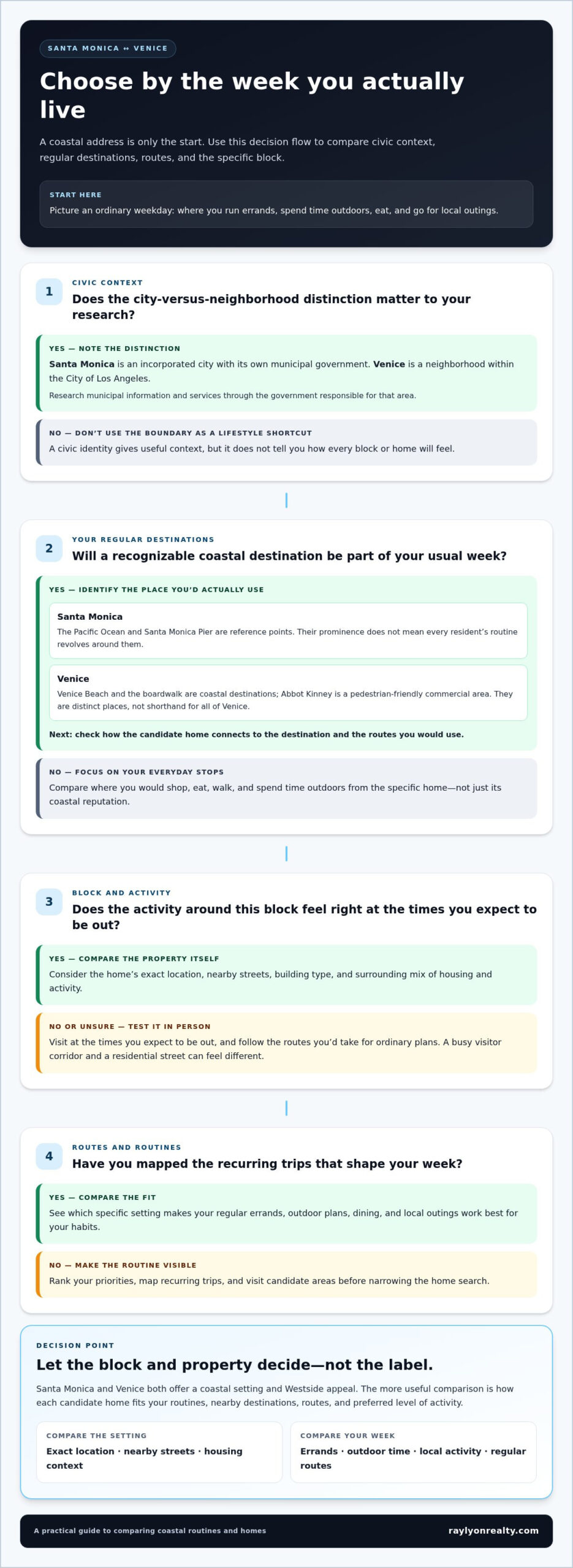
Which lifestyle fits you? A practical Santa Monica-Venice decision guide
Two coastal communities don’t automatically deliver the same routine or atmosphere. Use the santa monica vs venice lifestyle question as a starting point, then test your assumptions against your schedule and the specific homes you’re considering. A simple process can help separate what sounds appealing from what will matter on an ordinary day.
Match neighborhood priorities to your real weekly routine
Start with the things that shape most of your week, not the attractions you might visit once in a while. If you’re choosing with someone else, have each household member rank priorities on their own before comparing lists. Differences can surface early, while there’s still room to explore more than one area.
- Rank your priorities. Put outdoor time, errands, commute patterns, and desired neighborhood activity in order. Decide which needs are essential and which are preferences.
- Separate routine from occasional plans. Note the destinations you visit regularly, then list weekend outings or attractions separately. Don’t let an occasional highlight outweigh a daily need.
- Map recurring trips. Compare likely routes from candidate locations to work, errands, recreation, and social plans. Consider how often you’ll make each trip and what travel options suit your routine.
- Visit the areas. Spend time on candidate blocks at times that reflect your schedule. A weekday visit and a weekend visit can reveal different conditions, so avoid basing a decision on one quick stop.
- Compare specific properties. Look at the immediate setting, access to places you use, and whether the home’s layout supports your plans. Revisit the strongest options before drawing a conclusion.
Test the fit at the block and property level
On each visit, pay attention to details that are hard to judge online: the feel of the street, activity nearby, your route to regular destinations, and how the home’s layout works for your household. Check conditions in person, and return at another relevant time if your first impression doesn’t reflect your typical schedule. A city-wide reputation or a single visit isn’t enough to assess a specific home.
Keep notes in the same format for each property. Record what feels convenient, what might become a tradeoff, and which priorities the home supports. This makes it easier to compare homes on practical details rather than letting one appealing feature dominate the decision.
If your shortlist grows beyond Santa Monica and Venice, broaden the search with a nearby option such as the Mar Vista neighborhood guide. Once your priorities are clear, work with a Westside residential buyer’s representative to identify suitable properties and navigate offers and escrow.
Find a Westside home that fits your Santa Monica or Venice lifestyle
Once you’ve compared routines and candidate blocks, turn what you learned into a focused home-search brief. The goal isn’t to find a property that matches a neighborhood reputation. It’s to identify a home whose location, setting, and features support the priorities you’ve ranked. Keep Santa Monica, Venice, or both in consideration until the individual properties give you a clearer sense of fit.
Translate lifestyle preferences into a focused home search
Make your brief specific enough to guide a search, but flexible enough to leave room for a home that works in an unexpected way. Start with your non-negotiables, then separate them from features you’d welcome but could trade off. If you’re searching with others, agree on which priorities matter most before comparing properties.
- Everyday routine: Note the recurring trips, outdoor activities, and neighborhood activity you want nearby.
- Location priorities: Identify preferred blocks or settings, and record what you learned from visiting them.
- Property needs: List the home type, layout, and features that support your household’s plans.
- Tradeoffs: Mark what you’re willing to reconsider, such as a preferred setting in exchange for a more suitable layout.
Use this brief to compare each home on its own merits. Two properties in the same area can differ in their immediate surroundings and how easily they connect to your regular destinations. Local knowledge can help put a block and property in context, so your search reflects more than an address or a broad idea of the santa monica vs venice lifestyle.
Take the next step with local buyer representation
A buyer’s representative can use your priorities to identify suitable properties, help you assess how each fits your search, and guide you through offers and escrow. Ray Lyon Realty represents residential buyers and sellers across the Los Angeles Westside, including Santa Monica and Venice. That local focus can help when your decision depends on comparing specific blocks and homes rather than choosing by reputation alone.
For broader context on working with an agent, explore this Los Angeles real estate agent guide. Then put your priorities to work: discuss your Westside home search with Ray Lyon Realty and shape a search around the homes and locations that fit your life.
Turn your neighborhood shortlist into a confident next step
The right choice doesn’t have to be a permanent verdict on Santa Monica or Venice. It can be the home that best supports this chapter of your life, with room to reassess as your routines and priorities change. Let the santa monica vs venice lifestyle comparison sharpen your questions, then use the answers to guide your next move.
Before you start touring, write a short brief: what you need nearby, what kind of home feels right, and which tradeoffs you’re comfortable making. Bring it along as you compare properties. A clear set of priorities makes it easier to focus on homes that fit, rather than getting pulled in different directions by a great view or a memorable first impression.
When you’re ready to explore possibilities, explore Westside homes with local guidance. Take the search one considered step at a time. The right fit is out there, and a thoughtful process can help you recognize it.
Frequently Asked Questions
Is Santa Monica or Venice better for everyday living?
Neither is automatically better; the right fit depends on what you need from home and your regular routine. Someone who prioritizes a particular commute may value a different location than someone whose week centers on nearby recreation or local errands. Compare homes by their actual surroundings and access to recurring destinations. A short list of must-haves and acceptable tradeoffs can make the choice more personal and practical.
Is Venice part of Santa Monica?
No. Venice is a neighborhood within the City of Los Angeles, while Santa Monica is a separate incorporated city. That distinction can affect which city government handles municipal matters tied to a particular address. When researching a home, use its address to identify the relevant city resources rather than assuming nearby coastal communities share the same municipal structure. Neighborhood names alone don’t tell you which city’s information applies.
Can you walk between Santa Monica and Venice?
Yes, walking between parts of Santa Monica and Venice is possible, but the experience depends on your starting point, destination, and chosen route. A walk from one coastal destination to another differs from traveling between residential blocks farther inland. Before setting out, check a current map for pedestrian routes and any access changes, then allow for the actual distance and conditions. For a home search, try the walk from the specific property you’re considering.
Which is quieter, Santa Monica or Venice?
There isn’t a reliable city-wide answer; noise can change by block, building, and time of day. A home near a busy street or popular destination may feel different from one on a residential block. During a showing, listen with windows open and closed, and return at another time if you can. Also notice nearby activity and whether the home’s layout places bedrooms or outdoor areas toward quieter or busier surroundings.
What is the main lifestyle difference between Santa Monica and Venice?
The main difference is how local character, civic setting, and a home’s location combine to shape your routines. Santa Monica is its own city, while Venice is part of Los Angeles, but that doesn’t determine which one will feel right to you. In the santa monica vs venice lifestyle comparison, focus on your preferred day-to-day pace, the places you’ll use often, and the specific home rather than relying on a broad neighborhood stereotype.
How do I decide between a home in Santa Monica and one in Venice?
Compare the homes side by side against the same criteria. Note how each fits your household’s schedule, what the immediate surroundings are like, and whether the layout supports your needs. If possible, revisit each property at a different time and travel the routes you expect to use regularly. Keep a brief written record after each visit. That makes it easier to weigh practical details later instead of relying only on the first impression.
Does Venice have the same local services as Santa Monica?
Not exactly, because the communities fall under different city governments. Santa Monica has its own municipal government; Venice is governed as part of the City of Los Angeles. The services and departments relevant to an address may therefore differ. If a specific service matters to your decision, look up the property’s address through the appropriate city’s official resources. This is especially useful when comparing municipal information that may not apply across the city boundary.