
Is now a good time to buy in Santa Monica? The answer depends on the home and your timing: Santa Monica luxury homes averaged 69 days on the market on October 27, 2026, while 32.7% of all homes sold above list price in September. Over the three months ending September, homes received an average of two offers. This Santa Monica luxury home market report puts those signals in context, so you can weigh the pace of sales against the competition.
Before making a move in a high-value market, it helps to understand what recent activity can and cannot tell you. The figures do not point to one answer for every buyer or seller, but they can show what to watch and when to reassess. This Santa Monica luxury home market report reviews recent sales and days-on-market trends, offer activity, and how property type and pricing can shape your timing.
Key Takeaways
- Compare the September median sale price and its year-over-year change with the specific home and property type you’re considering.
- Use the 49-day median time on market over the three months ending September 2026 to frame your search pace, while accounting for how individual homes differ.
- Factor in the share of homes with price drops when assessing whether a listing’s asking price may leave room for negotiation.
- Plan your timing around more than market averages: a home’s pricing, condition, and fit can affect how quickly it attracts serious buyers.
Is Now a Good Time to Buy in Santa Monica?
Whether buying now makes sense depends on your budget, the home you want, and your flexibility in negotiations. These citywide measures provide context, but they cannot predict the value of a particular estate or neighborhood.
Compare like property types before judging relative value.
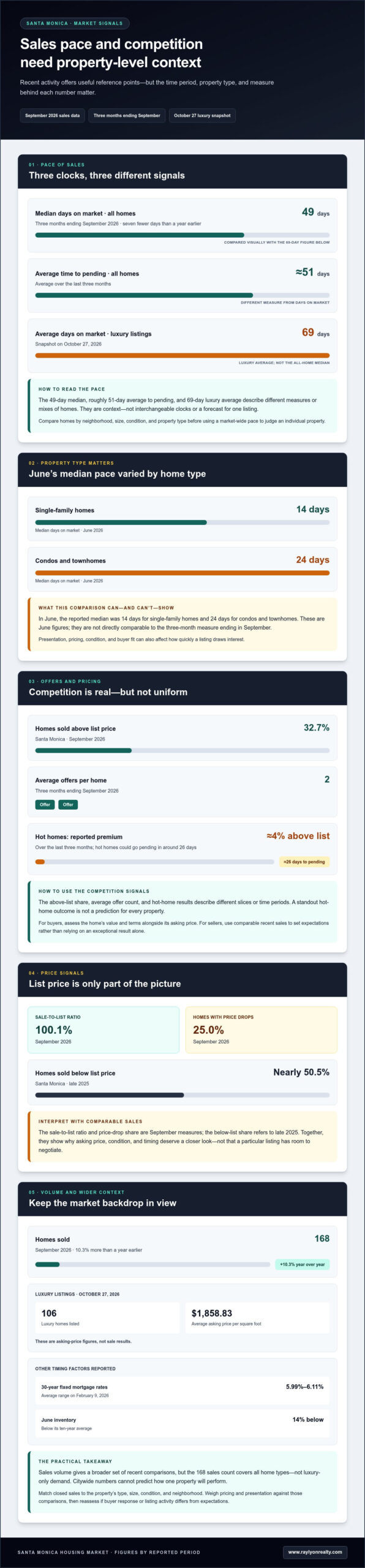
Asking prices show the range at the luxury end, rather than typical sold prices. On October 27, 2026, 106 luxury homes were listed, and the average asking price per square foot was $1,858.83. Those are asking prices, not sale results.
For meaningful neighborhood and city comparisons, align property type, size, condition, and sale date. The available figures do not establish whether Santa Monica luxury homes cost more or less than comparable homes in Beverly Hills or Pacific Palisades. Match those details first, and compare closed sales with closed sales rather than with asking prices.
Sale-to-list figures suggest pricing discipline matters: Santa Monica’s ratio was 100.1% in September 2026, while 25.0% of homes had price drops. Mortgage rates averaged 5.99% to 6.11% for 30-year fixed loans on February 9, 2026. June inventory was 14% below its ten-year average. A buyer’s budget and available choices both shape timing. For coastal-zone considerations, assess the property’s location and intended work during due diligence, since these can affect plans and costs.
Homes sold and days on market
Santa Monica’s September 2026 sales activity picked up: 168 homes sold, a 10.3% increase year over year. That count covers all home types, so it shows overall transaction volume rather than luxury-only demand. For a buyer, more closed sales can provide a broader set of recent comparisons. For a seller, the count offers context, but it doesn’t show how quickly a particular listing will attract an offer.
Timing varies by metric. Over the three months ending September 2026, Santa Monica homes had a median of 49 days on market, seven fewer days than a year earlier. Average homes went pending in around 51 days over the last three months. Days on market is a useful measure of how long a home remains listed, while pending time offers another perspective on the sale process. Read the measures together, not as interchangeable clocks.
Luxury listings moved more slowly by the October 27, 2026 snapshot, averaging 69 days on market. That average can reflect a different mix of homes than the citywide median, including larger estates and properties with distinct features. Compare similar listings by neighborhood, condition, and size before treating either figure as a forecast.
Property type also changes the pace. In June 2026, single-family homes had a 14-day median on market, compared with 24 days for condos and townhomes. Those figures cover that month, while the 49-day measure covers a three-month period ending in September. The different time windows and property mixes matter. A square-foot comparison alone won’t explain why one listing sells sooner; presentation, pricing, and buyer fit also shape interest.
For sellers, use days on market to review whether listing exposure is translating into serious interest, then reassess price and presentation against comparable sales. Local luxury listing guidance can help frame that review around the property and its likely buyer.
Buyer and seller timing considerations
For buyers and sellers, the outlook is mixed: demand remains local, while sale outcomes can vary. From April through June 2026, 86% of Santa Monica homebuyers searched within the metropolitan area, and 14% searched to move out of the city. Another 7% of buyers searched to move into Santa Monica from outside metropolitan areas. These patterns help frame the pool of potential buyers, but they don’t predict interest in a particular property.
Seller timing also depends on pricing expectations. Nearly 50.5% of Santa Monica homes sold below list price in late 2025. That makes the asking price and the property’s condition important parts of a timing plan. If showings and buyer responses are weak, compare the listing with similar properties and reassess its presentation and price. For buyers, a below-list sale elsewhere can inform negotiations, but it doesn’t guarantee the same result for a sought-after home.
Recent transactions show why timing requires property-level context. Because those sales differ in location and likely property characteristics, they are not direct substitutes. Before making an offer or setting an asking price, compare recent sales by home type, condition, size, and neighborhood.
For buyers, the main risk is treating a broad market trend as a guarantee about a particular home. Set your priorities, then weigh the asking price against comparable sales and the property’s condition. Sellers can prepare by deciding which outcome matters most, reviewing competing listings, and setting a pricing strategy before launch. Near Montana Avenue, for example, compare relevant nearby homes rather than relying on a citywide average. Use that evidence to choose a pace that fits your goals.
Market competitiveness and offer activity
Offer activity shows a market with competition, but not uniform bidding pressure. In September 2026, 32.7% of Santa Monica homes sold above list price. Over the three months ending September, homes received an average of two offers. Those figures describe different periods, so use them as context, not a prediction for an individual California property. A home’s location, condition, and asking price all shape its response.
The strongest listings can move faster and command a premium. Over the last three months, hot homes could sell for about 4% above list price and go pending in around 26 days. That pace makes preparation important for buyers: understand the property’s value, decide your priorities, and be ready to assess the terms alongside price. Sellers can use comparable recent sales to set expectations before listing, rather than relying on a standout result alone.
Negotiations involve more than the offer amount. Santa Monica buyers were negotiating for inspections and repairs, unlike conditions described as rare two years earlier. Buyers should account for the property’s condition and any requested repairs when evaluating an offer. Sellers can anticipate questions by organizing relevant property details and considering how the home’s condition may affect buyer decisions.
Location adds another layer. A property north of Montana may attract a different group of buyers than a home elsewhere in Santa Monica, and neighborhood context affects which properties buyers compare. Review similar nearby listings, then weigh presentation, condition, and offer terms together. A higher offer may not be the strongest proposal if its terms raise other concerns. Sellers should compare the full terms, while buyers should shape an offer around their priorities and the home’s market position.
Use these signals to build a strategy around the specific property, not a citywide average. For guidance on positioning a Santa Monica home and evaluating offers, discuss your luxury home sale.
Ray Lyon Realty: New Construction Sales
Ray Lyon Realty helps Santa Monica buyers and sellers make informed moves through New Construction Sales, luxury listings, and investment property sales. Turn to its New Construction Sales offering when you’re weighing a newly built home against resale properties, or assessing how the property fits your priorities. Sellers considering a luxury listing can get support positioning the home and evaluating offers in light of local market conditions. Investors can also explore property sales, including specialized transactions such as 1031 exchanges and trust sales.
Start by identifying your goal: buying new construction, selling a luxury home, or pursuing an investment property transaction. This gives the conversation a clear focus on the property and the decision ahead. Contact Ray Lyon Realty or visit www.raylyonrealty.com to discuss your Santa Monica real estate plans.
Make Your Next Move With a Clear Plan
A Santa Monica luxury home market report is most useful when it helps clarify what matters in your own decision. Before acting, separate must-haves from preferences, decide which tradeoffs you can accept, and set a point to reassess your plans. You might revisit your search when a property better fits your needs, or refine your selling strategy as your priorities change.
Ray Lyon Realty represents residential buyers and sellers, including clients pursuing new construction and luxury listings. Start with a focused conversation about your goals, the property, and the decisions ahead. You do not need every detail settled before you begin.
Contact Ray Lyon Realty to discuss your plans, and take the next step with a clearer sense of direction.
Frequently Asked Questions
What is the latest Santa Monica luxury home market report for 2026?
The latest 2026 snapshot shows 106 luxury homes listed in Santa Monica on October 27, with an average of 69 days on market. These are asking-market measures, not completed-sale results. For a purchase decision, compare current listings with recently closed homes of similar type and condition.
What is the median sale price for luxury homes in Santa Monica?
These figures distinguish property types, but they do not provide a single luxury-only median.
How have Santa Monica luxury home prices changed year over year?
Santa Monica’s median sale price across all home types was down 1.0% year over year for the three months ending September 2026. The city’s median sale price per square foot was down 10.0% year over year. These broad-market trends offer context, not a luxury-only price change. Compare a particular home with similar properties, since location, condition, and property type affect its value.
How many luxury homes are for sale in Santa Monica and how quickly are they selling?
There were 106 luxury homes listed in Santa Monica on October 27, 2026, and luxury listings averaged 69 days on market. That average describes listed luxury homes, while citywide timing measures cover different home types and periods. To judge a specific listing’s pace, compare it with nearby homes that share similar features, then consider its price and showing activity.
What is the price per square foot for luxury homes in Santa Monica?
The average asking price for Santa Monica luxury homes was $1,858.83 per square foot on October 27, 2026. That figure reflects listings, not closed sales. Differences in property type and timing matter when using these figures to evaluate an individual home.