

A lower monthly rent isn’t automatically the cheaper choice, and a mortgage payment alone can’t tell you whether buying will pay off. If you’re weighing renting vs buying in los angeles 2026, the key questions are how long you’ll stay, what ownership adds to the budget, and whether the neighborhood fits your life.
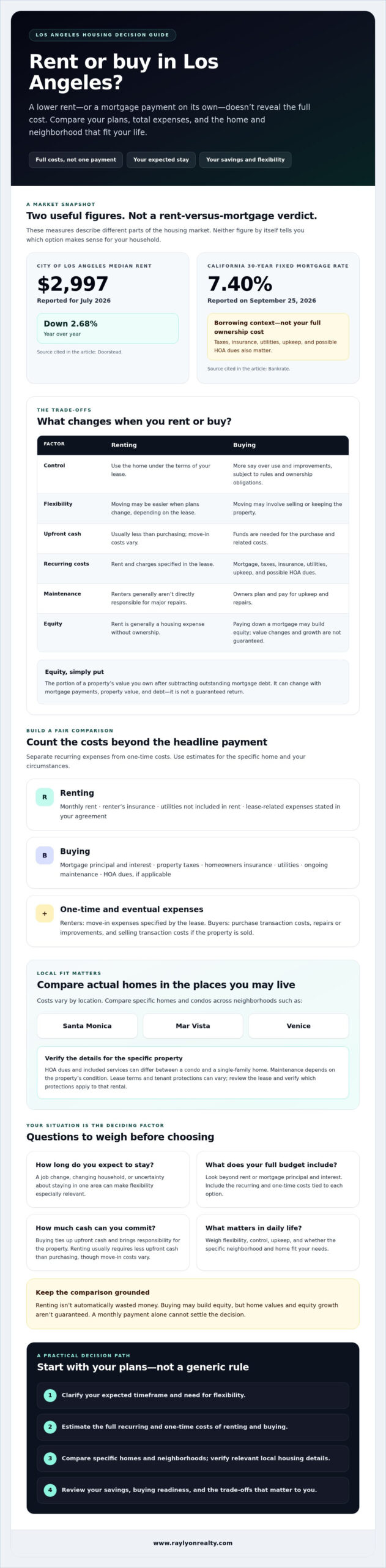
That comparison matters in a market where costs vary by location. Doorstead reported the median rent in the City of Los Angeles at $2,997 in July 2026, down 2.68% year over year. Bankrate reported California’s 30-year fixed mortgage rate at 7.40% on September 25, 2026. Neither figure, by itself, tells you which option makes sense for your household.
This guide compares total housing costs, including taxes, insurance, upkeep, and buying or selling expenses. It also explains how savings, your expected time horizon, and lifestyle can shape the decision, with local factors to consider across Los Angeles neighborhoods. Start with your own plans, not a generic national rule.
Key Takeaways
- For renting vs buying in los angeles 2026, compare the full cost of each option, not rent against a mortgage payment alone.
- Include property taxes, insurance, maintenance, HOA dues where applicable, and utilities when estimating ownership costs.
- Compare specific homes and condos in areas such as Santa Monica, Mar Vista, and Venice, and verify local housing details before deciding.
- Your expected stay, savings, and need for flexibility can matter as much as the monthly payment. Renting isn’t automatically wasted money.
- Clarify your timeframe, estimate total costs, compare neighborhoods, and review your buying readiness before choosing a next step.
Renting vs. Buying in Los Angeles 2026: Comparison
Choosing a home in Los Angeles can feel high stakes because the costs are substantial and your plans may change. The answer to renting vs buying in los angeles 2026 depends on your circumstances. Renting and buying are different financial and lifestyle choices, with trade-offs in flexibility, cash flow, control, and responsibility.
A monthly payment tells only part of the story. Rent is generally a housing expense without ownership. A buyer’s mortgage payment may contribute to equity over time, alongside interest and other costs. Buying also ties up upfront cash and makes you responsible for the property. Local supply and demand help shape both rental and home markets, as outlined in these economic principles of real estate.
For a quick visual comparison, watch this video on whether to rent or buy when moving to Los Angeles:
| Factor | Renting | Buying |
|---|---|---|
| Control | Use the home under the terms of your lease. | Greater control, subject to applicable rules and ownership obligations. |
| Flexibility | Often easier to move when plans change, depending on the lease. | Moving may involve selling or keeping the property. |
| Upfront cash | Usually less than purchasing, though move-in costs vary. | Requires funds for the purchase and related costs. |
| Recurring costs | Rent and any charges specified in the lease. | Mortgage, taxes, insurance, utilities, and possible HOA dues. |
| Maintenance | Renters generally aren’t directly responsible for major repairs. | Owners plan and pay for upkeep and repairs. |
What does renting provide that buying does not?
Renting can suit people facing a job change, a growing or changing household, or uncertainty about how long they’ll stay in one area. It can make moving less complicated and usually avoids direct responsibility for major property repairs. However, lease terms and rent changes vary, and tenant protections depend on the property’s location and circumstances. Review the lease and verify which protections apply to that specific rental.
What does buying provide that renting does not?
Buying gives you ownership and more say over how you use and improve the home, within applicable rules. As you pay down the mortgage, you may build equity, but home values and equity growth aren’t guaranteed. Owners also take on costs and upkeep that renters may not pay directly.
Home equity is the portion of a property’s value you own after subtracting any outstanding mortgage debt. It can change with mortgage payments, property value, and debt, so it isn’t a guaranteed return.
Compare the Full Cost of Renting and Buying in Los Angeles
A useful comparison starts with the total cost of each option, not just rent versus mortgage principal and interest. For homeowners, the monthly mortgage payment is only one part of the budget. Taxes, insurance, utilities, upkeep, and possible homeowners association (HOA) dues can change the picture. Renters have expenses of their own, including insurance, utilities, and charges specified in the lease.
Which costs belong in a rent-versus-buy calculation?
Separate recurring expenses from one-time costs. This makes it easier to compare monthly cash flow while accounting for what it takes to move in, buy, or sell.
- Renting: Monthly rent, renter’s insurance, utilities not included in rent, and lease-related expenses stated in your agreement.
- Buying: Mortgage principal and interest, property taxes, homeowners insurance, utilities, ongoing maintenance, and HOA dues if applicable.
- Upfront and eventual costs: For renters, include move-in expenses specified by the lease. For buyers, account for purchase transaction costs and repairs or improvements. If you sell, include the costs of that transaction, too.
Use estimates that match the specific home and your circumstances. A condo’s HOA dues and included services may differ from those of a single-family home. Maintenance needs also depend on the property’s condition. Don’t assume a general estimate applies to every Los Angeles property.
How does time in the home change the comparison?
Buying and selling involve transaction costs, which can weigh more heavily if you move after a shorter stay. A break-even comparison estimates how long ownership would need to last for its net costs to compare favorably with renting. It should account for your expected time in the home, financing, ownership expenses, rent changes, and possible sale proceeds. The result depends on the assumptions, not just the monthly payment.
The break-even point depends on verified inputs and your time horizon, not a universal rule. Test more than one scenario, especially if your plans could change or future home values are uncertain. Treat potential appreciation as an assumption, not a guaranteed gain. This keeps a spreadsheet useful without making it look like a prediction.
For a grounded comparison, use actual lease terms and property-specific ownership estimates. Revisit the numbers if your timeline changes. If you’re weighing homes or condos on the Westside, a conversation about Los Angeles Westside buyer representation can help you compare local options and neighborhood fit. It won’t replace a review of your finances or lending readiness, but it can make your property search more specific.
How Los Angeles Neighborhoods and Local Rules Affect the Decision
In Los Angeles, a rent-versus-buy comparison becomes more useful when it’s tied to a specific home and address. Santa Monica, Mar Vista, and Venice each offer different housing options, but broad neighborhood labels can hide important differences. Compare the property’s type and condition, your commute, access to the amenities you use, and the lifestyle you want. Then check current rental and sale options in the exact area instead of relying on citywide averages.
How might the choice differ across Westside neighborhoods?
Start with your daily needs. One household may prioritize commute time or transit access; another may value outdoor space, a particular home type, or nearby services. Compare similar rentals and properties for sale in Santa Monica, Mar Vista, and Venice. Note differences in size, condition, included features, and ownership costs. For a closer look at one area, explore this Mar Vista neighborhood guide.
Property type matters, too. A condo and a single-family home may differ in maintenance responsibilities, shared amenities, and possible HOA dues. For the renting vs buying in los angeles 2026 decision, use current, location-specific listings and check when the information was collected. A local buyer’s agent can help you assess property options and neighborhood fit, but affordability and lending readiness still need to be considered separately.
Which California and local housing rules should renters check?
Rent protections aren’t uniform across rental homes. State law, local ordinances, the property’s location and type, and eligibility all matter. California’s AB 1482 cap for covered, non-rent-stabilized units is 8.7% from August 1, 2026, through July 31, 2027. The 3% annual increase cap for units covered by Los Angeles City’s Rent Stabilization Ordinance applies from July 1, 2026, through June 30, 2027. These limits don’t necessarily apply to every unit.
Before signing or comparing a lease, confirm which rules apply to the property. Check the relevant city housing department’s current guidance, including the City of Los Angeles Housing Department for properties potentially covered by its ordinance. For homes in Santa Monica or other jurisdictions, consult that city’s official source. Review the lease, too. Address-specific confirmation helps you avoid assuming a rule applies simply because a home is in Los Angeles County.
When Does Renting or Buying Make More Sense for Your Situation?
There isn’t a single right answer to renting vs buying in los angeles 2026. Your plans, finances, and comfort with responsibility matter as much as the property itself. Renting isn’t automatically wasted money: it provides a place to live, and flexibility can be valuable if your job, household, or preferred neighborhood may change. Buying isn’t automatically a winning investment, either. Home values can fall, and repairs and other ownership costs can strain a budget.
When could renting be the more practical choice?
Renting may fit if you’re unsure how long you’ll stay, don’t have enough savings for purchase-related costs and a financial cushion, or prefer not to handle major repairs directly. A shorter stay can make the costs of buying and later selling more important to weigh. Compare actual lease terms and total housing expenses with a realistic ownership budget. Don’t treat flexibility as if it has no value.
For example, if a likely job change could move you across Los Angeles or out of the area, consider whether a lease offers a more workable path than buying and potentially selling sooner than planned. Check the lease’s duration, renewal terms, and any charges or rules that could affect your plans.
When could buying be worth exploring?
Buying may be worth considering if you expect to stay, have savings for upfront expenses and emergencies, and want ownership or greater control over your home. Pre-approval can help clarify what a lender may be willing to finance. A separate budget helps you decide what payment and ongoing responsibilities feel manageable. Neither guarantees that a purchase is affordable for your household.
If you’re weighing a purchase on the Los Angeles Westside, a local buyer’s agent can help you assess neighborhood fit and compare homes or condos. For a practical overview of the process, read this Los Angeles home buyer’s guide.
Use this readiness check before choosing:
- Savings: Can you cover upfront expenses and still keep an emergency cushion?
- Stability: Are your income and household plans steady enough for the commitment you’re considering?
- Time horizon: How long do you realistically expect to live in the home?
- Repair tolerance: Are you prepared to plan for maintenance and unexpected repairs?
If buying is on your shortlist, talk with a Los Angeles Westside residential real estate professional about local options and neighborhood fit. Include your budget and financing questions in the conversation.
Your Next Steps for Renting or Buying on the Los Angeles Westside
Turn your renting vs buying in los angeles 2026 comparison into a decision you can revisit as your plans develop. Work through these practical steps using your actual budget and preferred Westside areas, not a general rule about renting or owning.
- Define your timeframe. Estimate how long you expect to stay in the area. Note possible changes, such as a job move or household shift, that could affect your plans.
- Calculate total costs. Compare your current or prospective lease expenses with property-specific ownership costs. If you’re considering a purchase, speak with a qualified lender about financing and review likely taxes, insurance, maintenance, and any HOA dues.
- Compare areas and property types. Consider homes and condos in Westside neighborhoods that fit your daily needs. Weigh commute, space, amenities, and property condition rather than relying on broad neighborhood assumptions.
- Review your readiness. Look at your savings, budget, comfort with maintenance, and tolerance for a longer commitment. If renting, read the lease carefully and verify which local tenant protections apply to that specific property.
What should you prepare before exploring a purchase?
Gather a realistic monthly budget, an estimate of available savings, your preferred locations, and an honest time horizon. List the property features you need, such as a certain number of bedrooms or outdoor space, and decide where you can compromise. This keeps your search focused and makes it easier to compare options with different trade-offs. For an overview of how buyer representation works, see this Los Angeles real estate agent guide.
How can local guidance help without making the decision for you?
Local knowledge can help clarify how property types and neighborhood trade-offs fit your priorities. A conversation with a residential real estate professional can help you explore Westside buying options, but the choice remains yours. It won’t replace lender guidance or a careful review of your finances, and it can’t promise a particular outcome.
If you’re considering a purchase, talk with Ray Lyon Realty about your buying goals and Los Angeles Westside neighborhoods. Use the discussion to explore local options while deciding whether the timing and numbers work for you.
Make Your Next Housing Move With Confidence
The best answer to renting vs buying in los angeles 2026 comes from matching the numbers to your plans. Look beyond rent or mortgage alone. Consider the full costs, how long you expect to stay, and the responsibilities you’re ready to take on. A flexible rental can be a sound choice, just as buying may fit when your finances and time horizon support it.
Local details matter, too. Compare the specific home types and neighborhoods you’re considering, and verify lease terms and applicable protections before deciding. If buying is on your mind, review your budget and property-specific expenses, then consider how Westside options fit your priorities.
Ray Lyon Realty represents residential buyers across the Los Angeles Westside, with local expertise in Santa Monica, Mar Vista, and Venice. Talk with Ray Lyon Realty about buying on the Los Angeles Westside to explore neighborhood fit and available options. The decision remains yours, and a clear view of your goals is a strong place to start.
Frequently Asked Questions
Is it better to rent or buy in Los Angeles in 2026?
Neither option is automatically better; it depends on your finances, plans, and priorities. For renting vs buying in los angeles 2026, compare what each choice means for your monthly budget, upfront cash, and expected time in the home. Consider how much flexibility you want and whether you’re ready for ownership responsibilities. A side-by-side comparison using your actual housing options is more useful than a general rule.
How long should you plan to stay in a home before buying in Los Angeles?
There’s no universal minimum stay that makes buying worthwhile. The right timeframe depends on the property’s purchase and eventual selling costs, your ongoing expenses, and what happens to the home’s value. Estimate the total cost of owning over several possible timeframes, then compare it with renting for the same period. If a move could come sooner than expected, include that possibility rather than assuming you’ll stay.
Does renting mean you are throwing money away?
No. Rent pays for housing and may also provide flexibility, which can be useful if your work, household, or plans are in flux. Buying can build equity, but that isn’t guaranteed, and owners take on costs and responsibilities beyond the mortgage. Compare the value of renting’s flexibility with the full cost of owning. The goal isn’t to avoid every expense, but to choose housing that fits your life and budget.
What costs should I compare when deciding whether to rent or buy in Los Angeles?
For renting, include rent, renter’s insurance, utilities you pay separately, and lease-related expenses. For buying, count mortgage principal and interest, property taxes, homeowners insurance, utilities, maintenance, and any HOA dues. Add upfront purchase expenses and eventual selling costs to a separate estimate. Compare both options over the same period, using figures tied to the specific lease or property rather than broad averages.
Do rent control or tenant protections apply to every Los Angeles rental?
No. Protections can depend on the property’s jurisdiction, type, eligibility, and other circumstances, so don’t assume a rule applies to every rental in Los Angeles. Check the lease and confirm address-specific information with the appropriate city or government housing source. If you’re unsure which rules cover the unit, seek guidance from a qualified tenant resource or legal professional before relying on a particular rent limit or protection.
Can I buy a home in Los Angeles if I am not sure how long I will stay?
Possibly, but uncertainty makes it especially important to test different timelines. Estimate what buying, owning, and selling could involve if you moved sooner than planned, then compare that with renting during the same period. A qualified lender can explain financing options, while a realistic budget helps you assess your comfort with the costs. You can also explore homes with a residential buyer’s agent without treating that conversation as a commitment to purchase.