

A Redfin Estimate can be a useful starting point, but it isn’t the sale price. Whether a Redfin estimate is accurate in California depends on how closely its comparable sales and property details match the home and its neighborhood.
It makes sense to want a clear number when weighing a purchase or planning to sell. Online estimates offer a quick reference, but unique features, renovations, and local market differences can make a home’s value harder to capture.
This article explains how Redfin estimates are calculated, why they can differ from a final sale price, and how to compare automated estimates with local market evidence. You’ll also find a practical way to judge when an online number is a helpful guide and when the property and neighborhood need a closer look.
Key Takeaways
- Treat an online estimate as a starting point, then compare it with recent sales of genuinely similar homes.
- Unique layouts, renovations, and neighborhood-level differences can make automated valuations less reliable.
- Compare estimates from multiple valuation models and consider which property details or sales each may weigh differently.
- For a purchase or sale decision, use local market knowledge to assess what online data may miss.
Property features and neighborhood factors that can make estimates inaccurate
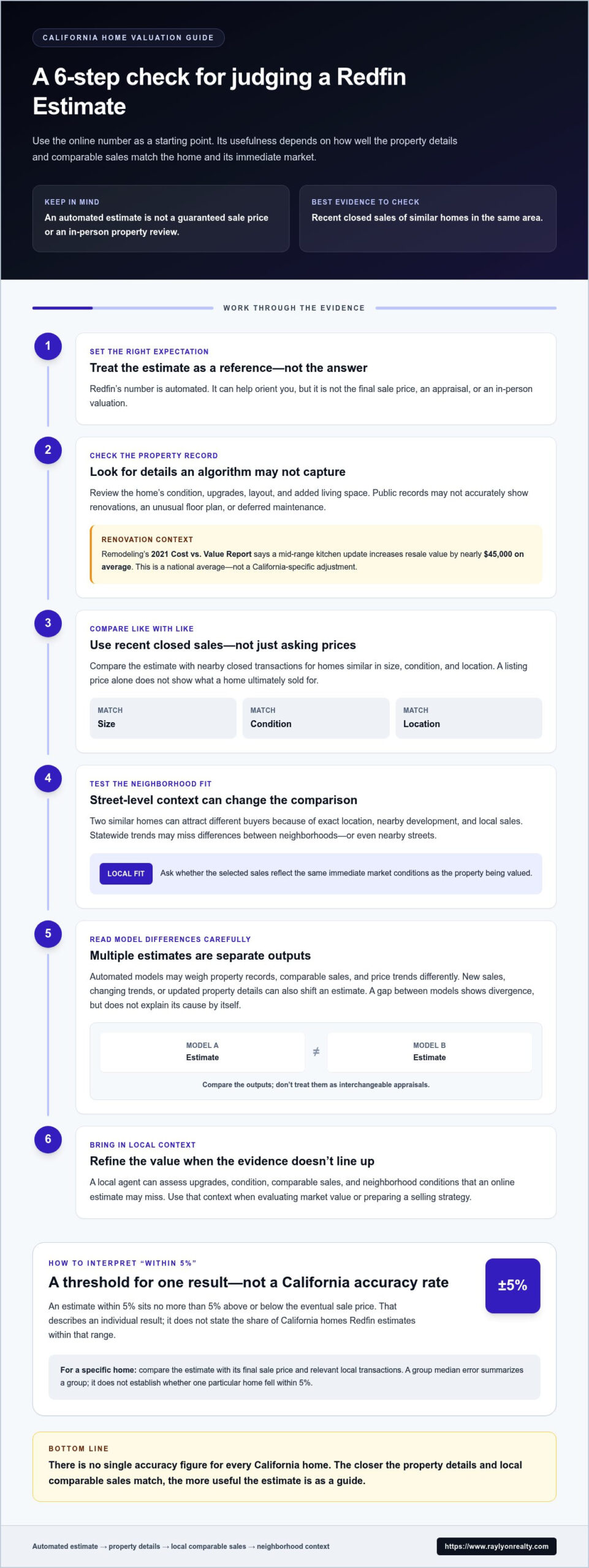
To get a more accurate California home valuation, compare recent closed sales with your home’s condition, upgrades, layout, and precise location. A local real estate agent can account for property details and market conditions an online estimate may miss.
Property-Specific Features
Property-specific details can separate your home from the market homes an algorithm uses as comparisons. A remodeled kitchen, unusual floor plan, added living space, or deferred maintenance may not appear accurately in public records. Remodeling’s 2021 Cost vs. Value Report says a mid-range kitchen update increases resale value by nearly $45,000 on average. That national average isn’t a California-specific adjustment, but it shows why an automated value estimate can miss renovation differences.
Neighborhood-Level Factors
Neighborhood factors affect value differently from a home’s individual condition. Two similar houses can attract different buyers because of their exact location, nearby development, or recent sales nearby. An agent familiar with a California neighborhood can assess whether a comparable sale reflects the same local conditions. Statewide trends may not capture street-level differences that matter when setting a seller’s price.
| Option | Property detail | Neighborhood fit | Best use |
|---|---|---|---|
| Online estimate | Recorded features | Broad sales patterns | Initial reference |
| Recent comparable sales | Similar homes and condition | Nearby closed transactions | Grounding a value estimate |
| Local agent review | Upgrades and condition | Street-level context | Preparing a selling strategy |
Choose the method that best reflects both the home and its immediate market. If an estimate overlooks a permitted addition or compares your property with homes in a different neighborhood, use closer sales and a local review to refine the figure. Other automated models, including a Ray Lyon Realty valuation tool, can provide additional reference points, but algorithms may weigh property records and sales differently. Comparing results can show where estimates diverge, though it won’t explain the gap by itself. Before relying on an estimate, check whether its comparisons match your home’s size, condition, and location.
These figures are not a California pricing benchmark. Differences between automated estimates can reflect different algorithm weights, and algorithms may change over time.
Redfin estimates within 5% of sale prices
An estimate within 5% means it sits no more than 5% above or below the eventual sale price. That threshold describes an individual result, not the share of California homes Redfin estimates within that range. To judge a specific estimate, compare it with the home’s final sale price and relevant local transactions.
Redfin Estimates and Sale Prices
Compare an estimate with the final sale price, not only the listing price. A home may sell above or below its asking price, so listing-price comparisons don’t establish the estimate’s error rate. Median error describes the middle-sized difference across a group of properties, while the median error rate expresses that difference proportionally. Neither measure alone tells you whether a particular home fell within 5%.
Redfin’s estimate is automated, not an in-person valuation. The online number itself is not an in-person visit or a property-specific agent review.
Home Value Calculations and Estimate Updates
Automated estimates use comparable sales, property characteristics, and price trends. Valuation models may weigh those inputs differently because their algorithms vary. As a result, estimates can differ even when they use recent transactions. New sales, changing price trends, and updated property details can also affect an estimate. Compare the figures as separate model outputs, not interchangeable appraisals.
To assess a value, compare it with closed sales of similar properties, then identify differences in location, condition, and recorded features. A real estate brokerage review can add local context when you’re considering market value or setting a listing price. For a local real estate perspective, focus on comparable transactions instead of relying on one automated number.
Accuracy Across California Cities and Regions
No California city or region can be identified as consistently having the most accurate Redfin Estimates from the available comparison. Accuracy depends on whether local sales are recent and comparable, and whether property records reflect the homes being valued. Those conditions can vary within a city as well as across regions.
For a California property, compare its estimate with nearby closed sales of similar homes in size, condition, and location. A median error rate summarizes a group; it does not predict an individual seller’s result. If the estimate differs from close matches, inspect the selected comparisons and property details before using it to guide a sale decision.
How accurate is Redfin Estimate in California?
There isn’t one accuracy figure that describes every California home. Judge a Redfin Estimate against comparable closed sales and the property’s details, rather than treating it as a guaranteed sale price.
A 2016 study sample covered 7,531 U.S. postal codes and homes in 189 Census-defined metropolitan areas. SSRS randomly selected 500 to 1,000 pending home sales each day from October 19 through November 30, 2016; 6,338 sales had closed by November 30. Those figures describe the study’s national sample, not a California-only accuracy rate.
Sample size and geographic coverage matter, but they don’t show a California seller how close an estimate will be for one property. The result for a specific home depends on whether comparable sales reflect the same neighborhood, condition, and features. A statewide number can also hide meaningful differences between local markets.
For a practical check, compare the estimate with recent closed sales of similar homes in the same area. See whether those properties match the home’s size, condition, and notable upgrades. If the estimate and comparable sales differ, identify which sales or property details might explain the gap before using the figure to plan a listing price.
Redfin estimates are based on automated inputs, while the final sale price reflects a buyer’s decision in the actual transaction. Market changes between the estimate date and the sale can widen the difference. So, is a Redfin estimate accurate in California? It can be a useful reference, but its relevance depends on local comparisons and how closely the available property information matches the home.
Use the estimate as one data point, then weigh it against nearby closed sales and current local conditions. If comparable homes have different layouts or renovation levels, for example, a direct price comparison may be less meaningful. Focus on the closest matches before deciding what value is reasonable for your California property.
How does Redfin calculate home values and update estimates?
Redfin’s automated estimate uses comparable sales, property characteristics, and price trends. These inputs help its model calculate a value from recorded information and market activity. The estimate is a model output, not an appraisal based on an in-person inspection.
Comparable sales provide context: recently sold homes can indicate what buyers have paid for similar properties. The comparison is more useful when the homes share relevant features and location. A sale from a different market area may offer less relevant evidence, even if the properties look similar in their listings.
Property characteristics add another layer. Recorded size, rooms, and other features inform the estimate, while details missing from the data may not affect the result. For example, if records don’t reflect a substantial renovation, the algorithm may not account for the home’s updated condition as a human reviewer would.
Price trends help the model reflect movement in the market. As new sales and market information become available, the estimate can change. Automated valuation models can produce different results because their algorithms assign different weights to sales, property details, and trends. Algorithms may also change over time, so an estimate can shift even when the home itself hasn’t changed.
To interpret a change, compare the current estimate with its previous value, then consider what may have changed:
- New comparable sales may have entered the model.
- Updated property information may affect the recorded features.
- Price trends may have shifted in the home’s local market.
Use those checks to understand the number’s movement, not just its latest position. For a selling decision, pair the estimate with relevant closed sales and a review of the property’s actual condition. Discuss your home’s market value with a real estate professional when you’re preparing to set a listing price.
Automated estimates may diverge even without a change to the property because each model can weigh the same factors differently. An algorithm update can also shift an estimate over time. Treat each figure as the output of its specific model. Estimates need not match, and a changed figure does not prove the home itself has changed.
Ray Lyon Realty: New Construction Sales
Ray Lyon Realty represents buyers and sellers in residential real estate, including new construction sales. For a newly built home, an automated estimate may have fewer comparable resale transactions to draw on, so weigh the property’s features and nearby sales alongside the online figure.
For sellers weighing a listing, a Luxury Listing Agent can help assess how the home fits its local market. Investors considering a property can turn to Investment Property Sales for transaction guidance, including specialized investor transactions such as 1031 exchanges and trust sales. These services are most relevant when you’re moving from an online estimate toward a purchase or sale decision.
Contact Ray Lyon Realty to discuss your residential real estate goals.
Turn the Estimate Into a Thoughtful Next Step
An online value becomes more useful when it helps you decide what to do next. If you’re considering selling, use it to frame questions about timing, presentation, and your goals, rather than letting one figure set your strategy. Whether a Redfin estimate is accurate in California matters less than how well your next decision reflects your property and plans.
Ray Lyon Realty represents clients buying and selling residential properties, including newly built homes and luxury listings. If you’re weighing a sale, a purchase, or a new-construction home, choose support that fits the decision in front of you. Contact Ray Lyon Realty to discuss your priorities and a practical path forward.
Contact Ray Lyon Realty about your home value and take the next step with a clearer plan.