

Last Tuesday, a buyer in Santa Monica opened a 45-page inspection report only to find a cracked sewer line and outdated electrical panels staring back at them. It’s a gut-wrenching moment when your dream home on the Westside suddenly feels like a potential financial liability. According to a 2023 survey by the American Society of Home Inspectors, 86% of inspections find at least one item that needs repair. You’ve likely spent months searching for the right property, and the fear of overpaying is real. However, this report isn’t a dead end; it’s your most powerful tool for negotiating home price after inspection.
I know the pressure you feel during the standard 17-day contingency period, especially when you’re worried the seller might move on to a backup offer. You deserve a fair deal that accounts for major defects without draining your savings. In this guide, I’ll use my block to block knowledge of the LA market to show you how to master the “second negotiation.” We’ll look at how to secure repair credits or price reductions that lower your out-of-pocket closing costs so you can finalize your purchase with total confidence in your home’s structural integrity.
Key Takeaways
- Learn why a seller’s “as-is” disclosure is rarely the final word and how the inspection period serves as your most critical window for the “second negotiation.”
- Discover how to separate cosmetic “lipstick” issues from the “Big Five” structural necessities to ensure you’re focusing on what truly matters for your investment.
- Understand the strategic advantages of closing cost credits over physical repairs and why this “holy grail” approach often wins in competitive Westside markets.
- Master the art of negotiating home price after inspection by leveraging professional contractor bids and hard evidence to secure the best possible deal.
- Find out how “block to block” local expertise and a calm, strategic broker can help you navigate high-stress escrow hurdles without losing your dream home.
The Inspection Period: Understanding the Second Negotiation
Entering escrow in Los Angeles feels like a hard-won victory, but the real work starts once you’re under contract. The inspection period is the most critical phase of the California escrow process because it functions as a second negotiation. Many buyers assume the price they agreed to on day one is final. In reality, What is a home inspection? It is a professional deep dive that often uncovers hidden costs, providing the leverage needed for negotiating home price after inspection. You aren’t just looking for cosmetic flaws; you’re identifying systemic issues like outdated electrical panels or foundation cracks that could cost $20,000 or more to fix.
The Request for Repair (RR) form is the formal vehicle for these requests in the California Residential Purchase Agreement. This document allows you to ask for specific repairs, a credit toward your closing costs, or a straight reduction in the sales price. Using this form strategically ensures the seller understands your concerns are based on facts, not just a desire to pay less. It keeps the conversation professional and focused on the property’s actual condition.
What Does ‘As-Is’ Actually Mean in Los Angeles?
In high-demand neighborhoods like Santa Monica or Venice, sellers often list homes “as-is” to discourage minor repair requests. Legally, the C.A.R. purchase agreement states the property is sold in its present condition. However, this disclosure doesn’t waive your right to investigate. Paragraph 12 of the standard contract protects the buyer’s right to conduct inspections regardless of the “as-is” status. If a major defect is found, the “as-is” label doesn’t prevent you from negotiating home price after inspection. We focus on “big ticket” items like HVAC systems and roofing rather than “lipstick” issues to maintain a strong bargaining position.
Contingency Timelines and Why They Matter
The standard California contract allows for a 17-day contingency period, but the Los Angeles market moves much faster. It’s common for sellers to demand a 7-day or 10-day window for inspections to ensure the buyer is serious. Waiving these contingencies to win a bidding war is a massive risk that can lead to expensive surprises after move-in. If your general inspector finds something concerning, you can use form ETA to request a contingency extension for specialized evaluations, like a sewer scope or a chimney inspection. Contingency removal is the point of no return for your deposit.
Evaluating the Report: Deal-Breakers vs. ‘Lipstick’ Issues
When that 50-page inspection report lands in your inbox, it’s easy to feel overwhelmed by the sheer volume of red ink. I always tell my clients to separate the “lipstick” from the bones. Lipstick issues are purely cosmetic. They’re the chipped baseboards in a Venice bungalow or the dated brass fixtures in a Mar Vista kitchen. These are easy fixes that shouldn’t derail your deal. You want to focus your energy on structural necessities and safety hazards that impact the home’s long-term value. Identifying these critical flaws is the secret to successfully negotiating home price after inspection without losing the property to a backup offer.
The ‘Big Five’ Deal-Breakers
I categorize the most expensive repairs into the “Big Five”: Foundation, Roof, HVAC, Plumbing, and Electrical. In older Santa Monica neighborhoods, the foundation is your first priority. A hairline settling crack is common in a 1940s build, but horizontal cracks or significant floor sloping often signal a structural failure that requires seismic retrofitting. You also need to evaluate the roof’s remaining life. If a coastal home has a roof with less than 5 years of life left, it’s a major negotiation point. For electrical, we specifically watch for knob-and-tube wiring or Federal Pacific panels. These aren’t just old; they’re fire hazards. Many insurance companies won’t even issue a policy for a home with these panels, and your lender may refuse to fund the loan until they’re replaced.
Local LA Hazards: Sewer, Termites, and Methane
Los Angeles has unique geographic quirks that require specialized inspections. In Mar Vista and Venice, a sewer lateral inspection is a non-negotiable step. Tree roots or clay pipe collapses can lead to a $15,000 surprise the week you move in. Don’t skip the termite report either. In Southern California, we look at Section 1 and Section 2 items. Section 1 covers active infestations or dry rot, which the seller traditionally pays to clear. Section 2 covers preventative measures, which usually fall on the buyer.
If you’re looking at property near the historic oil fields in Westside LA, you must check if the home sits in a designated methane zone. Properties in these areas might require specific mitigation systems, such as sub-slab vents or sensors, to ensure the air stays safe. Understanding these local nuances gives you the leverage needed when negotiating home price after inspection to ensure you aren’t overpaying for deferred maintenance. If you’re feeling unsure about a specific line item on your report, connecting with a local expert can help you determine which repairs are standard and which are genuine red flags.
- Sewer Lateral: Potential $15,000+ repair often missed by general inspectors.
- Section 1 Termites: Active damage that sellers typically cover in CA.
- Methane Zones: Critical safety checks for specific Westside zip codes.
- Uninsurable Electrical: Federal Pacific or Zinsco panels that stop a loan from closing.
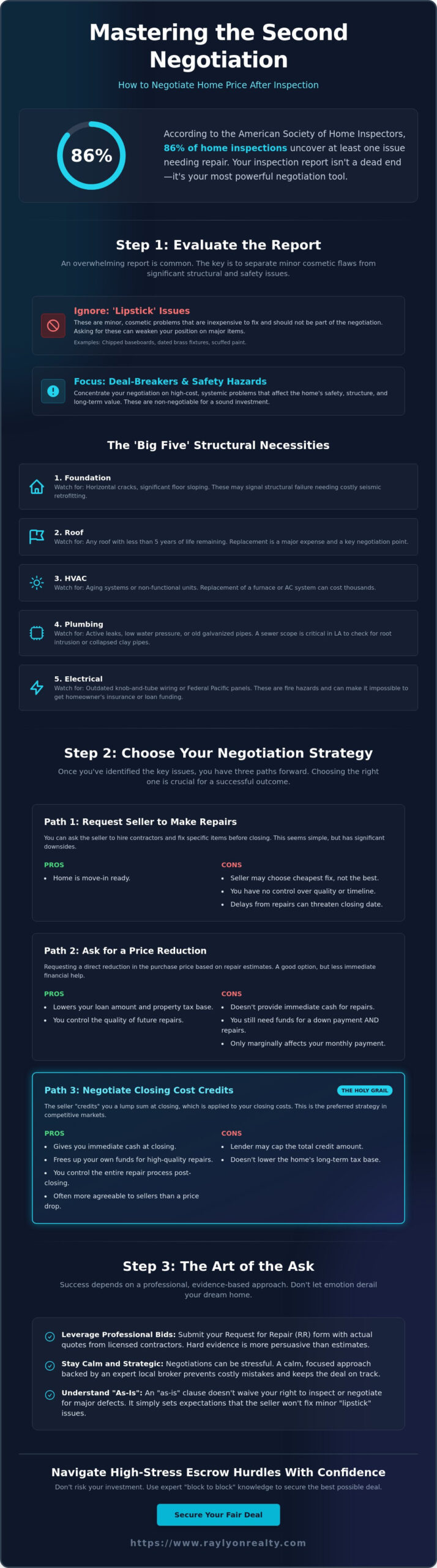
Three Strategic Paths: Repairs, Credits, or Price Reductions
Once you have your inspection report in hand, you’re at a critical crossroads. Negotiating home price after inspection isn’t just about the final number; it’s about how that value is delivered to you. You have three primary levers to pull: asking for physical repairs, requesting closing cost credits, or seeking a straight reduction in the sales price. Each path has a different impact on your bank account and your long-term mortgage payments.
Many buyers gravitate toward asking the seller to fix everything on the list. This is often a strategic mistake. Sellers are naturally motivated to find the cheapest and fastest solution to keep the deal moving toward the finish line. This can result in “lipstick on a pig” repairs that meet the bare minimum requirements but fail shortly after you move in. Unless the issue is a deal-breaker for your lender, it’s usually better to handle the work yourself so you can control the quality of the materials and the expertise of the contractors.
The Case for Closing Cost Credits
Closing cost credits are frequently the best option for buyers who want to keep their liquid cash intact. Instead of the seller fixing a leaky pipe, they give you a credit that offsets your closing expenses. If your total closing costs are $18,000 and the seller agrees to a $5,000 credit, you only need to bring $13,000 to the table. This keeps $5,000 in your pocket to address repairs on your own schedule. Taking a credit allows you to vet and hire your own licensed contractors to perform the work after the property is officially yours. Be aware that most conventional lenders limit these credits to 3% or 6% of the purchase price, depending on your down payment amount.
When to Demand Physical Repairs
There are specific instances where you should insist the seller handles the work before escrow closes. These are typically “must-fix” items that involve safety or loan eligibility. In California, sellers are legally required to ensure water heaters are double-strapped for earthquake safety and that smoke detectors are properly installed. If a roof is so damaged that an insurance company refuses to issue a policy, the seller must address it, or the loan won’t fund. When you demand repairs, always include these requirements in your request:
- Work must be performed by a licensed and bonded professional in that specific trade.
- The seller must provide copies of all paid invoices and receipts into escrow.
- Work must be completed at least 3 to 5 days before the final walkthrough so you can verify the fix.
If you don’t need immediate cash and the home is safe to inhabit, a straight price reduction is a clean way to handle negotiating home price after inspection. This lowers your total loan amount and your monthly interest payments for the next 30 years. It’s an excellent tool for addressing “future” problems, like an HVAC system that’s 15 years old but still functioning.
The Art of the Ask: Negotiation Tactics for the Westside Market
Negotiating home price after inspection in the Westside isn’t about being aggressive; it’s about being the most prepared person in the room. Sellers in neighborhoods like Venice or Brentwood are often savvy homeowners who have seen it all. Your request must be backed by undeniable data rather than emotional pleas. This strategy transforms a tense confrontation into a business discussion centered on market value.
Using Bids as Leverage
When you ask for a price reduction, numbers on a page carry more weight than opinions. If an inspector finds a foundation issue or an aging HVAC system, don’t just guess the cost. We recommend getting a formal bid from a licensed professional immediately. To secure a $10,000 credit, you should ideally present a $12,000 contractor bid. This 20% buffer accounts for the unexpected costs that frequently pop up during Westside renovations.
Ray Lyon Realty uses its deep network of local contractors to get these accurate quotes quickly. This speed is vital because your contingency period is likely short. Once you have the bid, give the seller a choice: they can hire the crew to fix the issue before closing, or they can credit you the amount so you can oversee the work yourself. Most sellers prefer the credit because it removes their liability and lets them close the deal faster. It also gives you total control over the quality of the repair.
Reading the Market Temperature
Your leverage depends entirely on the local climate. In Santa Monica, where inventory is often tight, a seller might have three backup offers waiting. If those backups are “as-is” or cash, your room for negotiating home price after inspection shrinks significantly. However, if a property in Mar Vista has sat for more than 21 days, the seller’s urgency increases. We look at the “Days on Market” (DOM) to determine how much pressure we can apply.
Focus your requests on “Big Rock” items like roofing, electrical, or plumbing. Avoid nickel-and-diming for small cosmetic issues like chipped paint or loose doorknobs. This keeps the seller on your side and shows you’re acting in good faith. You also need to create a narrative. If the inspection reveals $30,000 in dry rot, explain that the home’s original “turn-key” price no longer reflects its actual condition. If the seller refuses to budge on a major structural repair and you’re already at the top of your budget, you have to know your walk-away point. A deal only works if the math makes sense for your long-term investment goals.
Navigating the Final Hurdle with Ray Lyon Realty
Escrow feels like a pressure cooker. It is the standard 17-day window in California where most deals either solidify or crumble. When you’re negotiating home price after inspection, you don’t just need a paper pusher. You need a broker who understands the actual bones of a house. Ray Lyon Realty brings “block to block” knowledge to every transaction. We’ve spent years walking the streets of the Westside, seeing which homes were built to last and which ones were just given a quick coat of “lipstick” to hide deeper issues.
Our goal is to protect your investment from the moment your offer is accepted. We help you move toward contingency removal with total confidence. By identifying the real value where others only see problems, we ensure you aren’t overpaying for a property with deferred maintenance. We stay calm so you can stay focused on your move. Our strategic approach includes:
- Analyzing the inspection report to separate cosmetic flaws from structural “deal-breakers.”
- Leveraging Ray’s network of trusted contractors for immediate, accurate repair estimates.
- Maintaining a professional, firm stance with the seller’s agent to secure credits or price reductions.
- Ensuring all paperwork is finalized correctly to move toward a successful close.
We don’t just find you a house; we find you a sound investment. By the time we reach the final walkthrough, you’ll know exactly what you’re buying. This clarity is what turns a high-stress escrow into a celebratory closing day.
Why Experience Matters in Inspection Negotiations
Ray isn’t just an agent; he’s a builder. Having personally managed home flips and construction projects, he views a 50-page inspection report through a different lens. He knows what a specific repair should cost and which contractors can get it done right. This hands-on background is why we are considered leading real estate agents in los angeles ca for savvy buyers. We bridge the gap between a scary report and a smart purchase, ensuring you get top dollar value for your investment.
Ready to Find Your Next Westside Home?
The Westside market moves fast, especially in highly sought-after pockets. If you’re looking for a community with character and great schools, explore our latest mar vista los angeles listings. We are ready to help you find a home that fits your lifestyle and your portfolio. Negotiating home price after inspection is easier when you have a strategist in your corner.
Schedule a strategy session today to discuss your upcoming purchase or sale. Whether you’re a first-time buyer or a seasoned investor, Ray Lyon is here to guide you through every hurdle. Contact us for a consultation and let’s get you into your next home.
Secure Your Westside Investment with Confidence
Mastering the second negotiation is about more than just reading a report. It’s about knowing which structural issues require a hard line and which cosmetic “lipstick” fixes can be handled later. Whether you’re eyeing a bungalow in Mar Vista or a contemporary estate in Santa Monica, success comes down to choosing the right path between repairs, credits, or a price reduction. Successfully negotiating home price after inspection demands a strategy backed by real-world experience. Ray Lyon brings a unique perspective to your escrow, drawing from his personal background in building and flipping homes to spot what others miss. You don’t have to guess about repair costs when you have direct access to a vetted network of Westside contractors who provide reliable estimates on the fly. This block to block knowledge ensures you never overpay for a property with hidden headaches. Let’s turn that inspection report into your strongest bargaining chip.
Schedule a Strategy Session with Ray Lyon to Navigate Your Escrow
You’ve found the right house; now let’s make sure it’s the right investment for your future.
Frequently Asked Questions
Can a seller back out of a deal if I ask for repairs after the inspection?
No, a seller cannot typically back out of a deal just because you ask for repairs during your contingency period. In California, the standard Residential Purchase Agreement protects buyers who are negotiating home price after inspection. The seller has the right to refuse your request, but they can’t cancel the contract unless you fail to remove your contingencies by the agreed-upon deadline.
What are the most common mandatory repairs required by law in California?
California law requires three specific safety items to be in place before a property sale can close. Sellers must install functioning smoke alarms in every bedroom, place carbon monoxide detectors on every level, and ensure water heaters are double-strapped to meet seismic safety standards. These requirements come from the California Health and Safety Code and are usually non-negotiable during the escrow process.
Is it better to ask for a price reduction or a closing cost credit?
A closing cost credit is often better for buyers who want to keep more cash in their bank accounts on moving day. While a price reduction lowers your monthly mortgage payment by a small amount, a credit directly reduces the thousands of dollars you owe at the end of the transaction. Most lenders allow these credits up to 3% or 6% of the purchase price depending on your specific loan program.
How do I know if an inspection finding is a ‘deal-breaker’?
A deal-breaker is typically a major structural or safety failure that costs more than 1% of the home’s purchase price to repair. Issues like a cracked foundation, active termite infestations, or outdated knob-and-tube wiring often fall into this category. You should weigh these high-cost items against your budget and the property’s potential resale value in the competitive Los Angeles market.
What happens if the seller refuses to make any repairs or give credits?
You have the choice to either move forward with the purchase as-is or cancel the contract and receive your earnest money deposit back. This assumes you haven’t yet signed the formal contingency removal form. If the seller won’t budge, we’ll look at the total cost of deferred maintenance to see if the property still makes financial sense for your long-term goals.
Can I negotiate the price after the appraisal if it comes in low?
Yes, you can negotiate the price if the appraisal comes in lower than the contract price and you have an appraisal contingency. If the bank values the home at $950,000 but you’re under contract for $975,000, the seller often agrees to lower the price to bridge that $25,000 gap. Without this adjustment, you’d have to cover the difference in cash to secure your loan approval.
Should I get a specialized inspection for the sewer line and roof?
You should definitely get specialized inspections for the sewer line and the roof, especially in older Los Angeles neighborhoods. A standard general inspection only provides a surface-level look. A sewer scope uses a camera to find hidden root intrusions or pipe collapses that can cost $10,000 or more to repair. Similarly, a dedicated roof inspector can identify the remaining lifespan of tiles more accurately.
How much does a typical home inspection cost in Los Angeles?
A general home inspection in Los Angeles typically costs between $400 and $600 according to local service provider averages. Prices fluctuate based on the property’s square footage and age. Specialized add-ons, like a $250 sewer scope or a $150 chimney check, are common for older homes. These fees are a strategic investment that gives you the data needed for negotiating home price after inspection.