

Navigating the Los Angeles real estate market can feel like trying to read a map in the dark. One headline screams ‘market crash,’ while another predicts a surge, leaving you caught between the fear of buying at the peak and the worry of being priced out forever. That’s why we’re cutting through the noise with a clear, data-driven analysis of the los angeles real estate market trends 2026.
In this expert forecast, we’ll break down what the numbers are *really* telling us. We’ll dive into the key factors set to influence home prices, inventory levels, and interest rates two years from now. More importantly, we’ll translate that complex data into straightforward, actionable strategies whether you’re looking to buy, sell, or invest in LA.
Our goal is to replace confusion with confidence. This guide is designed to give you the clarity and strategic advantage you need to make a smart, informed decision for your future. Let’s get started.
Key Takeaways
- Get our data-backed forecast for home prices and sales volume to navigate the los angeles real estate market trends 2026 with confidence.
- Discover specific, expert-backed strategies for buyers, sellers, and investors to achieve their unique goals in the evolving market.
- Understand how the homeowner “lock-in effect” will continue to influence inventory levels and what it means for your timing.
- Go beyond city-wide data with a hyper-local analysis of how 2026 trends will specifically impact key Westside neighborhoods.
Setting the Stage: How 2024-2025 Trends Are Shaping 2026
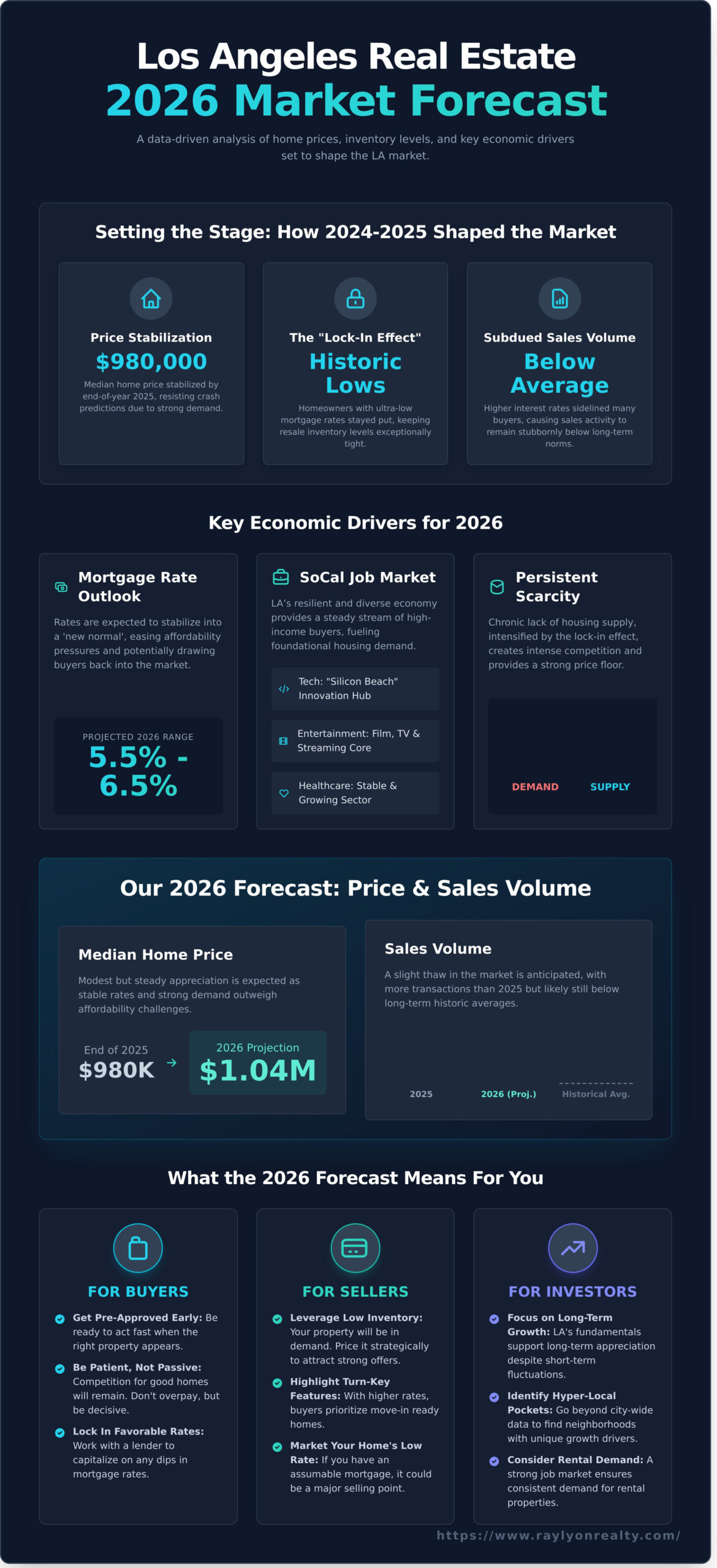
To accurately forecast the los angeles real estate market trends 2026, we first need to understand the critical shifts that occurred over the past two years. The period from 2024 to 2025 was defined by a market in transition. Gone were the frenzied bidding wars of the pandemic; in their place, we saw a more calculated environment shaped by high interest rates, persistent inflation, and economic uncertainty. This created a significant “lock-in effect,” where homeowners with ultra-low mortgage rates from previous years chose to stay put rather than sell and face a much higher monthly payment.
For a clear visual breakdown of these foundational shifts, the following video offers an excellent overview:
This dynamic influenced both buyers and sellers, setting a specific baseline as we head into 2026. By the end of 2025, the Los Angeles median home price stabilized near $980,000, with sales volume remaining stubbornly below long-term averages. Let’s break down the key factors that brought us here.
The Interest Rate Rollercoaster
The Federal Reserve’s aggressive rate hikes throughout 2024 sent shockwaves through the market, pushing mortgage rates to two-decade highs and sidelining many prospective buyers. While 2025 brought a period of relative stabilization and even modest rate dips, the damage to affordability was done. This period solidified the importance of interest rates as the primary lever controlling market activity, making the Fed’s 2026 policy decisions the most critical factor to watch.
Inventory Levels: The Persistent Scarcity
Los Angeles has long struggled with a lack of housing supply, and the 2024-2025 market only tightened the screws. The lock-in effect kept resale inventory at historic lows. This scarcity is a core tenet of the LA market, a problem compounded by California’s ongoing housing shortage, which new construction has been unable to resolve. The result? Intense competition for well-priced, desirable homes, which has kept a solid floor under property values.
Price Adjustments vs. Price Crashes
It’s crucial to distinguish between a market correction and a crash. While some headlines fueled fears of a crash, what we actually witnessed were modest price adjustments, typically in the 5-10% range, concentrated in specific submarkets. A crash implies a rapid, widespread drop of 20% or more. This never materialized in LA due to foundational demand from a strong job market and the chronic inventory shortage, which continues to support prices.
Key Economic Drivers for the 2026 Los Angeles Market
The Los Angeles real estate market never exists in a vacuum. To truly understand the los angeles real estate market trends 2026, we have to look at the powerful forces shaping it from both a national and a local perspective. While affordability remains a significant challenge, it’s constantly balanced by a world-class job market and strong demographic demand. As we look ahead, the interplay between these key drivers will define the opportunities for both buyers and sellers. The official 2026 California Housing Market Forecast highlights many of these same dynamics, reinforcing their importance across the state.
Federal Reserve Policy and Mortgage Rate Outlook
All eyes remain on the Federal Reserve. By 2026, we anticipate that the turbulence of the past few years will have settled, with mortgage rates finding a ‘new normal,’ likely in the 5.5% to 6.5% range. While this is higher than the historic lows we once saw, stability is key. Even a small quarter-point change can significantly impact your monthly payment and overall purchasing power, making it crucial to work with a lender who can help you lock in a favorable rate when the time is right.
The Southern California Job Market
LA’s resilient economy is the engine that powers housing demand. Key sectors continue to thrive, providing a steady stream of qualified, high-income buyers. We are closely watching employment trends in:
- Tech: “Silicon Beach” remains a global hub for innovation and venture capital.
- Entertainment: The film, television, and streaming industries are foundational to LA’s identity and economy.
- Healthcare: A massive and consistently growing sector providing stable, long-term employment.
As more companies solidify their return-to-office policies, we expect to see renewed demand in neighborhoods with convenient commutes, further influencing local price points.
State & Local Housing Policies
For years, the story of LA real estate has been one of high demand and critically low supply. State and local governments are actively working to change this narrative. Policies encouraging the construction of Accessory Dwelling Units (ADUs) and legislation designed to increase housing density are slowly beginning to add much-needed inventory. While these initiatives won’t solve the housing shortage overnight, their cumulative effect by 2026 will be a key factor in stabilizing the los angeles real estate market trends 2026 and creating new opportunities for homeowners and investors.
Our 2026 Forecast: What to Expect for LA Home Prices & Sales
Navigating the future of LA real estate requires a clear, data-driven perspective. While no one has a crystal ball, our analysis of economic indicators and expert projections points towards a market that is shifting from frantic to more fundamentally sound. Understanding the key los angeles real estate market trends 2026 is the first step to making a smart move. Keep in mind, this is a county-wide forecast; neighborhoods from Santa Monica to Pasadena will have their own unique dynamics.
LA Market Forecast 2026: At a Glance
- Median Home Price: Modest appreciation of 2-4%
- Home Sales Volume: Slight increase of 3-5% year-over-year
- Average Days on Market: 30-40 days
- Market Condition: Shifting from a strong seller’s market towards a more balanced environment.
Home Price Projections: A Shift Towards Stability
The era of double-digit price hikes is likely behind us. For 2026, we expect home prices to stabilize, with modest and more sustainable appreciation. The primary reason is affordability; with mortgage rates expected to remain elevated compared to historic lows, runaway price growth simply isn’t feasible for most buyers. Projections from major industry groups, including the 2026 California Housing Market Forecast, support this view of tempered growth. We anticipate the luxury sector may see some softening, while well-priced, entry-level homes will continue to see strong competition.
Sales Volume & Market Pace: A Thaw in Activity
After a few years of gridlock, expect to see more “For Sale” signs in 2026. We predict a slight but meaningful increase in the number of homes sold as buyers and sellers adjust to the new normal for interest rates. While the market will still lean in favor of sellers due to persistent low inventory, buyers will have slightly more breathing room. A typical, well-marketed property will likely go into contract within 30-40 days, a healthier pace than the frenzied bidding wars of the recent past.
The Wildcard: Inventory Growth
The biggest variable for the los angeles real estate market trends 2026 is inventory. Will homeowners who locked in sub-3% mortgage rates finally decide to move? We believe a small but growing number will, driven by major life events like new jobs or growing families. Even a modest increase in the number of available homes for sale would be a significant development. More inventory means more choices for buyers, less upward pressure on prices, and a crucial step toward a more balanced and sustainable real estate market for everyone.
What the 2026 Forecast Means for You: Buyer, Seller & Investor Strategies
A forecast is just a set of data until you know how to use it. As someone who has built, bought, and sold my own properties right here in LA, I know that success comes from turning market knowledge into a smart, personalized plan. The shifting los angeles real estate market trends 2026 present unique opportunities and challenges. Here’s how to navigate them, whether you’re buying, selling, or investing.
Guidance for Home Buyers in 2026
For buyers, 2026 is about preparation and precision. While the market may offer more breathing room than in previous years, the best properties will still move quickly. To give yourself a competitive advantage, you must:
- Get Fully Pre-Approved: Don’t just get pre-qualified. A full underwriting pre-approval shows sellers you are a serious, capable buyer ready to close.
- Be Ready for Competition: Well-priced, well-maintained homes in prime neighborhoods will still attract multiple offers. We’ll work together to craft a compelling offer that stands out.
- Explore Opportunities: Some neighborhoods may see price corrections or slower growth. This is where we can find hidden gems and opportunities for value that others might overlook.
Advice for Home Sellers in 2026
If you’re thinking of selling, success in 2026 will be defined by strategy, not just timing. The frenzied days of collecting 20 offers sight-unseen are likely behind us. Instead, focus on the fundamentals: pricing and presentation are non-negotiable. Your home needs a sophisticated marketing strategy that targets the right pool of qualified buyers. This means more than a sign in the yard-it means professional staging, high-quality photography, and a digital campaign designed to create demand. A carefully prepared home, priced correctly from the start, is the key to securing top dollar.
Opportunities for Real Estate Investors
For savvy investors, a more balanced market uncovers new avenues for growth. The key is knowing where to look. Multi-family units remain a strong bet, buoyed by LA’s persistent rental demand. Properties that need some work-the ones with “good bones” but deferred maintenance-can also offer significant returns for those willing to put in the work. While short-term flips require careful calculation, the long-term buy-and-hold strategy continues to be a proven wealth-builder in Southern California. The core demand for housing here isn’t going away.
Navigating these los angeles real estate market trends 2026 requires a partner with deep, block-to-block knowledge. Your goals are unique, and your strategy should be too. Let’s build your personal real estate strategy for 2026.
Westside Spotlight: How 2026 Trends Will Impact Key Neighborhoods
Understanding the broader los angeles real estate market trends 2026 is one thing, but knowing how they will affect a specific street or neighborhood is where true expertise makes a difference. As Westside specialists, we see these macro trends play out on a block-by-block basis. Here’s our on-the-ground perspective for the communities we know best.
Santa Monica: Enduring Appeal and Luxury Stability
Santa Monica’s “blue-chip” status isn’t going anywhere. Its world-class location, top-tier schools, and vibrant lifestyle create a floor for property values that few other areas can match. We predict the condo market will remain a popular entry point for those seeking the 90402 lifestyle, while single-family homes will continue to be viewed as legacy assets. Expect sustained demand from a mix of local move-up buyers and international clients looking for a stable investment, keeping the market resilient against wider economic shifts.
Mar Vista: The Hub of Single-Family Home Demand
Mar Vista will continue its evolution into one of the Westside’s most desirable family hubs. Its central location and community feel are powerful draws. The trend of large-scale remodels and new construction on larger lots will persist, steadily raising the neighborhood’s average price point. By 2026, we anticipate that well-maintained, turnkey homes will command a significant premium, often attracting multiple offers as inventory for quality family homes remains tight.
Venice: The Intersection of Culture and Real Estate
Venice’s market dynamics will remain as unique as its culture. The key variable here is the health of the tech industry. A strong “Silicon Beach” in 2026 will fuel demand for high-end architectural homes and properties near Abbot Kinney. Conversely, a tech downturn could create buying opportunities. Classic beach bungalows will retain their timeless appeal, attracting buyers who value historic charm and are willing to invest in renovations. This dual market of modern design and vintage character will continue to define Venice real estate.
Navigating these distinct micro-markets requires more than just data; it requires deep local knowledge and a strategic approach. If you are considering buying or selling on the Westside, let’s connect and create a plan tailored to your goals.
Your Strategic Advantage in the 2026 Los Angeles Real Estate Market
As we look toward 2026, the forecast is clear: the Los Angeles market will present unique opportunities for savvy buyers, sellers, and investors. Success will hinge on understanding the key economic drivers and the specific micro-trends shaping desirable Westside neighborhoods. Navigating the predicted shifts in inventory and pricing requires more than just data; it demands a strategic, forward-thinking approach.
Understanding the core los angeles real estate market trends 2026 is the first step, but turning that knowledge into a successful outcome is where expert guidance becomes invaluable. With a proven track record representing both buyers and sellers, deep, block-to-block knowledge of Westside LA, and personal experience as a local investor and developer, we offer a perspective that goes beyond the headlines.
Whether you’re planning your first purchase or positioning a key investment, the right strategy makes all the difference. Thinking of buying or selling in 2026? Let’s talk about your strategy. Together, we can turn market predictions into your personal success story.
Frequently Asked Questions About the LA Real Estate Market
Is the Los Angeles housing market going to crash in 2026?
A crash like the one in 2008 is highly unlikely. The market today is built on stronger fundamentals, including stricter lending standards and a chronic housing shortage that fuels demand. While price growth may slow down or we see a minor correction, the core economic drivers of Los Angeles remain robust. We anticipate a period of stabilization or modest growth rather than a sharp downturn, as underlying demand for LA property remains consistently high.
Will it be easier to buy a house in Los Angeles in 2026?
While “easy” isn’t the first word that comes to mind for LA real estate, 2026 may offer some relief for buyers. We expect a more balanced market with slightly more inventory and less of the frantic bidding wars seen in previous years. However, affordability will continue to be a significant hurdle. Navigating the los angeles real estate market trends 2026 will still require a solid strategy and an experienced agent to help you find the right opportunities.
Are mortgage rates expected to go down in 2026?
Most economists predict that mortgage rates will stabilize or see a modest decrease by 2026 as the broader economy cools. However, a return to the historic lows of 2020-2021 is not expected. Buyers should prepare for rates that are more in line with historical norms. The best approach is to get pre-approved to understand your purchasing power and be ready to act when you find the right home, regardless of minor rate fluctuations.
What is the best month to buy a house in Los Angeles?
If you’re looking for less competition and potentially more motivated sellers, the best time to buy is typically in the late fall and winter months (October through January). The market slows down during the holidays, creating opportunities for savvy buyers. While the spring and summer have the most listings, they also have the most competition, which often leads to higher prices. An off-season search can give you a valuable competitive edge.
Is Los Angeles real estate still a good long-term investment?
Absolutely. Over the long term, Los Angeles real estate has consistently proven to be a superb investment. The city’s limited land, diverse economy, and international appeal create a foundation for steady appreciation. While market conditions fluctuate year to year, owning property in a world-class city like LA remains one of the most reliable ways to build significant, long-term wealth. It’s a marathon, not a sprint, and history shows that patience pays off.
Should I sell my LA home in 2026 or wait?
The decision to sell always depends on your personal financial and life goals. The 2026 market is projected to be more balanced, which can be an excellent environment for homeowners who are looking to sell and buy in the same area. If you’re relocating, downsizing, or need to cash in on your equity, it could be a very strategic time. The best first step is to get a professional home valuation to understand your position and plan accordingly.