

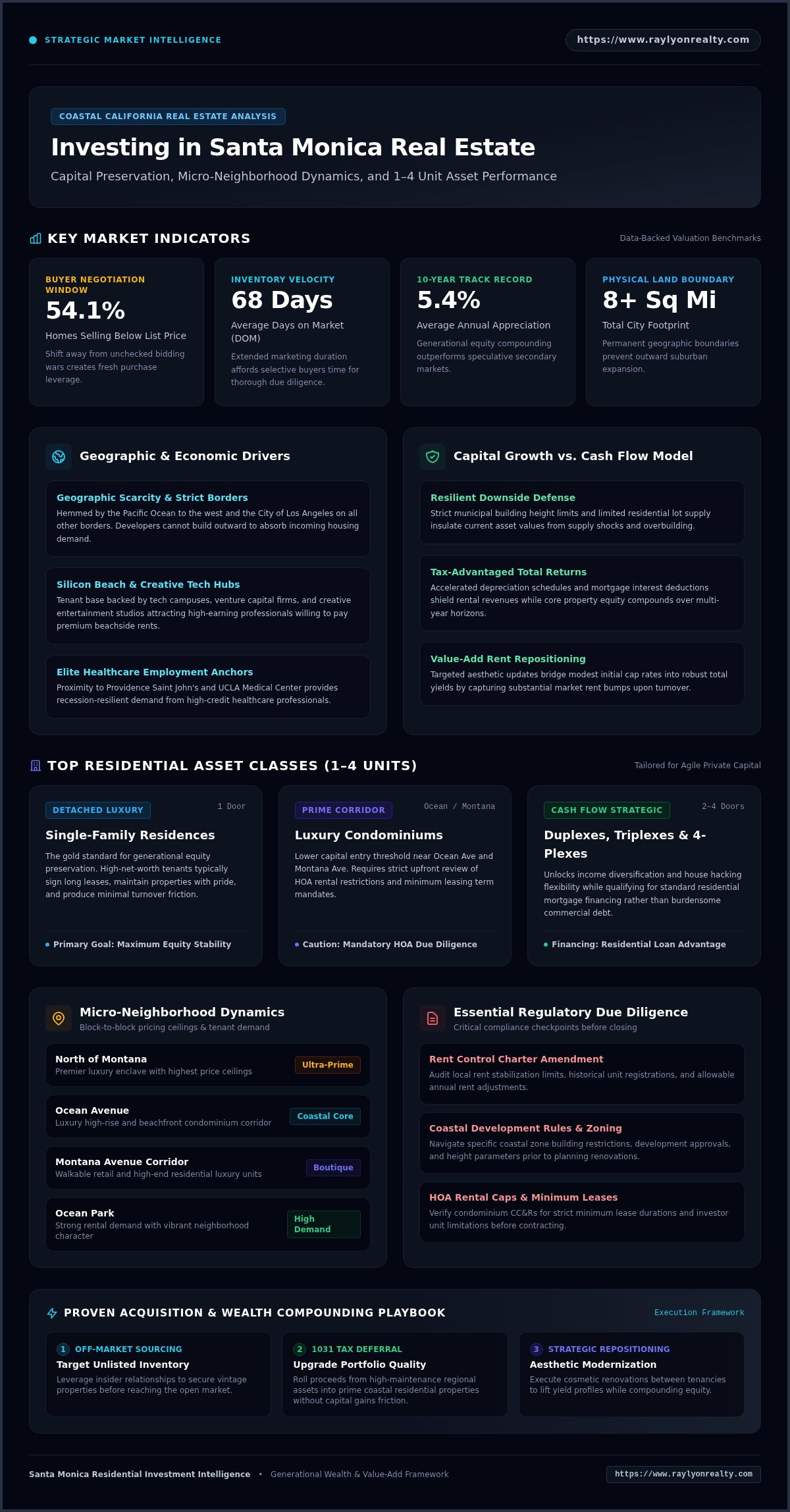
With 54.1% of homes selling below list price and properties averaging 68 days on the market, investing in santa monica real estate in 2026 is no longer defined by unchecked bidding wars. If you’ve hesitated to deploy capital here, that hesitation is completely natural. Compressing cap rates, local rent stabilization limits, and aggressive all-cash buyers can make finding upfront cash flow feel like an uphill battle.
The reality is that prime coastal assets continue to produce superior total returns, but only when you drive performance through proactive, hands-on value-add strategies. In this guide, you’ll discover how to identify high-yield residential assets, navigate coastal zoning regulations, and build long-term wealth across the Westside. We’ll examine the block-to-block shifts granting buyers fresh leverage, smooth 1031 exchange tactics, and how insider access unlocks off-market inventory before it reaches the open market.
Key Takeaways
- Explore why geographic barriers and strict zoning preserve long-term capital stability when investing in santa monica real estate.
- Compare single-family homes, luxury condominiums, and multi-unit residential properties to match your specific risk profile and appreciation goals.
- Uncover how micro-neighborhood dynamics, from North of Montana to Ocean Park, impact tenant demand and investment price ceilings.
- Master essential regulatory due diligence, including the local Rent Control Charter Amendment and coastal development rules, before closing.
- Discover proven acquisition playbooks, including off-market deal sourcing and tactical 1031 exchange strategies, to maximize portfolio performance.
Why Investing in Santa Monica Real Estate Delivers Long-Term Capital Growth
Santa Monica sits in a rare geographic pocket. Hemmed in by the Pacific Ocean to the west and Los Angeles on all other borders, the city spans just over eight square miles. As detailed in this geographic Overview of Santa Monica, strict municipal borders mean developers cannot build outward to absorb new housing demand. For buyers, this permanent physical constraint creates a natural buffer under residential valuations that inland markets simply can’t replicate.
To see firsthand how coastal land scarcity shapes the city’s premier enclave, take a tour of the local luxury landscape:
Macro Drivers: Geographic Scarcity and Silicon Beach Demand
When investing in santa monica real estate, your tenant base is backed by some of Southern California’s strongest economic engines. Silicon Beach tech campuses, venture capital firms, and creative entertainment studios draw high-earning professionals who willingly pay a premium for short commutes and beachside living. Proximity to elite healthcare networks like Providence Saint John’s and UCLA Medical Center adds another layer of stability, delivering high-credit tenants through every economic cycle.
Capital Preservation vs. Cash Flow: Setting Realistic Expectations
Santa Monica is rarely an entry point for high upfront cap rates. Instead, savvy buyers focus on generational equity growth and wealth preservation. Property values here achieved an average annual appreciation rate of 5.4% over the last decade, proving that coastal stability consistently outperforms speculative secondary markets.
- Resilient downside defense: Strict building heights and limited lot supply safeguard asset values against overbuilding.
- Tax-advantaged returns: Accelerated depreciation schedules and interest deductions help offset rental income while your equity compounds.
- Value-add upside: Targeted cosmetic upgrades and strategic repositioning unlock substantial rent bumps, bridging the gap between modest initial cash flow and robust total yields.
Top Residential Asset Classes for Santa Monica Property Investors
Most institutional commentary centers strictly on massive apartment blocks. That perspective misses where nimble private capital actually thrives. When investing in santa monica real estate, residential assets spanning one to four units offer accessible leverage, agile exit opportunities, and significant upside through strategic repositioning.
Single-Family Homes and Luxury Condominiums
Single-family residences represent the gold standard for long-term equity preservation. Tenants in high-end detached properties typically stay longer, handle routine upkeep with pride, and generate stable rent collections with near-zero turnover friction. On the other hand, luxury condos near Ocean Avenue or along Montana Avenue offer a lower capital entry barrier. If you target condominiums, verify HOA rental caps and minimum lease durations during initial contract reviews to prevent unexpected leasing restrictions.
Small Multi-Unit Residential (2-4 Units)
Duplexes, triplexes, and fourplexes sit in a strategic sweet spot. They unlock the risk mitigation of multiple rental checks while qualifying for standard residential mortgage financing rather than burdensome commercial debt structures. Key benefits include:
- Income diversification: A single vacancy won’t wipe out your monthly revenue stream.
- House hacking flexibility: Owner-investors can live in one unit while offsetting mortgage obligations with the adjacent doors.
- Operational agility: Smaller footprints allow you to renovate individual spaces between tenancies without displacing an entire building.
1031 Exchange Replacement Properties and Value-Add Flips
For investors moving out of high-maintenance regional properties, deploying proceeds into coastal residential trades defers hefty capital gains while upgrading your overall portfolio quality. The highest returns often stem from classic properties needing modern aesthetic refreshes. Upgrading tired kitchens, swapping fixtures, and rethinking indoor-outdoor flow capture immediate market equity.
Executing this successfully demands an operator mindset. Having a seasoned professional who understands contractor costs and floor plan optimization makes all the difference. To uncover off-market properties primed for strategic renovation, consult with the specialists at Ray Lyon Realty to evaluate potential returns through an experienced builder lens.
Evaluating Santa Monica Neighborhoods: Where to Deploy Capital
Santa Monica isn’t a monolithic housing market. Real estate performance varies sharply from block to block, where crossing a single boulevard alters lot sizes, school boundaries, and tenant profiles. Success when investing in santa monica real estate depends on matching your financial horizon with the distinct profile of each micro-neighborhood.
North of Montana: The Ultra-Luxury Capital Preservation Play
Running from Montana Avenue up to the San Vicente bluffs, this enclave represents pure wealth preservation. Lots regularly exceed 8,000 square feet, accommodating expansive architectural estates that attract high-profile executives, founders, and established families. Premium public school assignments and quiet residential streets create fierce, recession-resistant appeal. While gross yields are naturally tight, downside risk is virtually non-existent during broad market pullbacks.
Ocean Park and Mid-City: Prime Rental Demand Hubs
South toward the Venice border, Ocean Park pulses with foot traffic, beach culture, and historic craftsman charm. Tenants here prioritize lifestyle above all else. They want to walk to coffee shops along Main Street and bike down to the sand within five minutes. Turnaround time between vacancies is exceptionally swift. Mid-City, positioned slightly further east, offers convenient proximity to the E Line rail and major commercial studios, drawing medical staff and digital media specialists seeking streamlined commutes.
Sunset Park and Pico District: Value-Add and Growth Opportunities
If your strategy centers on forced equity and square-footage expansion, Sunset Park offers compelling fundamentals. The neighborhood features classic mid-century bungalows sitting on deep, flat parcels. These properties are ideal candidates for strategic upgrades:
- ADU development potential: Generous rear yards frequently allow detached accessory dwelling units or two-story garage conversions.
- Reconfiguration upside: Older, segmented floor plans can be converted into bright, open-concept living areas that capture modern aesthetic expectations.
- Lower initial price per square foot: A more accessible basis relative to coastal bluffs leaves healthier room for renovation budgets and equity growth.
Balancing these distinct submarkets ensures you don’t overpay for the wrong asset type. Whether you choose North of Montana for pristine capital preservation or Sunset Park for high-upside repositioning, aligning neighborhood dynamics with your core objective is essential for long-term portfolio growth.
Essential Due Diligence: Navigating Santa Monica Regulations and Zoning
Rigorous due diligence separates profitable acquisitions from costly oversights. While Santa Monica offers unmatched capital security, municipal rules are exceptionally strict. Anyone investing in santa monica real estate must inspect local municipal codes, title histories, and structural integrity before removing contract contingencies.
Santa Monica Rent Control and Tenant Protection Laws
Most residential multi-unit structures constructed before April 10, 1979, fall under the Santa Monica Rent Control Charter Amendment. These rules differ significantly from general California state law and City of Los Angeles ordinances. For the period running through August 31, 2026, the maximum allowable annual general rent increase is 2.3%, capped firmly at $60 per month. Landlords can pass through up to half of the annual registration fee to tenants, which amounts to $10 per unit per month. Fortunately, the Costa-Hawkins Rental Housing Act exempts single-family homes and separately alienable condominiums from vacancy control, allowing market-rate pricing upon new lease execution.
Unlocking Density: California ADU Laws and Lot Optimization
State ADU legislation creates substantial upside for strategic buyers. Adding an accessory dwelling unit or converting an underutilized detached garage immediately boosts rentable square footage. Single-family zoning (R1) limits primary building heights to 28 feet and two stories, while multifamily zones (R2, R3, R4) permit 30 to 50 feet. Before committing to architectural plans, verify setback parameters, main electrical panel capacity, and sewer lateral conditions to avoid costly infrastructure surprises.
Structural Due Diligence: Soft-Story Retrofits and Coastal Maintenance
Physical inspections require a sharp eye for coastal exposure and municipal retrofit mandates. Keep these critical checklist items front and center during your inspection timeline:
- Seismic compliance: Two-to-four unit properties featuring tuck-under parking must meet Santa Monica mandatory soft-story seismic retrofit standards.
- Salt-air corrosion: Marine air degrades standard exterior metals and stucco quickly; evaluate framing ties, balcony railings, and window flashing.
- Official rent board registry checks: Cross-check documented registration certificates directly with the Santa Monica Rent Control Board to confirm lawful base rents.
Evaluating these complex technical layers requires boots on the ground and true Westside experience. To protect your downside and evaluate target inventory through an experienced investor lens, partner with Ray Lyon Realty before submitting your next offer.
How to Build a Winning Santa Monica Real Estate Acquisition Strategy
Public listings only tell half the story on the Westside. High-performing coastal deals rarely linger on syndication portals waiting for multiple bids to pile up. Successfully investing in santa monica real estate requires an active pipeline, disciplined underwriting, and creative negotiation terms that solve a seller’s specific problem.
Sourcing Off-Market Inventory and Distressed Assets
Many generational property owners in Santa Monica are ready to simplify their lives. Direct outreach uncovers long-time landlords, inherited family properties, and trust estates looking for discreet, private sales rather than public open houses. These off-market transactions let you bypass emotional bidding wars, negotiate directly with decision-makers, and acquire value-add inventory at an attractive basis.
Structuring Competitive Offers in a Supply-Constrained Market
Price is rarely the only lever in competitive negotiations. Sellers navigating probate, estate distributions, or rigid replacement windows care deeply about certainty and flexibility. You can gain a distinct edge by implementing these tactics:
- Streamlined diligence windows: Conduct pre-offer preliminary research on zoning and municipal registries to safely shorten inspection contingencies.
- Custom closing schedules: Offer extended rent-backs or tailored closing dates to accommodate a seller’s personal transition timeline.
- Clarity and speed: Present fully documented financing or clean proof of funds to remove transaction anxiety upfront.
Understanding these subtle levers is why seasoned buyers study how expert real estate agents in Los Angeles CA structure offers that sellers accept over marginally higher, unpredictable bids.
Partnering with Ray Lyon Realty for Your Westside Portfolio
Securing prime residential assets takes more than standard MLS access. It demands representation from an advisor who walks properties with an operator’s eye. Operating from 2115 Main Street in Santa Monica, Ray Lyon brings firsthand experience in property flipping, cosmetic repositioning, and portfolio management. We evaluate potential acquisitions through practical construction realities, accurately scoping renovation budgets and identifying ADU capacity before you submit an offer.
Whether you’re executing a delicate 1031 exchange or expanding your luxury footprint across Santa Monica, Venice, and Mar Vista, discreet relationship sourcing delivers access to exclusive private inventory. Reach out today to consult with Ray Lyon Realty on your investment strategy and secure your next Westside asset with total confidence.
Position Your Portfolio for Long-Term Coastal Success
Successfully investing in santa monica real estate comes down to pairing coastal land scarcity with a hands-on value-add mindset. By targeting submarkets tailored to your risk tolerance, navigating local municipal regulations cleanly, and identifying residential assets with ADU or cosmetic upside, you build a resilient foundation for compounding wealth.
Achieving those results requires a partner who understands the market as an investor, not just a salesperson. Based at our boutique headquarters at 2115 Main Street in Santa Monica, Ray Lyon Realty brings decades of firsthand property investment, renovation, and flipping experience to your corner. From guiding intricate 1031 exchanges and estate sales to unlocking discreet off-market inventory, we help you make clear, confident acquisition decisions.
Ready to build lasting equity along the coast? Schedule an investment consultation with Ray Lyon Realty today and discover how an operator’s perspective transforms your portfolio.
Frequently Asked Questions
Is buying rental property in Santa Monica profitable given strict rent control?
Yes, investing in santa monica real estate remains highly profitable when investors prioritize long-term equity growth over upfront yield. Coastal land scarcity and consistent Silicon Beach tenant demand drive superior capital appreciation. Savvy buyers achieve strong returns by targeting post-1979 builds, acquiring exempt single-family residences, or forcing equity through value-add cosmetic renovations and ADU additions that bypass legacy rent caps.
How do California ADU regulations impact Santa Monica single-family home investments?
California ADU laws create an immediate opportunity to increase gross rental revenue and usable square footage on single-family parcels. State-mandated streamlined permitting allows owners to build detached accessory units or convert existing garages without burdensome parking replacement mandates. In neighborhoods like Sunset Park, deep lot dimensions make adding an ADU one of the cleanest strategies to unlock forced equity and expand income.
What are the rules for completing a 1031 exchange into Santa Monica real estate?
To execute a valid 1031 exchange, you must formally identify potential replacement properties within 45 calendar days of selling your relinquished asset and complete the acquisition within 180 days. Both assets must be held for business or investment purposes. You must also work with an independent qualified intermediary to hold proceeds in escrow, preventing taxable constructive receipt of your capital gains during the transaction.
Are single-family homes subject to Santa Monica rent stabilization limits?
No, single-family homes and separately alienable condominiums are exempt from local rent control limits under the California Costa-Hawkins Rental Housing Act. While landlords must still follow general state and local tenancy rules regarding habitability and eviction procedures, you can establish market-rate pricing whenever signing a new lease agreement. This makes single-family properties particularly attractive for investors seeking complete pricing freedom.
What is a soft-story retrofit, and does it affect Santa Monica apartment buildings?
A soft-story retrofit is a structural reinforcement required for multi-unit buildings with tuck-under parking or open ground floors vulnerable to seismic failure. Santa Monica strictly enforces seismic retrofits for wood-frame and non-ductile concrete structures built before modern codes. When evaluating prospective multi-unit properties, review municipal compliance records to confirm whether mandatory structural work has already been completed and signed off by the city.
How does Santa Monica real estate appreciation compare to other Westside Los Angeles neighborhoods?
Santa Monica delivers steadier appreciation and stronger downside protection than most Westside Los Angeles enclaves. With a 10-year historical average annual appreciation rate of 5.4%, coastal supply limits create a protective price floor. While neighboring pockets like Mar Vista offer slightly higher immediate yields, investing in santa monica real estate provides exceptional long-term capital preservation due to institutional prestige, top-rated schools, and strict building caps.
What should an investor look for during physical due diligence in coastal Santa Monica?
Physical due diligence in coastal zones requires assessing accelerated wear from marine moisture and salt air. Inspect exterior stucco, window flashing, structural framing ties, and balcony waterproofing for signs of corrosion or water intrusion. In addition, evaluate main electrical panel capacity, inspect sewer lines with video scopes, and cross-reference municipal building permits with the local rent registry before removing inspection contingencies.