

Imagine sitting at the dinner table, looking around at rooms that feel too quiet or a mortgage that feels too heavy, knowing it’s time for a change while your partner remains firmly rooted. You might be wondering how to convince my spouse it’s time to sell without sparking a month-long argument. It’s a delicate balance. You want to protect your relationship while also protecting your financial future.
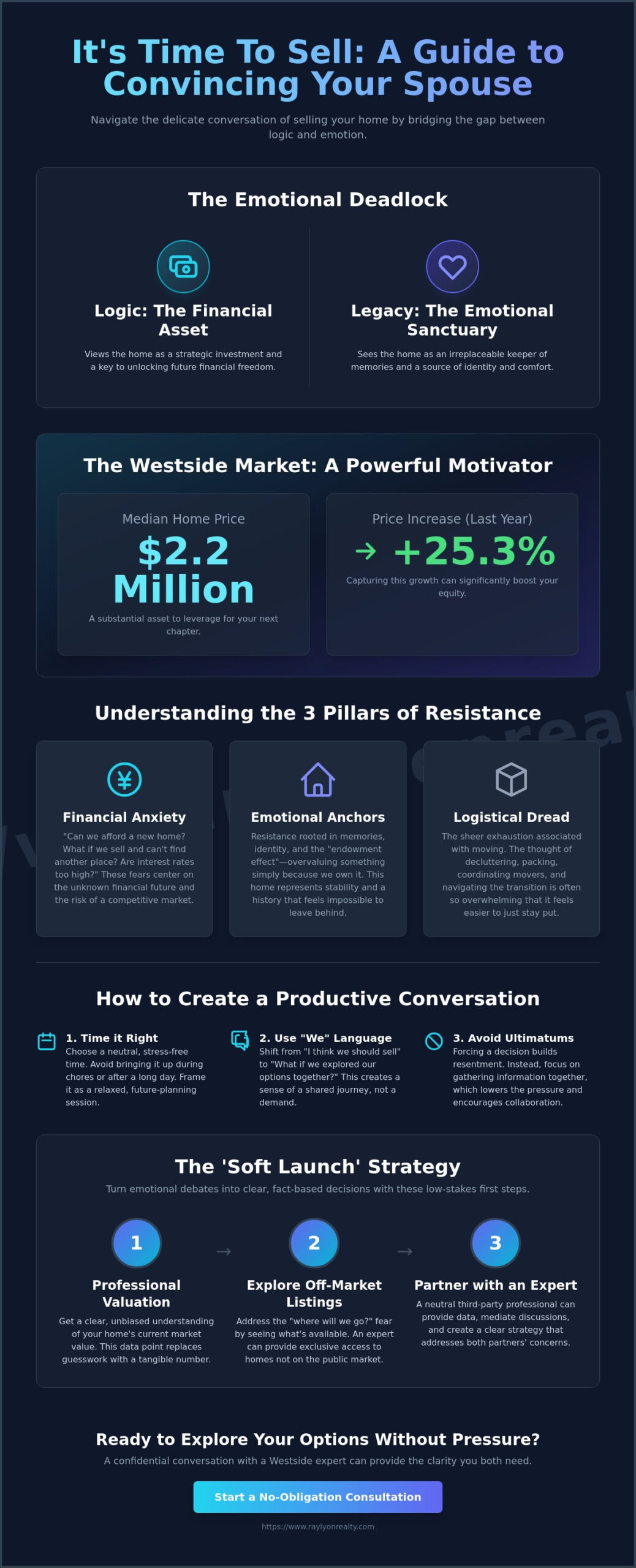
We understand that the emotional ties to a family home are just as real as the equity you’ve built. With Westside home prices up 25.3% over the last year to a median of $2.2 million, the strategic window to move might be closer than your partner realizes. This guide will help you navigate these complex conversations by blending genuine empathy with current market data. You’ll learn how to present a clear plan that addresses their fears, maximizes your equity, and ensures you both feel excited about the next chapter of your lives together.
Key Takeaways
- Identify if your partner views your home as a financial asset or an emotional sanctuary to help bridge the communication gap.
- Learn how to convince my spouse it’s time to sell by addressing the three pillars of resistance, including the fear of navigating a competitive buy-side market.
- Use current Westside market data to show the potential ROI of selling now and how those funds can fuel your next lifestyle chapter.
- Explore low-stakes strategies like a professional property valuation to turn emotional debates into clear, fact-based decisions.
- See how partnering with a local expert provides exclusive access to off-market listings, making the transition to a new home smoother and less intimidating.
Navigating the Emotional Deadlock of Selling Your Home
Selling a home is a monumental life event. It consistently ranks as a top-five life stressor, often compared to the pressure of a career change or a major health issue. If you are struggling with how to convince my spouse it’s time to sell, you are likely stuck in the “Deadlock.” This occurs when one partner views the home as a strategic financial asset, while the other sees it as an irreplaceable sanctuary of memories. It is a clash of logic versus legacy.
To better understand the legal and logistical side of this shared decision, watch this helpful video:
In the 2026 real estate climate, a unified front is more than just a marital goal; it is a financial necessity. With Westside median home prices reaching $2.2 million in March 2026, the stakes are incredibly high. A house that sits on the market because one partner is sabotaging showings or refusing to declutter can lead to thousands in lost equity. You must find a way to honor the memories of the past without letting them anchor you to a property that no longer serves your future needs. Balancing these two realities is the only way to move forward with confidence.
The Psychology of ‘Home’ vs. ‘House’
Your spouse might view the sale as a loss of identity rather than a simple relocation. This resistance often stems from the “endowment effect,” a psychological bias where we overvalue items simply because we own them. This often leads to the psychological discomfort of cognitive dissonance. They might logically understand that current mortgage rates make this a strategic time to move, but their emotional attachment creates an internal conflict that manifests as “not being ready.” Distinguishing between this emotional grip and a genuine fear of the unknown is the first step toward a resolution.
Setting the Stage for a Productive Conversation
Timing is everything. Don’t start this conversation while your spouse is washing dishes or after a stressful day at the office. Choose a neutral time and place where you can both focus. Frame the move as a joint venture by using “we” and “our” rather than “I think” or “you should.” This shifts the narrative from a demand to a shared vision for the family’s next chapter. Most importantly, avoid the ultimatum trap. Forcing a decision rarely leads to a harmonious listing; instead, it builds resentment that can derail the entire process before it even begins. Patience and empathy are your best tools for how to convince my spouse it’s time to sell.
Identifying the Root of the Resistance
To break the deadlock mentioned earlier, you must first understand that resistance is rarely about the house itself. It’s about what the house represents. When you are looking for how to convince my spouse it’s time to sell, you’ll find that their “no” is usually built on three pillars: financial anxiety, emotional anchors, or logistical dread. Identifying which pillar is the strongest allows you to address the actual problem rather than arguing in circles about floor plans.
A common but unspoken fear is “maintenance fatigue” versus “renovation hope.” You might be exhausted by the constant upkeep of an older Westside property, while your partner clings to a vision of a future remodel that has stayed on the to-do list for years. This creates a cycle of resentment. One person sees a money pit; the other sees unrealized potential. Acknowledging this difference in perspective is vital. Additionally, the sheer thought of the moving process can be a primary deterrent. Packing decades of life into boxes and coordinating a transition is a massive logistical hurdle that often feels easier to avoid entirely.
If you’re feeling overwhelmed by these hurdles, a quick conversation with a strategic Westside real estate professional can often help clarify which fears are grounded in reality and which are simply projections of stress.
Fear of the ‘Next Step’ in a Low-Inventory Market
In highly desirable neighborhoods like Mar Vista or Venice, the “where do we go?” question is a significant source of anxiety. In March 2026, only 80 homes were sold across the Westside, a decrease from 98 the previous year. This scarcity makes spouses worry they will sell their “sanctuary” and have nowhere to move. You can mitigate this by researching “Plan B” housing options before you even list. Reviewing a Mar Vista, Los Angeles Neighborhood Guide together can help your partner visualize a new life in a different pocket of the city, turning a vague fear into a concrete plan.
Financial Insecurity and the ‘Bird in the Hand’ Fallacy
Many homeowners feel “locked in” by legacy mortgage rates from years ago. With the average 30-year fixed mortgage rate at approximately 6.53% as of May 2026, the jump from a 3% or 4% rate feels like a step backward. This is the “bird in the hand” fallacy. It’s easy to focus on the interest rate while ignoring the real cost of staying in a home that requires expensive repairs or no longer fits your lifestyle. When you calculate the true cost of maintenance and the potential for equity growth in a more efficient property, the financial case for moving often becomes much clearer.
Presenting the Logical Case: Market Data and Financial Freedom
Presenting a logical, data-backed case is often the most effective strategy for how to convince my spouse it’s time to sell. While emotions are valid, they shouldn’t cloud the reality of your financial health. In March 2026, Westside home prices reached a median of $2.2 million, marking a 25.3% increase from the previous year. This rapid appreciation represents a significant amount of wealth that is currently “trapped” in your walls. By waiting, you risk missing a window where your equity is at a historic peak, especially as market forecasts for the remainder of 2026 point toward a period of normalization with more modest, single-digit growth.
Selling now allows you to redeploy that equity into more efficient investments or a lifestyle that actually fits your daily reality. Many homeowners find themselves paying for square footage they no longer use or a yard that requires constant, expensive upkeep. When you compare the “Cost of Staying”—which includes rising property taxes, high utility bills, and the inevitable repairs of an aging Los Angeles structure—against the “Benefit of Selling,” the numbers often tell a compelling story. Don’t forget the tax advantages; under Section 121, married couples filing jointly can often exclude up to $500,000 of gain from their taxable income, which is a powerful way to preserve your family’s wealth.
The ‘Westside Advantage’: Santa Monica and Beyond
Neighborhoods like Santa Monica show incredible resilience even when broader market shifts occur. This localized demand creates a unique “seller’s window” for those who understand how to position their property. However, navigating these hyper-local nuances requires more than just a quick glance at a real estate app. Understanding the difference between a generic estimate and a true market value is where the expertise of a real estate broker in Los Angeles becomes essential. They provide the granular data accuracy needed to move the conversation with your spouse from speculation to a concrete, actionable strategy.
Creating a ‘Stay vs. Sell’ Financial Comparison
To make the situation real, sit down together and calculate your potential net proceeds after all obligations are met. You can estimate your walk-away amount by taking your expected sale price and subtracting the typical 7% to 10% in Los Angeles closing costs, which includes real estate commissions and the $4.50 per $1,000 city documentary transfer tax. Visualizing a specific dollar amount often changes the entire tone of the discussion. Instead of talking about “leaving our home,” you are now talking about “securing a specific sum for retirement” or “funding a new investment venture.” It is vital to remember that an aging home is often a hidden drain; every year you stay in a house that needs a new roof or updated HVAC is a year those funds aren’t growing in a more modern, lower-maintenance asset.
The ‘Soft Launch’ Strategy: Low-Stakes Ways to Explore Selling
Jumping straight into a formal listing can feel like a trap to a hesitant partner. If you’re wondering how to convince my spouse it’s time to sell, start with a “soft launch” instead. This approach focuses on gathering information rather than making permanent, high-stakes decisions. Propose a casual, no-commitment walkthrough with a trusted local expert. This helps move the conversation from emotional guesses to objective facts. When a professional provides a valuation, it removes the personal bias from the discussion. You aren’t just “wanting to move” anymore; you’re looking at a specific financial reality based on current data.
Another low-stakes step is a “trial house hunt.” This isn’t about buying a home tomorrow. It’s about seeing what your current equity can actually provide in today’s market. You might also start minor “pre-sale” decluttering. Clearing out a garage or a spare room isn’t just about prep work; it’s a way to test the waters of detachment. It allows both of you to physically feel the process of letting go without the pressure of a “For Sale” sign in the front yard. This slow transition helps lower the emotional temperature and makes the idea of moving feel manageable rather than overwhelming.
The Professional Consultation as a Neutral Third Party
A strategic realtor acts as a consultant rather than just a salesperson. Bringing in an outside expert can break the deadlock by providing a “Strategic Pricing Analysis” without any obligation to sign a listing agreement. This third-party perspective is invaluable for navigating the Real Estate Agents in Los Angeles CA: Your Ultimate 2026 Guide and finding someone who understands your specific neighborhood dynamics. If you’re ready to see where your property stands in the current market, you can reach out for a strategic valuation to get the clarity you need to move forward together.
Visualizing the New Life
Building excitement is often more effective than winning an argument. Spend a Saturday visiting open houses in your target neighborhoods without the pressure of having a checkbook ready. This shifts the focus from what you’re losing to what you’re gaining. Consult with a lender to understand your current buying power, especially with Westside median prices hitting $2.2 million in early 2026. Create a “Must-Have” list for your next home together. This exercise forces both partners to look forward, turning the move into a creative project for your shared future rather than a chore to be avoided.
Partnering with a Westside LA Expert to Bridge the Gap
When the data is clear but the emotional resistance remains, the right partner can make all the difference. Ray Lyon doesn’t just act as a residential realtor; he serves as a strategic mediator between your financial goals and your spouse’s emotional ties. His deep personal history in property flipping and portfolio management allows him to speak the language of ROI with total authority. He can explain exactly how a strategic sale today translates into a more secure retirement or a better education fund tomorrow. This professional perspective often helps a hesitant partner see the move not as a loss of a home, but as the gain of a better future.
One of the biggest hurdles in how to convince my spouse it’s time to sell is the fear of being left with nowhere to go. In a market where inventory remains tight, this is a valid concern. However, Ray’s unique signature is his access to exclusive, off-market opportunities that aren’t visible to the general public. This “insider” advantage significantly reduces the stress of the “buy-side” struggle. Knowing that a network of specialists is working to find your next sanctuary before the current one even hits the market can be the turning point that moves a spouse from “maybe” to “yes.”
Strategic Preparation and Staging
The process of preparing an asset for the market is a powerful tool for emotional detachment. Professional staging is about more than just aesthetics; it helps both spouses begin to see the home as a high-value product rather than a collection of memories. Ray handles the heavy lifting by coordinating minor, high-impact upgrades that maximize your equity while minimizing daily disruption. This hands-on approach ensures that the property is positioned to win in the competitive Westside landscape. By the time the first open house occurs, the mental shift from “our home” to “our investment” is often complete.
Taking the First Step Together
The goal is always a win-win for your marriage and your bank account. You don’t need to have every detail figured out to start the process. A low-pressure, confidential meeting can provide the clarity needed to make a unified decision. This isn’t about a sales pitch; it’s about a calm, expert-led strategy session that respects the complexity of your situation. If you’re ready to explore what’s possible, you can schedule a confidential strategy session with Ray Lyon Realty. Turning the page on this chapter is easier when you have a seasoned expert guiding every step of the way.
Your Next Chapter Starts with a Shared Vision
Deciding to move is about more than just changing an address; it’s about aligning your lifestyle with your financial potential. You’ve learned how to bridge the gap between emotional attachment and market reality by using localized data and low-stakes exploration strategies. By focusing on a shared “we” and using a professional as a neutral guide, the transition becomes a strategic opportunity rather than a source of conflict. Clarity is your best ally when you are navigating how to convince my spouse it’s time to sell.
With deep expertise in the Santa Monica, Mar Vista, and Venice markets, I bring firsthand experience in property flipping and investment to every client interaction. My approach is entirely client-centric, designed to reduce the stress of complex transactions while protecting your equity. Ready to see what your home is worth? Get a professional valuation from Ray Lyon Realty today. You don’t have to navigate this life-changing decision alone. Let’s work together to build a plan that leaves both you and your spouse feeling excited and confident about what comes next.
Frequently Asked Questions
Can I sell my house if my spouse refuses to sign the listing?
No, you typically cannot sell a co-owned property without your spouse’s consent if both names are on the deed. In California, community property laws usually require both partners to sign the listing agreement and the final closing documents. If you’re facing this hurdle, it’s best to focus on communication and mediation rather than legal force. Forcing a sale usually requires a court ordered partition, which is expensive and damaging to the relationship.
How do I talk to my spouse about selling without it turning into an argument?
Start the conversation during a calm, distraction-free time rather than in the middle of a busy weeknight. Use “we” language to frame the move as a shared goal for your family’s future. Ask open-ended questions to understand their specific fears. Listening to their concerns about how to convince my spouse it’s time to sell often reveals that they aren’t against the move; they’re just afraid of the transition.
What if we sell our house but can’t find a new one in Los Angeles?
You can protect yourself by including a seller’s contingency in your contract, which gives you a set amount of time to find a replacement home. Another option is a lease-back agreement, where you stay in your current home as a tenant for a few months after closing. Working with an agent who has access to off-market properties in neighborhoods like Venice or Mar Vista also expands your options beyond the public inventory.
Should we renovate our home before trying to convince a spouse to sell?
Focus on minor, high-impact repairs rather than major renovations that might not offer a full return on investment. Large projects often add stress and financial strain, which can make a hesitant spouse even more resistant to the idea of moving. A professional walkthrough can help you identify which refresh items, like new paint or landscaping, will help the home sell without the headache of a long construction project.
How do I show my spouse that now is the best time to sell in Santa Monica?
Share hyper-local data showing the current demand for homes in Santa Monica versus the available inventory. While national headlines can be confusing, the Westside often operates in its own micro-market. Showing your partner that buyers are actively looking for homes exactly like yours can turn a theoretical idea into a tangible opportunity. Real-time sales data from your specific neighborhood provides the objective proof needed to make a confident decision.
What are the tax implications of selling our primary residence in 2026?
Most couples can exclude up to $500,000 of capital gains from their taxes if they’ve lived in the home for two of the last five years. However, you should also account for the City of Los Angeles documentary transfer tax and Measure ULA if your property value exceeds $5 million. Always consult with a tax professional to understand how these local and federal regulations apply to your specific financial situation before listing.
How can a real estate agent help mediate a disagreement between spouses?
An experienced agent acts as a neutral third party who brings objective market facts to the table. They can help lower the emotional temperature by shifting the focus from personal feelings to strategic financial goals. By providing a clear roadmap for the move, an agent helps both partners feel heard and supported. This professional guidance often provides the clarity needed for how to convince my spouse it’s time to sell without causing further friction.
What is the ‘soft launch’ method for selling a home?
The soft launch is a low-pressure way to test the market without fully committing to a public listing. It involves getting a professional valuation, decluttering a few rooms, and perhaps visiting a few open houses together. This method allows a hesitant spouse to get used to the idea of moving in small, manageable steps. It turns a massive life change into a series of minor, low-stakes decisions that build momentum over time.