

The neighborhood that looks perfect on a weekend visit may feel different on a Monday morning. If you’re wondering how to choose the right neighborhood in LA, test how a place fits your real routine instead of relying on its reputation or a polished online description.
Comparing neighborhood names can still leave out what matters day to day. Commute times, transit options, street noise, errands, and even the feel of a block can vary from one location to the next. A good first impression is useful, but it can’t tell you everything about living there.
This guide offers a practical way to build a shortlist around your priorities, budget, and longer-term plans. You’ll learn how to compare areas such as Mar Vista and Santa Monica, plan repeatable on-the-ground checks, and observe places at different times. Local real estate guidance can add context about homes and neighborhood trade-offs, while your own research helps confirm what works for you.
Key Takeaways
- Start with your commute, household needs, preferred pace, and housing priorities to create a focused shortlist.
- Compare travel, housing options, nearby services, noise, and personal fit. Remember that travel times depend on your route and when you go.
- Use a consistent scorecard to weigh Santa Monica, Mar Vista, and Venice against your priorities rather than choosing by reputation.
- Visit shortlisted areas at different times, map routine trips, and record what you observe before deciding.
- Learning how to choose the right neighborhood in LA means using local buyer guidance to clarify property trade-offs while independently checking what matters to you.
How to Choose an LA Neighborhood: Start With Priorities
A neighborhood shapes how you get to work, run errands, spend time with others, and recharge at home. Before touring properties, decide what your location needs to support. To get your bearings, browse this list of Los Angeles neighborhoods, then narrow your search to specific areas that suit your routine. Broad labels can help you begin, but they can’t tell you how a particular street or home will work for you.
Write down your regular destinations, household needs, preferred pace, and housing priorities. Separate must-haves from preferences: a workable commute might be essential, while being near a favorite café may be a bonus. This distinction helps keep appealing extras from outweighing what you need every week.
Turn your daily routine into a neighborhood scorecard
List recurring trips, such as work, caregiving, groceries, school or other household needs, and recreation. Rank each priority and decide which trade-offs you’re willing to make. For example, you might accept a longer trip to work in exchange for more space, but not if it makes a regular caregiving commitment difficult.
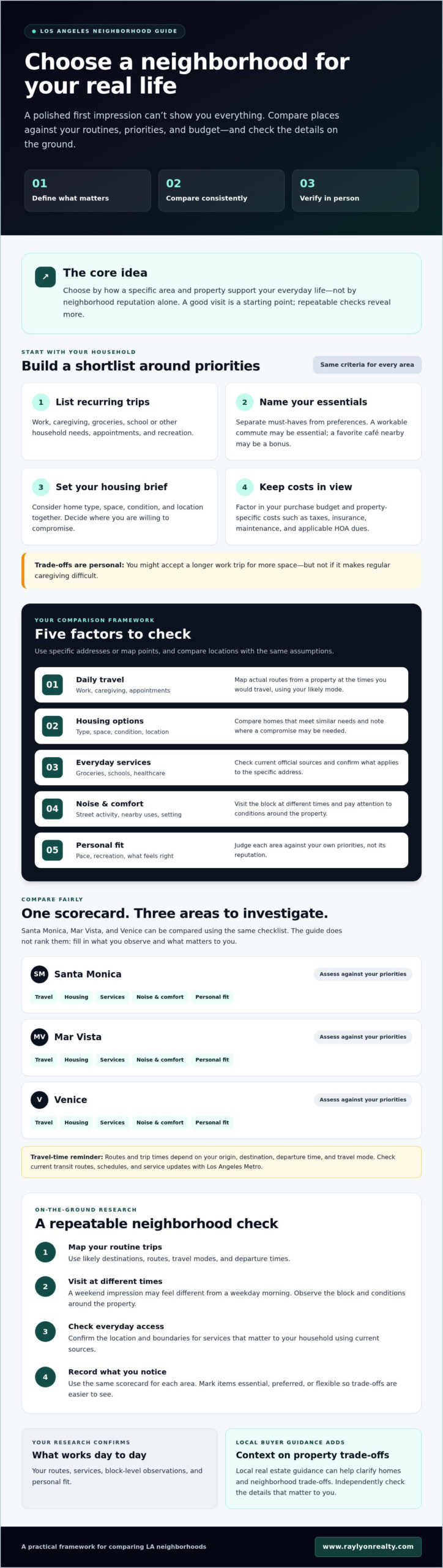
Use the same criteria for every area so your comparison stays fair. A simple grid can include:
- Daily destinations: How manageable are your usual trips?
- Household needs: Are the services and facilities you rely on accessible?
- Preferred pace: Does the area suit how you want to spend your time?
- Housing priorities: Are the home types and features you want realistic options to explore?
Mark each item as essential, preferred, or flexible. The scorecard won’t choose for you, but it will make trade-offs easier to see.
Set a realistic housing and location brief
Consider location and property together. A larger home, a particular condition, or a specific housing type may affect which locations fit your search. Decide what matters most: would you consider a condo to prioritize a certain area, or is space more important than being close to a preferred destination?
Keep your purchase budget and property-specific costs in view as you compare locations. Consider relevant costs such as taxes, insurance, maintenance, and any homeowners association dues, where applicable. This helps prevent a strong emotional connection to an area from pushing the property search beyond your comfort zone. For more on preparing for the purchase process, see the Los Angeles homebuyer guide.
Which LA Neighborhood Factors Matter Most When Comparing Areas?
A neighborhood’s reputation can’t tell you what a specific block feels like or whether a particular property fits your needs. Compare locations using the same criteria and travel-time assumptions, and use specific addresses or map points. That keeps a popular name or a single appealing visit from standing in for practical research.
Use a consistent framework, then investigate the details that matter most to your household:
| Factor | What to compare | How to check |
|---|---|---|
| Daily travel | Trips to work, caregiving, and regular appointments | Map routes from a specific property at the times you’d travel, using your likely mode of transportation. |
| Housing options | Property types, space, condition, and location | Compare homes that meet similar needs, and note where you may need to compromise. |
| Everyday services | Groceries, schools, healthcare, and other routine destinations | Check current official sources and confirm the location and boundaries that apply to the specific address. |
| Noise and comfort | Street activity, nearby uses, and how the setting feels | Visit the block at different times and pay attention to conditions around the property. |
| Personal fit | Pace, recreation, and the features that make a place feel right | Compare against your own priorities rather than a neighborhood’s reputation. |
Compare commute, transit, and everyday access
Travel time depends on your origin, destination, time of day, and travel mode. Test the routes you’d actually use, including at the times your household would usually leave. For transit, check current routes, schedules, and service updates directly with Los Angeles Metro. A neighborhood name alone doesn’t guarantee that errands or a station are convenient from a particular home, so check the actual route and distance.
For broader context, Los Angeles County census data offers geographic and demographic information at the census-tract level. Use it as context, not as a substitute for current, address-specific checks.
Evaluate housing fit, comfort, and location-specific risks
Compare property types and likely trade-offs without assuming an entire area offers the same housing choices or costs. Check the property’s location, not just its neighborhood label, against official FEMA flood information and applicable local hazard resources. For coastal properties, consult current California Coastal Commission guidance and review the disclosures relevant to that specific home. Verify school boundaries and local services with the responsible agencies, since boundaries and information can change.
If you’re weighing Westside locations, a local buyer representative can help you compare homes and area-specific trade-offs while you verify your own priorities. Explore local buyer representation as one resource in your research.
How Do Santa Monica, Mar Vista, and Venice Compare for Your Lifestyle?
Santa Monica, Mar Vista, and Venice are useful examples of how nearby Westside areas can appeal for different reasons. There’s no universally best choice. Use your scorecard to test which location aligns with your routine, housing priorities, and preferred pace, then verify details around each property you consider.
Broad descriptions can help you form questions, but they shouldn’t settle the decision. Santa Monica is often associated with a more walkable, polished feel; Mar Vista with a residential atmosphere and a strong community identity; and Venice with an eclectic, creative character. Treat these as starting points, not guarantees about a particular block, home, or resident experience. Amenities, routes, and access can vary within each area.
Use Westside examples to test your priorities
If Santa Monica is on your shortlist, explore this Santa Monica real estate guide for more focused context. For Mar Vista, see the Mar Vista neighborhood guide. These resources can help you frame questions, but confirm current details independently for the property and routine you have in mind.
For Venice, check the exact block, the routes you’d use, and access to your regular services. Don’t assume a neighborhood’s overall identity describes every street or determines how convenient daily life will feel.
Compare alternatives without relying on neighborhood stereotypes
Apply the same criteria to actual listings in each area. Compare property type, space, condition, nearby destinations, and travel routes, rather than weighing a listing against a general impression of another neighborhood. Verify school boundaries with the relevant district, and check current transit and local-service information through the responsible sources.
The same scorecard can lead different buyers to different answers. Someone who prioritizes nearby destinations may favor a property that makes regular trips easier. Someone who values a quieter residential setting or a particular home layout may weigh other factors more heavily. The goal isn’t to confirm a reputation; it’s to see how the location and property work together for you.
Use these examples to refine your shortlist, then visit the specific locations you’re considering and see whether your first impressions hold up in practice.
How to Visit and Research an LA Neighborhood Before You Buy
A focused visit can test whether a location fits your routine, but one pleasant afternoon can’t tell the whole story. Use the same process for every area: shortlist locations, map routine trips, visit, verify key details, then reassess your notes. This repeatable approach makes how to choose the right neighborhood in LA less about first impressions and more about evidence you can compare.
Revisit a prospective neighborhood at different times because a block can feel and function differently as traffic, parking, noise, and street activity change. Note when and where you visited so you don’t mistake one snapshot for a typical day.
A practical neighborhood visit checklist
Start with the routes you’d use most. Walk or drive to likely destinations and record friction points, such as an awkward crossing, a difficult turn, or a route that feels less convenient than it looked on a map. Check how the immediate surroundings feel near the property, not just along the area’s best-known streets.
- Observe noise, parking, traffic, and street activity at more than one time.
- Check whether nearby amenities are open, accessible, and useful for your household.
- Write down what you directly observed, including the visit time and location.
Keep notes specific. “Busy at the corner during my visit” is an observation. “Always noisy” is a conclusion one visit can’t establish.
Verify the details that maps and listing descriptions cannot settle
Some questions need current, authoritative answers. Confirm school assignment with the relevant school district, transit routes and service with Los Angeles Metro, and local boundaries with the responsible public agency. Don’t rely on an old map, listing description, or neighborhood label when a boundary or service detail could affect your plans.
For a specific property, review available disclosures and hazard information, and consult qualified professionals about issues that require expert interpretation. Separate verified facts from personal impressions, then reassess each location using the same checklist. This helps limit recency bias, where the latest visit dominates your decision, and confirmation bias, where you focus only on details that support an early favorite.
For help comparing Westside homes and location trade-offs, connect with a local buyer representative while continuing to verify the details that matter to you.
How a Local LA Buyer’s Agent Can Help You Choose With Confidence
A buyer representative can turn your priorities into a more focused search. Instead of browsing every available home, use your scorecard to narrow the locations and property types worth exploring. For buyers working out how to choose the right neighborhood in LA, local knowledge can help clarify how a particular property and its surroundings compare with the priorities you’ve set.
That guidance shouldn’t mean someone else chooses your neighborhood. Ask an agent to explain trade-offs, not prescribe an area. You remain in control of the decision, and details such as school assignment, transit service, hazards, and property condition may call for independent checks or input from other qualified professionals.
Questions to ask a neighborhood-focused buyer representative
Use an initial conversation to understand how the agent will work with your criteria. Ask for clear reasoning, not just a list of recommended places. Useful questions include:
- How will you compare locations against my stated priorities and routine?
- What trade-offs should I consider among location, property type, condition, and budget?
- Which details do you verify, and which should I confirm with an official source or another qualified professional?
- How will you help me compare actual homes and their immediate surroundings rather than relying on broad neighborhood descriptions?
Look for an approach that makes room for your preferences and acknowledges what still needs checking. Ray Lyon Realty represents residential buyers across the Westside, including Santa Monica, Mar Vista, and Venice, and its local knowledge can support comparisons among properties and locations.
Turn your shortlist into a confident next step
After visiting and researching your shortlisted areas, update your scorecard. Remove locations that repeatedly miss essential needs and revisit any that remain close contenders. Then compare suitable homes against your location criteria, so an attractive listing doesn’t quietly shift what matters most to you.
If you’re also deciding how to evaluate an agent, read this Los Angeles real estate agent guide for additional selection context. When you’re ready to discuss your priorities and Westside home search, talk with Ray Lyon Realty about your LA home search.
Make Your LA Shortlist Work for You
The strongest neighborhood choice isn’t necessarily the one with the biggest reputation. It’s the place that supports your daily routine, fits your housing priorities, and works for your budget and longer-term plans. A consistent scorecard helps you compare areas fairly, while visits at different times reveal details that maps and listing descriptions can miss.
As you decide how to choose the right neighborhood in LA, focus on specific properties and blocks, verify important details with current sources, and stay open to trade-offs. Santa Monica, Mar Vista, and Venice each offer different possibilities, but your own priorities should guide the comparison.
Ray Lyon Realty represents residential buyers across the Westside, with local expertise in Santa Monica, Mar Vista, and Venice. If you’d like support comparing locations and homes, talk with Ray Lyon Realty about your LA home search. A clear process and the right questions can help you move forward with greater confidence.
Frequently Asked Questions
Is there one best neighborhood in LA for everyone?
No. The right fit depends on your priorities, budget, household needs, and the specific location of a home. Start with a consistent scorecard, then compare areas using the same criteria instead of relying on reputation alone. Before deciding, check property-level details such as nearby services, routes, and applicable boundaries, since these can vary within the same neighborhood.
How do I compare neighborhoods in Los Angeles before buying a home?
First rank your priorities, then shortlist areas that could meet them. Map your regular trips and test likely routes at realistic times. Visit each area more than once, check key details with current authoritative sources, and compare actual homes using consistent criteria. This process helps you determine how to choose the right neighborhood in LA based on daily fit rather than online reputation or a single favorable visit.
What should I look for when visiting an LA neighborhood?
Test the routes you’d use for work, errands, caregiving, and recreation. Pay attention to noise, parking, street activity, and access to services, and revisit at different times to see how conditions change. Note what you observe instead of treating one visit as conclusive. A visit can’t confirm school assignment, transit service, property disclosures, or hazards, so verify those details through current official sources or qualified professionals.
How can I check commute times between LA neighborhoods?
Commute time depends on your starting point, destination, travel mode, and time of day. Map the trip from a specific property to your actual destination, then test it at the times you’d normally travel. For transit, check current routes and service information directly with Los Angeles Metro. Treat any single estimate as a snapshot, not a promise of your regular travel time, since routes and conditions can vary.
Are Santa Monica, Mar Vista, and Venice good neighborhoods for homebuyers?
They may suit different buyers, but there’s no blanket ranking that fits everyone. Compare specific blocks, available housing types, nearby amenities, and the routes you’d use. Broad neighborhood descriptions can suggest what to investigate, but they don’t guarantee a particular lifestyle or level of access. For more context, read the Santa Monica real estate guide and Mar Vista neighborhood guide, then verify details for each property.
How do I check schools and services for a specific LA home?
Confirm school assignment and local services through the responsible official agency using the exact property address. Boundaries, programs, and service information can change, so check current sources rather than relying only on an online map, listing description, or neighborhood label. If a particular school or service matters to your decision, contact the relevant agency to verify that the address qualifies and that the offering meets your household’s needs.
Should I work with a local real estate agent to choose an LA neighborhood?
A local buyer representative can help compare locations and properties against your stated priorities and explain trade-offs among location, home type, and budget. Ask how they assess areas, what details they verify, and what you should confirm independently. Local insight can support your research, but it doesn’t replace checking official information or consulting qualified professionals about matters that require specialized review. The final choice should reflect your own needs.