

In the competitive Westside Los Angeles market, your bank balance is only half the story; your strategy is what actually wins the keys. Whether you’re eyeing a modern condo in Mar Vista or a quiet street in Santa Monica, the financial bar is high and the pace is fast. It’s completely natural to feel a bit overwhelmed by the shifting 2026 mortgage landscape. You might be worried about how a single point on your credit score affects your interest rate, or perhaps you’re anxious that your hard-earned down payment won’t be enough to compete with aggressive offers.
The good news is that getting your finances in order to buy a home doesn’t have to be a source of stress when you have a proven roadmap. This guide provides the expert strategies I use with my own clients to help them secure a distinct competitive edge. You’ll gain a clear understanding of local financial nuances, from 2026 jumbo loan limits to those often-overlooked closing costs that catch many buyers off guard. We’ll walk through a concrete checklist to ensure you’re fully mortgage-ready, giving you the confidence to move quickly when the right Westside opportunity appears.
Key Takeaways
- Shift your mindset from simply saving cash to engineering a strategic buyer profile that stands out to Westside sellers.
- Learn why a 740+ credit score is the critical benchmark for securing the best possible interest rates when getting your finances in order to buy a home.
- Navigate the 20% down payment myth by evaluating which low-down-payment options are actually viable in competitive neighborhoods like Venice and Mar Vista.
- Prepare a robust documentation portfolio that satisfies modern underwriting requirements and prevents last-minute closing delays.
- Understand how your financial readiness acts as your entry ticket to work with top local experts and move at LA speed during the search.
The Financial Reality of Buying a Home in 2026
Financial readiness in 2026 is a sophisticated game of numbers. It’s no longer just about having a pile of cash in a savings account. Today, getting your finances in order to buy a home requires engineering a buyer profile that looks bulletproof to a lender. This means optimizing your liquidity, debt ratios, and tax returns to prove you can handle the unique pressures of the California market. With inflation and interest rates stabilizing but remaining higher than the previous decade, your purchasing power depends on how cleanly you present your financial history. You aren’t just saving for a down payment; you’re building a case for why you are a low-risk investment for a bank.
The Westside LA market, specifically neighborhoods like Santa Monica and Mar Vista, requires a specialized financial approach because the stakes are higher. Standard national advice often fails here because the price entry points are significantly elevated. You need a strategic partner who understands these local hurdles and can help you prepare a bid that stands out in a sea of competitive offers. If you are looking for similar professional representation in the French market, you can check out IMOBLEX to learn about their services in Toulouse. Preparing your finances a year in advance gives you the leverage to act when the right opportunity appears.
Understanding the Westside LA Price Entry Point
In 2026, Santa Monica and Venice continue to command premium prices that defy national averages. Traditional financial advice often suggests spending no more than three times your annual income on a home, but that math rarely works in Mar Vista or Venice. Here, entry-level starter homes often overlap with luxury price points in other states. You need to decide early if you are buying a primary residence or looking for an investment property. Lenders view these differently, and the down payment requirements for an investment property on the Westside can be significantly steeper. Local knowledge is vital because block-by-block price variation can change your loan requirements from a conventional to a jumbo mortgage. Understanding where your loan falls relative to 2026 jumbo loan limits for Los Angeles County is a critical step in getting your finances in order to buy a home.
The 28/36 Rule vs. 2026 Realities
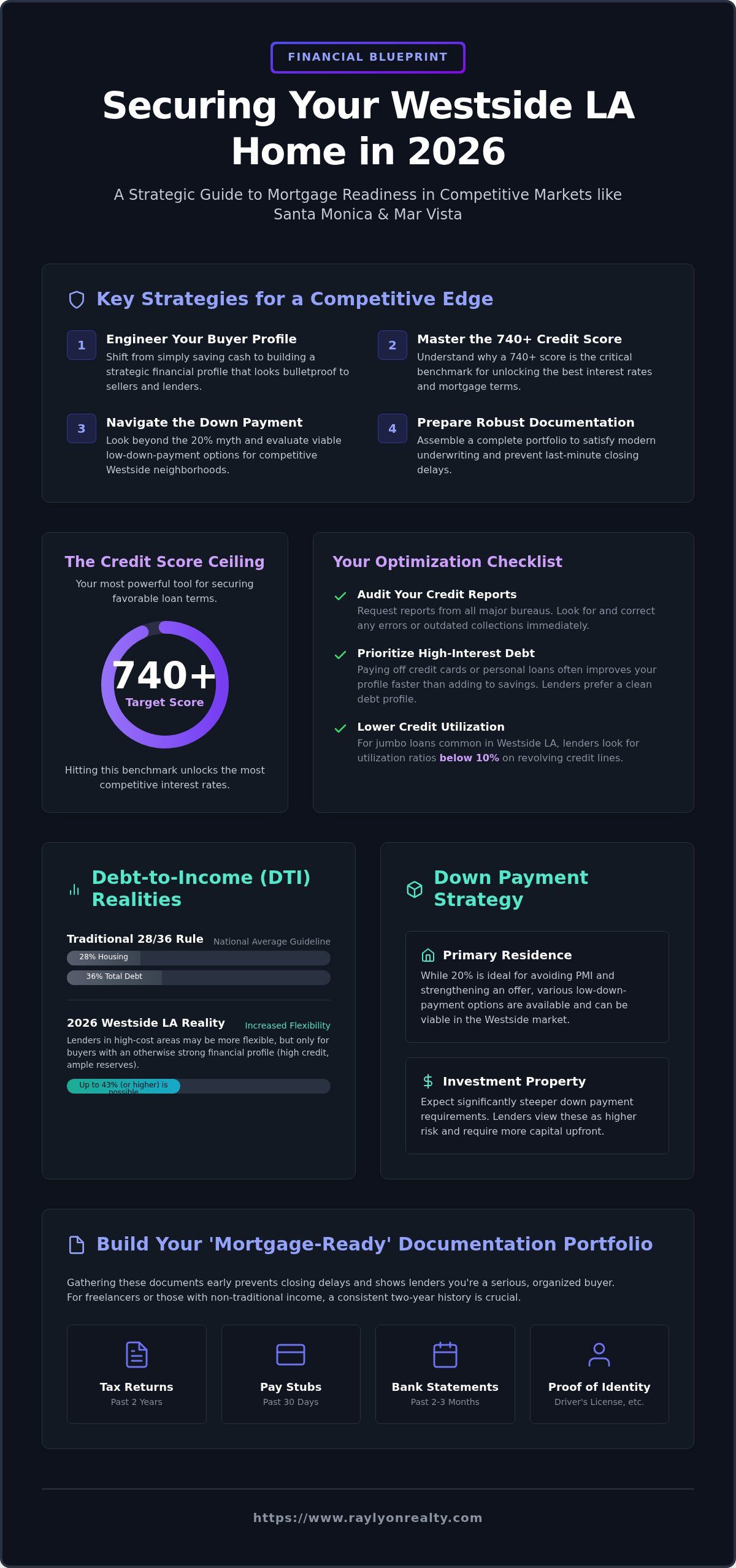
Debt-to-income (DTI) is the primary risk metric lenders use to determine how much of your monthly gross income can go toward debt payments. While the traditional 28/36 rule suggests that housing costs shouldn’t exceed 28% of your income, 2026 lenders in high-cost areas like LA are sometimes more flexible, provided your overall profile is strong. They’ve also become much more sophisticated in how they analyze remote work income and gig economy earnings. If you’re a freelancer or a remote tech worker, expect underwriters to look for a consistent two-year history of stable earnings. They want to see that your income isn’t just a temporary spike but a sustainable trend that supports a high-value mortgage. Balancing your DTI before you apply for a loan is the most effective way to maximize your leverage.
Auditing Your Credit and Debt for Maximum Leverage
Your credit score is the single most powerful tool you have when getting your finances in order to buy a home. In the 2026 mortgage market, 740 has become the “Credit Score Ceiling.” While you can certainly qualify with a lower score, hitting this benchmark unlocks the most competitive interest rates and favorable terms. Even a 20-point difference can translate into hundreds of dollars saved on your monthly payment, which is vital in high-value areas like Santa Monica. To start, perform a deep-dive audit by requesting your reports from the major bureaus. Focus on soft inquiries that don’t ding your score. Look for reporting errors or outdated collections that could be dragging you down. Correcting these early gives the bureaus time to update your profile before you ever talk to a lender.
Many buyers struggle with the “Debt-First” versus “Savings-First” debate. While a large down payment is helpful, lenders often prefer to see a clean debt profile. Paying off a high-interest credit card or a lingering personal loan often moves the needle faster than adding that same amount to your savings account. It reduces your monthly obligations and proves you can manage credit responsibly. If you’re unsure which debts to prioritize, consulting with a local real estate expert can help you understand what Westside lenders are currently prioritizing in their risk assessments.
Optimizing Your Credit Score for Jumbo Loans
Because Westside LA property values often exceed conforming loan limits, you’ll likely be applying for a jumbo loan. These high-balance products come with much stricter scrutiny. Lenders here often look for credit utilization ratios below 10% on all revolving lines. If your cards are near their limits, pay them down at least three months before applying. Strategic credit seasoning is also vital. Avoid opening any new lines of credit, such as retail cards or auto loans, for at least 12 months before your purchase. New inquiries can signal financial instability to an underwriter, even if your score remains high.
Managing Your Debt-to-Income (DTI) Ratio
Toxic debt is the primary killer of borrowing power. High-interest retail cards and large car payments eat into the income you could otherwise use for a mortgage. In 2026, mortgage algorithms have become more nuanced regarding student loans, often calculating your debt based on actual income-driven repayment plans rather than a flat percentage of the balance. However, the goal remains the same: keep your total monthly debt payments as low as possible. A lower DTI doesn’t just help you get a loan; it helps you win a bidding war by showing the seller your financing is rock-solid. This financial flexibility allows you to handle aggressive counter-offers with confidence and poise.
The Down Payment Strategy: Beyond the 20% Myth
In Santa Monica or Venice, the 20% down payment isn’t just a tradition; it’s a competitive tool. While national headlines often highlight low-down-payment programs, getting your finances in order to buy a home in a high-demand market usually requires a more aggressive cash strategy. Sellers prioritize certainty. A higher down payment signals that your financing is less likely to fall through during the appraisal process. If you’re looking at FHA or VA loans, they are absolutely viable, but you must pair them with a robust documentation portfolio to remain attractive in a multi-bid scenario.
Private Mortgage Insurance (PMI) is another factor to weigh. If you put down less than 20%, you’ll likely pay a monthly premium that doesn’t go toward your equity. In a high-price market, this can add several hundred dollars to your monthly carry. Sourcing these funds also requires a clear paper trail. Whether you’re using gift funds from family, a 401(k) loan, or liquidating stock assets, lenders in 2026 want to see “seasoned” funds that have been in your account for at least 60 to 90 days.
Jumbo Loan Down Payment Requirements in 2026
Because many homes in Mar Vista and Santa Monica exceed conforming limits, you’ll likely enter the world of jumbo financing. In 2026, most jumbo lenders require 20% to 25% down to secure the best interest rates. Beyond the down payment, lenders look for “post-closing reserves.” This means having enough liquid cash left over to cover 6 to 12 months of mortgage, tax, and insurance payments. Having these reserves doesn’t just satisfy the bank; it gives you the peace of mind that a sudden repair won’t derail your finances.
Budgeting for ‘The Other 3%’: Closing Costs
One of the biggest mistakes buyers make is forgetting to budget for closing costs. In California, these typically range from 2% to 3% of the purchase price. This includes title insurance, escrow fees, and transfer taxes. If you’re buying a $2 million home, that’s an additional $40,000 to $60,000 you need to have ready. Never drain your entire savings to reach a down payment goal. You’ll want a “day-one” fund for immediate needs like painting, security systems, or minor renovations. Keeping a financial buffer as part of getting your finances in order to buy a home ensures your transition into homeownership is smooth and stress-free.
Building Your ‘Mortgage-Ready’ Documentation Portfolio
Underwriting in 2026 has become a forensic process. Lenders aren’t just checking your credit score anymore; they’re performing a deep-dive audit of your entire financial history. Getting your finances in order to buy a home means being prepared for an invasive level of scrutiny. If you’re self-employed or have a complex income structure involving K-1s, expect underwriters to look closely at the health of your business entities, not just your personal take-home pay. They want to ensure your income is stable and likely to continue at the same level for the foreseeable future. The key to a smooth escrow is having every document ready before you even step foot in an open house.
For those navigating these specialized requirements, you can learn more about LoansByJB (The Nuhome Team), a Southern California brokerage that excels in managing complex mortgage scenarios with a personalized, investor-focused approach.
The “Paper Trail” rule is non-negotiable. Lenders need to see exactly where your money comes from to satisfy strict anti-money laundering regulations. If you move $50,000 from a brokerage account to your checking account, you’ll need the statements from both sides to prove it wasn’t an undisclosed loan. Don’t wait until you’re in the middle of a fast-moving Westside transaction to start hunting for PDFs. Create a dedicated ‘Home Buying’ digital folder today to store these PDFs securely. Being able to respond to a lender’s request in minutes rather than days can be the difference between a closed deal and a missed opportunity.
The Essential Documentation Checklist
Lenders typically require a minimum of two years of tax returns and W-2s to establish your income baseline. They’ll look for consistency and will question any significant drops in year-over-year earnings. You’ll also need at least two months of full bank statements for every account you own. This “lookback window” allows underwriters to spot any large, unexplained deposits that might suggest you’ve taken on new debt. Finally, remember the “Keep Your Job” rule. Verification of employment usually happens twice: once at the start and once right before you close. Avoid any career pivots or job hops until the keys are in your hand.
Proving Your Liquid Assets
If you’re receiving help from family, California’s anti-money laundering rules require a very specific paper trail for gift funds. You’ll need a signed gift letter stating the money is not a loan, along with proof of the donor’s ability to provide the funds. Asset seasoning is equally important. Lenders want to see that your down payment has been sitting in your account for at least 60 to 90 days. Cash “under the mattress” or sudden deposits from unverified sources won’t count toward your closing costs. If you’re ready to start the search with a team that knows how to handle these complexities, reach out to Ray Lyon Realty to begin your Westside home-buying journey with confidence.
Transitioning from Financial Prep to the Home Search
Once you have finished getting your finances in order to buy a home, the transition from spreadsheets to property tours should feel like a victory lap. In the high-stakes Westside market, a pre-approval letter is far more than a formality; it is your verified entry ticket to work with the top real estate agents in los angeles ca. Most sellers in 2026 won’t even grant a private showing without proof of funds or a robust lender letter. Your prior preparation allows you to move at ‘LA Speed,’ meaning you can submit a binding offer the same day a property hits the market without scrambling for bank statements.
Success in this phase relies on a winning team approach. Your lender and your Realtor must be in constant communication to ensure your offer is tailored to the specific seller’s needs. Whether you choose to lock in your interest rate immediately or float in a volatile market, these decisions should be made strategically based on current economic data and your personal risk tolerance. This synergy ensures that when you find the right home, the financial mechanics are already in motion.
Leveraging Your Financial Health in Santa Monica
A strong financial profile gives your Santa Monica realtor a distinct advantage at the negotiating table. We use a ‘Clean Offer’ strategy, where your financial certainty often outweighs higher bids that come with risky financing contingencies. In neighborhoods like Mar Vista, Los Angeles, sellers often prefer a buyer who can guarantee a 21-day close over one offering more money but with a shaky loan profile. Connecting with local Westside lenders who understand these neighborhood nuances is vital for a seamless transaction.
Your Next Step: The Consult
Many buyers wait until they think they are ‘perfectly ready’ to reach out, but the best time to talk to an agent is while you are still getting your finances in order to buy a home. Early collaboration allows us to bridge the gap between your financial prep and the actual keys to your new home. We can identify potential hurdles before they become deal-breakers and position you for exclusive, non-public opportunities. When you’re ready to turn your financial strategy into a real estate reality, Schedule a strategic buyer consultation with Ray Lyon Realty to start your journey.
Your Future on the Westside Starts with Strategy
Success in the 2026 Los Angeles market isn’t about luck; it’s about the deliberate choices you make months before you ever sign a contract. By optimizing your credit profile, managing your debt-to-income ratio, and organizing a forensic documentation portfolio, you’re doing more than just saving money. You’re building the leverage needed to win in high-stakes neighborhoods like Santa Monica and Mar Vista. Remember that getting your finances in order to buy a home is a marathon that requires both discipline and a deep understanding of local market nuances.
You don’t have to navigate these complex financial hurdles alone. At Ray Lyon Realty, we bring a unique perspective as both experienced brokers and personal investors. We specialize in crafting strategic bids that stand out, ensuring your offer carries the weight of a cash-buyer even when you’re utilizing jumbo financing. Our personalized approach is designed to reduce your stress and maximize your competitive edge from day one.
Ready to turn your financial prep into a Westside home? Contact Ray Lyon Realty today. We’re here to help you bridge the gap between financial readiness and the keys to your new front door. Your Westside journey is just beginning, and we can’t wait to see where it leads.
Frequently Asked Questions
How much money should I have saved before buying a home in Los Angeles?
You should aim to have at least 23% to 25% of the purchase price saved before making an offer in Los Angeles. This covers a 20% down payment and roughly 3% for closing costs. Additionally, lenders for high-value Westside properties often require “post-closing reserves” equal to 6 to 12 months of mortgage payments. Having this liquidity ensures you can handle the competitive bidding environment and immediate homeownership expenses without financial strain.
Can I buy a home in Santa Monica with a low credit score?
While you can technically qualify for certain loans with a lower score, buying in Santa Monica with a sub-700 score is challenging. Most Westside sellers look for buyers with rock-solid financing to ensure a smooth closing. A low score often results in higher interest rates or stricter down payment requirements. If your score is low, focus on getting your finances in order to buy a home by disputing errors and lowering credit utilization before you start your search.
What is the minimum down payment for a jumbo loan in 2026?
Most jumbo lenders in 2026 require a minimum down payment of 20% for properties in high-cost areas like Mar Vista and Venice. Some specialized programs may allow for 10% or 15% down, but these often come with higher interest rates or require private mortgage insurance. Because Westside home values frequently exceed conforming loan limits, preparing for a full 20% down payment remains the most effective strategy for securing the best possible terms and offer strength.
How long does it take to get my finances in order for a mortgage?
You should ideally begin the process of getting your finances in order to buy a home 6 to 12 months before you plan to move. This timeframe allows you to “season” your assets, improve your credit score, and clear any “toxic” debt like high-interest credit cards. It also gives you time to establish a consistent two-year paper trail of income, which is particularly important if you’ve recently changed jobs or started a business.
Should I pay off all my debt before applying for a home loan?
You don’t necessarily need to be debt-free, but you should prioritize lowering your debt-to-income (DTI) ratio. Lenders look for a total DTI that typically stays below 36% to 43%, including your future mortgage payment. Focus on paying off high-interest revolving credit or large car loans that eat into your monthly borrowing power. Keeping some manageable debt, like a low-interest student loan, is often fine as long as your overall profile remains strong and liquid.
What are the hidden costs of buying a home in California?
Beyond the purchase price, you must budget for supplemental property taxes, which catch many California buyers by surprise after closing. You should also account for higher homeowners insurance premiums, especially in areas with specific environmental risks. Other costs include escrow fees, title insurance, and immediate maintenance needs. We recommend setting aside an additional 1% of the home’s value for a “day-one” fund to cover these essential post-purchase expenses and minor renovations.
How does being self-employed affect my ability to buy a home on the Westside?
Being self-employed means you’ll face more rigorous documentation requirements, but it doesn’t prevent you from buying a home. Lenders will typically average your net income from the last two years of tax returns. They will also look closely at your year-to-date profit and loss statements to ensure stability. To succeed, keep your business and personal expenses strictly separated and avoid taking excessive tax deductions that artificially lower your qualifying income in the years before you buy.
Is it better to wait for interest rates to drop or buy now?
Timing the market is notoriously difficult; it’s usually better to buy when you are personally and financially ready. If you wait for rates to drop, you may face even higher home prices and increased competition from other buyers who have been sitting on the sidelines. Remember that you can often refinance your mortgage later if rates decrease, but you cannot change the purchase price of the home. Focus on your long-term investment goals rather than short-term market fluctuations.