

Buying your first home in California can feel overwhelming. You’re faced with staggering prices, a whirlwind of unfamiliar paperwork, and a nagging fear of making a costly mistake. It’s easy to feel like your dream of homeownership is just out of reach. That’s why having a trustworthy first time home buyer guide california is not just helpful-it’s essential. What if you could trade that anxiety for confidence and replace confusion with a clear, proven roadmap to follow?
We’ve been there, both personally and with countless clients just like you. We created this 10-step guide to demystify the entire process, from start to finish. Inside, you’ll find a simple, chronological checklist that takes you from initial financial planning to finally holding the keys. We’ll uncover all the costs involved-not just the sticker price-and introduce you to programs designed to make homeownership more affordable. Consider this your definitive plan for navigating the market with an expert by your side.
Key Takeaways
- Start your journey by mastering the two most important savings goals-your down payment and closing costs-to build a strong financial foundation.
- Learn why assembling the right team, especially a knowledgeable local agent, is your most powerful advantage in California’s competitive market.
- This first time home buyer guide california breaks down how to craft a winning offer and navigate the crucial escrow period with confidence.
- Discover California-specific assistance programs that can significantly lower your upfront costs and make homeownership more accessible.
Step 1-2: Financial Prep for the California Market
Before you even start browsing online listings or attending open houses, the most important work begins with your finances. In California’s fast-paced real estate market, being prepared is your greatest competitive advantage. While trends in homeownership in the United States are always shifting, achieving that goal in the Golden State requires a solid financial foundation. This section of our first time home buyer guide california will walk you through getting your finances in order so you can shop for a home with confidence.
To get a great overview of the process, take a few minutes to watch this helpful video:
Assess Your Credit and Debt-to-Income Ratio (DTI)
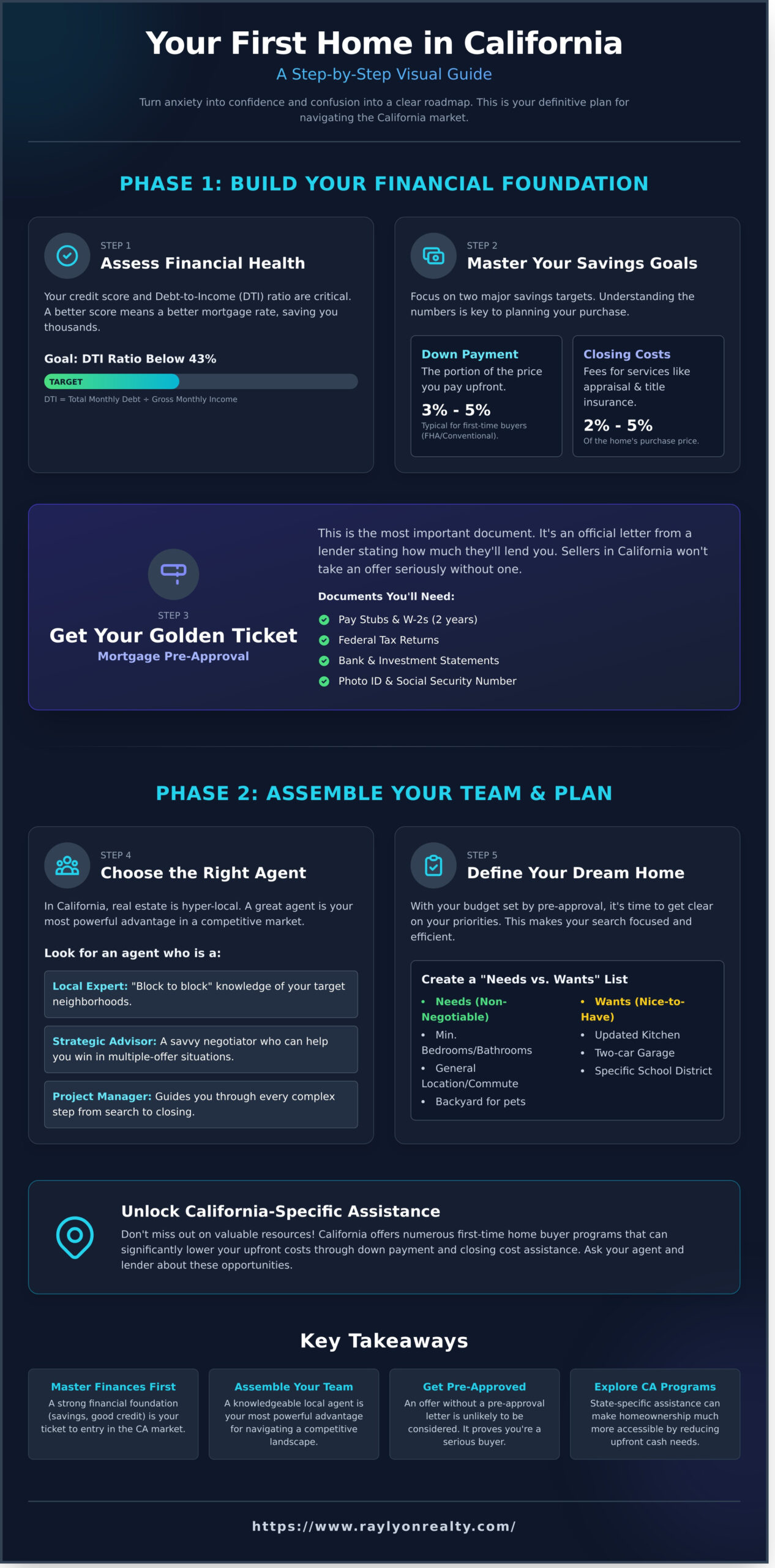
Your credit score is a key factor lenders use to determine your mortgage rate-a higher score can save you thousands over the life of your loan. Start by checking your credit report for free at AnnualCreditReport.com and dispute any errors immediately. Next, calculate your DTI by dividing your total monthly debt payments (car loans, student loans, credit cards) by your gross monthly income. Lenders want to see a DTI below 43%. To improve your numbers, focus on paying bills on time and reducing credit card balances.
Save for Your Down Payment and Closing Costs
You have two major savings goals: the down payment and closing costs. While a 20% down payment helps you avoid Private Mortgage Insurance (PMI), it’s not always required. Many conventional loans accept as little as 3-5% down, and FHA loans require just 3.5%. Don’t forget to budget for closing costs, which typically run between 2-5% of the home’s purchase price. These fees cover services like the appraisal, title insurance, and lender processing. Be sure to explore California-specific down payment assistance programs that can help bridge the gap.
Get Pre-Approved for a Mortgage
A pre-approval letter is your golden ticket in California. In fact, we consider it the most important document covered in this first time home buyer guide california. It’s different from a pre-qualification, which is just a rough estimate. For a pre-approval, a lender verifies your income, assets, and credit to determine exactly how much they will lend you. In a competitive market, sellers won’t take an offer seriously without one because it proves you’re a credible buyer. To get pre-approved, you’ll need to gather key documents:
- Recent pay stubs and W-2s from the last two years
- Federal tax returns
- Bank and investment account statements
- Photo ID and Social Security number
Step 3-4: Build Your Team & Define Your Dream Home
Buying a home in California isn’t a solo journey-it’s a team sport. With the right professionals in your corner and a clear vision, you can navigate the market with confidence. This part of our first time home buyer guide for California is all about assembling that winning combination: your expert agent, a trusted lender, and a well-defined home wishlist.
Choose the Right Real Estate Agent
In a state as diverse as California, real estate is hyper-local. An agent with “block to block” knowledge of your target neighborhoods is your greatest competitive advantage. They do more than just unlock doors; a great agent is your strategic advisor, savvy negotiator, and project manager who can uncover off-market opportunities and guide you through every complex step.
When interviewing potential agents, ask targeted questions:
- How well do you know the specific neighborhoods I’m interested in?
- What is your strategy for helping buyers win in a competitive, multiple-offer situation?
- Can you connect me with past clients who were also first-time buyers?
A dedicated local expert understands the nuances that data alone can’t show you. Meet our team and see how an expert Westside LA agent can give you an edge.
Your agent will also connect you with trusted mortgage lenders. The right lender is just as crucial-they need to understand your complete financial picture and goals. A knowledgeable loan officer will help you explore all your options, including valuable resources like the state-supported California first-time homebuyer programs, ensuring you have access to every advantage.
Create Your Home Wishlist
With your pre-approval in hand, it’s time to translate your dreams into a practical checklist. Getting clear on your priorities now will make your home search focused and efficient. Start by separating your non-negotiables from your “nice-to-haves.”
- Must-Haves (The Deal-Breakers): These are your absolute requirements, like a minimum number of bedrooms, a specific school district, or a manageable commute time.
- Nice-to-Haves (The Bonuses): These are features you’d love but can live without, such as a newly renovated kitchen, a home office, or a swimming pool.
Finally, think beyond today. Will this home still fit your life in five or ten years? Considering your long-term goals is a key part of a smart purchase and prevents a costly move down the road.
Step 5-7: The Search, Offer, and Escrow Process
You’ve done the financial prep work, and now the fun begins! This part of our first time home buyer guide for California is where you start viewing properties and can truly envision your future. Once you find “the one,” we move quickly to secure it. This phase is about being strategic, protected, and prepared for the final steps toward getting your keys.
Making a Competitive Offer
In California’s fast-paced market, a strong offer is more than just the price. It’s a strategic package designed to stand out. Your offer will include the purchase price, your proposed terms, and contingencies. In a multiple-offer situation, we can discuss strategies like an escalation clause or a compelling personal letter to the seller. You’ll also include an earnest money deposit-typically 1-3% of the purchase price-which is held by a neutral third party to show the seller you’re a serious, committed buyer.
Navigating Inspections and Contingencies
Once your offer is accepted, we enter the due diligence period. This is where contingencies-clauses that let you back out of the deal without losing your deposit-become your safety net. Key contingencies include:
- Inspection Contingency: Allows you to hire a professional to thoroughly inspect the home’s condition.
- Appraisal Contingency: Ensures the home is valued by the lender at or above the purchase price.
- Loan Contingency: Protects you if your financing falls through. Having a solid pre-approval from a trusted source, like the CalHFA FHA Program, gives sellers confidence and strengthens your position here.
If the inspection uncovers issues, we can negotiate with the seller for repairs or credits toward your closing costs.
Understanding the Escrow and Title Process
In California, an escrow company acts as a neutral third party that holds all funds, documents, and instructions from both the buyer and seller. Once your offer is accepted, “opening escrow” begins the clock on your transaction timeline. The escrow officer ensures all conditions of the purchase agreement are met before the sale is finalized. During this time, a title company will conduct a search to ensure the property has a “clear title,” meaning no one else can claim ownership. Title insurance is then purchased to protect you from any future claims against your property. This is a critical final step to securing your investment before you officially close and become a homeowner.
Step 8-9: Secure Financing & Explore Assistance Programs
Once your offer is accepted, you’re officially in escrow. Now, the focus shifts to working closely with your lender to finalize your home loan. This is a critical step in any first time home buyer guide california, as it’s also the perfect time to explore the wealth of financial assistance available-which can save you thousands in upfront costs.
Navigating these programs can feel complex, but the payoff is well worth the effort. Tapping into these resources can significantly lower your down payment and closing costs, making your dream of homeownership a reality much sooner.
California First-Time Home Buyer Programs
The Golden State offers some of the best assistance programs in the country, primarily through the California Housing Finance Agency (CalHFA). Programs like the MyHome Assistance Program can provide a deferred-payment junior loan to cover your down payment and closing costs. While the wildly popular California Dream For All Shared Appreciation Loan is currently paused pending new funding, it highlights the state’s commitment to helping new buyers. It’s always worth checking for its potential return or similar state-level initiatives.
Popular Federal Loan Types
In addition to state aid, several federal loan types are specifically designed to make homeownership more accessible. Here are three of the most popular options for new buyers:
- FHA Loans: Insured by the Federal Housing Administration, these loans are perfect for buyers with smaller down payments (as low as 3.5%) and more flexible credit score requirements.
- VA Loans: A fantastic benefit for eligible veterans, active-duty service members, and surviving spouses. These loans often require no down payment and have no private mortgage insurance (PMI).
- USDA Loans: If you’re looking to buy in a designated rural or suburban area, a USDA loan offers a zero-down-payment option for qualified buyers. Many areas just outside major city centers qualify.
Don’t stop at the state and federal level. Many California cities and counties offer their own unique grants and loan assistance programs. As local experts, we make it our business to stay on top of these programs to give our clients a competitive advantage. Give us a call, and we’ll help you navigate the financial side of your home purchase with confidence.
Step 10: Closing the Deal and Getting Your Keys
You’re in the home stretch! After navigating financing, inspections, and negotiations, just a few final steps stand between you and your new front door. This is the exciting conclusion to your journey, and this first time home buyer guide for California is here to walk you through it. Let’s finish strong.
The Final Walkthrough
Typically conducted 24-48 hours before closing, the final walkthrough is your last opportunity to inspect the property. This isn’t a formal inspection but a chance to ensure everything is as you expect. Bring your purchase agreement and inspection reports with you.
- Verify Repairs: Confirm that all repairs the seller agreed to have been completed to your satisfaction. Ask for receipts if necessary.
- Check Condition: Ensure the home is in the same condition as when you made your offer. Look for any new damage that may have occurred during the seller’s move-out.
- Test Everything: Turn on all lights, run the faucets, flush the toilets, and test major appliances one last time.
Closing Day: What to Expect
Closing day, also known as “signing,” is when ownership officially transfers. In California, this usually happens at an escrow or title company office. You’ll meet with an escrow officer or notary who will guide you through a large stack of documents. Key items include the Closing Disclosure, which finalizes your loan details, and the deed of trust. This is also when you will pay your down payment and closing costs via a cashier’s check or wire transfer. Once all documents are signed and the funds are confirmed, the sale is recorded and you get your keys!
First Steps as a California Homeowner
Congratulations, you did it! The keys are in your hand. Before you start unpacking, tackle a few essential tasks to get settled. First, change the locks for security. Next, arrange to have utilities like electricity, gas, water, and internet transferred into your name. Don’t forget to forward your mail through the USPS. Finally, start getting familiar with your new responsibilities, including when property taxes are due. Owning a home is a major milestone, and our team at Ray Lyon Realty is always here to be a resource long after the sale is complete.
Your California Homeownership Journey Starts Here
Buying your first home in California is a significant milestone, and now you have a clear roadmap. The journey, while detailed, is absolutely achievable with the right preparation and support. From organizing your finances to building the right professional team, each step brings you closer to your goal. This first time home buyer guide california is designed to empower you, but the most crucial element is having an expert partner to navigate the local market’s complexities.
In a competitive market like Westside LA, that partnership makes all the difference. At Ray Lyon Realty, we pride ourselves on our proven track record of helping first-time buyers succeed. Our deep, ‘block to block’ knowledge of Westside neighborhoods gives you a competitive edge, while our approachable, professional guidance ensures you feel confident and supported from start to finish.
Ready to take the first step on the Westside? Let’s find your dream home together. Congratulations on starting this exciting chapter. We can’t wait to help you turn your dream into an address.
Frequently Asked Questions
How much money do I actually need for a down payment in California?
You probably need less than you think! While 20% is ideal to avoid private mortgage insurance (PMI), it’s not a requirement. Many first-time buyers qualify for loans with much smaller down payments. For example, FHA loans require as little as 3.5% down, and some conventional loans start at just 3%. On a $700,000 home, 3.5% is $24,500, a much more achievable goal for many than the traditional $140,000.
What credit score is needed to buy a house for the first time in California?
Lenders look for a history of responsible credit use. While a higher score gets you better interest rates, you don’t need a perfect one. For an FHA loan, the minimum score is often around 580. For most conventional loans, lenders typically look for a score of 620 or higher. We always recommend speaking with a trusted lender early on to understand your specific qualifications and how you can improve your standing if needed.
How long does the home buying process typically take in California?
The timeline can vary, but a good estimate is between 2 to 4 months from start to finish. The initial home search can take anywhere from a few weeks to several months, depending on market conditions and your specific needs. Once your offer is accepted, the escrow period-where inspections, appraisals, and loan processing happen-typically lasts about 30 days. We help you navigate every step to keep the process moving smoothly and efficiently.
What are the most common closing costs for a buyer in California?
Closing costs are the fees required to finalize your home loan and are separate from your down payment. In California, these typically range from 2% to 5% of the home’s purchase price. Common costs include lender origination fees, appraisal fees, title insurance, escrow fees, and pre-paid property taxes. We’ll provide you with a detailed estimate from your lender so you know exactly what to expect and can budget accordingly.
Can I get help with my down payment in California?
Absolutely! California offers several excellent Down Payment Assistance (DPA) programs designed to help first-time buyers. Programs like CalHFA offer loans and grants to cover your down payment and closing costs, making homeownership more accessible. Exploring these options is a key part of our strategy, and this is a topic we cover in depth in our complete first time home buyer guide for California. Let us connect you with a lender who specializes in these valuable programs.
What are Mello-Roos taxes and do I have to pay them?
Mello-Roos is a special property tax found in many newer California communities to fund local infrastructure like schools, parks, and roads. Not all homes have it. If a property is in a Mello-Roos district, the tax is added to your annual property tax bill. It’s a crucial detail to be aware of, and we always ensure you have a complete picture of a home’s total tax liability before you ever make an offer.
Is it better to buy a condo or a single-family home for a first property?
This decision really comes down to your lifestyle, budget, and long-term goals. A condo often means less maintenance, access to shared amenities like pools or gyms, and a lower purchase price. However, they come with monthly HOA fees. A single-family home offers more privacy, space, and freedom, but you are responsible for all upkeep. We can help you weigh the pros and cons of each to find the perfect fit for you.