

The neighborhood with the higher sales tax might actually be your smartest financial move for 2026. If you’re looking at the Westside, you’ve probably felt the pull of two very different worlds just a few blocks apart. You want the top-tier schools and walkable downtown of an independent city, but you also crave the larger lots and relaxed vibe of a traditional residential pocket. It’s a tough choice, especially when you’re weighing Culver City’s 10.75% sales tax against the slightly lower rates in Los Angeles. This culver city vs mar vista neighborhood comparison provides the clarity you need to stop second-guessing your investment.
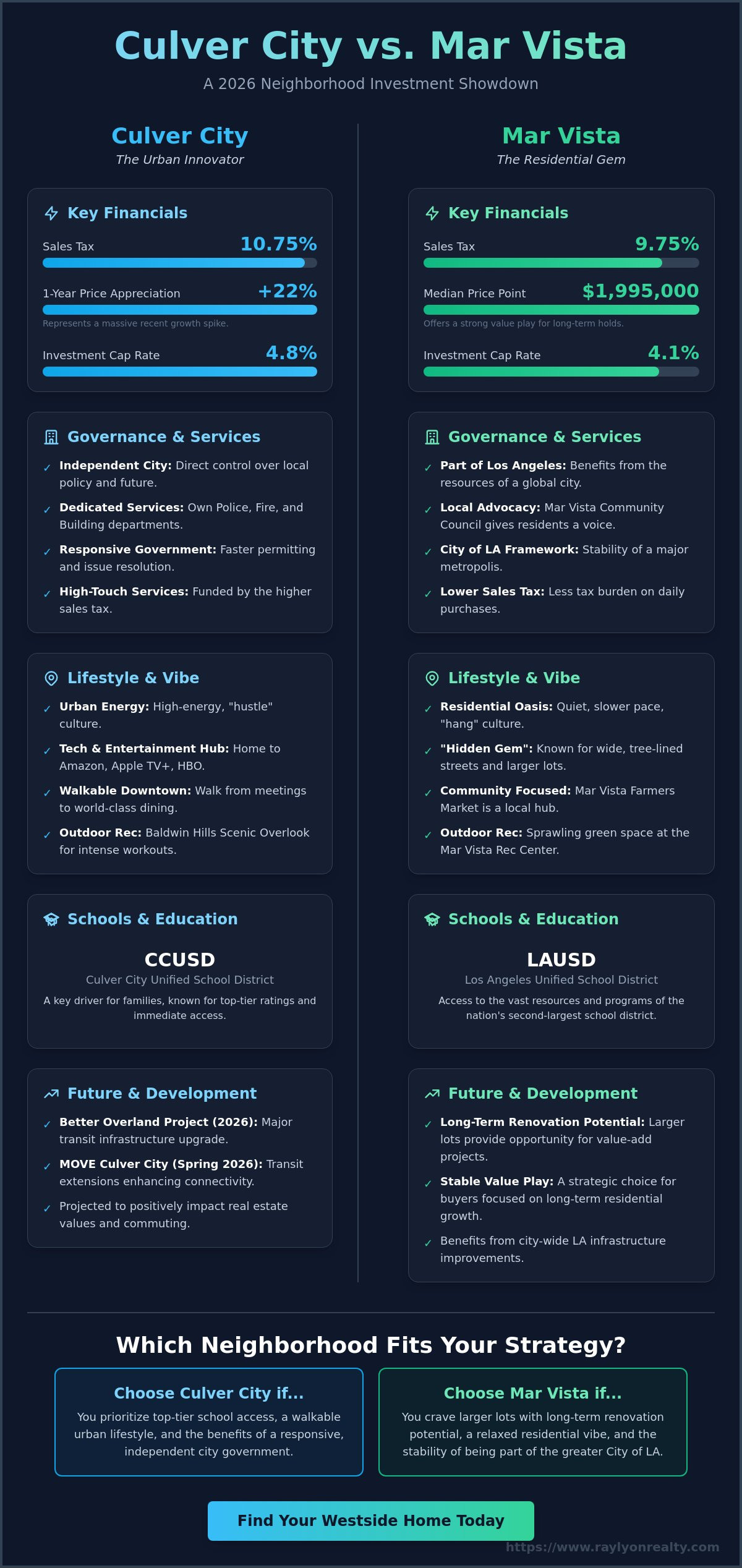
We’ll dive into why Culver City saw a massive 22% price appreciation this past year and whether Mar Vista’s $1,995,000 median price point still offers a better long-term value play for your family. You’ll get a direct look at the CCUSD versus LAUSD debate, the impact of the 2026 Better Overland transit project, and the real-world difference between 4.8% and 4.1% investment cap rates. I’ve spent years watching these streets evolve and helping clients navigate these specific boundaries. I’m here to share the data so you can choose your next home with total confidence.
Key Takeaways
- Understand how Culver City’s independent status affects your property taxes and local services compared to Mar Vista’s role within the City of Los Angeles.
- Use this 2026 culver city vs mar vista neighborhood comparison to analyze the trade-offs between school district ratings and residential lot sizes.
- Identify the specific lifestyle differences between the walkable, tech-driven energy of downtown Culver City and the quiet, tree-lined “hidden gem” pockets of Mar Vista.
- Learn how upcoming infrastructure projects like “Better Overland” and “MOVE Culver City” are projected to impact real estate values and commuting patterns.
- Discover which neighborhood aligns with your specific investment goals, whether you prioritize immediate school access or long-term renovation potential.
Culver City vs Mar Vista: The Governance and Identity Divide
When you look at a map, the border between these two areas seems invisible. But the moment you buy a home, that line becomes the most important factor in your daily life. This culver city vs mar vista neighborhood comparison starts with a fundamental truth: one is a self-governed city and the other is a pocket of a massive metropolis. Culver City operates as a bustling urban hub with its own rules; Mar Vista serves as a quiet residential retreat within the City of Los Angeles.
This divide affects your wallet and your peace of mind. In 2026, Culver City residents pay a 10.75% sales tax to fund their high-touch services. Mar Vista neighbors pay 9.75%. While the tax is higher in the “Heart of Screenland,” the trade-off is often found in the speed and quality of local government. Whether it’s a trash pickup issue or a question for the city clerk, having a smaller, dedicated staff often means getting answers in hours rather than days. It’s about deciding if you want to be a citizen of a focused municipality or a resident of a premier LA neighborhood.
To better understand this concept, watch this helpful video:
The Culver City Independent Advantage
Being an independent city gives Culver City direct control over its future. This includes specific initiatives like the “Better Overland” transit projects and the “MOVE Culver City” extensions scheduled for Spring 2026. For homeowners, the biggest win is often the permitting process. While the City of LA can be a labyrinth for renovation approvals, Culver City’s dedicated building department is generally more accessible and responsive. You also get the security of the Culver City Police and Fire departments, which are known for rapid response times. This sense of local control is a big part of why many people check the Culver City Wikipedia page to understand its unique “Screenland” history before they commit to a luxury listing here.
Mar Vista: The Best of the City of Los Angeles
Mar Vista offers a different kind of value. As part of Los Angeles Council District 11, it benefits from the massive infrastructure and resources of a global city. However, it maintains a distinct identity through the Mar Vista Community Council. This advisory group ensures the neighborhood’s voice is heard on issues like zoning and local parks. Living here gives you access to City of LA resources without the urban density of a corporate hub. This distinction is vital for a culver city vs mar vista neighborhood comparison because it highlights the balance between city-wide policy and local charm. It’s a strategic choice for buyers who want the stability of a major city framework but prefer the laid-back, residential atmosphere of the Westside’s “hidden gem.”
Lifestyle and Vibe: Urban Energy vs. Residential Oasis
Culver City has evolved into a legitimate tech and entertainment powerhouse. With Amazon, Apple TV+, and HBO setting up major operations here, the area feels like a mini-metropolis. It’s a high-energy environment where you can walk from a high-stakes production meeting to a world-class dinner in minutes. If you want to check out the latest community events or city initiatives, the official Culver City website is a great place to start. It’s a distinct shift from the sleepy studio town of the past.
Mar Vista offers the opposite. It remains the Westside’s “hidden gem,” known for wide, tree-lined streets and a slower pace of life. While Culver City is about the “hustle,” Mar Vista is about the “hang.” You’ll find neighbors walking dogs toward the Mar Vista Farmers Market on Sundays rather than rushing to a corporate campus. This culver city vs mar vista neighborhood comparison often comes down to how much “city” you want in your daily life. One offers a skyline; the other offers a sanctuary.
Outdoor enthusiasts face a choice between verticality and breadth. The Baldwin Hills Scenic Overlook in Culver City offers an intense workout with panoramic views of the entire basin. In contrast, the Mar Vista Recreation Center provides sprawling green space, community sports, and a classic park atmosphere. It’s the difference between a high-intensity hike and a relaxed afternoon on the grass.
Dining and Entertainment: The Culver Core
The density of Michelin-recognized dining in Downtown Culver is staggering. Developments like Ivy Station and Platform have created a social ecosystem where high-end retail meets curated food halls. Nightlife here is sophisticated, anchored by the Kirk Douglas Theatre and a thriving local gallery scene. It’s perfect for those who want their social life right on their doorstep. You don’t just live in Culver City; you participate in it.
The Mar Vista Quiet: Space, Privacy, and ADUs
Mar Vista shines regarding property potential and long-term flexibility. The lot sizes here are typically larger than those in Culver City, providing more privacy and substantial backyard space. In 2026, we’re seeing a major trend toward high-end ADU (Accessory Dwelling Unit) development in this pocket. These “granny flats” aren’t just for guests anymore. They’re sophisticated home offices or high-yield rental assets that maximize the property’s ROI. If you’re looking for a luxury listing agent who understands how to value these additions, it’s essential to look at the data. Mar Vista also sits closer to the coast, capturing a consistent ocean breeze that provides natural cooling Culver City often misses.
Real Estate and Schools: Comparing the 2026 Numbers
The numbers for 2026 tell a compelling story about value and lifestyle. When conducting a culver city vs mar vista neighborhood comparison, the first thing you’ll notice is the price gap. Culver City’s median sale price currently sits at approximately $1,450,000. It has seen a staggering 22% increase in value over the last year. Mar Vista, meanwhile, commands a higher median price of about $2,075,000. While the entry point is higher in Mar Vista, buyers often find they get more “house” in terms of lot size and residential privacy. Culver City tends to be more compact, with a price per square foot ranging between $850 and $950, whereas Mar Vista can reach $1,220 in its most sought-after pockets.
Inventory trends also differ significantly. Culver City offers a diverse mix of condos and townhomes, especially near the tech hubs, with prices ranging from $600,000 to $1,200,000. Mar Vista remains more strictly residential, focused on single-family homes that offer the classic Westside “hidden gem” feel. If you’re looking for a new construction sale or a luxury listing, Mar Vista’s larger lots provide a better canvas for modern architectural masterpieces. However, Culver City’s rapid appreciation makes it a powerhouse for those prioritizing equity growth in a short window.
CCUSD vs. LAUSD: The School District Dilemma
For many families, the decision stops at the school district line. The Culver City Unified School District (CCUSD) is a massive draw, earning an “A” grade in 2026 and being named the most diverse district in the county. It offers a “small-town” educational feel that is hard to find elsewhere in Los Angeles. Mar Vista residents are served by LAUSD, but it’s home to some of the district’s brightest spots. Mar Vista Elementary also holds an “A” grade from Niche for 2026. Families here often supplement their strategy with local neighborhood charters or private options, which remain a staple of the Westside education landscape.
Investment Potential and Property Taxes
The financial fine print matters just as much as the floor plan. Culver City is an independent city, meaning it has its own municipal tax structure. You’ll face a 10.75% sales tax and a median effective property tax rate of 1.32%. For specific details on municipal assessments and the proposed 2026 parcel taxes, you can visit Culver City’s official government portal. Mar Vista follows the City of Los Angeles tax rates, which are slightly lower at 9.75% for sales tax. From an investment perspective, Culver City currently offers a higher average cap rate of 4.8% compared to Mar Vista’s 4.1%. The “Culver City Premium” is the strategic price gap buyers accept to secure guaranteed access to the independent school district and hyper-local city services.
Commuting and Connectivity in the Silicon Beach Era
Location is everything on the Westside. In any culver city vs mar vista neighborhood comparison, you’ll find that both areas act as the geographic heart of Silicon Beach. Culver City serves as the primary gateway between the coast and the rest of Los Angeles. Mar Vista sits strategically between the tech hubs of Venice and Playa Vista. If your office is at Google in Venice or Meta in Playa Vista, Mar Vista offers a shorter, surface-street commute that often avoids the freeway entirely. It’s a major draw for those who want to spend less time in their cars and more time at the beach.
The Expo Line (E Line) has fundamentally reshaped Culver City. Transit-oriented developments have turned the area near the station into a vibrant, walkable core. Mar Vista lacks a direct rail connection, but it makes up for it with superior bike-ability. The Ballona Creek Bike Path acts as a “commuter highway” for both neighborhoods, allowing residents to bypass traffic and reach the ocean in under 20 minutes. For those who prefer two wheels, the 2026 Better Overland Project is adding 2.5 miles of protected bike lanes. This project, along with the MOVE Culver City Eastern Segment construction starting in Spring 2026, ensures that getting around without a car is becoming a reality rather than a dream.
The Tech Commute: Silicon Beach Access
Proximity to the “Big Three”—Google, Facebook, and Amazon—is a major driver for property values here. Mar Vista is often the preferred choice for Venice-based tech workers because it captures that coastal proximity without the Venice price tag. If you work at Amazon or Apple TV+, living in Culver City means you might not even need a car for your daily commute. Traffic hacks for 2026 involve mastering the local cut-throughs. Smart residents use Sawtelle or McLaughlin to navigate the north-south corridors, leaving the 405 to the tourists and long-distance commuters. Understanding these granular patterns is why many buyers work with a residential realtor who knows the Westside street by street.
Public Transit and Walkability Scores
Culver City boasts some of the highest walkability scores in the region, particularly in the Downtown and Arts District areas. You can grab coffee, hit the gym, and go to work all within a six-block radius. Mar Vista offers “pocket” walkability. The areas near Venice Boulevard and Washington Boulevard are thriving with local cafes and the famous Sunday Farmers Market. While it feels more suburban, these pockets provide a high quality of life without the constant urban buzz. The continued expansion of the E Line and improved bus lanes in 2026 are expected to keep property values trending upward as more people prioritize connectivity over square footage.
Making the Choice: Which Neighborhood Fits Your Strategy?
Choosing between these two Westside staples involves more than just a zip code. It’s a decision that impacts your daily commute, your children’s education, and your long-term wealth. This culver city vs mar vista neighborhood comparison has shown that while the areas share a border, they offer vastly different investment paths. Your decision should mirror your lifestyle needs and your 2026 financial objectives.
The “Family First” strategy remains the primary driver for Culver City buyers. If you want the security of an independent school district and the convenience of a walkable downtown, you’re paying for a premium community experience. It’s a turn-key lifestyle where the city services are as polished as the new tech campuses. For many, the slightly higher municipal taxes are a fair trade for the peace of mind that comes with Culver City’s rapid response times and dedicated local governance.
If you’re focused on the “Growth” strategy, Mar Vista is often the superior choice. The larger lot sizes provide a blank canvas for those looking to add value through high-end renovations or ADU construction. Leveraging a Mar Vista Los Angeles expert allows you to find those “diamond in the rough” properties that the general public overlooks. At Ray Lyon Realty, we prioritize strategic local knowledge over the generic data used by big-box agencies. We help you see the potential in a property before the rest of the market catches on.
Final Verdict: Culver City vs. Mar Vista
- Culver City: Best for those who prioritize top-tier public schools, urban walkability, and a sense of municipal identity.
- Mar Vista: Best for buyers seeking privacy, larger outdoor spaces, and the potential for significant appreciation through property improvements.
The decision usually hits a tipping point when we look at your daily routine. Do you see yourself walking to a production studio, or would you rather have a private backyard retreat with a coastal breeze? The best neighborhood is the one that aligns with your 5-year financial goals.
Next Steps: Touring the Westside with an Insider
The 2026 market is competitive, and the best homes often sell before they ever hit a public search engine. Identifying these “pocket listings” requires a deep network of local specialists and neighbors. Having a real estate agent in Los Angeles CA who understands the nuances of both jurisdictions is your greatest competitive advantage. We don’t just show houses; we map out your future in these communities.
Ready to find your perfect Westside home? Schedule a strategy session with Ray Lyon today to map out your search and gain access to the most exclusive opportunities in Culver City and Mar Vista.
Secure Your Westside Future with Confidence
Choosing the right neighborhood in 2026 requires a deep look at how you want to live and grow. You’ve discovered that Culver City offers an unmatched “small-town” city feel with elite schools, while Mar Vista provides the residential space and renovation flexibility that savvy homeowners crave. This culver city vs mar vista neighborhood comparison shows that both areas are premier Westside investments, but they serve very different long-term strategies. Whether you want the walkable energy of the Screenland or the quiet, coastal-adjacent streets of the “hidden gem,” the right choice depends on your specific five-year plan.
Navigating these competitive boundaries is easier when you have a strategic partner. At Ray Lyon Realty, we bring over 15 years of local Westside expertise to every transaction. We specialize in identifying properties with high-ROI renovation potential and ADU opportunities that maximize your equity. Plus, our clients get exclusive access to off-market listings that never hit the public search engines. When you’re ready to stop researching and start touring, find your dream home with a Westside expert at Ray Lyon Realty. Your perfect home is out there, and I can’t wait to help you find it.
Frequently Asked Questions
Is Culver City more expensive than Mar Vista in 2026?
Mar Vista generally commands a higher median price point than Culver City in 2026. While Culver City’s median sale price is approximately $1.45 million, Mar Vista’s median often exceeds $2.075 million. This price difference usually reflects Mar Vista’s larger residential lots and its coastal proximity. Buyers looking for entry-level Westside options often find more variety in Culver City’s condo and townhome market, which starts at a lower entry point.
Are the schools in Mar Vista as good as Culver City Unified?
Both neighborhoods offer top-tier educational opportunities, but the governance structure differs. The Culver City Unified School District is an independent, “A” rated district that serves as a major draw for families seeking a small-town feel. Mar Vista is served by LAUSD, but it features highly-rated “A” schools like Mar Vista Elementary. Choosing between them often depends on whether you prefer a self-contained district or a specific high-performing school within the larger Los Angeles system.
What are the property tax differences between Culver City and Mar Vista?
Property tax rates are relatively comparable, though Culver City carries additional municipal assessments. Culver City’s median effective property tax rate is around 1.32%, while Mar Vista falls within the standard Los Angeles County range of 1.21% to 1.45%. It’s important to note that Culver City has a higher sales tax of 10.75% and an 11% utility user tax. These are factors you’ll want to consider in your total monthly cost of living.
Which neighborhood is safer: Culver City or Mar Vista?
Both areas are regarded as some of the safest residential pockets on the Westside. Culver City benefits from having its own dedicated police and fire departments, which typically results in faster response times for local residents. Mar Vista is served by the LAPD’s Pacific Division. While crime rates are low in both, Culver City’s independent municipal services provide an extra layer of visibility and local accountability that many homeowners appreciate.
How long is the commute from Mar Vista to Silicon Beach?
The commute from Mar Vista to Silicon Beach is exceptionally short, often taking just 5 to 15 minutes. Because Mar Vista sits directly between Venice and Playa Vista, residents can use surface streets like Venice Boulevard or Washington Boulevard to reach major tech campuses. This proximity allows many workers to bypass the 405 freeway entirely. It makes the neighborhood one of the most convenient locations for tech professionals working at Google, Meta, or Amazon.
Is Mar Vista a good place for real estate investment?
Mar Vista remains an excellent choice for real estate investment, particularly for value-add strategies. With an average cap rate of 4.1% in 2026, it offers steady returns and strong long-term appreciation potential. The neighborhood’s larger lot sizes are ideal for building high-end Accessory Dwelling Units (ADUs). These units can significantly increase rental yield and property value in a market where demand for modern, private living spaces continues to outpace supply.
What is the ‘Culver City Transfer Tax’ and who pays it?
The Culver City Transfer Tax is a municipal tax triggered when real property changes ownership. As of 2026, the rate is $4.50 per $1,000 of the sale price for properties under $1.5 million, with higher tiered rates for luxury listings. While custom dictates that the seller usually pays this fee, it’s a negotiable item during the escrow process. This tax is unique to the independent city and doesn’t apply to homes within the Mar Vista boundaries.
Can I build an ADU in both Culver City and Mar Vista?
Yes, you can build an Accessory Dwelling Unit (ADU) in both jurisdictions thanks to favorable California state laws. However, a culver city vs mar vista neighborhood comparison reveals that Mar Vista’s larger lot sizes often provide more flexibility for detached units and backyard privacy. Culver City’s permitting process is handled by its own building department, which can be faster than the City of Los Angeles, but you’ll often have to work within tighter space constraints.