

Culver City is no longer just an “up-and-coming” neighborhood; in 2026, it’s a mature, tech-anchored powerhouse where the median home sale price has reached $1.45 million. While some investors worry that the Silicon Beach market is saturated, the reality is that the full operational status of major Apple and Amazon campuses has created a permanent class of high-income professionals. To find true value in this environment, you need a surgical, data-first culver city property investment analysis that identifies specific pockets of growth rather than following the crowd.
I understand that the high barrier to entry and the complexity of California’s 1031 exchange “clawback” rules can feel intimidating, especially when you’re managing a significant portfolio. It’s easy to feel stressed by the 3.25% rent increase cap or the nuances of new density laws like SB 79. This guide will give you the confidence to navigate these hurdles by providing a clear look at local sub-markets and actionable strategies to maximize your ROI. We’ll dive into the latest data on mortgage rates and inventory trends to ensure your next move is both strategic and profitable.
Key Takeaways
- Understand how the permanent presence of tech giants like Apple and Amazon is stabilizing property values and driving rental demand among high-income professionals.
- Access a detailed culver city property investment analysis that breaks down CAP rates and Cash-on-Cash returns for both single-family and multi-family units in the 2026 market.
- Learn how to navigate the complexities of 1031 exchanges and California’s unique tax reporting requirements to successfully upgrade your portfolio.
- Discover how to leverage trust sales and probate opportunities to find value in a high-barrier market where off-market deals are the key to high yields.
- Explore how local expertise in flipping and renovation can help you identify high-potential assets that others might overlook in a balanced market.
The 2026 Culver City Investment Landscape: Why It Still Dominates
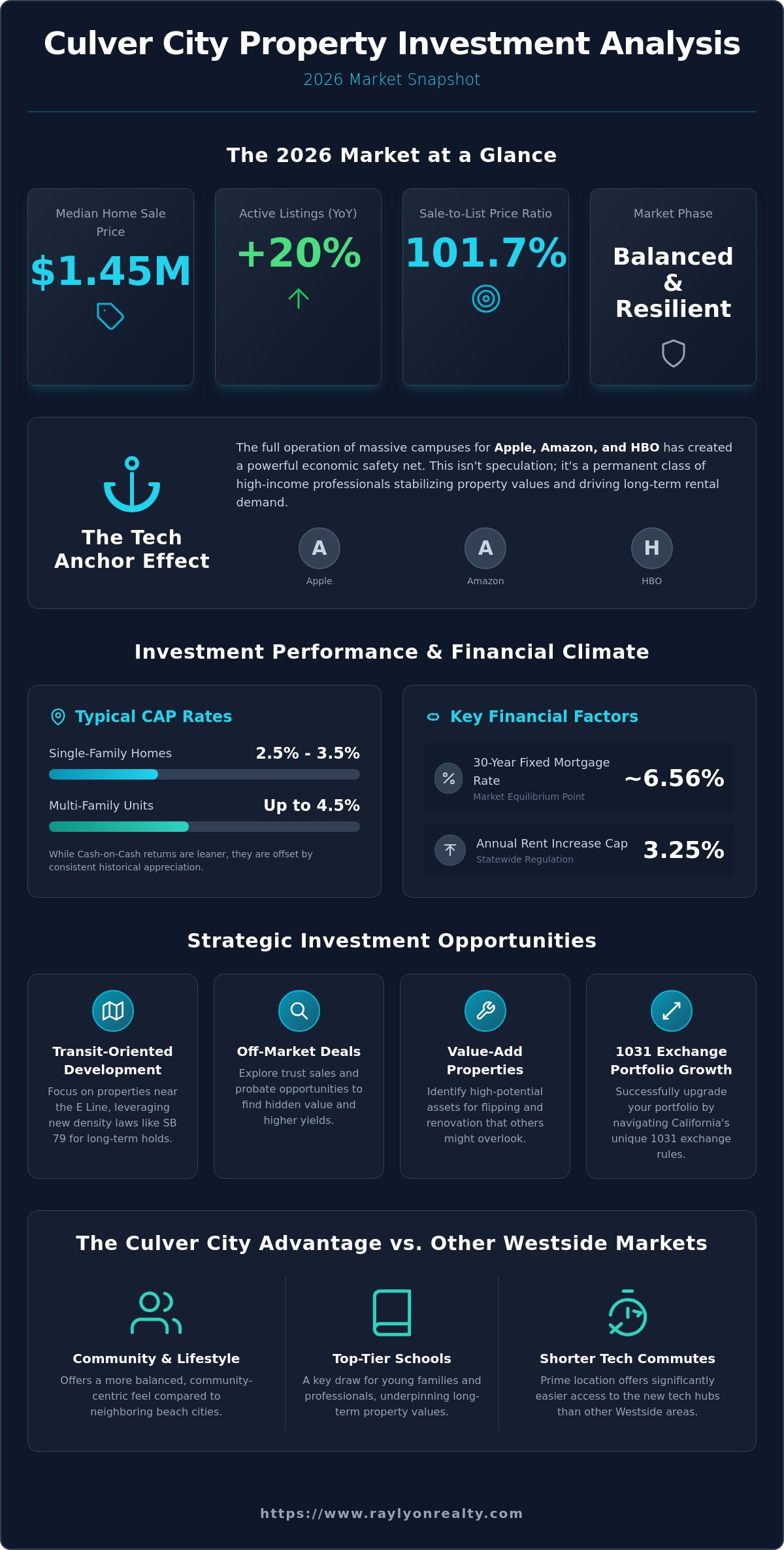
Culver City in 2026 is a study in market resilience. While other parts of Los Angeles have seen fluctuating demand, this area remains a high-priority target for a sophisticated culver city property investment analysis. We’ve moved past the post-pandemic frenzy into a balanced market phase. Active listings are up 20% compared to last year, which gives buyers more breathing room, yet the median sale price holds strong at $1.45 million. This stability is exactly what seasoned investors look for when the goal is preserving capital while capturing steady equity growth.
To get a better sense of what this market looks like on the ground, watch this video on luxury price points in the area:
The city’s identity has evolved beautifully over the decades. It still honors its roots as the “Heart of Screenland,” but the History of Culver City is now being written by tech giants. The massive campuses for Apple, Amazon, and HBO are fully operational in 2026. These aren’t just office buildings; they’re economic anchors. When companies of this scale invest billions into local infrastructure, it creates a safety net for private residential buyers. You aren’t just buying a house; you’re buying into a sub-market backed by the world’s most profitable corporations. We’re seeing a clear shift from the rapid, speculative appreciation of the early 2020s toward sustained, predictable wealth building.
Culver City vs. Neighboring Westside Markets
Culver City occupies a unique middle-ground on the Westside. While Santa Monica and Venice often command higher price-per-square-foot tags, they don’t always offer the same community-centric feel or top-tier school district rankings. Tech workers and young families are choosing Culver City because it offers a more balanced lifestyle and a shorter commute to the new tech hubs. Even with more inventory available, the sale-to-list ratio remains high at 101.7%. This proves that while there are more homes to choose from, buyers are still willing to pay a premium for the right residential asset.
The 2026 Macro-Economic Climate in Los Angeles
Local policy is currently a major driver of property value. New legislation like SB 79, which went into effect on July 1, 2026, incentivizes developers to build more densely near transit hubs. This makes residential properties near the E Line incredibly valuable for long-term holds. As the city continues to implement its General Plan 2045, the focus on walkable, transit-oriented living will only intensify. With mortgage rates hovering around 6.56% for a 30-year fixed loan, the market has found a new equilibrium that supports steady growth through 2030. This environment favors the strategic investor who prioritizes location and local economic drivers over short-term trends.
Key Performance Indicators (KPIs) for Culver City Property
To build wealth in this mature market, you have to look past the sticker price. A successful strategy in 2026 requires a rigorous culver city property investment analysis that weighs immediate cash flow against long term equity. While the median home price of $1.45 million might seem high, the underlying metrics tell a story of stability. In the current climate, typical CAP rates for single family homes hover between 2.5% and 3.5%. Multi family units offer slightly more breathing room, often reaching 4.5% if the property is managed efficiently and kept outside of the strictest rent control brackets; for those diversifying their holdings across different regions, you can learn more about Elite Agents & Partners and their specialized approach to residential and commercial property management.
Cash on cash returns are naturally leaner when mortgage rates sit at 6.56% for a 30 year fixed loan. However, the real power of Culver City lies in its historical appreciation. Over the last decade, this area has consistently outperformed national averages. It has transformed from a quiet studio town into a global tech hub. If you’re looking to run these numbers on a specific asset, it’s helpful to partner with a local expert who understands the granular details of Westside valuations. Minor “value add” renovations, such as updating mid century kitchens or adding an ADU, can often yield a 2x return on the capital invested by tapping into the high expectations of the local workforce.
Rental Yield Analysis by Neighborhood
Yields vary significantly depending on which pocket you target. Lucerne Higuera is the “tech heart” of the city. It offers the highest rental demand due to its proximity to the Apple and Amazon campuses. Carlson Park, by contrast, is a family oriented stronghold. It typically sees lower turnover and higher long term stability, though initial yields might be lower. Investors must also account for the current rent increase cap of 3.25%, which is effective through June 30, 2027. This makes selecting the right tenant and starting at a market rate price point more critical than ever.
Calculating the Real Cost of Ownership
Owning property here involves more than just a mortgage payment. The median effective property tax rate in Culver City is 1.32%, which is a significant line item in any culver city property investment analysis. You should also set aside a maintenance reserve of at least 1% of the property value annually, especially for the charming but older Westside homes that require specialized care. Insurance premiums have also seen adjustments in 2026. It’s wise to get a comprehensive quote during your due diligence period to ensure your projected ROI remains intact.
The “Apple & Amazon” Effect: Economic Drivers of Demand
The transformation of Culver City into a global tech epicenter isn’t a future prediction; it’s the current reality of 2026. The massive footprints of Apple on Washington Boulevard and Amazon at the historic Culver Studios have fundamentally altered the local economy. This revitalization also brings a new wave of high-profile brand activations and live events to the area; to see the caliber of production that these global entities expect, check out Lar&Co. When you conduct a culver city property investment analysis today, you’re looking at a market supported by thousands of high earning professionals who prioritize proximity to their headquarters. These aren’t just transient workers. They’re individuals with significant disposable income who are looking for long term residential stability near their offices.
This demographic shift has turned walkability into a primary currency for property value. Culver City’s “15 minute city” design allows residents to move between world class dining, office campuses, and transit without a car. This lifestyle appeal acts as a moat, protecting property values even during broader market shifts. Beyond the tech influence, the Culver City Unified School District remains a massive draw. Families often pay a premium to secure a home within the district boundaries, ensuring that residential assets here maintain a high floor for both resale value and rental demand.
Tech Hub Expansion: Beyond the Culver Studios
The growth isn’t stopping at the existing HQs. Several new commercial developments are slated for completion through late 2026 and early 2027, which will bring even more high income renters into the urban core. We’ve observed a distinct “Halo Effect” where residential properties within a two mile radius of major tech campuses see higher occupancy rates and more aggressive bidding. These renters are looking for luxury finishes and modern amenities, which creates a prime opportunity for investors to purchase older assets and perform strategic upgrades to meet this demand.
Lifestyle and Infrastructure as Value Anchors
The evolution of Downtown Culver City has created a ripple effect that extends into neighboring areas. Public works projects, including expanded green spaces and bike friendly corridors, have made the city more desirable than ever. These infrastructure investments provide a sense of permanence that institutional and private investors crave. While Culver City remains the primary target for many, mar vista los angeles serves as a complementary market for investors looking for slightly different price points while staying close to the tech corridor’s momentum. This interconnectedness across the Westside ensures that your investment is part of a larger, thriving economic ecosystem rather than an isolated pocket of growth.
Strategic Investment Paths: 1031 Exchanges and Portfolio Growth
Scaling a portfolio in a high barrier market like the Westside requires more than just capital; it requires a tax efficient strategy. Many investors are currently using 1031 exchanges to transition out of older, high maintenance assets in other parts of Los Angeles and into the stable, tech driven environment of Culver City. This move isn’t just about appreciation. It’s about upgrading the quality of your tenant base and the long term resilience of your equity. A thorough culver city property investment analysis should always include a plan for deferring capital gains to keep your wealth building momentum.
Beyond traditional listings, savvy buyers are looking toward trust sales and probate opportunities. These often provide a path to entry at a more competitive price point, though they require a deep understanding of local contractual nuances. With the average interest rate for a 30 year fixed mortgage in California sitting at 6.56% as of July 2026, leveraging equity from existing properties to fund multi family acquisitions has become a popular way to offset higher borrowing costs with increased rental volume.
The 1031 Exchange Roadmap for 2026
The rules for tax deferral remain strict, and the timelines are unforgiving. You have exactly 45 days from the sale of your relinquished property to identify a replacement in Culver City, and 180 days to close. In a market where inventory has increased by 20% but competition remains steady, having a pre-vetted list of targets is essential. Be mindful of California’s “clawback” rule, which requires annual reporting on Form 3840 if you ever move your investment out of state. Additionally, new legislation under AB 1611 has eliminated 1031 eligibility for large corporations owning 50 or more single family homes, which may slightly shift the competitive landscape in favor of individual private investors.
Multi-Family vs. Single-Family Investment
The “house hacking” trend continues to dominate the local market. Investors often purchase a multi family property, living in one unit while the other covers a portion of the mortgage. This is particularly effective given the current 15 year fixed mortgage rate of 5.81%. Culver City’s zoning laws and the recent SB 79 legislation also make Accessory Dwelling Units (ADUs) a goldmine for value add strategies. Adding a modern ADU to a single family lot can drastically improve your cash on cash return without the need for a full multi family acquisition. If you want to explore these off market opportunities and strategic upgrades, reach out to discuss your portfolio goals and how we can find the right asset for your 1031 exchange.
Partnering with Ray Lyon Realty for Your Culver City Portfolio
Ray Lyon doesn’t just sell residential assets; he lives the investment life. My personal history with property development, flipping, and portfolio management means I’ve navigated the same risks and rewards you’re weighing right now. This firsthand experience is why our team provides a level of insight that generic online tools simply can’t match. When we perform a culver city property investment analysis, we aren’t just pulling recent sales data. We’re looking at the physical condition of the property, its potential for an ADU, and how it fits into the broader 2026 tech economy.
One of our biggest strengths is what we call the “Insider Advantage.” In a market where the highest-yield assets often sell before they ever hit the MLS, our network gives you access to non-public listings and pre-market opportunities. This is critical in the Westside corridor, where local connections often determine who secures a deal. We move beyond surface-level data to give you a surgical look at what a property is truly worth. You’ll get a clear picture of potential equity growth without the guesswork of a generic automated algorithm.
A Client-Centric Approach to Investment
Choosing the right real estate broker in los angeles is about finding a partner who values your long-term ROI as much as you do. We recently helped an investor take a dated mid-century property and, through a series of strategic cosmetic upgrades and a garage conversion, significantly increase the projected rental yield. Our network of specialists, from professional stagers to 1031 exchange intermediaries, ensures that every step of your transaction is handled by a pro. We aim to reduce the stress of complex Westside deals by projecting competence and genuine care for your financial future.
Start Your Culver City Investment Analysis Today
The 2026 market is full of opportunity for those who have the right data at their fingertips. Don’t rely on a generic algorithm to make a million-dollar decision. Instead, book a strategic consultation to review your current portfolio and see where Culver City fits into your growth plans. We can provide a custom market report for specific neighborhoods like Carlson Park or Lucerne Higuera, giving you the competitive edge you need to succeed. Get a professional Culver City property analysis from Ray Lyon Realty and let’s start building your Westside legacy together.
Secure Your Future in the Westside’s Tech Anchor
Culver City has transitioned from a rising star to a foundational asset for any serious Southern California portfolio. The permanent presence of Apple and Amazon provides a level of economic stability that few other neighborhoods can match. Whether you’re looking to leverage a 1031 exchange or maximize a single lot with a strategic ADU addition, the 2026 market offers clear paths to long term wealth for those who move with precision. Success here isn’t about following the crowd; it’s about using a detailed culver city property investment analysis to find the value that others miss.
I bring my personal history in property flipping and renovation to every deal, ensuring you see the potential in an asset before the hammer even swings. My team specializes in navigating complex trust sales and 1031 exchanges, providing you with exclusive access to off-market Westside opportunities. Don’t leave your ROI to chance in this competitive environment. Analyze Your Next Culver City Investment with Ray Lyon Realty today. Let’s work together to turn these market insights into your next successful acquisition. Your Westside legacy starts with a single, smart move.
Frequently Asked Questions
Is Culver City real estate a good investment in 2026?
Culver City remains an excellent investment because of its economic moat created by major tech anchors. While the median home sale price has reached $1.45 million, the 101.7% sale-to-list ratio proves that demand is still incredibly strong. It’s a balanced market that rewards long term equity growth and stability rather than short term speculation.
What is the average CAP rate for Culver City rental properties?
Typical CAP rates currently range from 2.5% to 3.5% for single family homes, while multi family units can reach 4.5% with efficient management. Investors must factor in the maximum annual rent increase of 3.25% effective through June 2027. A detailed culver city property investment analysis will help you identify specific assets where you can maximize these yields through strategic renovations.
How do Apple and Amazon impact the Culver City housing market?
The presence of these tech giants has created a permanent class of high income professionals who prioritize living near their headquarters. Their fully operational campuses in 2026 have stabilized property values and ensured a consistent pool of qualified renters. This corporate footprint acts as a safety net, protecting your investment from the volatility seen in other parts of Los Angeles.
Can I use a 1031 exchange to buy a home in Culver City?
You can use a 1031 exchange for any residential property that is held for investment purposes rather than as a primary residence. You must identify the replacement property within 45 days and close within 180 days. New legislation in 2026 has limited these exchanges for massive corporations, which actually gives individual private investors a better chance to secure prime Westside assets.
What are the best neighborhoods in Culver City for property investment?
Lucerne Higuera is the top choice for investors targeting tech professionals due to its proximity to major HQs. Carlson Park remains a favorite for those seeking family oriented tenants and long term stability. If you’re looking for transit oriented growth, focus on properties near the E Line where new zoning laws like SB 79 are driving density and value.
How much are property taxes for investment homes in Culver City?
The median effective property tax rate in Culver City is 1.32%. When conducting your culver city property investment analysis, you should also account for the local sales tax rate of 10.75%. These tax revenues support the independent school district and high quality public works that keep local real estate in such high demand.
Are there many off-market property opportunities in Culver City?
Yes, but these deals rarely make it to public listing sites or major consumer portals. Many of the best value add opportunities come through trust sales, probate, or private brokerage networks. Securing these off market deals requires working with a local expert who has deep roots in the Westside community and can spot a pre-market opportunity before it becomes a bidding war.
What is the difference between Culver City and Mar Vista for investors?
Culver City offers an independent school district and a concentrated hub of tech employers, whereas Mar Vista is part of the City of Los Angeles with different zoning and service structures. Investors often choose Culver City for the premium rental rates and lower average days on market. Mar Vista acts as a complementary market that provides different price points while still benefiting from the Westside’s tech driven economy.