

If you are eyeing an $8 million sale price for your North of Montana estate, did you realize that crossing that threshold triggers a “cliff tax” that could cost you over $448,000 in city transfer taxes alone? Calculating the total cost to sell a house in Santa Monica has become increasingly complex in 2026. Between the high-stakes Measure GS rates and the shifting landscape of negotiable commissions, many sellers feel like they’re walking through a financial minefield before the first open house even begins.
It’s completely natural to feel uneasy about how much of your hard-earned equity will actually stay in your pocket. You deserve a transparent look at your walk-away profit long before you sign a listing agreement. This guide provides a clear line-item breakdown of every essential expense, from mandatory LA County fees to the strategic “lipstick on a house” upgrades that drive real ROI. We’ll explore current tax tiers, explain how to handle buyer agent concessions, and show you exactly how to navigate the Westside market to maximize your final check.
Key Takeaways
- Learn why the total cost to sell a house in Santa Monica typically ranges between 7% and 10% of the final sale price and how to accurately estimate your walk-away profit.
- Understand the financial impact of the Measure GS “cliff tax” and standard county transfer fees to avoid expensive surprises during the closing process.
- Navigate the 2026 commission landscape with confidence by focusing on fee transparency and the value of professional representation in a complex market.
- Discover the specific “Coastal Modern” staging and repair strategies that offer the highest return on investment for Westside properties.
- See how a strategic listing partner uses local market data and custom net sheets to help you choose the most profitable offer for your unique situation.
Total Cost to Sell a House in Santa Monica: The 2026 Overview
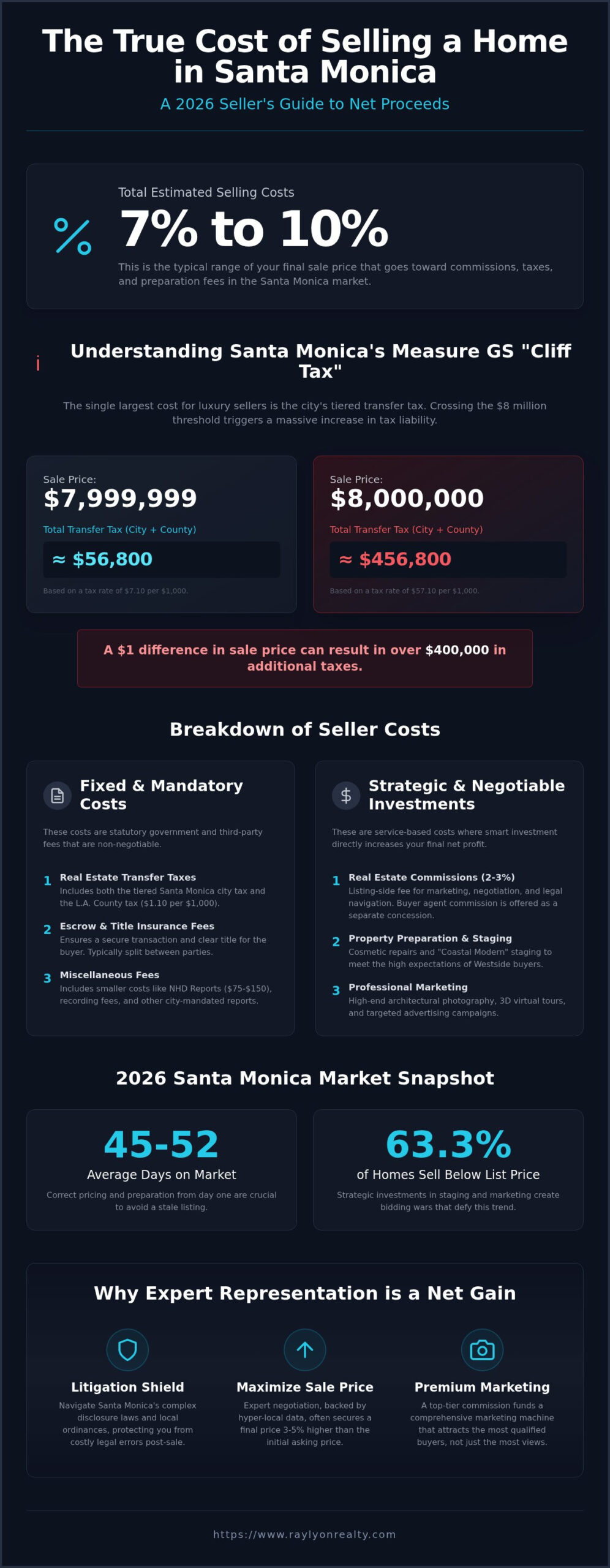
When you decide to list your home, the first number you likely think about is the sale price. However, savvy Westside sellers know the figure that really matters is your net proceeds. Net proceeds are the final amount a seller receives after all liens and expenses are paid. In 2026, the total cost to sell a house in Santa Monica generally falls between 7% and 10% of the final sale price. While that range might seem broad, it reflects the unique tax structures and high-end preparation costs specific to our coastal market.
Santa Monica stands apart from the rest of Los Angeles County because of its multi-layered tax system. While most sellers expect standard county fees, our city adds its own tiers, particularly for properties over certain price points. Shifting your focus from “what’s the cheapest way to sell” to “how do I maximize what I keep” is essential. Often, investing in strategic preparation or professional representation yields a much higher final check than a “discount” approach ever could.
The Santa Monica Real Estate Market Context
Current 2026 inventory levels remain tight, which gives sellers some leverage, but buyers are more discerning than ever. We’re seeing an average of 45 to 52 days on market across the city, but this varies significantly by neighborhood. A property in 90402 (North of Montana) might have higher carrying costs due to its larger footprint and luxury price tag compared to a condo in 90405. Pricing correctly from day one is the best way to avoid the hidden cost of a “stale” listing. When a house sits, buyers start asking what’s wrong with it, which often leads to aggressive requests for seller concessions and credits.
Fixed vs. Negotiable Selling Expenses
Not all costs are created equal. Some are statutory, meaning they’re non-negotiable government fees. A major component of these fixed costs is the Real estate transfer tax, which in Santa Monica includes both a county-wide rate and a city-specific rate that scales based on your sale price. These are legal requirements you can’t bypass or negotiate away.
On the other hand, service costs are where you have more control and can exercise strategy. These include:
- Brokerage commissions and professional fees.
- Staging and cosmetic “lipstick” renovations.
- High-end marketing and architectural photography.
- Pre-listing inspections and NHD reports (typically $75 to $150).
Investing in these areas shouldn’t be viewed just as an expense, but as a calculated move to drive up the final bid. In a market where 63.3% of homes sell under list price, the right preparation can be the difference between a price cut and a bidding war.
Real Estate Commissions and Professional Fees in 2026
The 2026 real estate landscape has moved toward a model of total transparency. When calculating the cost to sell a house in Santa Monica, you’re no longer looking at a single, rigid percentage. Instead, you’ll find value-based fees that reflect the specific level of service and marketing expertise provided. Typically, listing side commissions in Los Angeles now range between 2% and 3%. Sellers also have the flexibility to offer a concession to the buyer’s agent, a strategy that remains common in the Westside market to attract the widest pool of qualified prospects.
Choosing the agent with the lowest fee might feel like an easy win, but it often results in the lowest net proceeds. A discount broker rarely has the budget for high-end marketing or the experience to navigate a high-stakes negotiation. Beyond the sale price, professional representation serves as your primary shield against litigation. Santa Monica has stringent local ordinances. Missing a single disclosure or city-mandated report can lead to costly legal errors long after the keys have changed hands. While you’re reviewing California property tax information to calculate your final prorations, remember that your agent’s expertise in paperwork is just as critical as their skill in sales.
What Your Commission Actually Covers
A premium commission isn’t just a fee for “listing” a home. It’s an investment in a comprehensive marketing machine. In Santa Monica, where buyers expect a “finished product” aesthetic, this includes high-end architectural photography and immersive 3D virtual tours that filter for serious prospects. More importantly, it covers the strategic negotiation process. An experienced local expert often secures 3% to 5% above the initial asking price through savvy counter-offers and buyer vetting. They also manage the labyrinth of disclosures that are unique to our specific coastal zip codes.
Evaluating the ROI of a Luxury Listing Agent
High-value transactions require more than just an MLS entry. A luxury listing agent provides access to “off-market” buyer networks and international portals that standard agents simply can’t reach. This “insider” access is vital in neighborhoods like North of Montana or Ocean Park, where many sales happen quietly. A strategic partner also acts as a risk mitigator during escrow. They anticipate potential hurdles with inspections or appraisals, ensuring the deal doesn’t collapse at the last minute. If you want to ensure your transaction is handled with this level of precision, you can explore our strategic listing services to see how we maximize value for our clients.
Santa Monica Closing Costs: Transfer Taxes and Escrow
While commissions often take center stage, the specific taxes and fees associated with a Santa Monica zip code can significantly impact your bottom line. Unlike many other parts of Southern California, sellers here deal with a multi-tiered tax structure. Understanding these figures early is vital for an accurate estimate of the cost to sell a house in Santa Monica. In our region, closing costs are divided into three main buckets: statutory government taxes, title and escrow fees, and administrative charges.
Every seller in Los Angeles County pays a standard County Transfer Tax of $1.10 per $1,000 of the sale price. However, Santa Monica adds its own city-level tax on top of this. For properties sold under $5 million, the city rate is $3.00 per $1,000. If your home sells for between $5 million and $8 million, that rate doubles to $6.00 per $1,000. These costs are typically deducted directly from your proceeds at the close of escrow.
Measure GS and High-Value Property Taxes
The most significant financial shift for luxury sellers in 2026 is Measure GS, often referred to as the “homelessness and schools” tax. This is a “cliff tax,” meaning it applies to the entire sale price if the transaction hits the $8 million mark. For any sale at or above $8 million, the tax rate jumps to $56.00 per $1,000. This creates a massive disparity for properties valued near that specific threshold.
Consider a $10 million estate North of Montana. The Measure GS tax alone would be $560,000. When you add the county tax and the standard city tiers, the total tax bill becomes a major factor in your financial planning. This high cost is a primary reason why residential sales over $8 million in Santa Monica dropped by 53% in the year following the measure’s implementation. A strategic listing partner will help you evaluate if pricing just below this threshold might actually net you more money than a sale slightly above it.
Escrow, Title, and Administrative Fees
Outside of taxes, you’ll navigate the professional fees required to transfer the deed. In Southern California, it’s customary for the seller to pay for the owner’s title insurance policy. This policy protects the buyer from any future claims against the property’s title. Escrow fees, which cover the neutral third party managing the funds and paperwork, are typically split 50/50 between the buyer and seller.
- Natural Hazard Disclosure (NHD) Report: Usually costs between $75 and $150.
- Title Insurance: Varies by sale price but remains a standard seller expense in LA.
- Administrative Costs: Budget for notary fees, wire transfers, and messenger services, which usually total a few hundred dollars.
These administrative details might seem small compared to a six-figure tax bill, but they ensure a smooth, legally sound transfer. Having a clear view of these line items prevents any last-minute “sticker shock” when you receive your final closing statement.
Property Preparation: Staging, Repairs, and “Lipstick”
In the Santa Monica market, buyers aren’t just looking for square footage; they are buying a specific coastal lifestyle. This high expectation means that property preparation is a significant part of the cost to sell a house in Santa Monica. While generic real estate advice often suggests a simple deep clean, Westside buyers expect a “turn-key” experience. If your home feels like a project, you’ll likely see aggressive requests for repair credits or lower initial offers. Investing in “lipstick” renovations, such as fresh neutral paint, modern light fixtures, and updated cabinet hardware, often yields a much higher return than major structural overhauls.
Curb appeal is equally critical, especially in neighborhoods like Sunset Park where the “walkable” neighborhood feel is a primary selling point. Refreshing the landscaping with drought-tolerant, native plants and ensuring the entryway looks pristine creates an immediate emotional connection. Spending a few thousand dollars on these cosmetic touches helps you stand out in a market where over 60% of homes have recently sold below their list price. Beyond aesthetics, we recommend pre-listing inspections. Paying for a professional to walk through the home before it hits the market allows you to fix minor issues on your own terms. This proactive approach prevents a buyer from discovering those same issues during escrow and demanding $10,000 in credits for a $1,000 repair.
The ROI of Professional Staging
In our local market, “Coastal Modern” staging is essentially a requirement. This aesthetic uses light woods, linen textures, and an airy palette to make spaces feel larger and more inviting. Professional stagers understand how to highlight a home’s architectural strengths while downplaying any awkward layouts. Industry research consistently shows that staged homes sell significantly faster and often command higher premiums than vacant or poorly furnished properties. At Ray Lyon Realty, we take a hands-on approach to this process. We coordinate with a network of specialists to ensure your home’s presentation matches the high-end expectations of Santa Monica buyers.
City-Mandated Retrofitting and Inspections
Santa Monica has specific ordinances that can catch unprepared sellers off guard. One of the most important is the 9A Report, also known as the Residential Building Record and Report of Conservation Laws. This city-mandated document confirms that the property complies with local energy and water conservation requirements. You’ll also need to ensure the home meets seismic safety standards, including proper bracing of water heaters and the installation of automatic gas shut-off valves. Additionally, you must provide a Natural Hazard Disclosure (NHD) report, which typically costs between $75 and $150. These reports are non-negotiable parts of the transaction. If you want to ensure your home is fully compliant before you list, you can request a custom property preparation plan from our team.
Calculating Your Net Proceeds with Ray Lyon Realty
Understanding the total cost to sell a house in Santa Monica is only half the battle. The real goal is translating that data into a clear financial outcome. While generic online calculators offer a rough estimate, they often fail to account for the granular details of Measure GS or the specific ROI of Westside staging trends. At Ray Lyon Realty, we provide every client with a custom Net Sheet. This document outlines every single line item, from the standard county tax to the specific city luxury tiers. This ensures you know exactly what your walk-away profit will be before you ever sign a listing agreement.
Strategic pricing is about more than just picking a high number. Sometimes the highest offer on paper isn’t the most profitable one for your bottom line. If an offer pushes you just past the $8 million mark, the resulting “cliff tax” could actually leave you with less money than a slightly lower offer. We help you evaluate every bid by looking at buyer concessions, financing certainty, and tax implications. Our deep roots in the Westside allow us to spot these nuances that outside agents might overlook. We focus on the final check you receive at the end of escrow, not just the number on the contract.
The Ray Lyon Advantage: Strategic Seller Representation
Our approach is built on hands-on experience that goes beyond standard real estate services. Having personally managed property renovations and personal investments, I look at your home through the lens of a developer. This allows me to advise you on which repairs will actually put more money in your pocket and which ones are a waste of time. We also specialize in the complexities of high-value trust sales and 1031 exchanges, ensuring that seasoned investors and local families have the expert guidance they need. Our goal is to make selling your LA home a stress-free experience by handling the technical heavy lifting while you focus on your next chapter.
Ready to List? Your Action Plan
Success in the 2026 market requires preparation and a clear strategy. Your action plan starts with a simple walkthrough. We’ll identify the high-ROI “lipstick” repairs we discussed earlier to ensure your home meets the high expectations of Santa Monica buyers. We also recommend reviewing a preliminary title report early in the process. Catching potential liens or deed issues now prevents delays during the 45 to 52 days your home is likely to be on the market. When you’re ready to see the real numbers for your property, Get your custom Santa Monica Net Proceeds estimate today and take the guesswork out of your sale.
Secure Your Financial Future on the Westside
Selling a home in our unique coastal market is a high-stakes financial event. By now, you understand that the total cost to sell a house in Santa Monica is about much more than just a commission percentage. It’s a calculated combination of strategic property prep, navigating the cliff-tax thresholds of Measure GS, and ensuring total compliance with city-mandated reports. Each of these steps is an opportunity to protect your equity and maximize your final walk-away profit.
We focus on a personalized strategy for every listing, leveraging deep knowledge of Santa Monica neighborhoods to ensure you don’t leave money on the table. Whether you’re navigating a complex trust sale or simply moving to your next chapter, having a partner with a proven track record in luxury and investment sales makes all the difference. You’ve worked hard to build value in your property; we’re here to help you secure it. Maximize Your Net Proceeds – Contact Ray Lyon Realty today. We look forward to helping you move forward with absolute confidence.
Frequently Asked Questions
How much is the transfer tax in Santa Monica in 2026?
The total transfer tax is a combination of Los Angeles County and City of Santa Monica fees. The county charges a flat $1.10 per $1,000 of the sale price. The city uses a tiered system: $3.00 per $1,000 for sales under $5 million; $6.00 per $1,000 for sales between $5 million and $8 million; and $56.00 per $1,000 for any sale at or above $8 million.
Does Measure ULA apply to houses in Santa Monica?
No, Measure ULA is specific to the City of Los Angeles and does not apply to properties within Santa Monica city limits. Instead, Santa Monica has its own high-value transfer tax known as Measure GS. While both taxes target luxury real estate to fund housing and schools, the thresholds and rates differ, so it’s vital to use a local expert who understands these specific boundaries.
Who pays for the escrow fees in Santa Monica, the buyer or the seller?
In Southern California transactions, it’s customary for the buyer and seller to each pay their own share of the escrow fee, typically a 50/50 split. The seller also traditionally pays for the owner’s title insurance policy. These customs can technically be negotiated during the offer process, but they remain the standard practice for most Westside residential sales.
Is staging really necessary for a home in Santa Monica?
Staging is considered a requirement rather than an option if you want to maximize the cost to sell a house in Santa Monica and your final return. Buyers in this market expect a “Coastal Modern” aesthetic that feels move-in ready. Because staged homes often sell faster and for higher premiums, the initial investment in furniture and decor usually pays for itself several times over at the closing table.
What is the Santa Monica 9A Report and why do I need it?
The 9A Report is a city-mandated Residential Building Record and Report of Conservation Laws. You need it because Santa Monica law requires sellers to disclose the legal use and permit history of the property to the buyer before the sale is finalized. It also ensures the home complies with local water and energy conservation standards, such as low-flow plumbing fixtures.
Can I negotiate the commission when selling my Santa Monica home?
Yes, all real estate commissions are negotiable. Following the 2024 NAR settlement, there’s more transparency than ever regarding how agents are compensated. You’ll typically negotiate a fee for your listing agent’s services and decide whether to offer a concession to the buyer’s agent to make your property more competitive to a larger pool of prospects.
What are the typical closing costs for a seller in 90402?
Sellers in the 90402 zip code should prepare for higher absolute costs because median home prices often exceed $4.9 million. If your sale price hits the $8 million mark, your cost to sell a house in Santa Monica will include the $56 per $1,000 Measure GS tax. This single line item can significantly shift your net proceeds, making strategic pricing around that threshold extremely important.
How long does it typically take to sell a house in Santa Monica right now?
Average days on market in Santa Monica currently range between 45 and 52 days. This timeline can fluctuate based on your specific neighborhood and how accurately the home was priced at the start. Properties that are professionally staged and strategically marketed often see shorter timelines, while overpriced listings may sit longer and eventually require price concessions to attract a buyer.