

The rental history may shape the investment as much as the property itself. When buying an investment property in Santa Monica, start by understanding the rules: properties built before 1979 are subject to rent control regulations, and Santa Monica prohibits unhosted vacation rentals of less than 30 days. Those facts can influence which rental strategy makes sense.
It’s natural to focus first on potential income, but a sound decision also depends on the property’s type, condition, location, and rental history. This guide explains how to weigh those factors and assess their effect on the home’s appeal to future renters and buyers.
You’ll also learn what to consider across Santa Monica neighborhoods, how transit and parks can shape location appeal, and which questions to resolve before making an offer. The goal is to compare opportunities more practically and decide whether a property fits your investment plans.
Key Takeaways
- Review a property’s rental history and applicable rent-control rules before deciding how it could generate income.
- Compare Santa Monica neighborhoods and property types by purchase goals, condition, and potential renter appeal.
- Assess the Pico District as one part of your appreciation analysis, and weigh long-term value alongside rental income.
- For condos, look beyond the unit itself: association reserves, inspections, and possible special assessments can affect ownership costs.
- Consider nearby transit, parks, and beach access when evaluating renter interest and future resale appeal.
1. Santa Monica rent-control exemptions and rental history
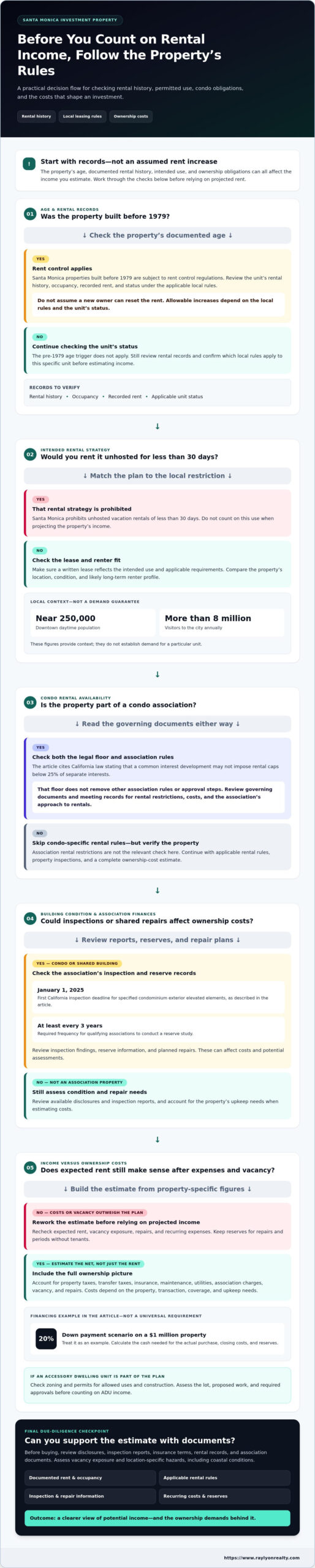
Start with the property’s age and rental records. Santa Monica properties built before 1979 are subject to rent control regulations. Before buying an investment property in Santa Monica, review the unit’s rental history, occupancy, and recorded rent. Don’t assume a new owner can reset the rent. Allowable increases depend on the applicable local rules and the unit’s status, so use its documented history when estimating income.
Local leasing rules affect the rental strategy. Santa Monica prohibits unhosted vacation rentals of less than 30 days. A written lease should reflect the intended use and applicable requirements. Downtown’s daytime population is near 250,000 people, and the city receives more than 8 million visitors annually. Those figures provide context, but they don’t establish demand for a particular unit. Compare its location, condition, and likely long-term renter profile.
Condo buyers should review association documents before estimating rental availability. A California common interest development may not impose rental caps below 25 percent of separate interests, according to California Legislative Information. That floor does not remove other association rules or approval steps. Read the governing documents and meeting records to understand restrictions, costs, and the association’s approach to rentals.
Building inspections and association finances can affect ownership costs. The first California inspection deadline for specified condominium exterior elevated elements was January 1, 2025, according to California Legislative Information. Qualifying associations must conduct a reserve study at least every three years, according to California Legislative Information. Review inspection findings, reserve information, and possible repair plans before estimating a condo’s net income.
Financing requirements vary by property and borrower. A separate example uses a 20% down payment on a $1 million property. Treat these as scenarios, then calculate the cash needed for your purchase, closing costs, and reserves.
Property taxes, transfer taxes, insurance, maintenance, utilities, association charges, and vacancy all affect operating results. The costs depend on the property, transaction, coverage, and upkeep needs. Zoning and permits determine allowed uses and construction, including accessory dwelling unit plans. Before counting on ADU income, assess the lot, proposed work, and required approvals.
Before buying an investment property in Santa Monica, review disclosures, inspection reports, insurance terms, rental records, and association documents. Assess vacancy exposure and location-specific hazards, including coastal conditions. Compare expected rent with recurring expenses, and set aside reserves for repairs and periods without tenants. Factoring in ongoing day-to-day oversight is essential for any landlord, and reviewing the practices of experienced residential operators such as eandsmgmt.ca highlights how routine maintenance and tenant coordination affect long-term operating budgets. This gives you a clearer picture of potential income and ownership demands.
Santa Monica properties built before 1979 are subject to rent control, and a new owner should not assume they can reset the rent. Allowable increases depend on the applicable local rules and the unit’s status, so buyers should use its documented rental history when estimating income.
2. Santa Monica neighborhood property types
Santa Monica offers several property types to compare. Condos, townhomes, and detached houses each bring different ownership considerations. A condo may offer a smaller footprint, while a house can give you more control over the property. Townhomes fall between those options, but association rules and shared costs still matter. Compare the building, location, and likely renter profile.
Prices show how broad the local market can be. Listing prices are individual examples, not neighborhood-wide valuations.
Houses also span a broad range. Compare each property’s condition, layout, and rental history with nearby comparable homes. Then consider whether expected rent can support both the purchase and ongoing ownership costs.
To choose a neighborhood, first match the property type to your investment plan. Consider each listing’s location, access to daily needs, and distance from transit or parks. Compare homes in the same area and of the same type, rather than treating every Santa Monica property as equivalent. A condo and a detached house can attract different renters, even on nearby streets.
Nearby Los Angeles markets have lower listed average home values: $927,891 in Los Angeles, $863,012 in Hawthorne, and $750,675 in Inglewood. These figures compare asking or estimated values, not investment returns. Returns depend on rent, vacancy, operating costs, financing, and eventual resale proceeds.
A beach bungalow illustrates why purchase timing and property history matter. This example describes one property, not a forecast for every home. For a practical comparison, calculate expected income and expenses separately, then assess the property’s condition and resale appeal.
Ray Lyon Realty’s local Santa Monica real estate expertise can help investors compare property opportunities and weigh neighborhood fit. Use that perspective when narrowing choices across condos, townhomes, and houses.
The listed home search page shows 320 results for Santa Monica, California. That count can provide a starting point for comparing available property types, but it does not replace checking each listing’s details, condition, and fit with an investment plan.
3. Pico District appreciation potential
Appreciation can strengthen an investment, but it shouldn’t replace rental analysis. Santa Monica single-family homes are described as appreciating between 4% and 7% each year. That range is market context, not a Pico District forecast. Compare recent nearby sales, property condition, and planned holding period before using appreciation in your projections.
Start with the specific block, not just the neighborhood name. In the Pico District, compare similar homes by size, condition, and property type. Then note differences that can influence buyer appeal, such as layout, outdoor space, and access to daily needs. Don’t assess a home needing major work as if it were a renovated comparable.
Use a simple example to understand how appreciation affects equity. A Santa Monica property rising from $1 million to $1.3 million over five years produces a $300,000 gain. That example shows a change in property value, not rental cash flow. Your analysis should keep projected rent, operating expenses, and resale value in separate calculations.
Another investment example describes a first Santa Monica rental property appreciating by 35% over five years. It illustrates one outcome, not a standard result for every Pico District property. Review the purchase basis and comparable sales behind any appreciation estimate. A neighborhood-wide percentage can hide meaningful differences between individual homes.
Leverage can change the return measured against invested cash. In the provided example, a $300,000 gain on a $200,000 investment represents a 150% return over five years. That calculation focuses on the initial investment amount. It doesn’t replace a full account of borrowing costs, ownership expenses, or rental income.
Build a Pico District comparison before making an offer. Record comparable sale prices, property condition, and time on market. Separate facts from assumptions in your estimate. If a projection depends on renovations, identify the work and how it could affect the property’s appeal. Then assess whether expected rent supports holding the property.
Santa Monica’s Montana area offers a useful contrast, but compare like with like. Match property types and condition before drawing conclusions from nearby sales. For Pico District homes, weigh income potential alongside resale factors. A disciplined comparison helps you assess whether appreciation supports your strategy or simply makes the asking price seem attractive.
4. Property types, including houses, condos, and townhomes
Choose a property type that fits your investment plan. A detached house gives you control over the building and outdoor areas. A condo shifts some shared maintenance decisions to its association. A townhome may combine private living space with shared features. Compare the likely renter, upkeep responsibilities, and association rules before choosing. Each property type creates a different balance of control and recurring expenses.
For a house, inspect the entire parcel and building. Review the roof, plumbing, heating, and any visible signs of water damage. Note repairs that could affect habitability, rental appeal, or resale. Consider whether the layout suits the renters you hope to attract. A house with several usable rooms may appeal to a different household than a compact one-bedroom unit.
When considering a condo, the initial purchase price is only the beginning. That starting figure doesn’t capture the unit’s full ownership cost. Review association dues, financial statements, governing documents, and planned work. Compare the unit’s condition with the shared areas, since building upkeep can affect tenants’ experience and resale appeal.
Townhomes deserve a separate review, even when they look like houses from the street. Identify which areas belong exclusively to the owner and which are shared. Read the association documents for rules on rentals, exterior changes, and common costs. Then compare the townhome’s floor plan, parking, and upkeep responsibilities with nearby condos and houses. These details help clarify its likely renter fit.
Small multifamily properties can include more than one rental unit. The market information distinguishes financing terms for Santa Monica multifamily buildings with four units, making unit count important when comparing properties. Review the layout, existing leases, condition, and potential operating expenses together. A building’s total rent matters less if substantial repair needs reduce its net income.
Use the same comparison steps for every property type when buying an investment property in Santa Monica. First, record your purchase assumptions and likely rental use. Next, list ongoing expenses, including maintenance and shared charges. Then assess the work needed before occupancy and the property’s resale appeal. For condos and townhomes, review association records; for houses, examine the building and parcel. Keep projected rent separate from appreciation estimates.
One street can have properties with different formats and ownership demands. A condo calls for close attention to association finances, while a house requires direct attention to its structure and parcel. A townhome may involve both. Compare each option with your investment goals, expected work, and ability to manage its obligations. This grounds your decision in more than property type or asking price, a strategy often recommended by Ray Lyon Realty.
California condominium associations must include a reserve summary and possible special-assessment disclosure in the annual budget report, so review it before comparing condo costs.
5. Transit, parks, and location factors affecting resale appeal
Location shapes how renters use a home and how buyers assess it. In Santa Monica, evaluate nearby transit, parks, and beach access separately. Map each route from the property entrance, rather than relying on the neighborhood name. A home north of Montana may suit different routines than one near downtown. Compare practical access and property features before estimating resale appeal.
Santa Monica identifies four Metro E Line stations as transit-oriented development stops. For a prospective purchase, locate the nearest station and consider the actual walking route. Note whether daily destinations require a car or are accessible by transit. This helps you describe the property’s convenience clearly. Don’t treat proximity alone as proof of demand; relate it to the home’s likely renter profile.
Parks add another useful location comparison. Santa Monica has 32 parks and more than 130 acres of public parkland. Check which park is closest, then consider how its location fits daily routines. A nearby green space may be relevant to renters who value outdoor access. For resale, record the route and surrounding street conditions, not just the park’s name.
The coastline offers a distinct location feature. Santa Monica’s state beach covers 245 acres and extends three miles. Compare a property’s route to the beach with its access to transit and neighborhood services. Beach proximity may influence how prospective renters or buyers view a location, but the home’s condition and layout still matter. Keep those factors separate in your assessment.
Create a simple location comparison for each candidate property. Record walking routes to transit, parks, and the beach. Note nearby services and any barriers along the way. Compare homes in areas such as downtown and north of Montana using the same criteria. Consistency helps reveal whether a location advantage is practical or simply sounds appealing in a listing.
Resale appeal also depends on how clearly buyers can see a property’s advantages. Use a map to show transit access, nearby parkland, and routes to the beach. Then compare those features with similar properties and consider the intended buyer or renter. A convenient location can strengthen a property’s appeal, while condition, price, and usable space remain central to the decision.
Use these location factors to narrow your shortlist before making an offer. Explore Santa Monica property opportunities with local guidance focused on investment decisions.
Ray Lyon Realty: New Construction Sales
Ray Lyon Realty helps investors assess Santa Monica opportunities through Investment Property Sales and New Construction Sales. Turn to the team when comparing an existing rental with a new-build purchase, or when weighing property condition, location, and resale potential. For investors handling a 1031 exchange or trust sale, the transaction structure can also shape the buying or selling decision.
Bring your priorities to the conversation: preferred property type, target neighborhood, rental history, and investment plans. This creates a clear starting point and focuses the search on properties that fit your goals. If you plan to sell a property, Ray Lyon Realty also offers luxury listing representation.
Contact Ray Lyon Realty to discuss your Santa Monica investment property plans.
Turn your investment plan into a clear next step
Before making an offer, turn your priorities into a short decision brief. Note your preferred property type, the rental approach you’re considering, and the trade-offs you’re willing to accept. This gives each viewing a purpose and helps you compare opportunities against your goals, rather than reacting to a property’s first impression.
For anyone buying an investment property in Santa Monica, the next move may be to discuss the search with a real estate professional who understands the local market. Ray Lyon Realty offers Residential Realtor representation, New Construction Sales, and Luxury Listing Agent services. Those options can support different plans, whether you’re assessing a new build, buying a home, or preparing a property for sale.
Bring your priorities and questions to a conversation with Ray Lyon Realty. Contact Ray Lyon Realty today to discuss your next step. A focused plan can make the search feel more manageable and help you move forward with greater clarity.
Frequently Asked Questions
What is the median home price and typical rent in Santa Monica, California?
For rent, compare properties with the same bedroom count, condition, and rental terms. A studio and a multi-bedroom home serve different renter needs, so citywide averages may be less useful than current, closely matched listings and the unit’s rental history.
What are current rental yields and cap rates for Santa Monica investment properties?
Calculate a property’s cap rate by dividing annual net operating income by its purchase price. Rental yield compares rental income with the purchase price, usually before or after expenses, depending on the method. For a Santa Monica property, estimate income using comparable units, then subtract operating costs such as maintenance, insurance, taxes, and vacancy. Use consistent assumptions when comparing properties, since different expense methods change the result.
Which Santa Monica neighborhoods and property types are best for rental investment?
The best fit depends on your budget, target renter, and ownership priorities. Compare areas such as Pico District, downtown, and north of Montana based on each property’s condition, access, and rental potential. A condo may suit an investor seeking a smaller property, while a house offers more direct control. Townhomes and multifamily buildings bring different shared costs and leasing considerations. Match each option to your investment plan before choosing.
What financing options and down payment requirements apply to investment properties in California?
Financing requirements vary by property and borrower.
What are property taxes, transfer taxes, and other costs of buying investment property in Santa Monica?
Property taxes, transfer taxes, insurance, maintenance, utilities, association charges, and vacancy can affect operating results. Costs vary by property, transaction, coverage, and upkeep needs. Compare expected rent with recurring expenses, and keep reserves for repairs and vacancies.