

A strong marketing pitch isn’t enough reason to sign an exclusive listing agreement on the spot. Take time to compare agents and understand the agreement’s terms. In California, real estate agents also have a legal fiduciary obligation to act in their client’s best interest. Knowing how to choose a listing agent in California means weighing that responsibility alongside the agent’s plan for your home.
It’s reasonable to want clear answers before trusting someone with a major sale. This guide shows you how to compare marketing plans, budgets, communication styles, listing technology, and agreement terms, and explains what fiduciary duty means in practice. You’ll have a clearer framework for deciding which agent’s approach fits your priorities.
Key Takeaways
- Compare written marketing plans, sample listing materials, and the technology each agent will use to present your home.
- Set expectations for updates and communication early so the working relationship fits your needs.
- Review the proposed price strategy and listing agreement terms before deciding whether to sign.
- Understand how fiduciary duty shapes an agent’s responsibility to put your interests first throughout the sale.
1. Assessing marketing plans, budgets, and listing technology
Ask each agent for a written plan showing how your property will reach likely buyers. It should identify online listings, open houses, advertising, property visuals, and who handles each step. For any pre-market exposure, ask what it involves, when it begins, and how it affects the public launch. A clear plan makes it easier to compare the work proposed, not just the sales pitch. For sellers learning how to choose a listing agent in California, a written plan shows whether the strategy fits their property and priorities.
How do you compare California listing agents’ recent sales and marketing plans? Review homes each agent sold in the past 90 days, focusing on properties similar to yours and in the same area. Then compare sample photos, descriptions, proposed channels, and explanations of how each tactic reaches buyers. Local knowledge matters: an agent should explain which nearby sales and buyer preferences inform the plan.
What does a California listing agent do? The agent helps set a pricing strategy, prepares the marketing plan, presents the home to buyers, and guides offers and negotiations. Ask how the agent coordinates property presentation, online exposure, and open houses, and which marketing costs or tasks require your approval. California listing commissions are negotiable, so discuss compensation separately from proposed marketing expenses.
Technology should help expand reach and keep listing information accurate. In Los Angeles County, CRMLS is used for most listings, and listings typically syndicate from the local MLS to major public-facing portals. Ask which tools the agent uses, how updates are handled, and how buyers can arrange a showing. Connect each tool to a practical outcome, such as correcting listing details quickly or making viewing information accessible.
What are warning signs of a bad listing agent in California? Treat a refusal to provide a written plan, explain comparable sales, or clarify the marketing budget as a reason to pause. Be cautious of promises about a guaranteed price or buyer response without a clear strategy. A practical part of how to choose a listing agent in California is looking for specific examples and a willingness to explain how the plan could change if buyer interest is weak.
2. Communication and personal fit
Interview three agents using the same questions, then compare how clearly each answers. A polished presentation matters less than whether the agent listens, explains tradeoffs, and understands your priorities. Notice whether they address your concerns directly or steer the conversation back to a standard pitch. Their ability to make complex decisions understandable can shape the entire working relationship.
What questions should you ask when interviewing California listing agents? Ask how they prefer to communicate, who will handle your updates, and how they respond when an offer or issue needs quick attention. Ask for an example of a challenging seller situation and how they handled it. These answers reveal their judgment and communication style more clearly than a general promise of excellent service.
Set communication preferences before signing. If you prefer a phone call for major decisions and email for routine updates, say so and agree on a workable approach. Clarify whether texts are appropriate for time-sensitive matters and who serves as your contact if the listing agent is unavailable. Specific examples prevent mismatched expectations, such as expecting daily updates when the agent plans to communicate only when something changes.
Discuss response times, too. Sellers are often advised to expect a response within 24 hours, but urgent offers may call for faster coordination. Agree on how the agent will alert you to a new offer, showing feedback, or a change in buyer interest. A shared communication plan should explain the channel, the type of update, and what decisions need your prompt attention.
Commission is another conversation to handle plainly. California listing commissions are negotiable, so ask the agent to explain the proposed arrangement and what services it covers. If you’re weighing a luxury sale, a conversation about your selling priorities can help clarify the fit. Discuss your selling priorities and communication expectations before choosing your next step.
3. Must you sign an exclusive listing agreement right away?
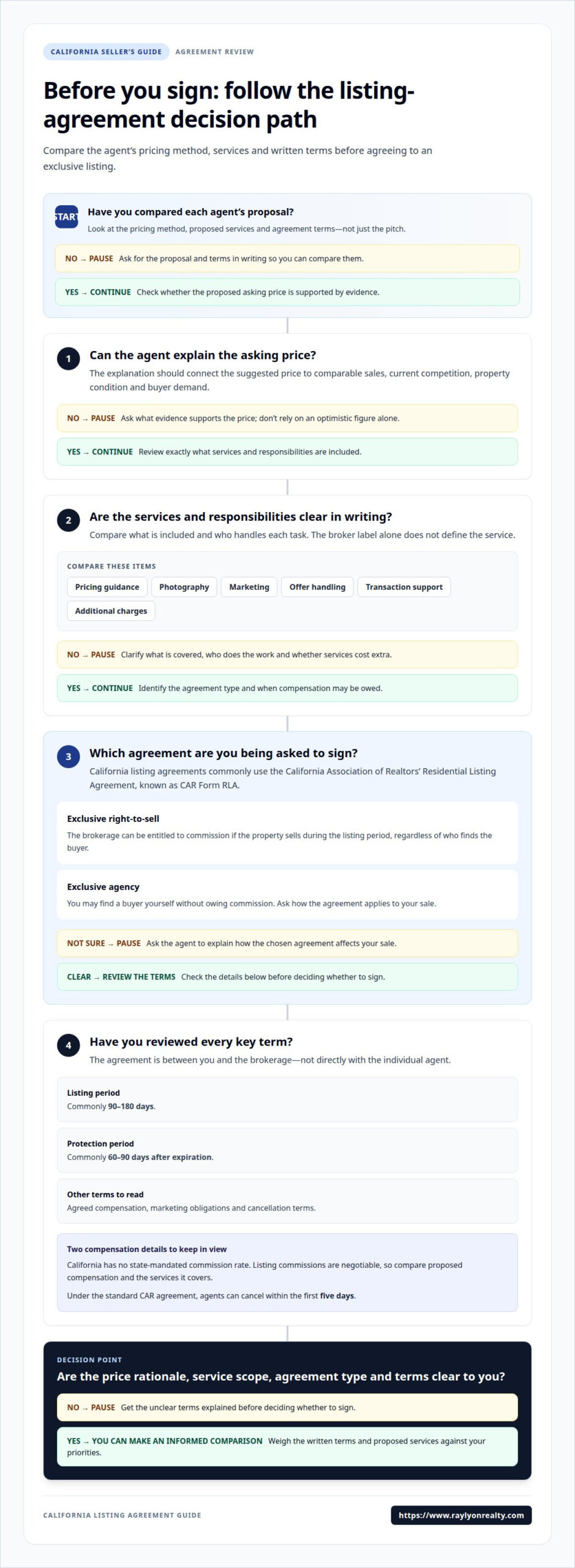
No. Before signing, compare each agent’s pricing method, proposed services, and agreement terms. Ask how the suggested asking price reflects comparable sales, current competition, property condition, and buyer demand. A sound explanation should show how the evidence supports the price, rather than relying on an optimistic figure to win your business.
How do you compare a full-service listing agent with a flat-fee or discount broker in California? Compare the specific services and responsibilities in writing, including pricing guidance, photography, marketing, offer handling, and transaction support. The label alone doesn’t tell you what’s included, who performs each task, or whether additional services carry separate charges.
What is the average real estate commission in California, and is it negotiable? There’s no state-mandated commission rate, and listing commissions are negotiable. Compare the proposed compensation and covered services rather than assuming one standard rate applies.
California listing agreements commonly use the California Association of Realtors’ Residential Listing Agreement, called CAR Form RLA. Read the listing period, agreed compensation, marketing obligations, cancellation terms, and protection period before signing. Listing periods commonly run 90 to 180 days, while protection periods commonly run 60 to 90 days after expiration. The agreement is between you and the brokerage, not directly with the individual agent.
An exclusive right-to-sell agreement can entitle the brokerage to commission if the property sells during the listing period, regardless of who finds the buyer. Under an exclusive-agency listing, you may find a buyer without owing commission. Ask the agent to explain how the chosen agreement applies to your sale. Under the standard CAR agreement, agents can cancel within the first five days. After that, cancellation typically requires mutual agreement.
Use referrals from friends or colleagues as a starting point, then request references from clients who sold similar properties. Read online reviews for specific examples of pricing advice, communication, and follow-through. Ask references how the final sale compared with the agent’s initial pricing strategy and what happened when plans needed to change.
4. Real estate agent fiduciary duty
California real estate agents have a legal fiduciary obligation to act in their client’s best interest. That principle matters throughout the transaction, not only when choosing an asking price or reviewing an offer. A confident seller should understand how the agent will explain options, handle sensitive information, and keep the seller’s interests central when decisions become complicated.
Make the duty practical by discussing real examples before signing. Ask how the agent would handle competing offers, a buyer request that could affect your plans, or new information that changes the sale strategy. Listen for clear explanations of your choices and potential consequences. Keep important decisions and agreed next steps in writing so both sides can refer to the same record.
How do you verify a California real estate agent’s license and disciplinary history? Use the California Department of Real Estate’s public lookup tool to confirm the agent’s license is current, then review the department’s disciplinary information. The department advises consumers to contact it for clarification about discipline.
Pay attention to how an agent responds when you raise a concern. A trustworthy professional should address the issue directly, explain relevant options, and avoid pressuring you into a decision before you understand it. For example, if an offer includes unfamiliar terms, ask the agent to explain how they affect your priorities and what questions remain for the transaction.
What are California rules for seller disclosures and listing agents? Disclosure requirements depend on the property and circumstances, so ask which forms and information apply to your sale. A listing agent can help organize the disclosure process and explain what each form requests, while you provide accurate information about the property.
For a luxury sale, careful attention to fiduciary responsibility can help keep complex decisions focused on your goals. Talk with a listing professional about your selling priorities and how they’ll guide decisions during the transaction.
Ray Lyon Realty: Luxury Listing Agent
Ray Lyon Realty helps sellers whose priorities call for tailored representation, including those preparing a luxury home for sale. As a Luxury Listing Agent, the focus is on aligning the property’s presentation and marketing with its features, likely buyers, and your goals for the sale.
This may also be a relevant next step if your plans involve selling new construction or an investment property. Ray Lyon Realty offers New Construction Sales and Investment Property Sales, including support for specialized transactions such as 1031 exchanges and trust sales for investor clients. The right fit depends on the type of property and the decisions involved.
If you’re ready to discuss your selling priorities and the representation that fits them, contact Ray Lyon Realty.
Set Your Priorities Before Taking the Next Step
Your next move can be simpler if you decide what matters most in the sale. Is your priority a particular timeline, a hands-on process, or a strategy tailored to your property? Write down your main goal and the decisions you want guidance on. That gives your next conversation a practical starting point.
Choosing how to choose a listing agent in California comes down to finding representation that aligns with your priorities and gives you room to make informed decisions. Ray Lyon Realty represents residential sellers, and a conversation can help you explore whether its approach fits your plans.
Bring your property details and the questions that still matter to you. Start a conversation with Ray Lyon Realty and take your next step with a clearer sense of direction.
Frequently Asked Questions
Do you have to sign an exclusive listing agreement right away?
No. Take time to review the agreement and understand what you’re authorizing before signing. Ask when representation begins, how the brokerage handles buyers you’ve already spoken with, and what steps apply if you want to end the arrangement. If a clause is unclear, ask for a plain-language explanation and written clarification before you commit.
How do I choose a good real estate agent in California?
Choose an agent whose experience and working style fit your property and priorities. Compare how each candidate explains a realistic sale strategy, handles unexpected changes, and keeps decisions clear. Ask for a reference from a seller with a similar property, then discuss a practical scenario, such as a buyer requesting a longer closing period. The agent’s reasoning can reveal how they approach your needs.
What Should You Look for in a Listing Agent in LA?
Look for familiarity with the specific Los Angeles neighborhood and property type, not just broad citywide knowledge. For a condo in Santa Monica, for example, ask how the agent would position its features for likely buyers. For a home in Mar Vista or Venice, discuss which nearby properties offer useful comparisons and how the neighborhood shapes the sale strategy.
What experience and local market expertise should a California listing agent have?
Look for experience with properties like yours and a clear understanding of the buyers they’re likely to attract. A seller of a newly built home may need different positioning than an owner selling an investment property. Ask the agent to describe a comparable transaction, the challenge involved, and how their approach adapted. Relevant experience is more useful than a broad claim of expertise.
What fees and costs should sellers expect when hiring a California listing agent?
There’s no single standard commission amount; the listing commission is negotiable. Ask for a written breakdown of the proposed compensation and what it covers. Clarify whether costs for photography, staging, or other property preparation are included or separate. Also distinguish the agent’s compensation from other expenses involved in preparing and selling your property, so you can plan your budget clearly.