

Buying a property isn’t the only way to invest in real estate. A useful starting point for real estate investment strategies for beginners is deciding between direct ownership and investments through funds, ETFs, or REITs. The right option depends on your goals, risk tolerance, available capital, and desired level of involvement. Plan your exit before investing, rather than waiting until your priorities change.
It’s natural to focus first on how to get started, especially when the options seem very different. This guide explains what real estate investing involves, compares direct ownership with funds, ETFs, and REITs, and walks you through setting goals and researching markets. You’ll also learn why an exit strategy belongs in your plan from day one, including how selling or a 1031 exchange may fit your next move. By the end, you’ll have a clearer way to assess which approach suits your circumstances.
Key Takeaways
- Choose between direct property ownership and funds, ETFs, or REITs based on how hands-on you want to be.
- Set a clear investment goal, then research local demand, property costs, and the risks that could affect your returns.
- Plan how you might sell or reinvest before you buy, so your exit strategy supports your longer-term goals.
- Understand how investment structures differ, including the income distribution rules that apply to REITs and potential tax considerations.
What is real estate investing?
Real estate investing involves buying or financing property to earn rental income or benefit from appreciation. Start by comparing direct ownership with property-backed investments, including the time and effort each requires.
-
Evaluate Property and Market Factors
Assess the location, property condition, cash flow, and local market trends before considering a rental. Options include single-family homes, multifamily properties with 2-4 units, commercial buildings, and short-term rentals, often rented for 30 days or less. Each has different tenant needs and operating demands.
Estimate potential income against mortgage payments, taxes, insurance, repairs, and vacancies. A property may appreciate, but rising local demand alone doesn’t guarantee positive cash flow. Assess its condition and compare nearby rental demand and recent sales before deciding.
-
Weigh Investing Advantages and Disadvantages
Weigh potential rental income and appreciation against the work and risks of ownership. Direct ownership gives you control over the property, but landlord responsibilities can include screening tenants, collecting rent, handling repairs and maintenance, and arranging cleaning or customer service for short-term stays.
Choose between self-management and professional property management based on the time and attention you can commit. A manager can handle day-to-day tasks, while self-management keeps those decisions with you. Either approach still leaves you exposed to market, economic, and mortgage-rate risks. Certain qualifying businesses may be eligible for a Qualified Business Income deduction of up to 20% of business income, according to the Internal Revenue Service.
In 2026, the maximum amount a person could gift a child without tax implications was $19,000, according to the Internal Revenue Service.
-
Compare Rentals, REITs, and House Hacking
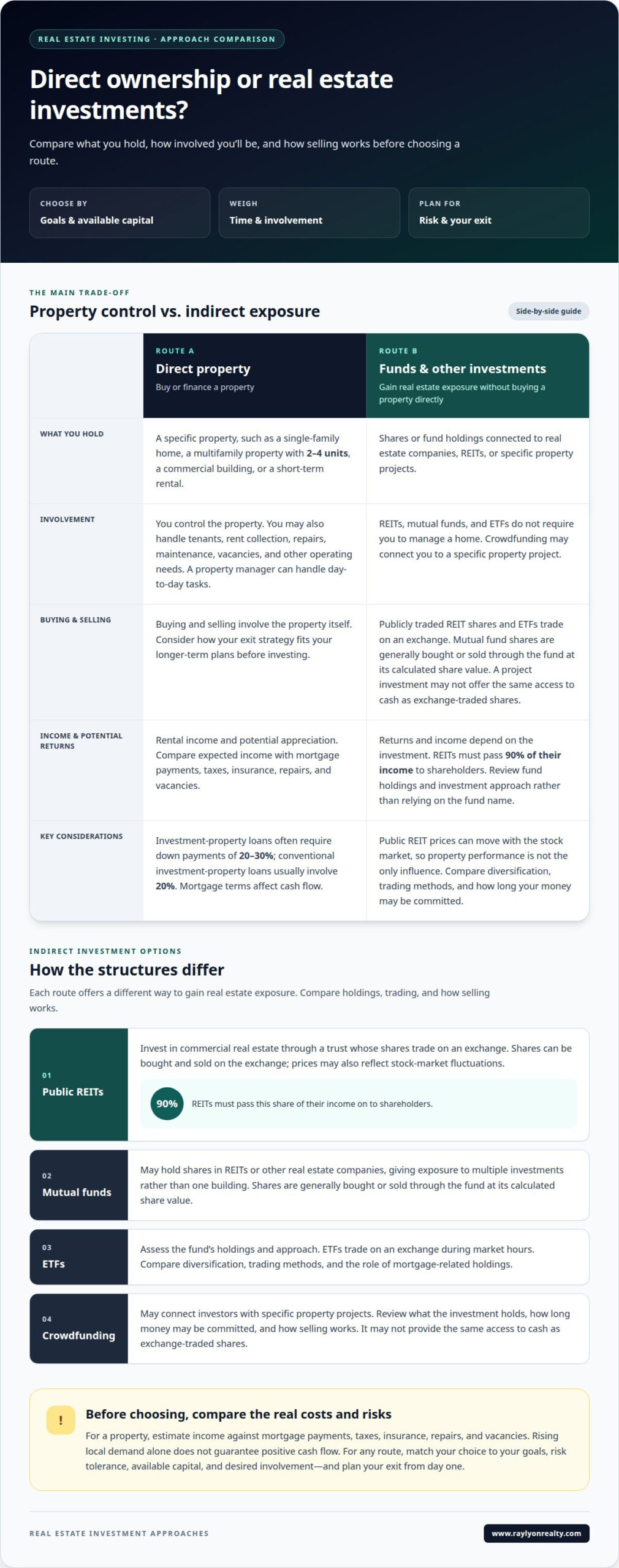
Decide whether direct ownership or a REIT better fits your time and desired involvement. Rental property offers direct control along with landlord responsibilities; REITs provide real estate exposure without requiring you to manage a home. Neither is automatically better for beginners. Choose according to your goals, involvement, and comfort with property-specific responsibilities.
House hacking means living in part of a property while renting out another portion, such as a room or separate unit. Rental income may offset housing costs, but you’ll share your home with tenants and remain responsible for upkeep, vacancies, and tenant matters.
Investment-property loans often require down payments of 20-30%; conventional loans on investment properties usually involve 20%. Mortgage rates vary with loan terms, borrower qualifications, and lender criteria. Focus on how those terms affect the property’s cash flow, not just its purchase price.
Real estate mutual funds, ETFs, and REITs
Compare these options by what they invest in, how their shares trade, and how returns reach you. Each provides a different way to gain real estate exposure without buying property directly.
-
Explore Indirect Real Estate Investing
Consider publicly traded REITs if you want exposure to real estate without managing buildings. These trusts invest in commercial real estate, and their shares trade on an exchange. That makes purchasing and selling shares different from selling a property. Public trading can also tie REIT prices more closely to stock-market fluctuations, so property performance isn’t the only influence. REITs must pass 90% of their income on to shareholders, according to the Internal Revenue Service. Compare that income structure with your goals and comfort with share-price movement.
-
Consider REITs and Crowdfunding
Compare crowdfunding with exchange-listed REITs before choosing an indirect investment. Crowdfunding may connect investors with specific property projects, while a publicly traded REIT offers shares that can be bought and sold on an exchange. Review what each investment holds, how long your money may be committed, and how selling works. A project investment may not offer the same access to cash as exchange-traded shares.
- Assess real estate mutual funds and ETFs by reviewing their holdings and investment approach. A fund may hold shares in REITs or other real estate companies, providing exposure to multiple investments rather than a single building. Mutual fund shares are generally bought or sold through the fund at its calculated share value, while ETFs trade on an exchange during market hours. Compare diversification, trading methods, and the role of mortgage-related holdings. A fund’s name alone doesn’t show how much property exposure or cash flow it provides.
For a direct-ownership comparison, investment property sales guidance can help connect a property decision with its location and likely use.
Setting investment goals and researching markets
Make a plan before choosing an investment. Set a goal, research a specific local market, and match your approach to your resources and risk tolerance.
-
Set Investment Goals
Write down what you want your investment to generate, such as rental income, long-term wealth, or equity growth. Set a timeframe and decide how much involvement suits your schedule. Building a property portfolio involves different choices from seeking cash flow from one rental. Identify the outcome that matters most before selecting a property.
-
Research Local Markets
Choose a neighborhood and gather evidence about rental demand, recent sales, property condition, and planned changes. Compare similar homes on the same streets rather than relying only on broad city averages. In Santa Monica, for example, demand and pricing can vary between neighborhoods and property types. Look for consistent local patterns, then consider whether the asking price and potential income support your goal.
-
Assess Liquidity and Market Volatility
Consider how quickly you may need access to your money. A property can take time to sell, while publicly traded investments can be bought or sold on an exchange. That convenience doesn’t eliminate market risk. Real estate investments are subject to market, economic, and mortgage rate risks. Before committing equity, consider how changes in borrowing costs or local demand could affect your plan.
-
Estimate Starting Investment Needs
Calculate the capital required for your chosen approach, including the down payment, closing costs, maintenance, insurance, and reserves. Direct real estate investing often requires tens of thousands of dollars, while the amount depends on the property and financing. A savings plan might direct 20% of regular income toward emergency reserves and real estate goals. Beginners need enough for their selected investment and its ongoing costs, not one universal amount.
Real estate investment exit strategies
Plan your exit before purchasing so changing goals don’t force a rushed decision. A clear route helps you compare selling, reinvesting, or keeping rental properties in light of expenses, cash flow, and your broader portfolio.
- Set the conditions for selling. Decide what might prompt a sale, such as a major repair, changing neighborhood demand, or a shift in your income needs. Estimate likely proceeds after debt and selling expenses. For example, a rental with rising maintenance needs may no longer support your passive income goal. Evaluate the decision against your original investment purpose, not just the latest estimated value.
- Consider reinvesting through a 1031 exchange. A 1031 exchange allows an investment property to be sold and proceeds invested into similar property, with capital gains taxes deferred if applicable conditions are met. This can keep a real estate plan moving rather than turning a sale into a full exit. Compare replacement properties by location, condition, expected income, and their fit with your next portfolio goal.
- Assess whether holding or borrowing fits better. Keeping a rental may preserve rental income and potential appreciation, but ownership also brings ongoing expenses and exposure to market changes. Owners may be able to borrow against equity in one property to finance another. Compare that option with selling, including how additional borrowing could affect cash flow and your ability to cover vacancies or repairs.
- Match the exit to your next priority. If your goal shifts from owning property to diversification, selling may free capital for other investments. If you still want real estate exposure, a replacement property or another investment structure may fit your plan. Compare the costs, timing, income needs, and risks of each route. A tax advisor can help assess tax consequences alongside your financial objectives.
Planning to sell or reinvest in a property? Discuss your investment property sale as you shape the next step.
Ray Lyon Realty: Residential Realtor
Ray Lyon Realty can help align your investment plan with a residential property purchase or sale. Specializing in homes, condos, and investment properties, the firm brings local market knowledge to decisions in Santa Monica, Mar Vista, and Venice.
Turn to its Investment Property Sales service when you’re evaluating a residential investment or planning a sale. Ray Lyon Realty also handles specialized transactions, including 1031 exchanges and trust sales, which can be relevant when an investment’s next step involves selling or reinvesting. For buyers considering newly built homes or sellers preparing a high-end property, New Construction Sales and Luxury Listing Agent services may also fit.
Contact Ray Lyon Realty to discuss your residential investment goals and possible next steps.
Turn your investment plan into a clear next move
Turn your priorities into a decision you can act on. Choose the type of property or market you want to pursue, identify what would make you walk away, and keep your exit plan in view as circumstances change. A practical approach to real estate investment strategies for beginners leaves room to reassess, rather than tying you to a property simply because you’ve already invested time.
When a residential purchase or sale is part of your plan, Ray Lyon Realty can help you assess how a specific property fits your goals. Services include Residential Realtor representation, New Construction Sales, and Luxury Listing Agent support. Whether you’re considering a newly built home or preparing a high-end property for sale, connect each move to your broader investment priorities.
Contact Ray Lyon Realty to discuss your property plans. A deliberate next step can help you move forward with greater clarity.
Frequently Asked Questions
What are the best real estate investment strategies for beginners in the United States?
The best starting strategy is one that fits your capital, time, and comfort with risk. Real estate investment strategies for beginners may include buying a residential rental, house hacking, or investing indirectly through a fund or REIT. Someone who wants to avoid tenant responsibilities, for example, may prefer an indirect option. Compare how each approach works before committing money.
How do beginners calculate rental property cash flow, cap rate, and cash-on-cash return?
Use separate calculations to understand operating performance and the return on your cash. Cash flow is rental income minus operating expenses and debt payments. Cap rate is net operating income divided by the property’s purchase price, multiplied by 100. Cash-on-cash return is annual pre-tax cash flow divided by the cash invested, multiplied by 100. Keep the expense categories consistent when comparing properties.
What taxes, insurance, and closing costs should beginner real estate investors expect?
Budget for property taxes, insurance premiums, closing costs, and ongoing repairs, then estimate how each affects net income. Tax treatment depends on the property, ownership, income, and expenses. Keep purchase documents and records of rental income and costs together. Before making a tax plan, discuss the investment details with a qualified tax professional, especially if you plan to sell or reinvest.
What landlord laws and rental regulations vary by state and city?
Rental rules vary by location and may cover property condition, required disclosures, security deposits, notices, and rental permits. Before operating a rental, identify the rules that apply to the property’s specific city and state. Requirements for a home in one city, for example, may differ from those in a neighboring municipality. Include compliance tasks in your operating plan and budget.
How can beginners find and evaluate profitable investment properties?
Start with a defined area and compare properties with similar size, condition, and intended use. Review recent comparable sales, local rental demand, likely repair needs, and realistic income assumptions. Estimate recurring expenses and test whether the property still meets your goals if rent or resale expectations change. A written comparison can show whether a promising listing also makes financial sense.
What are the risks of real estate investing, including vacancies, repairs, and market downturns?
Vacancies can interrupt rental income, unexpected repairs can raise expenses, and a downturn can affect property values or selling timelines. Stress-test your plan by estimating how you would cover costs during a vacancy or after a major repair. Keep funds available for ongoing obligations, and don’t rely on a quick sale to solve a cash-flow problem. Real estate prices and demand can change.