

Yes, you can negotiate closing costs with the seller by requesting a seller concession in your purchase offer. The amount you can receive depends on your loan type and applicable contribution limits; according to the U.S. Department of Housing and Urban Development, FHA loans allow seller concessions of up to 6 percent. This guide explains how to negotiate closing costs with a seller and bring less cash to closing.
Focus on negotiating the overall deal, rather than assuming every line on the closing statement can be reduced. A seller credit may cover eligible closing costs and prepaid expenses, while some government-imposed charges are fixed.
You’ll learn which costs may be negotiable, how to make a clear seller-credit request, and how to distinguish lender fees from charges that are generally harder to change. Your loan limits and offer terms also shape the conversation, so go in with a practical plan.
Key Takeaways
- Separate lender fees you may be able to negotiate from government charges that are generally fixed.
- Build your seller-credit request around a specific dollar amount and include it in the purchase contract.
- Shape your request around the home’s market conditions, competing offers, and the seller’s priorities.
- Compare the cash saved at closing with the full offer terms before deciding how to structure your bid.
Are closing costs negotiable?
Yes. You can negotiate eligible charges with the seller or lender. Put any agreed seller credit in writing.
-
Review the Loan Estimate and Closing Disclosure
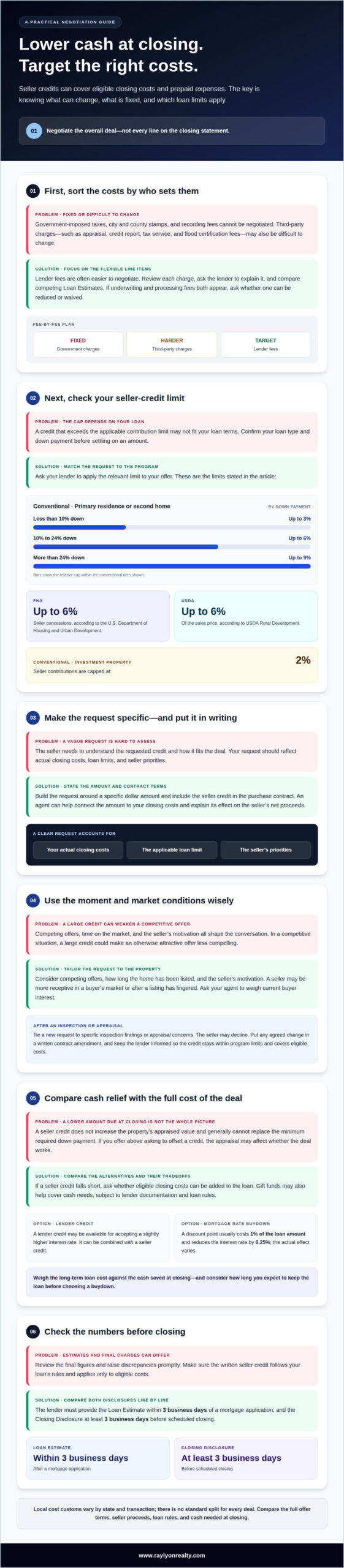
Compare the Loan Estimate with the Closing Disclosure line by line. A lender must provide the Loan Estimate within 3 business days of a mortgage application, and the Closing Disclosure at least 3 business days before scheduled closing. Use competing Loan Estimates to ask your lender about lower lender-charged fees or a rate adjustment. Check the final figures before closing, and raise discrepancies promptly.
-
Check seller concession limits
Confirm your loan type and down payment before choosing a seller-credit amount. For conventional loans on a primary residence or second home, the limits are 3 percent with less than 10 percent down, 6 percent with 10 to 24 percent down, and 9 percent with more than 24 percent down. FHA loans allow seller concessions of up to 6 percent, according to the U.S. Department of Housing and Urban Development. USDA loans allow concessions of up to 6% of the sales price, according to USDA Rural Development. Ask your lender to apply the relevant limit to your offer.
-
Consider timing after inspection or appraisal
You can request a seller credit after an inspection or appraisal if new findings affect your costs or the deal’s value, but the seller may decline. Tie your request to specific inspection findings or appraisal concerns, and put any agreed change in a written contract amendment. Keep your lender informed because the credit must comply with your loan’s concession limit and cover eligible costs.
-
Review customary costs and other funding options
Ask which buyer and seller costs are customary in the property’s state, then compare local practice with your purchase contract. There is no standard split for every state or transaction, and market resources from regional professionals like Krissy in the Keys (Krissy Carnahan, Realtor) demonstrate how location-specific property regulations and closing norms can differ. If a seller credit falls short, ask your lender whether eligible closing costs can be added to the loan. Gift funds may also help cover cash needs, subject to lender documentation and loan rules.
Nonnegotiable appraisal, credit, government, and tax fees
Before negotiating, sort charges by who sets them. Government fees, lender fees, and third-party charges are not all treated alike.
-
Separate negotiable from nonnegotiable fees
Review each line item and identify who charges it. The CFPB says taxes, city and county stamps, and recording fees are government-imposed costs that cannot be negotiated. Third-party charges, such as appraisal, credit report, tax service, and flood certification fees, may be difficult to change. Lender fees, by contrast, are often easier to negotiate.
-
Consider effects on approval, appraisal, and taxes
Ask your lender how a proposed seller concession affects loan approval and eligible costs. The credit must follow your loan program’s rules and generally cannot replace the minimum required down payment. It also does not increase the property’s appraised value. If you offer above asking to offset a credit, the appraisal may affect whether the deal works. Government taxes and recording charges remain separate costs.
- Compare lender estimates and ask about fees charged by the lender. The CFPB advises asking the lender to explain each charge. If both underwriting and processing fees appear, request details, as one may be reduced or waived. Compare competing Loan Estimates and ask whether the lender can match a lower origination quote. Focus on lender charges because many other fees are set by third-party providers.
- Make a fee-by-fee plan before paying. Mark government taxes and recording fees as fixed, third-party charges as harder to change, and lender fees as negotiation targets. A lender credit may also be available for accepting a slightly higher interest rate, and it can be combined with a seller credit. Compare the long-term loan cost with the cash saved at closing. For a locally informed perspective on purchase terms, explore Westside home buying guidance.
Using a real estate agent to negotiate seller concessions
Use local market evidence to frame your request, and tailor the concession to your purchase goals. A real estate agent can help shape terms that account for both the seller’s net proceeds and your cash needs.
-
Assess market conditions
Before proposing a concession, review competing offers, how long the home has been on the market, and the seller’s motivation. A seller may be more receptive in a buyer’s market or after a listing has lingered. In a competitive situation, a large credit could weaken an otherwise attractive offer. Ask your agent to weigh these factors and suggest a request suited to the property and current buyer interest.
-
Work with an agent on concessions
Ask your real estate agent to connect the requested credit to your actual closing costs and the seller’s likely priorities. For an investment property, conventional-loan seller contributions are capped at 2 percent. Make sure your proposed amount stays within the applicable loan limit, then have your agent explain how the request affects the full purchase offer. Local transaction guidance can help you assess the deal’s terms.
-
Consider alternative concessions
Compare a closing-cost credit with a seller-funded mortgage rate buydown. A discount point usually costs 1% of the loan amount and reduces the interest rate by 0.25%, though the actual effect varies. Consider how long you expect to keep the loan before choosing.
-
Address seller concessions and agent commissions
Keep seller concessions and agent commissions distinct in the purchase agreement. Sellers may be asked to pay commissions for both agents, but any commission agreement should be written into the purchase and sale agreement. Ask your agent to show how each requested payment affects the seller’s net proceeds. Compare that figure with your offer price and the cash relief you need at closing.
Negotiating seller-paid closing costs
Seller concessions are credits toward eligible closing costs and prepaid expenses, reducing the cash buyers bring to closing. To negotiate closing costs with seller concessions in mind, first identify your priorities: preserving cash at closing, lowering the purchase price, or balancing both.
-
Understand how seller concessions work
Request a specific dollar credit in your purchase contract. The seller’s contribution goes toward eligible costs rather than directly to you. Raise the request early so the seller can consider it alongside your price and other offer terms. Share the proposed credit with your lender, then compare it with your eligible expenses.
Consider the seller’s net proceeds as well as your cash needs. For example, a $510,000 offer with a $10,000 seller credit on a home listed at $500,000 nets the seller the full asking price before other transaction costs. The credit may make buying more manageable if you need cash for closing, while still giving the seller a clear offer structure.
-
Compare concessions with a lower purchase price
A lower purchase price may suit you better if reducing the amount financed matters more than lowering your immediate closing payment. A seller credit goes toward eligible closing expenses, while a price reduction changes the purchase price. To negotiate closing costs with the seller’s priorities in mind, compare how each option affects your cash, financing, and the seller’s expected proceeds.
The credit may leave more cash available at closing, while the lower offer reduces the purchase price. Ask your agent to compare both structures against your budget and goals before submitting the offer. Discuss your purchase offer with a real estate professional.
Ray Lyon Realty: New Construction Sales
Ray Lyon Realty helps buyers navigate new construction purchases, including offer terms that affect cash due at closing. Bring your questions about seller credits, builder incentives, and how each proposal fits your priorities. The team can help assess the transaction and clarify where a concession request belongs in the offer.
For existing homes, Ray Lyon Realty represents luxury listings and supports investment property sales. These services suit different goals, whether you’re buying a newly built home, selling a luxury property, or considering an investment purchase. Clear terms matter in each transaction, especially when comparing a seller credit with a price change.
Contact Ray Lyon Realty to discuss your real estate plans, or visit www.raylyonrealty.com.
Make your next offer with a clear plan
A strong offer is about more than the cash you bring to closing. Before submitting it, consider your priorities: preserving cash, keeping the purchase price within your budget, or choosing a home that supports your longer-term plans. Understanding these trade-offs helps you discuss how to negotiate closing costs with a seller while keeping the property itself in focus.
Ray Lyon Realty represents residential buyers, including those purchasing new construction, and sellers of luxury homes. That perspective can help you assess how offer terms fit the property and your goals.
Contact Ray Lyon Realty to discuss your offer, and take your next step with confidence.
Frequently Asked Questions
What closing costs can a home seller pay for the buyer?
A seller can contribute toward eligible closing costs and prepaid expenses, such as charges due at settlement. The credit can reduce the cash a buyer needs to bring to closing, but generally can’t pay the buyer’s minimum required down payment. Ask the lender to identify which costs qualify under the loan terms, then make sure the credit is applied to those expenses in the final paperwork.
Are there limits on seller-paid closing costs by loan type?
Yes. For conventional loans on a primary residence or second home, limits depend on down payment: 3 percent below 10 percent down, 6 percent with 10 to 24 percent down, and 9 percent above 24 percent down. Conventional investment-property contributions are capped at 2 percent. FHA and USDA allow up to 6 percent, with USDA’s limit based on sales price. VA true concessions are capped at 4 percent, while ordinary seller-paid closing costs aren’t capped.
How much can buyers typically negotiate in seller-paid closing costs?
A common guideline is a seller contribution of about 3% to 4% of the loan, but it isn’t a universal allowance. The amount must fit the buyer’s eligible costs and the applicable loan-program limit. For instance, a buyer whose closing expenses are lower than the requested credit can’t necessarily use the unused amount for other purposes. Set the request using the actual costs and loan terms.
How do you ask the seller to cover closing costs in an offer?
Request a specific dollar credit in your offer instead of leaving the amount open-ended. State that it will go toward eligible closing costs and prepaid expenses, and include the terms in the purchase contract. Raise the request early so the seller can consider it alongside the price and other conditions. Share the proposed credit with your lender to ensure it follows your loan’s rules.
What are the risks of asking a seller to pay closing costs in a competitive market?
A seller may prefer a competing offer with fewer requested concessions, especially when several buyers want the same home. A credit also reduces the seller’s proceeds compared with an otherwise identical offer without one. Offering above the asking price to offset a seller credit may create appraisal risk if the home does not appraise at the higher price. Weigh the cash benefit against the offer’s strength and the home’s supportable value.