

An off-market home in Los Angeles isn’t automatically cheaper or more expensive than a publicly listed one. Its value still depends on comparable sales, condition, and buyer competition. A private sale may mean less competition, but also less pricing transparency. Knowing how to find off-market homes in Los Angeles means getting timely access without letting urgency push you above a sound valuation.
It’s reasonable to ask whether a private opportunity offers a genuine advantage or is simply a home with less visibility. The answer depends on how the property is being marketed and whether its asking price aligns with recent comparable sales, not on the “off-market” label alone.
This guide explains the differences between off-market, pocket, and coming-soon listings, and how to combine targeted alerts with local broker relationships to hear about relevant homes. Alerts can help you spot new opportunities, while local knowledge puts a listing in context. You’ll also learn what to weigh before making an offer, so you can move decisively without treating every private listing as a bargain.
Key Takeaways
- Compare a private home’s asking price with relevant recent sales; an off-market label alone doesn’t make it a bargain.
- Set focused property alerts so emerging opportunities are easier to spot, then assess each listing on its own merits.
- Build relationships with brokers who know your target neighborhood and can help put private listings in local context.
- Use ownership records to identify properties that may merit further attention, while treating them as clues rather than proof a home is for sale.
What is the difference between off-market, pocket, and coming-soon listings?
These labels describe how buyers encounter a property, not whether it offers better value. In Los Angeles, compare the marketing format with recent comparable sales before judging the asking price.
Private Listing Formats and Pre-Market Deals
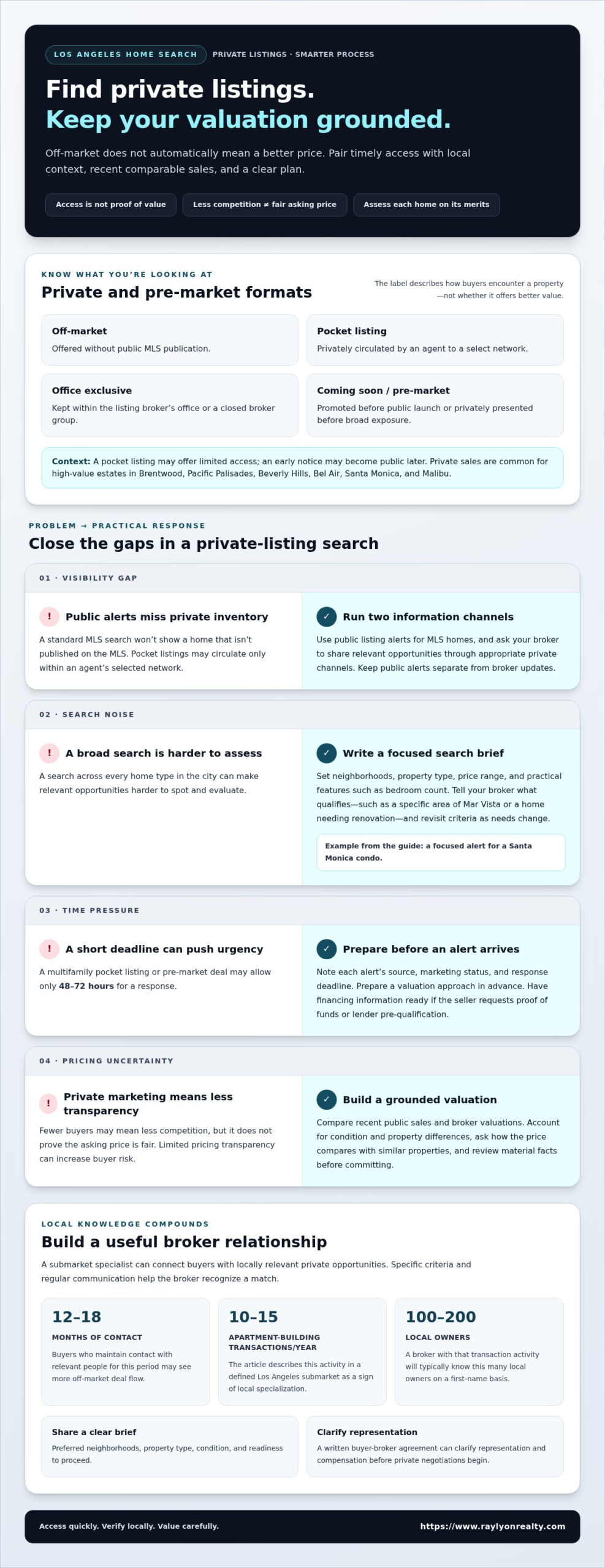
An off-market home is offered without public MLS publication; a pocket listing is privately circulated by an agent to a select network. Office exclusives stay within the listing broker’s office or a closed broker group. Curated networks may share details with vetted buyers or brokers, often under an NDA and with proof of funds.
A coming-soon listing is promoted before its public launch, while a pre-market deal may be privately presented before broad exposure. Distinguish these formats: a pocket listing may offer limited access, while an early notice may become public later. Private sales are common for high-value estates in Brentwood, Pacific Palisades, Beverly Hills, Bel Air, Santa Monica, and Malibu.
Off-Market and MLS Listing Differences
An MLS listing is entered into a shared listing system; an off-market home isn’t publicly published there. Under the Clear Cooperation framework, a U.S. property marketed publicly must be submitted to the MLS within a short window. In Los Angeles County, regional MLS rules also limit public advertising and private listing periods.
For-sale-by-owner homes are another route, but they aren’t automatically pocket listings. Los Angeles examples include a 992-square-foot home at 4506 Dockweiler St #302 and a 1,438-square-foot home at 8127 Gentry Ave in North Hollywood.
To assess an off-market asking price, compare recent public sales and broker valuations, then account for condition and property differences. Limited pricing transparency and pressure to decide quickly can increase buyer risk. Ask how the price compares with similar properties and review material facts before committing. Fewer buyers may mean less competition, but it doesn’t prove the asking price is fair.
Alerts for off-market homes
Alerts can help you spot public listings quickly, but a home that isn’t published on the MLS won’t appear in a standard MLS search. For off-market opportunities, pair property alerts with updates from a broker who receives private listing information. In California, the source of an alert matters as much as its speed.
Start by defining your search. Choose Los Angeles neighborhoods, property type, price range, and practical features such as bedroom count. A focused alert for a Santa Monica condo, for example, is easier to assess than a broad search across every home type in the city. Revisit your criteria when your needs change.
- Use public listing alerts to catch homes as they enter the MLS, including listings that may first appear as coming soon.
- Tell your broker what qualifies as a match, such as a specific area of Mar Vista or a home needing renovation.
- Review each match promptly and compare its details with recent local sales before deciding whether to pursue it.
Private inventory requires a different alert path. A pocket listing may circulate only within an agent’s selected network, so an automated public search won’t capture it. Ask your broker to share relevant opportunities through appropriate private channels, and have your financing information ready if a seller requests proof of funds or lender pre-qualification. For buyers considering properties abroad, platforms like European Listings provide a curated alert route with weekly hand-picked selections across southern Europe.
Keep the system useful by separating public alerts from broker updates. When an alert arrives, note its source, marketing status, and any response deadline. A multifamily pocket listing or pre-market deal may allow only 48-72 hours for a response, so prepare a valuation approach before urgency takes over. For additional context on Los Angeles homes, explore local property guidance.
Building relationships with submarket-specialist brokers
In Los Angeles, a broker focused on one submarket can connect buyers with locally relevant private opportunities. Specific criteria and regular communication help the broker recognize which homes fit your search.
Relationships with Local Brokers
A submarket specialist focuses on a defined area and builds working relationships with buyers, sellers, and local owners. That neighborhood focus can help you hear about a property before it reaches a broad audience.
Buyers learning how to find off-market homes in Los Angeles can start by sharing a clear brief: preferred neighborhoods, property type, condition, and readiness to proceed. Keep relevant contacts updated as your plans change. Buyers who maintain contact with relevant people for 12-18 months may see more off-market deal flow.
Ask about a broker’s recent activity in your target area. A broker closing 10-15 apartment-building transactions per year in a defined Los Angeles submarket will typically know 100-200 local owners on a first-name basis. A written buyer-broker agreement can clarify representation and compensation before private negotiations begin.
Networking Groups and Platforms
Los Angeles real estate networking groups and platforms circulate private opportunities through broker circles, curated networks, and member communications. These channels can connect a listing broker with buyer brokers or vetted buyers without advertising widely.
Make these channels more useful by sharing a concise profile of your target area, property type, and priorities. Keep your details current so a broker can identify relevant matches instead of sending unrelated listings. Buyers exploring niche property types in other markets use a similar targeted approach; for instance, those seeking equestrian acreage can turn to specialized resources like Colorado Horse Property to navigate regional opportunities.
A practical way to find off-market homes in Los Angeles is to pair local relationships with a focused search brief. Assess each opportunity on its own merits, and clarify representation before moving forward.
How can buyers use Los Angeles property records to identify potential off-market homes?
Property records can help you build a focused list of homes to research, but they don’t prove an owner plans to sell. In Los Angeles, use ownership details as a starting point, then compare each property with your preferred neighborhood and home type.
Begin with a specific area, such as Mar Vista, and identify properties that match your needs. Review available ownership and property records for clues such as trust ownership or a long-held property. Record the address and ownership information to organize further research.
- Match records to your criteria: focus on home type, location, and condition that fit your plans.
- Note ownership patterns: a home held in a family trust for 20-30 years is a situation worth prioritizing for further research.
- Keep a research log: track the address, record details, and any follow-up with a local real estate professional.
A trust or long ownership period is a lead, not evidence of seller intent. Treat each clue as a reason to learn more about the property, not as proof that it’s available. The owner may have no plans to sell, and records won’t tell you the home’s current condition or asking expectations.
Use the records to support a targeted, respectful inquiry through appropriate channels. If an owner expresses interest, compare the home with recent sales and assess property condition before considering an offer. For investment-focused searches, connect record research with your property goals and discuss your investment property search.
Ray Lyon Realty: New Construction Sales
Ray Lyon Realty offers New Construction Sales for buyers whose priorities include newly built homes rather than only private resales. That can be a useful path when an off-market search hasn’t surfaced a suitable fit, or when you want to compare new construction with existing homes in your target area.
For buyers focused on established homes, the right next step depends on the property and your goals. Ray Lyon Realty also works as a Luxury Listing Agent and handles Investment Property Sales, including specialized transactions such as trust sales and 1031 exchanges for investor clients. These options connect your search to the type of property or transaction you’re pursuing.
If you’re weighing new construction against other Los Angeles opportunities, contact Ray Lyon Realty to discuss your search.
Turn your search into a clear next step
Before pursuing a property, define what would make it right for your plans. Consider how you intend to use the home, what condition works for you, and which trade-offs you can accept. A clear brief keeps conversations focused and helps you decide based on fit, not just the appeal of an exclusive opportunity.
A thoughtful approach to how to find off-market homes in Los Angeles also means adjusting your search as priorities evolve. Keep your criteria practical and leave room to compare different paths to homeownership. Ray Lyon Realty’s residential buyer representation can help you weigh options against your goals.
For a conversation about your next move, contact Ray Lyon Realty. A thoughtful plan can make your search feel more manageable and put you in a stronger position to choose a home that suits you.
Frequently Asked Questions
Is buying off-market more expensive?
Not automatically. Judge an off-market asking price against recent comparable sales, property condition, and location. Private opportunities may attract less buyer competition, but limited pricing transparency can make value harder to assess. Compare the seller’s expectations with similar recent sales and consider whether the home’s condition or features justify any difference.
What does searching only public listings cost a Los Feliz buyer?
The main cost may be missing homes that sell privately, rather than a separate search fee. A Los Feliz buyer could also face a fast-moving public market: strong homes may go pending in 14-21 days.
Why do so many Los Feliz homes sell off-market?
Some Los Feliz owners prefer to handle a sale privately, limiting public exposure and sharing details through selected contacts. Laughlin Park illustrates the neighborhood’s distinct setting: roughly 60 houses sit behind one guarded entrance, and a large share of its home sales happen off-market before public listing. That private route can suit sellers who value a controlled, selective process.
What counts as an off-market home in Los Angeles?
An off-market home is offered for sale without publication on the public MLS. The term can describe different arrangements, from a seller sharing a home privately to an agent presenting it within a limited network. Ask how the opportunity is being circulated and whether public marketing has begun, since publicly marketed U.S. properties must be submitted to the MLS within a short window.
How can buyers find pocket listings and private home sales in Los Angeles?
Give a local buyer’s agent a specific brief: target neighborhoods, property type, condition, and purchase readiness. Ask the agent to circulate it through relevant private networks, and be ready to provide proof of funds or lender pre-qualification if requested. For a curated opportunity shared under an NDA, understand the confidentiality terms before receiving or distributing property details.
Which Los Angeles real estate agents specialize in off-market properties?
Look for buyer’s agents with deep knowledge of your target submarket and established relationships with local brokers. Ask how they source private opportunities and assess asking prices against comparable sales. For Westside residential searches, Ray Lyon Realty represents buyers of homes, condos, and investment properties, with localized knowledge of areas including Santa Monica, Mar Vista, and Venice.