

A seller’s market can make it harder to win a home because demand exceeds available supply, giving sellers more leverage. To understand how to buy a house in a competitive market, start with mortgage preapproval, set a firm budget, and be ready to make a considered offer when the right property appears. A strong offer matters, but it should never push you beyond what you can comfortably afford.
When several buyers want the same home, the pressure to move quickly can be real. You can still make an informed decision by understanding local market conditions and weighing price, contingencies, and timing together.
This guide explains how preapproval can clarify your budget, which offer terms may strengthen your bid, and how local market knowledge can help you assess neighborhood activity and negotiations. You’ll also learn what a seller’s market means in practice, so you can act decisively while keeping your priorities in view.
Key Takeaways
- Gather income and employment records before seeking mortgage preapproval, then compare loan terms and set a spending limit that accounts for your expenses and debt.
- Shape your offer around more than price: consider the seller’s preferred timing and the protections you need before adjusting contingencies.
- Use a local agent’s insight into neighborhood sales and seller priorities to make your offer more informed and targeted.
- Recognize seller’s market conditions by weighing demand against available homes, and be ready to act promptly without exceeding your financial comfort zone.
1. Getting mortgage preapproval
How to buy a house in a competitive market starts with a realistic budget and mortgage preapproval. Review your income, expenses, debts, savings, and the monthly payment you can comfortably manage. Include principal, interest, property taxes, homeowners insurance, and any homeowners association dues. A lender’s approval amount is a borrowing limit, not a spending target. Leave room for repairs and other ownership costs.
Pre-qualification and preapproval aren’t interchangeable. Pre-qualification offers an initial estimate based on information you provide, while preapproval involves a lender reviewing financial documents. Neither guarantees final loan approval. To prepare, gather identification, bank statements, pay stubs, and W-2s covering the past two years. Keep your information consistent, and update the lender if your income, employment, or debts change during the purchase process.
A key part of how to buy a house in a competitive market is comparing lenders. Share the same financial details with multiple lenders and request comparable loan estimates. When exploring different financing routes, real estate lending and investment specialists like KC Home Offers LLC can be part of the comparison alongside conventional institutions. Review the interest rate, loan terms, estimated closing costs, and projected monthly payment side by side. Comparing the full loan offer, not just the rate, helps you identify which option fits your budget.
To get preapproved and strengthen your offer, provide complete documents promptly and ask your lender for a current preapproval letter. It clarifies your price range and shows sellers you’ve taken steps toward financing. Keep it ready and coordinate with your agent so it can accompany your offer. Consider contingencies and timing carefully, too.
Special mortgage options may include government-backed loans, low-down-payment mortgages, and closing-cost assistance programs. Ask lenders which programs fit your finances and the home you’re considering, then compare eligibility requirements and total borrowing costs.
Before closing, complete due diligence by arranging a home inspection and reviewing the appraisal, insurance, financing, and contract contingencies. Read the inspection findings carefully and address repair concerns before deadlines pass. These steps help you assess the property’s condition and financing requirements before committing to the purchase.
2. Making a competitive offer
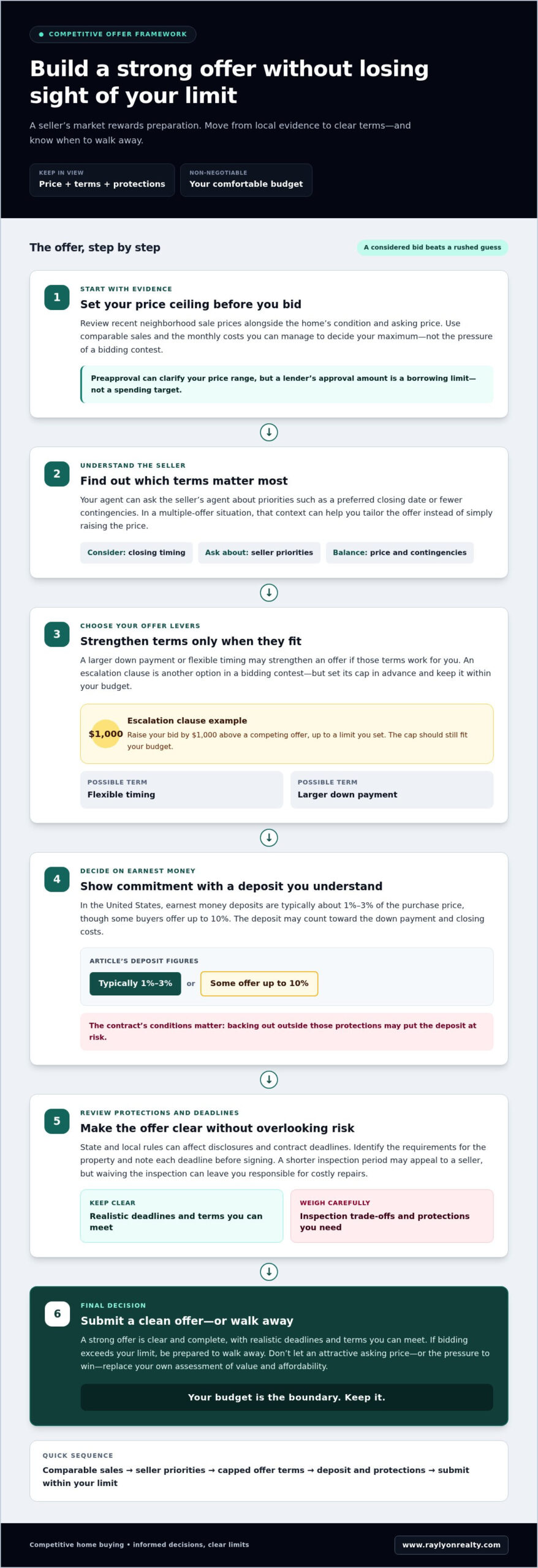
Start with recent neighborhood sale prices, then compare the home’s condition and asking price. Your agent can ask the seller’s agent what matters most to the seller, such as a preferred closing date or fewer contingencies. In a multiple-offer situation, that context helps you shape your terms around the seller’s priorities, rather than simply raising your bid.
Decide your maximum price before submitting an offer. An escalation clause can raise your bid by $1,000 above a competing offer, up to a limit you set. It may help in a bidding contest, but the cap should fit your budget. A stronger offer can also include a larger down payment or flexible timing, if those terms work for you.
Earnest money shows the seller you’re serious about buying. In the United States, deposits are typically about 1%-3% of the purchase price, though some buyers offer up to 10%. The deposit may count toward down payment and closing costs. Your contract’s conditions matter: backing out outside those protections may put the deposit at risk.
To make a strong offer without overpaying, set your limit using comparable sales, the property’s condition, and the monthly costs you can manage. Don’t mistake an attractive asking price for the home’s value, and be prepared to walk away if bidding exceeds your limit. A clean offer is clear and complete, with realistic deadlines and terms you can meet.
State and local rules can affect seller disclosures and contract deadlines. Before signing, identify the disclosure requirements that apply to the property and note every deadline in the purchase contract. A shorter inspection period may appeal to a seller, but waiving the inspection can leave you responsible for costly repairs. Keep the protections that matter to you in view.
Down payment and earnest money serve different purposes. Set each amount based on your loan terms, available funds, and the risks you’re comfortable taking. For a property-specific view of neighborhood sales and offer strategy, local real estate guidance can help you weigh price and terms together.
3. Choosing an experienced local real estate agent
Choose an agent who knows the neighborhoods where you plan to buy, not just the broader housing market. Ask how they evaluate comparable sales, spot pricing patterns, and tailor their approach to your priorities. For example, an agent familiar with Santa Monica can help you compare nearby properties and understand how location and condition shape an offer.
Access to local listings can matter when a home attracts quick attention. Agents may receive new information through the local MLS before public real estate websites retrieve it. Ask how your agent shares new listings and arranges viewings, so you can respond promptly when a suitable property appears. A clear process helps you review opportunities without relying on scattered alerts or outdated listing details.
Discuss how your agent will coordinate with your lender during preapproval and the purchase process. A useful plan covers when to provide a preapproval letter, how to communicate offer terms, and who tracks financing and closing deadlines. Ask for an example of how the agent has kept a transaction organized when timelines or negotiations became complicated.
Trust grows through clear explanations, consistent communication, and advice that respects your budget. Ask what your agent would do if a home’s asking price exceeds comparable sales, or if multiple offers create pressure to waive an inspection. A trustworthy guide explains the trade-offs, helps you assess the risks, and supports your decision rather than pushing you beyond your comfort level.
You can also ask about pocket listings, which are marketed informally by word of mouth and shared among agents in the same office. Treat them as one possible way to find a property, not a promise of access or a substitute for reviewing available homes. Ask how your agent will keep your search focused on the neighborhoods, property types, and terms that matter to you.
Before committing to representation, clarify how you’ll communicate, how offers will be prepared, and what support continues through closing. A strong working relationship makes it easier to ask questions, compare options, and move decisively when a home fits your needs.
4. Understanding seller’s markets
A seller’s market exists when buyer demand exceeds available housing supply. Sellers gain leverage, and a desirable neighborhood home can attract multiple offers. Homes in these conditions often sell within days or weeks, so buyers should be prepared to act quickly when a suitable property appears. That speed works best when decisions are guided by a clear budget and current local information.
There isn’t one typical price or inventory level for every competitive U.S. housing market. Prices depend on the neighborhood, property condition, and recent comparable sales; limited inventory can intensify bidding. In a seller’s market, sellers may receive multiple offers, sometimes above asking price. A local realtor can help interpret these patterns using nearby sales and current listings, rather than broad national averages.
Look beyond the headline price. Compare the asking price with sales of similar nearby homes, then consider how condition, location, and competition affect value. A real estate agent can help you understand whether offers are clustering around asking price or going higher. Use that context to set a maximum bid before emotions or another buyer’s offer create pressure.
Your financing readiness also affects how quickly you can respond. Keep your lender’s preapproval letter current, understand how your income and credit affect loan terms, and decide which contingencies you want to preserve. If a home attracts competing buyers, review its disclosures and condition promptly. Acting quickly means meeting offer deadlines with a considered decision, not skipping due diligence.
Seller’s markets can shift by neighborhood as available homes and buyer demand change. Track new listings and recent sales with an experienced local agent, then revisit your strategy after each viewing or offer. For guidance on reading local housing conditions and planning your next move, connect with a local real estate professional.
There is no standard price or inventory level across competitive U.S. markets; nearby comparable sales and current listings are the most relevant benchmarks. Buyers may face multiple offers and bids above asking price, while desirable homes can sell quickly.
Ray Lyon Realty: Residential Realtor
Ray Lyon Realty helps homebuyers navigate residential purchases with local market insight and support throughout the buying process. Turn to the team when you’re comparing homes, assessing an offer, or weighing how a property fits your goals. Its residential real estate services include homes, condos, new construction, luxury properties, and investment property sales.
For buyers considering an investment property, Ray Lyon Realty also handles specialized transactions such as 1031 exchanges and trust sales. The right guidance can help you evaluate the property and transaction details alongside your priorities, whether you’re buying a home to live in or exploring an investment.
If you’re ready to discuss your home search, contact Ray Lyon Realty.
Make your next move with a clear plan
Your next step is to turn what you’ve learned into a search strategy that fits your priorities. Decide which neighborhoods and property features matter most, while staying open to alternatives that meet your needs without stretching your budget. For buyers researching newly built residential developments or comparing options across international regions, specialized platforms like ainewlaunch.com show how digital tools can help evaluate building features and pricing trends. A thoughtful plan can help you respond to changing market conditions while keeping your decision grounded in what works for you.
For guidance on how to buy a house in a competitive market, Ray Lyon Realty offers residential real estate support, including new construction sales and luxury properties. Whether you’re starting your search or narrowing your options, reach out to discuss a path that matches your goals.
Start a conversation about your home search and take the next step with a plan that feels right for you.
Frequently Asked Questions
Is it harder to win in a seller’s market?
Yes, competition can make buying harder because demand exceeds available homes, giving sellers more leverage. Several buyers may pursue the same property, and attractive homes can move quickly. Set your priorities and spending limit before touring. If another offer wins, use the outcome to reassess your search criteria rather than rushing into a home that doesn’t fit.
What steps should buyers take before shopping for a house in a competitive market?
Set your financial boundaries and define what makes a home suitable before touring. Separate essentials, such as a workable layout, from preferences you could compromise on, such as finishes. Choose target neighborhoods and compare how location, condition, and property type affect your options. Then organize your financing information and plan how you’ll respond when a home meets your priorities.
What contingencies should buyers include or waive when making an offer, and what are the risks?
Common contingencies cover inspection, appraisal, financing, insurance, or the sale of your current home. Keep protections for risks you couldn’t comfortably absorb. For example, waiving an inspection contingency can leave you responsible for costly repairs, while waiving an appraisal contingency means covering a gap if the valuation falls below your offer. Shorter deadlines can make an offer more appealing without removing a protection.
What local laws and rules affect competitive home offers, disclosures, and contract deadlines?
State and local rules can affect seller disclosures and contract deadlines. Identify the disclosure requirements that apply to the property and note every deadline in the purchase contract.
What are typical home prices, inventory levels, and bidding trends in competitive U.S. housing markets?
There is no typical price or inventory level across U.S. markets; prices vary by neighborhood, property condition, and recent comparable sales. Limited supply can intensify bidding, with multiple offers sometimes above asking price, and homes often selling within days or weeks.