

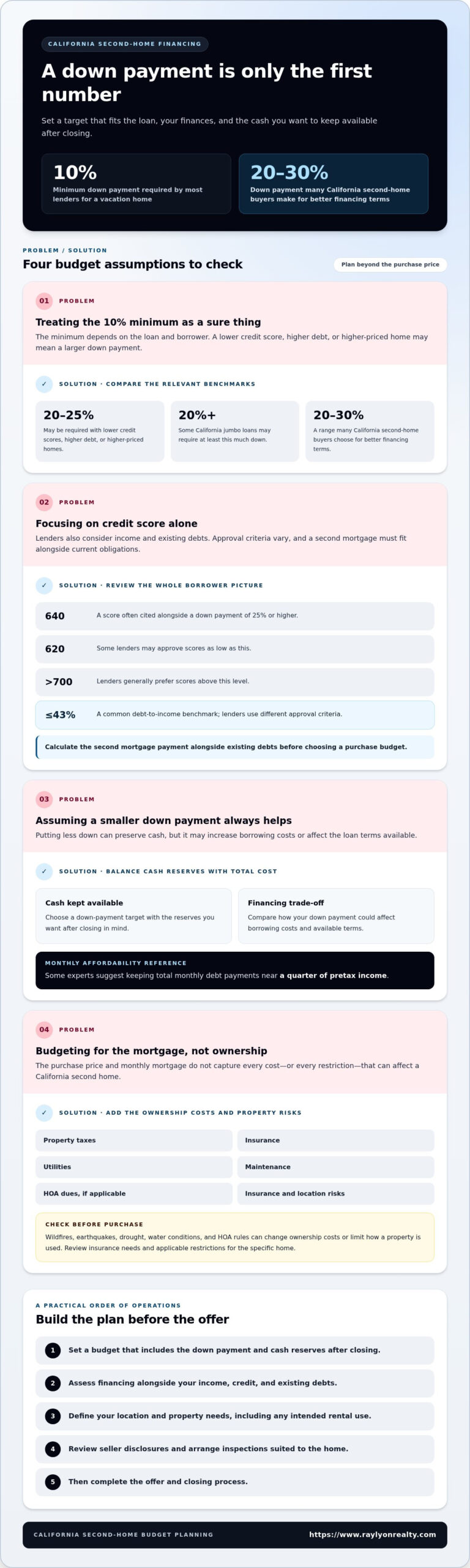
Most lenders require at least 10% down for a vacation home, and many California second-home buyers put down 20% to 30% for better financing terms. Your target depends on the property price, loan requirements, and the cash you want to keep available after closing. A sound plan for how to buy a second home in California starts with that down payment, but it doesn’t end there.
It’s easy to focus on the purchase price and underestimate the full budget, especially in California, where costs vary sharply by location and property type. This guide explains how to estimate upfront funds, understand when mortgage interest may be deductible, and compare the financial trade-offs between a personal getaway and an investment property. You’ll also see how coastal, wine-country, desert, and mountain markets can shape the homes and budgets you consider, helping you approach the search with a clearer financial picture.
Key Takeaways
- Set a down-payment target around your credit profile, existing debts, and the cash reserves you want after closing.
- Understand how personal use and rental activity can affect mortgage-interest deductions and a property’s tax treatment.
- Compare California regions before choosing a home; location and property type can shift the purchase budget significantly.
- Build a full ownership budget that accounts for costs beyond the mortgage, including taxes, insurance, upkeep, and community fees.
- Match the property to your plans, whether you’re seeking a personal retreat, a new-construction home, or an investment.
1. What is the minimum down payment for buying a second home in California?
Most lenders require at least 10% down for a vacation home, but the minimum depends on the loan and borrower. Buyers with lower credit scores, higher debt, or higher-priced homes may need 20% to 25%; some California jumbo loans may require 20% or more.
Credit and income shape the decision. A 640 credit score is often cited alongside a 25% or higher down payment, while some lenders may approve scores as low as 620. Lenders generally prefer scores above 700. A debt-to-income ratio of 43% or lower is a common benchmark, but lenders use different approval criteria. Calculate the second mortgage payment alongside existing debts before choosing a purchase budget.
To see how financing choices can affect your second-property budget, watch this video:
Affordability means more than qualifying for a mortgage. Some experts suggest keeping total monthly debt payments near a quarter of pretax income. Also budget for annual property taxes, insurance, utilities, maintenance, and any homeowners association dues. A lower down payment can preserve cash, but may increase borrowing costs or affect available loan terms.
Rental plans add tax and financing considerations. Rental income is taxable, while mortgage interest, property taxes, repairs, depreciation, and operating expenses may be deductible, depending on use. Renting the home for 14 days or fewer leaves that rental income untaxed under the tax treatment described. Profits above $250,000 for an individual may face capital gains tax unless specific conditions apply.
Insurance requirements vary with the lender and property risks. Include earthquake exposure in your risk and insurance planning, and review the home’s location and coverage terms before purchase.
A California second home may be used as a short-term rental, but lender requirements may prohibit placing it under a property management company’s control. City, county, and HOA rules can also affect rental use, so review the applicable restrictions for the specific property.
Before closing, review seller disclosures and arrange inspections suited to the home, such as a general property inspection and specialist evaluations for identified concerns. The practical steps are to set a budget, assess financing, define your location and property needs, review disclosures and inspections, then complete the offer and closing process.
Wildfires, earthquakes, drought, and HOA restrictions can change ownership costs or limit how a property is used. Compare these risks with insurance needs, water conditions, community rules, and the home’s intended use before making an offer.
2. Do I qualify for the mortgage interest deduction on a California second home?
A second home’s tax treatment depends on how you use it, how you finance it, and when you acquired it. Start by separating personal-use expenses from rental activity, then compare the mortgage debt and property taxes with the applicable deduction limits. This distinction matters because a vacation home and a rental-focused property can receive different tax treatment.
For homes acquired after December 15, 2017, mortgage interest is deductible on combined primary- and second-home debt up to $750,000, according to the Internal Revenue Service. The limit applies to the debt across both homes, not separately to each mortgage. For example, if your primary-home loan and second-home loan together exceed that amount, the full combined balance does not qualify for the deduction under this stated limit.
For a second home bought before December 16, 2017, the mortgage-interest deduction limit is $1 million, or $500,000 for married taxpayers filing separately, according to the Internal Revenue Service. Keep the purchase date and mortgage records with your tax documents. The acquisition date helps identify which limit applies, while the combined debt determines how much mortgage interest may be deductible.
Property taxes follow a separate calculation. The combined state and local tax deduction cap is $40,400 per tax return for tax year 2026. That cap affects how much state and local tax, including eligible property taxes, may be deducted. Add the second home’s property-tax records to your annual ownership expenses, then consider them alongside other state and local taxes rather than treating the property tax as an unlimited deduction.
Personal use also matters. A second-home buyer must use the property personally for at least half the year to meet the listed second-home requirements. If you rent the home, rental income is taxable, and mortgage interest, property taxes, repairs, depreciation, and operating expenses may be deductible. Track personal days, rental days, income, and expenses separately so the property’s actual use is clear.
Mortgage approval and tax treatment rely on different criteria. Lenders assess whether you can manage the second mortgage and other obligations; tax deductions depend on qualifying debt, acquisition date, property use, and eligible expenses. A favorable interest rate can reduce financing costs, but it doesn’t by itself establish that interest is deductible. Include both the loan structure and intended ownership pattern in your purchase budget.
If you’re weighing a rental-focused purchase against personal use, explore investment property purchase options as you compare property goals and ownership plans.
3. Second homes versus primary residences and investment properties
A primary residence is the home you use as your main residence; a second home is generally for personal use away from it. Lenders distinguish both from an investment property because occupancy, rental plans, and loan terms can differ. A California home’s classification should reflect how you actually use it, not simply the name on the purchase paperwork.
A property generally qualifies as a second home if you occupy it at least 14 days annually or 10% of its rental days, whichever is greater. The listed lender requirements also describe a second home as one unit. If you rent a vacation property and occupy it for less than two weeks per year, it is taxed as an investment property, not a residence. Keep a calendar of personal stays and rental periods to document use.
Investment-property financing can cost more: rates are typically 0.5 to 0.75 percentage points above primary-residence rates. VA and FHA loans are available only for primary residences, not second homes or investment properties. Rental income may be taxable, while eligible expenses and deductions depend on how the property is used. Utilities, repairs, and rental operations should be budgeted separately from personal ownership costs.
California property taxes also affect the long-term calculation. Proposition 13 limits annual increases in property-tax assessments to 2% until the property is sold. Annual taxes on a $2 million California home are estimated at $22,000 to $25,000. The actual property-tax requirements can differ by county and other local jurisdiction, so include the property’s location and assessed value in your ownership estimate.
Tax treatment can change if a second home becomes your primary residence. A homeowner may not qualify for the capital gains exclusion on a second home unless it was their primary residence for at least two of the past five years, according to the Internal Revenue Service. Before changing the use of a property, keep records showing occupancy, rental income, and expenses.
Rental use also creates liability exposure beyond ordinary upkeep. Review insurance coverage for the property’s use, guest access, and potential claims; owners may also discuss legal ownership structures with a qualified adviser. An entity can affect taxes, financing, and transaction paperwork, so weigh those factors before changing title.
California closing costs typically total 2% to 5% of the purchase price. Transfer taxes and other purchase fees depend on the property’s location and transaction details, so include them in your closing budget alongside title, escrow, and other settlement charges.
4. Down-payment expectations
Plan for more than one possible down-payment threshold. Second-home buyers typically need 10% to 20% down, while many California buyers put down 20% to 30% to obtain better financing pricing. A National Association of Realtors survey found that buyers who finance a second home typically put down 20%. These are planning benchmarks, not a single amount that applies to every loan.
Loan size and property price can raise the cash target. Jumbo loans for a California second home may require 20% or more down. For property above $1 million, California second-home jumbo loans may require 25% to 35%. A larger down payment can reduce the amount borrowed, but it also ties up funds that could otherwise cover reserves, repairs, or ongoing ownership expenses. A useful part of planning how to buy a second home in California is comparing that trade-off with your cash needs after closing.
Estimate the down payment against the specific home price, then keep closing costs separate. Second-home closing costs typically total 2% to 5% of the purchase price. This means your purchase funds need to cover both the down payment and settlement expenses, rather than treating the down payment as the full cash requirement. Avoid using every available dollar at closing.
Cash reserves are another part of qualification. Second-home lenders typically require borrowers to retain 2 to 6 months of combined mortgage payments in liquid reserves after closing. The research also describes borrowers needing to show they can cover six months of payments for both properties. In practice, calculate the primary and second-home mortgage payments together, then preserve enough accessible cash for the required reserve and unexpected costs.
Monthly ownership costs can make a lower down payment less affordable than it first appears. Budget annual property taxes of about 1.1% to 1.25% of the purchase price, plus a rough 2% to 4% of the home’s cost for annual second-home expenses.
If you plan to rent out the vacation property, assess the budget without assuming rental income will cover the mortgage payment. Consider whether seasonal demand, operating expenses, taxes, and periods without bookings still leave enough cash for both homes. A stronger reserve can help absorb vacancies or repairs without disrupting your primary-home budget.
Before making an offer, compare three amounts: cash for the down payment, closing costs, and reserves remaining afterward. As you decide how to buy a second home in California, test the expected payment alongside property taxes, association fees, utilities, and other expenses. This full comparison gives you a more useful affordability limit than the purchase price alone.
5. California second-home locations and home values
California’s second-home budget depends heavily on location and property type. A mountain cabin, desert retreat, wine-country home, and coastal property can fall into very different price brackets. Treat those figures as starting points, then compare specific communities and homes.
Regional entry prices show how wide the choices are. These ranges help narrow your search before you evaluate individual real estate listings.
Top-end locations stretch higher. A luxury estate in these markets can require a different financing plan than a more modest vacation property, including a larger cash reserve.
Some city-level median values offer another comparison point. These figures can help frame a location search, but a median does not describe every property or property type within a city.
Compare the intended use with the local price level. A coastal home may suit buyers prioritizing ocean access, while a desert property may better fit seasonal stays. Mountain and lake locations offer another setting. Estimate the mortgage payment based on the purchase price, down payment, and interest rate. Include mortgage interest, property taxes, insurance, utilities, and upkeep when comparing homes, not just the listing price.
Location also affects risk and carrying costs. Before choosing an area, consider access, property condition, insurance needs, and how often you expect to use the home. The key question is which location fits both your budget and ownership plans.
Use these regional ranges to shape a shortlist, then compare individual properties and their ongoing costs. Explore California second-home options as you refine your location and property search.
Ray Lyon Realty: New Construction Sales
Ray Lyon Realty helps buyers connect their second-home plans with suitable residential properties, including new construction. If you’re comparing a newly built home with an existing property, the team can help you assess options against your intended use, budget, and preferred location.
For buyers considering a rental-focused purchase, Ray Lyon Realty’s investment property services can support the property search and transaction. Buyers looking at a high-end home can also work with a luxury listing agent. These services are most relevant once you’ve clarified whether the property is for personal use, investment, or both, and have a budget in place.
Bring your priorities and location shortlist to the conversation. Contact Ray Lyon Realty to discuss your next steps.
Turn your second-home plans into a focused search
The next step is turning your budget into a practical shortlist. Decide what matters most: time with family, a specific setting, room to host guests, or the flexibility to rent the property. Then compare homes against those priorities, not just their listing photos. A clear set of needs can make the search more manageable and help you recognize the right fit.
Planning how to buy a second home in California also means choosing support that fits your search. Ray Lyon Realty offers residential representation, new construction sales, and luxury listing representation. Whether you’re considering a newly built home or a high-end property, the team can guide your next real estate decisions.
When you’re ready to discuss your plans and refine your search, contact Ray Lyon Realty. A thoughtful plan can help you move forward with clarity and confidence.
Frequently Asked Questions
How much do I need to put down on a second home?
Plan around the loan terms and your finances rather than assuming one down payment fits every buyer. Set aside separate funds for the down payment, closing, and post-purchase expenses. Lenders also assess the mortgage payment alongside your existing debts and may require liquid reserves after closing. Compare several down-payment scenarios in your budget to see how each changes the amount borrowed and the cash left available.
Do I qualify for the mortgage interest deduction on a California second home?
You may qualify if the loan and property use meet the applicable tax rules. For homes acquired after December 15, 2017, the Internal Revenue Service allows mortgage interest deductions on combined primary- and second-home debt up to $750,000. Keep loan statements and records of personal and rental use together. If you rent the property, track rental income and expenses separately, because the tax treatment depends on how the home is used.
How does Proposition 13 apply?
Proposition 13 limits annual increases in California property-tax assessments to 2% until the property is sold. For budgeting, distinguish the home’s assessed value from its market value, then account for the location’s property-tax bill. The limit applies to assessment increases, not to every cost of owning the home. A future sale can change the assessment basis, so don’t assume a previous owner’s tax bill will remain your bill.
What is the minimum down payment for buying a second home in California?
Some lenders require at least 10% down for a vacation home, while the amount you need depends on the loan and your qualifications. A 640 credit score is associated with a 25% or higher down payment in the stated guidance; some lenders may approve scores as low as 620. Ask for a loan estimate based on your intended occupancy, credit profile, debts, and property price.
Which markets offer the best value?
Value depends on the property type and your priorities, not just the lowest median. Consider what each market offers for your planned use, then compare individual homes, access, insurance needs, and ongoing costs. A city median is a starting point, not a price estimate for a particular home.
What are current mortgage rates and loan requirements for California second homes?
Mortgage rates vary with the loan, borrower, and property, so there isn’t one rate that applies to every California second-home purchase. Fixed-rate mortgages commonly come with 15- or 30-year terms. Lenders assess credit, debt-to-income ratio, income, down payment, and reserves. Compare loan offers using the interest rate, payment, and loan terms together; a rate alone doesn’t show the full borrowing cost.
How much are property taxes on a second home in California, including Proposition 13 rules?
Budget annual property taxes of about 1.1% to 1.25% of the purchase price. For a $2 million California home, annual property taxes are estimated at $22,000 to $25,000. Proposition 13 limits annual increases in property-tax assessments to 2% until the property is sold. Tax requirements can also vary by county and local jurisdiction, so include the specific property’s location in your estimate.
What are the tax implications of buying, renting, and selling a second home in California?
Rental income is taxable, and eligible mortgage interest, property taxes, repairs, depreciation, and operating expenses may be deductible based on use. Renting for 14 days or fewer leaves rental income untaxed under the described treatment. On sale, gains above $250,000 for an individual or $500,000 for married couples may be taxed unless specific conditions apply. Previously claimed rental-property depreciation may be taxed at up to 25% when sold for a profit.