

A property estimate website can give you a starting point, but its number may not answer the question that matters for an investment decision. If you’re wondering how to value an investment property in los angeles, match the valuation method to the property and test the result against local evidence. Online estimates may not reflect actual rental income, operating expenses, condition, or differences between neighborhoods.
Comparable sales, income calculations, and property-specific details can point in different directions. Market value is also different from investment return: a likely sale value alone doesn’t show whether the property’s income and costs fit your goals.
This guide explains how to build a preliminary estimate using the income, sales comparison, and cost approaches. You’ll learn what to compare, how rent and condition affect the analysis, and why local rules and neighborhood-level evidence matter. For Westside properties, experience with markets such as Santa Monica, Mar Vista, and Venice can help put comparable sales in context and inform a pricing strategy when you’re considering a sale.
Key Takeaways
- Separate a property’s evidence-based market value from its cash flow, equity, and the return you hope to earn.
- To understand how to value an investment property in los angeles, estimate rental income, subtract operating expenses, and compare the resulting income picture with market evidence.
- Use the income, comparable-sales, and cost approaches as complementary checks. Choose methods that fit the property and the evidence available.
- Review comparable sales for meaningful matches in location, property type, size, condition, and legal use before drawing conclusions.
- Gather property and rental records, document your assumptions, and account for applicable rules and occupancy details to make your preliminary estimate more defensible.
What Does It Mean to Value an Investment Property in Los Angeles?
Property value is not a single figure that an online estimate can reveal with certainty. It’s an evidence-based opinion of what a property might sell for under current market conditions, informed by relevant sales, income potential, condition, and permitted use. The estimate can guide a decision, but it isn’t a guaranteed sale price or a promise of what a buyer will offer.
Market value estimates a property’s likely price based on market evidence; investment return measures the financial results an owner may earn from it. These measures are related, but they answer different questions. Return can include income and changes in value, while cash flow tracks money left after income and expenses. Equity is the difference between the property’s value and debts secured against it. An investment target reflects the buyer’s own goals and assumptions.
A tax assessment is a separate figure used for property-tax purposes. Don’t automatically treat it as a current estimate of market value. For a broader overview of approaches and principles, see Real Estate Valuation Methods.
Which Los Angeles investment properties are being valued?
Property type helps determine which evidence is most useful. For a single-family rental or condo, compare similar nearby homes and use rent and expenses as additional context. For a small multifamily building, income from multiple units often deserves closer attention. A property with an accessory dwelling unit (ADU) calls for evidence that reflects the primary home, the additional unit, and the property’s documented use.
Occupancy matters, too. A vacant home, an owner-occupied property, and a rental with existing tenants may raise different considerations for buyers. Unit count and use also shape which sales are comparable. A duplex, for example, isn’t automatically comparable to a nearby single-family home just because they’re on the same street or have similar square footage.
Why an LA valuation needs more than a generic estimate
Broad estimates can miss important differences in location, layout, upkeep, occupancy, and buyer demand. Even on Los Angeles’ Westside, Santa Monica, Mar Vista, and Venice are distinct markets, not interchangeable labels for one area. Use sales and income evidence tied as closely as possible to the property’s neighborhood and characteristics, and check that each comparison reflects a similar use.
Condition can also change how useful a comparison is. Deferred repairs, updates, or functional differences may make two similar-sized properties less alike than they first appear. For neighborhood context, the Mar Vista neighborhood guide can help frame local features alongside property-specific evidence. The goal isn’t to force every detail into one formula, but to select evidence that fits the asset being valued.
How to Calculate Investment Property Value Using Income
The income approach asks what a property’s income may indicate about its value. It can be especially useful for rentals and small multifamily properties, but the result depends on realistic rent and expense assumptions. When considering how to value an investment property in los angeles, treat the calculation as one piece of evidence, then compare it with relevant sales and the property’s actual condition and use.
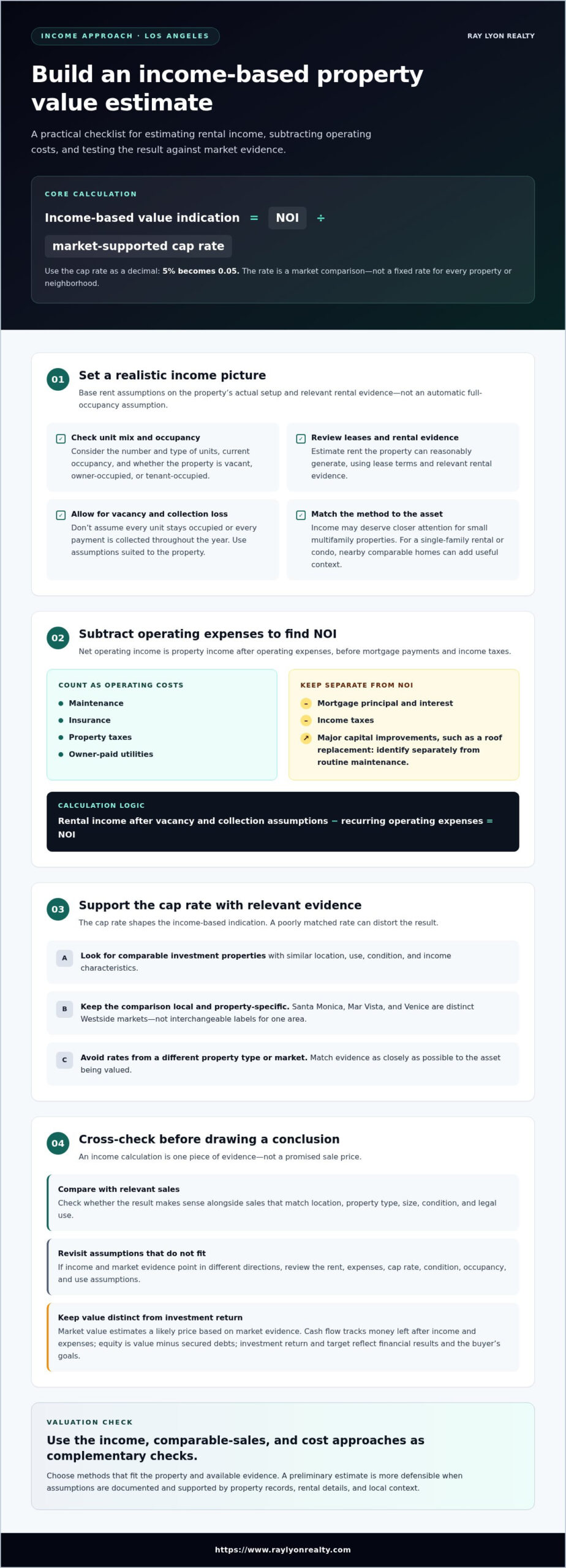
Income-based value indication = net operating income (NOI) ÷ market-supported capitalization rate (cap rate). NOI is the property’s income after operating expenses, before mortgage payments and income taxes. Enter the cap rate as a decimal in the calculation, so 5% becomes 0.05. A cap rate is a market comparison, not a fixed rate that applies to every property or neighborhood.
Build a reliable net operating income estimate
Start with rent the property can reasonably generate, based on its unit mix, occupancy, lease terms, and relevant rental evidence. Don’t assume every unit will be occupied and every payment collected throughout the year. Account for expected vacancy and collection losses using assumptions suited to the property, not a generic percentage.
Then subtract recurring operating costs, such as maintenance, insurance, property taxes, and owner-paid utilities. Review available records and allow for ongoing expenses realistically. Mortgage principal and interest are financing costs, not operating expenses; income taxes are generally analyzed separately. Identify major capital improvements, such as a roof replacement, separately from routine maintenance rather than treating them as ordinary annual operating costs.
Use cap rate and rent multiplier as checks, not answers
After estimating NOI, look for cap-rate evidence from comparable investment properties with similar locations, uses, condition, and income characteristics. A rate drawn from a different property type or market can distort the result. Valuation methods work best when matched to the asset and available evidence, as outlined in McKissock Learning’s discussion of Primary Real Estate Valuation Methods.
If annual NOI is represented by N and a supported cap rate by r, the income-based indication is N ÷ r. Treat this as a starting point, not a promised sale price. Compare the result with relevant sales, and revisit your assumptions if the figures don’t make sense together.
A gross rent multiplier (GRM) offers a quicker check: divide a comparable property’s sale price by its gross annual rent, then apply that multiplier to the subject property’s gross rent. Because GRM ignores vacancy and expense differences, it can make two properties look alike when their operating profiles differ. The California investment property ROI guide explains performance measures that can complement, but don’t replace, market-value analysis. For Westside investment-property context, Ray Lyon Realty’s local real estate guidance can help frame the evidence without treating a calculation as a guarantee.
How Comparable Sales and Other Methods Check an LA Property Valuation
Each valuation method highlights a different part of the evidence. For an owner-occupied home that could become a rental, comparable sales may carry more weight. For a property purchased mainly for its income, the income approach can be more informative. The cost approach adds another perspective, but rarely settles the question on its own. To assess how to value an investment property in los angeles, compare the methods and consider which evidence best fits the property’s use.
| Approach | Best use | Evidence needed | Key limitation |
|---|---|---|---|
| Sales comparison | Homes, condos, and properties with useful nearby sales | Completed sales of similar properties, with details on location, size, condition, and use | Close matches may be scarce; differences need careful consideration |
| Income | Rentals and properties where income is central to buyer analysis | Rental income, operating expenses, occupancy assumptions, and relevant market cap-rate evidence | Results depend on the quality of assumptions and comparable income evidence |
| Cost | Newer or unusual properties where replacement cost offers context | Land value, construction costs, and depreciation or condition considerations | Replacement cost may not reflect what buyers will pay for an established rental |
Use these approaches to inform one another, not to calculate a mechanical average. If the income indication and sales comparison point to different ranges, investigate why. The sale comparisons may have different unit counts, for example, or the income estimate may assume occupancy the property hasn’t demonstrated. Give the most relevant evidence the most weight and document your reasoning.
Choose comparable sales that actually fit the property
Start with completed sales in the same neighborhood and a relevant market period. Look for a close match in property type, size, condition, occupancy, and legal use. A condo sale may not be a sound substitute for a small multifamily property, even if they’re nearby. Note meaningful differences and adjust your analysis thoughtfully, without assuming a standard adjustment amount. Asking prices reflect seller expectations, not completed-sale evidence.
When online estimates and appraisals need context
Online estimates can provide an initial signal, but automated tools may not capture actual rent, interior condition, occupancy, or unusual features. A lender appraisal is prepared for a lending decision; an investor’s analysis may also weigh income and personal objectives. For investors seeking hard money or alternative financing, private lenders like Applewood Funding Inc evaluate these property fundamentals when structuring loans. Neither a website estimate nor one valuation method guarantees a definitive value. Treat each as an input, then check it against property-specific evidence.
Which Los Angeles Factors Can Change an Investment Property’s Value?
Two properties with similar layouts can support different estimates if their rental terms, condition, permitted use, or location differ. In Los Angeles, distinguish requirements that apply to a specific jurisdiction from broader market influences. Rules vary by property and location, so confirm current city, county, and state requirements for the particular address and property type before using them in an analysis.
Assessed value is a tax measure, rental income is a measure of operating potential, and market value is an estimate informed by what buyers may pay. These figures can influence one another, but they aren’t interchangeable. California’s Proposition 13 assessment framework is distinct from a current market-value estimate, so a tax assessment alone isn’t evidence of what a property would sell for today.
Check rent regulation and tax context carefully
Rent rules can depend on a property’s location, type, and eligibility. Confirm which jurisdiction applies and whether a restriction is relevant before treating current or potential rent as a reliable assumption. Lease terms and occupancy matter, too: existing agreements, vacant units, and the timing of rent changes may affect income expectations and how a buyer evaluates the property. For tax or legal interpretation, rely on the relevant public agency or a qualified professional.
Account for condition, ADUs, and neighborhood evidence
Build a property-specific record of repairs, deferred maintenance, improvements, and known retrofit considerations. Keep permits and other supporting records for improvements where available. An accessory dwelling unit can influence value, but don’t assume a standard contribution. Consider its documented status, condition, use, and evidence from comparable properties. Match neighborhood evidence closely, since Santa Monica, Mar Vista, Venice, and nearby areas each have their own relevant sales and property context.
When assessing an ADU or other added space, distinguish its physical presence from evidence that it can be used as assumed. Unit configuration, access, condition, and documented use can affect how comparable sales or income evidence applies. If documentation is incomplete, record the uncertainty rather than treating a rental assumption as established fact.
Local context can explain why a broad estimate doesn’t fit a particular property. Buyer demand varies by neighborhood and property characteristics, while condition and occupancy can make nearby sales less comparable than they appear. Ray Lyon Realty’s Westside experience, including Santa Monica, Mar Vista, and Venice, helps put local evidence in context.
For a property you’re evaluating or preparing to sell, explore investment-property guidance from Ray Lyon Realty to bring property details and neighborhood evidence into a clearer pricing discussion.
How to Build a Defensible Los Angeles Investment Property Valuation
A useful estimate is one you can explain: which records support it, which method you used, and where assumptions remain. Gather property-specific information first, then compare the income picture with relevant completed sales. This workflow for how to value an investment property in los angeles won’t guarantee a sale price, but it can make your preliminary estimate more transparent and easier to refine.
Prepare the records behind the estimate
Organize the information before settling on a figure. Keep verified records separate from estimates, and note the date and source of each item. A missing lease or uncertain expense shouldn’t quietly become a fact in your calculation.
- Collect income records. Gather the current rent roll, leases, occupancy details, and records of rent actually received. Note any gap between contract rent and your estimate of potential rent.
- Summarize operating expenses. Assemble available records for taxes, insurance, utilities, routine maintenance, and other recurring costs. Keep mortgage payments and major capital projects in separate categories.
- Document the property. Record property type, unit count, layout, condition, and any ADU details. Gather improvement records and available permit documentation so the analysis reflects the property as it exists.
- Build a comparison set. Save relevant completed sales and note how each property differs in location, use, size, condition, and occupancy. Record why you included or excluded each comparison.
- Write down assumptions. Identify estimates for vacancy, repairs, or other missing information. Label them as assumptions, and revisit the result if better records become available.
Use local expertise to interpret the evidence
Compare the income indication with the sales evidence. If they don’t align, don’t simply average the figures. Check whether rent and expense assumptions are supported, whether the sales truly match the property, and whether condition or use explains the difference. Keep a brief record of the evidence you relied on and why you gave it weight.
Local context can sharpen that review. Ray Lyon Realty represents buyers and sellers of residential and investment properties on Los Angeles’ Westside, including Santa Monica, Mar Vista, and Venice. Its experience with property ownership and investment-property transactions can help put comparable sales and property-specific details into context. The Los Angeles real estate agents guide offers more context on local representation.
Use your estimate as a reasoned starting point, not a substitute for legal, tax, lending, or appraisal advice. If you’re considering a sale, a locally informed pricing discussion can help you weigh the evidence and plan your next steps. Connect with Ray Lyon Realty to discuss your residential or investment property.
Put Your Valuation to Work
A preliminary valuation is most useful when it helps you decide what to do next. You might hold the property, explore a sale, or revisit your assumptions as leases, expenses, or condition change. Treat your estimate as a decision checkpoint, not a number to defend at all costs. If new evidence changes the picture, update the analysis.
For a clearer perspective on how to value an investment property in los angeles, consider how local transaction experience can inform your next step. Ray Lyon Realty brings experience with property ownership and flipping, along with investment-property transactions that include 1031 exchanges. That perspective can help frame a pricing discussion without promising a specific valuation or outcome.
If you’re weighing a sale or want to discuss your property’s market context, Discuss your Los Angeles investment property with Ray Lyon Realty. Start with the evidence and a clear view of your goals.
Frequently Asked Questions
Can I value a Los Angeles investment property if it is currently vacant?
Yes, but separate the property’s current income, which may be zero, from a projection of future rent. For example, if a unit is vacant during repairs, record the expected work and timing separately from any estimate of rent after it’s ready. Check whether comparable rentals reflect a similar unit and condition. Present more than one reasonable occupancy scenario if the timing or achievable rent is uncertain.
Is an investment property’s appraised value the same as its sale price?
No. An appraisal is an independent opinion prepared for a particular purpose and date; a sale price is what a buyer and seller agree to in a specific transaction. A seller may accept an offer after negotiation, or a buyer may pay differently based on timing and property condition. If the figures differ, compare their dates, assumptions, and intended use rather than assuming one automatically overrides the other.
How often should I update an investment property valuation?
There’s no single update schedule that fits every property. Revisit the estimate when a meaningful change could affect income, condition, use, or market evidence, such as a new lease structure or completed renovation. Keep dated copies of the rent and expense assumptions and the comparable sales you relied on. That record makes it easier to see what changed between estimates, especially when preparing for a potential sale or exchange.
Can an online estimate accurately value a rental property in Los Angeles?
An online estimate can be a helpful starting point, but it may miss details that shape a rental’s value, such as specific lease terms or a unit’s actual condition. For how to value an investment property in los angeles, use the estimate as a prompt to investigate, not as a final answer. If it differs from your analysis, check which property details or assumptions may explain the gap.
What documents help estimate an investment property’s value?
Useful records include leases, a current rent roll, expense statements, tax and insurance information, maintenance history, improvement records, and available permits. Note the period each record covers and whether a figure is actual or projected. For example, distinguish a contractor’s estimate for planned work from a paid invoice. This helps prevent outdated expenses or future assumptions from being mistaken for current operating facts.
Does a property’s value change if I plan to complete a 1031 exchange?
A planned 1031 exchange doesn’t independently set a property’s market value. Assess the property using evidence relevant to its income, condition, use, and comparable sales, then keep exchange planning separate from the value estimate. If you plan to reinvest proceeds elsewhere in Southern California, connecting with regional market specialists such as Adria Chamberlain | Keller Williams High Desert can help you evaluate potential replacement properties. Exchange requirements can involve tax rules and deadlines that depend on individual circumstances. Discuss those requirements with a qualified tax professional; a real estate valuation guide isn’t a substitute for tax advice.