

Selling an investment property can trigger a tax bill, but a 1031 exchange may let you defer recognizing the gain if you reinvest in qualifying real property. The question “what is a 1031 exchange in california real estate” often leads to practical concerns: whether a property qualifies, how strict the deadlines are, and what happens if the replacement property is outside California.
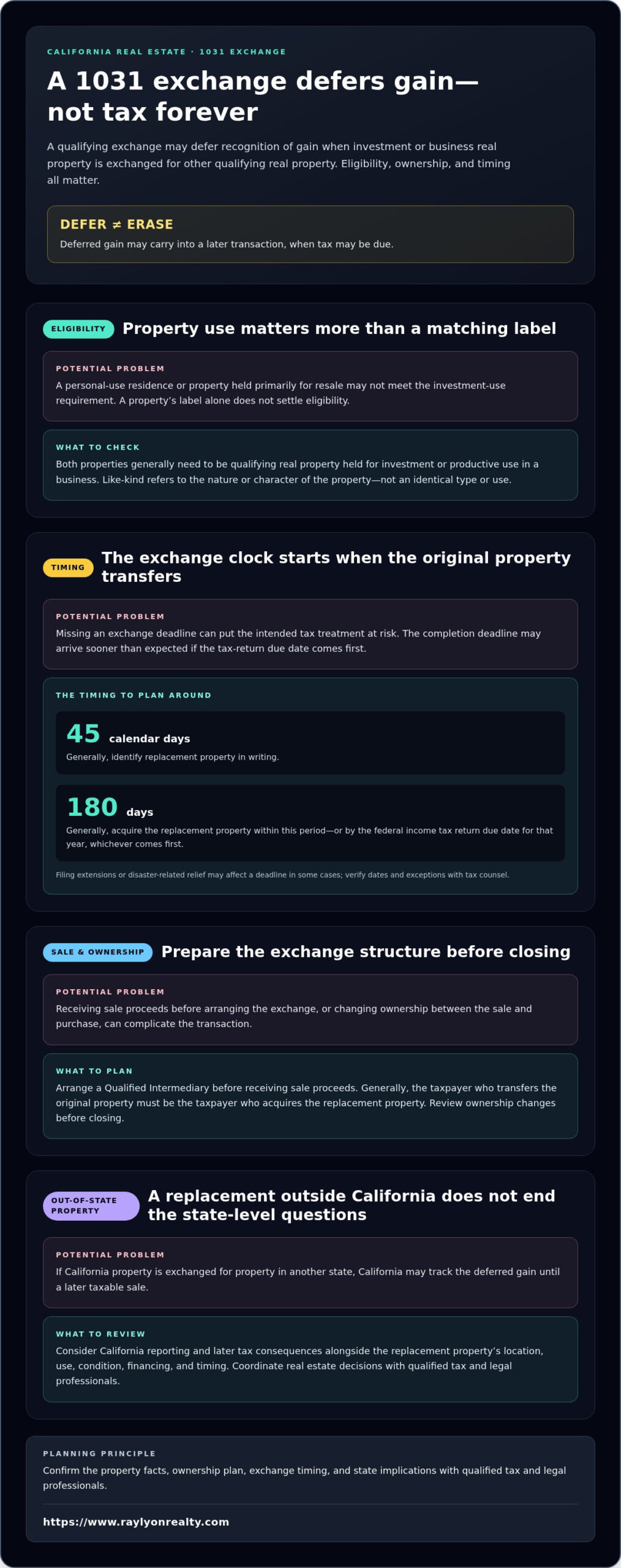
A qualifying exchange can defer federal and California income tax, but it does not erase tax, and the rules and timing matter. You generally have 45 days to identify replacement properties and 180 days to complete the purchase, subject to an earlier tax-return deadline. If you exchange California property for property in another state, California may track the deferred gain until a later taxable sale.
This guide explains how exchanges work, what to weigh before choosing one, and how to plan the real estate transaction. Ray Lyon Realty handles specialized 1031 exchange transactions for investors, coordinating the property sale and purchase while qualified professionals advise on tax and legal questions.
Key Takeaways
- Understand what is a 1031 exchange in california real estate and how property use and ownership can affect eligibility.
- Compare the potential benefits of reinvesting through an exchange with the consequences of selling, based on your circumstances.
- Plan before the relinquished property closes, including arranging a Qualified Intermediary before receiving sale proceeds.
- Evaluate replacement properties by investment purpose, location, condition, financing, and timing, not just geography.
- Coordinate real estate decisions with qualified tax and legal professionals, especially when a replacement property is outside California.
What Is a 1031 Exchange in California Real Estate?
A sale can create a tax bill if it results in a recognized gain, so it pays to plan before an investment property changes hands. If you’re asking what is a 1031 exchange in california real estate, the central idea is that a qualifying transaction may defer recognition of gain by exchanging investment or business real property for other qualifying real property.
Concise definition: A Section 1031 exchange is a structured exchange of qualifying real property held for investment or business use that may defer recognition of gain for federal income tax purposes. In an ordinary sale, the seller transfers the property for proceeds and may recognize gain in that tax year.
“Defer” does not mean “forgive.” A 1031 exchange can carry deferred gain into a later transaction, when tax may be due. The tax treatment depends on the facts and applicable rules. For general background on the concept and its history, see this Like-kind exchange overview.
What does like-kind real property mean?
For real estate, “like-kind” generally refers to the nature or character of the property, not an exact match in type. A qualifying exchange may involve different kinds of real property, provided the properties meet applicable requirements and are held for investment or productive use in a business. They do not have to look alike or serve identical purposes.
Use matters. A personal residence generally is not investment property, and property held primarily for resale may not qualify as investment property for an exchange. A property’s label alone does not settle the question. How it is used and held can matter, so have tax counsel review the facts before relying on exchange treatment.
Why do California property owners consider an exchange?
An exchange can help an owner keep capital invested in qualifying replacement real estate instead of taking sale proceeds out of the investment. For example, an owner might sell a rental property and use the exchange structure to acquire another qualifying property. That may allow the owner to reposition an investment while deferring gain, if the transaction meets the rules. It does not guarantee a tax result or make every replacement property a good fit.
California generally conforms to federal Section 1031 rules for real property, but state implications still deserve attention. An exchange from California property into property elsewhere may involve California reporting and later tax consequences. Property use, ownership, location, and the planned transaction all help shape the analysis. A real estate team can coordinate the sale and purchase details, while qualified tax and legal professionals address the tax treatment and legal structure.
Which California Properties Qualify, and What Rules Apply?
Eligibility depends on more than owning real estate. Property use, asset type, ownership structure, and timing all matter. If you’re researching what is a 1031 exchange in california real estate, use this checklist as a starting point, not as confirmation that a particular transaction qualifies.
- Investment or business use: The relinquished property and replacement property generally need to be held for investment or productive use in a business.
- Qualifying real property: Section 1031 applies to real property. Like-kind property does not have to be identical in type, but the assets and transaction must meet applicable requirements.
- Consistent taxpayer identity: The taxpayer who transfers the original property generally must be the taxpayer who acquires the replacement property. Ownership changes can complicate this analysis.
Which properties may qualify for a California 1031 exchange?
A rental home, investment parcel, or other qualifying real property held for business or investment use may be considered. The properties can differ in type. For example, like-kind treatment does not require exchanging one rental house for an identical house. By contrast, a personal-use residence or property held primarily for sale may not meet the investment-use requirement. A tax professional should review how each property is actually used and held.
California conforms to federal Section 1031 rules for real property, but California-specific reporting and tax consequences still need consideration. This can be especially relevant when the replacement property is outside California.
How do the deadlines and same-taxpayer rule work?
For a typical deferred exchange, the identification period begins when the relinquished property is transferred. The investor generally must identify replacement property in writing within 45 calendar days. The replacement property generally must be acquired within 180 days of that transfer, or by the due date of the taxpayer’s federal income tax return for that year, whichever comes first. Filing extensions and disaster-related relief may affect a deadline in some cases, so verify the dates and any applicable exception with tax counsel.
The same-taxpayer principle generally means the person or entity that gives up the original property needs to acquire the replacement property. A change in ownership, such as transferring property between an individual and an entity, can raise questions even if the parties view it as administrative. Review the ownership plan before closing, rather than after the exchange is underway.
Core requirements, subject to legal and tax review: The properties must be qualifying real property held for investment or business use, the exchange must meet identification and acquisition deadlines, and the taxpayer acquiring the replacement property generally must align with the taxpayer transferring the original property.
Map out ownership and dates early so the sale, identification, and purchase fit together. Ray Lyon Realty’s investment-property guidance can support the real estate side of planning, alongside advice from qualified tax and legal professionals.
Does a California 1031 Exchange Eliminate Tax? Compare the Trade-Offs
No. A 1031 exchange can defer recognition of gain, but it does not necessarily erase the tax obligation. Deferred gain may become taxable in a later transaction. Understanding what is a 1031 exchange in california real estate means weighing the potential deferral against the flexibility of selling and deciding what to do with the proceeds.
Neither path suits every investor. An exchange may help someone who wants to continue investing in qualifying real estate, while a taxable sale may suit an owner whose priorities have changed. Compare the trade-offs with your investment plan and tax adviser’s guidance:
Timing: A taxable sale recognizes gain under applicable tax rules. An exchange has strict identification and acquisition deadlines that can shape when and what you buy.
Reinvestment flexibility: After a taxable sale, you generally have more freedom to use the proceeds. An exchange requires a qualifying replacement-property transaction.
Potential deferral: A qualifying exchange may defer gain recognition. A sale that recognizes gain does not provide that exchange-based deferral.
Planning complexity: A sale still requires tax planning, but an exchange adds coordination among the sale, replacement property, intermediary, and deadlines.
When might an exchange fit an investor’s goals?
An exchange may fit an owner’s plans if they want to keep capital invested in real estate, change property type, or reposition an investment rather than cash out. The strategy should fit the investment, not just the tax objective. Consider whether suitable replacement property is available, whether financing and timing are workable, and whether the new asset supports your longer-term goals. Review the choice with qualified tax counsel, since the tax consequences depend on your circumstances.
A replacement purchase made mainly to meet a deadline may not serve the investor well. Compare its location, condition, expected role in your portfolio, and financial demands with the alternative of selling and recognizing gain. A real estate partner can coordinate transaction details, while tax and legal professionals assess the consequences.
What California issues arise when replacement property is out of state?
California generally conforms to federal Section 1031 rules for real property, but an out-of-state replacement does not necessarily remove California’s interest in deferred gain from a California property. Under California’s clawback approach, the state may tax that deferred gain when the out-of-state property is later sold in a taxable transaction. The result depends on the taxpayer’s facts and the transaction.
California taxpayers who exchange California property for out-of-state property generally have an annual reporting obligation using FTB Form 3840, California Like-Kind Exchanges, to track deferred gain. Confirm current filing requirements and how they apply to your exchange with a tax professional familiar with federal and California rules. Weigh the reporting responsibilities along with the property and investment trade-offs. Ray Lyon Realty’s investment-property experience can support the real estate coordination side of that decision.
How to Plan a California 1031 Exchange Before Closing
Start planning before the relinquished property closes. Once the seller receives sale proceeds, it may be too late to structure a standard deferred exchange. If you’re considering what is a 1031 exchange in california real estate, timing is part of the answer: the sale, intermediary arrangements, property identification, and replacement purchase need to work as one coordinated transaction.
What should an investor decide before listing or accepting an offer?
Before the sale is underway, clarify your investment goals, ownership structure, expected sale timing, and priorities for the replacement property. Discuss the exchange plan with tax counsel and arrange a Qualified Intermediary before closing. The intermediary generally holds the exchange funds and helps structure the transaction. The real estate brokerage coordinates property-sale and purchase details, not tax advice or intermediary services.
A practical sequence can keep the moving parts visible:
- Set the plan before marketing. Review ownership, investment objectives, likely timing, and replacement-property criteria with your tax and legal advisers. Discuss whether an exchange fits your situation.
- Coordinate the sale and exchange structure. Before the relinquished property transfers, engage the Qualified Intermediary and coordinate escrow so sale proceeds are not paid directly to you.
- Record the transfer date. Use the transfer date to track the identification and completion periods. Confirm the precise dates with your advisers.
- Identify and acquire replacement property. Submit written identification within the applicable period, then complete the acquisition within the exchange deadline. Keep sale, purchase, financing, and escrow milestones aligned.
How can the deadline sequence stay manageable?
Put every key date in one written timeline and share it with the people coordinating the transaction. The general federal framework gives an exchanger 45 calendar days after transfer to identify replacement property in writing and 180 days to acquire it, or until the tax return due date for that year if earlier. Count these periods from the transfer date, not from the date you begin searching.
Document identification and deliver it according to the exchange arrangements. Keep a copy and confirm receipt. A pending offer or property search does not change the deadline. The sequence is: transfer the relinquished property, identify replacement property within 45 days, and complete the acquisition within 180 days or by the earlier applicable return due date. Have qualified advisers verify the dates and any exception that may apply to your circumstances.
Ray Lyon Realty supports investors with real estate transaction coordination for specialized exchanges, while tax treatment and Qualified Intermediary services remain outside the brokerage’s role. Plan your investment-property transaction with Ray Lyon Realty as you coordinate the property side of the exchange.
Choosing Replacement Property and Real Estate Support in Los Angeles
A replacement property should make sense as an investment, not just fit an exchange calendar. As you consider what is a 1031 exchange in california real estate, separate two questions: Does the property support your investment plan, and do the tax rules allow it to qualify? A different property type or location may still meet like-kind standards, but geography alone does not establish eligibility. Have a qualified tax professional review the proposed exchange.
How should investors evaluate a replacement property?
Start with the role you want the property to play. Compare its intended use, local market context, physical condition, financing needs, and fit with your ownership plan. In Westside Los Angeles, neighborhood-level research can help you assess whether an area fits your objectives. For example, a Mar Vista neighborhood review can add local context, but it cannot predict a property’s performance.
- Investment purpose: Define what you want the asset to contribute, such as a different property profile or a change in location.
- Market and location: Consider the neighborhood, nearby amenities, and how the setting fits your investment strategy. Past or expected market activity does not guarantee returns.
- Condition: Review the property’s current state and likely repair needs as part of the purchase decision.
- Financing and timing: Assess whether financing, due diligence, and closing milestones can align with your exchange schedule.
- Ownership and tax review: Consider how the replacement will be held and have tax counsel evaluate like-kind treatment and exchange requirements.
Searching beyond Los Angeles can widen the options, but tax review remains important. A California property exchanged for out-of-state real estate may still involve California reporting or later tax considerations. Discuss the specific properties and ownership plan with a tax professional familiar with federal and California rules before committing.
What can a real estate team contribute to exchange planning?
A real estate team can help shape a sale strategy, search for investment properties, negotiate offers, and coordinate purchase and escrow details around the transaction timeline. That coordination can be useful when the sale and replacement purchase need to progress in tandem. For broader context on working with an agent in the Los Angeles market, review a Los Angeles real estate agent guide.
Ray Lyon Realty represents investors in property sales and purchases and handles specialized exchange transactions. The brokerage supports the real estate side of the process. Tax eligibility, exchange structuring, Qualified Intermediary arrangements, and tax advice belong with the appropriate qualified specialists.
Use your evaluation criteria to narrow the search, then coordinate transaction milestones with your advisers. To discuss the real estate side of an investment-property transaction, talk with Ray Lyon Realty about your investment property.
Make Your Next Property Move with a Clear Plan
Before listing a property, turn your goals into a short decision brief. Note what you want your next investment to accomplish, which locations and property types you would consider, and what would make you pause or walk away. Share that plan with your tax and legal advisers, then align your real estate search with their guidance. This can help you assess options without letting tax timing alone drive the decision.
If you’re still asking what is a 1031 exchange in california real estate, connect the tax concept to your specific transaction. Ray Lyon Realty works with investor clients on specialized exchange transactions and investment-property purchases and sales, with local knowledge of Santa Monica, Mar Vista, Venice, and the wider Westside. The brokerage supports the real estate process, while qualified professionals advise on tax and legal questions.
Talk with Ray Lyon Realty about your investment property plans and take the next step with a thoughtful strategy.
Frequently Asked Questions
Can a vacation rental qualify for a 1031 exchange?
Yes, a vacation rental may qualify if it is genuinely held for investment or business use rather than primarily for personal enjoyment. The owner’s pattern of personal stays, rental activity, and how the property is held can all matter. For example, occasional personal use may raise different questions from frequent owner occupancy. Keep records of rental and personal use, and have a tax professional assess the facts before treating the property as eligible.
Can an LLC complete a 1031 exchange if its ownership changes?
Possibly, but a change in LLC membership can raise a same-taxpayer issue. The answer may depend on the LLC’s tax classification, who owned the relinquished property, and who will acquire the replacement. Changing members between sale and purchase could complicate the exchange even if the LLC name remains unchanged. Review the structure with qualified tax and legal advisers before making ownership changes around an exchange.
What happens if the replacement property is worth less than the relinquished property?
A lower-value replacement may result in taxable “boot,” meaning some gain could be recognized rather than deferred. The calculation depends on the full exchange, including cash received, debt relief, and other transaction details. A lower purchase price does not automatically determine the tax result, but it is a reason to review the numbers before committing. Ask your tax adviser to model the proposed exchange so you understand potential consequences before closing.
Can one 1031 exchange include multiple relinquished properties?
Yes, an exchange may involve more than one relinquished property, but coordinating several sales can make the timeline and identification plan more complex. Each transfer can affect the relevant exchange deadlines, so staggered closings need careful date tracking. If two properties sell on different dates, do not assume they share one deadline. Have the Qualified Intermediary and tax adviser map each transfer and replacement-property identification to the correct schedule.
Does replacement-property debt have to match the debt on the property sold?
No, the loan balance does not necessarily need to match exactly. However, paying off debt on the relinquished property without replacing it with sufficient debt or additional cash may create taxable boot, depending on the exchange’s full financial details. Compare the sale’s net proceeds, debt relief, and replacement financing before finalizing an offer. A tax professional can assess how the proposed loan structure affects your exchange rather than relying on a simple dollar-for-dollar rule.
Can exchange funds be used to improve a replacement property?
Potentially, through a properly structured improvement exchange, but it requires planning before the replacement property is acquired. Improvements generally need to be completed within the exchange period, and only work in place when the taxpayer receives the property may count toward its exchange value. A renovation plan that runs beyond the deadline can create problems. Have the tax adviser and Qualified Intermediary review the structure, scope, title, and construction schedule before proceeding.
Is a Qualified Intermediary required for a delayed 1031 exchange?
Yes, a Qualified Intermediary is generally essential for a valid delayed exchange. The investor should not take possession of the sale proceeds; the intermediary facilitates the exchange and holds the funds under the exchange arrangement. Engage the intermediary before the relinquished property closes, not after proceeds have been received. Because a delayed exchange has strict timing and documentation requirements, coordinate the intermediary’s role with escrow and tax advisers from the start.