

What should a real estate agent marketing plan for my home include? The strongest plan is not necessarily the one with the longest list of tactics. It connects each decision to the property, its likely buyers, and your goals. You should be able to see how pricing, preparation, and promotion work together, not just hear a promise to “get it out there.”
On LA’s Westside, a thoughtful plan reflects the home and its neighborhood, whether you’re selling in Santa Monica, Mar Vista, or Venice. Staging and minor upgrades can help shape how a property is presented, while pricing and marketing position it for the market. Each recommendation should have a clear purpose rather than feel like a generic checklist.
Use this 2026 checklist to understand the key parts of a listing plan, compare proposals through specific questions and deliverables, and prepare for a practical conversation about your sale strategy. The sections cover preparation, photography, audience, distribution, pricing, and how the plan can respond to buyer feedback.
Key Takeaways
- Use a real estate agent marketing plan for my home to assess specific deliverables, timing, and communication, not broad promises alone.
- Understand how preparation, accurate listing details, and photography help buyers assess a property.
- Compare proposed marketing channels with clear information about what the agent will do and how progress will be shared.
- Prepare for launch by clarifying your goals, gathering property details, and noting questions about condition or improvements.
- See how local insight, pricing, preparation, marketing, and offer negotiation fit together in a Westside LA sale strategy.
What should a real estate agent marketing plan for my home include?
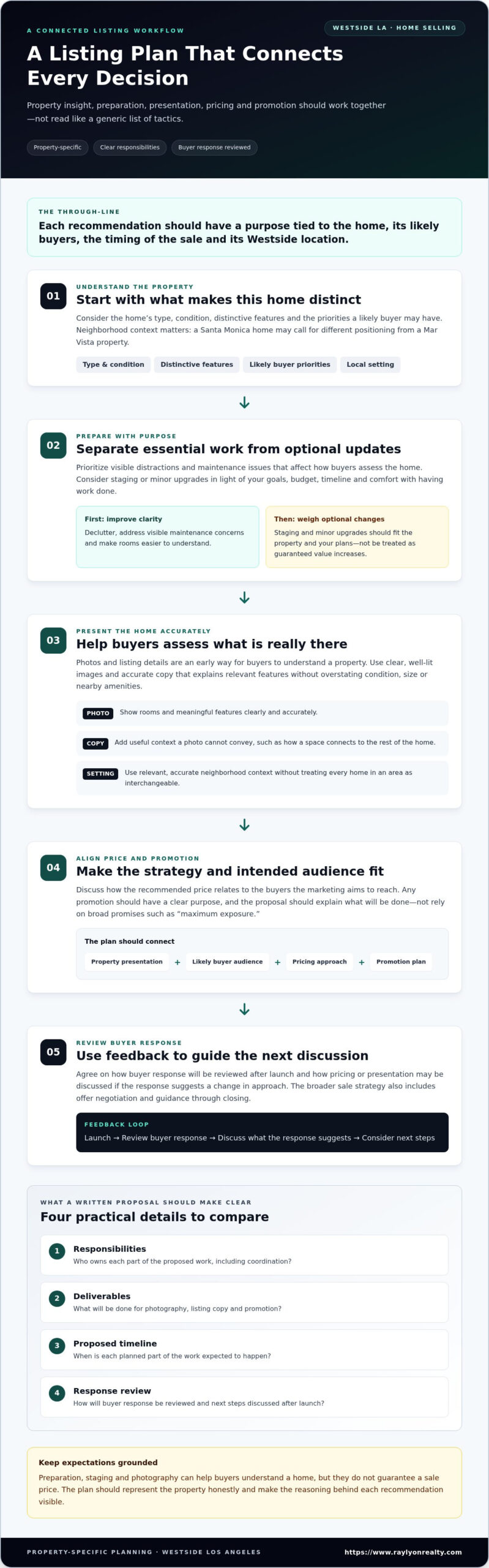
A real estate agent marketing plan for my home should explain how the property will be prepared, presented, and promoted as one connected effort. It should be more than a menu of generic tactics or a promise of “maximum exposure.” Each recommendation should relate to the home, its likely buyers, the timing of the sale, and its Westside location.
A useful written plan identifies the property-specific work, who is responsible for it, when it will happen, and how buyer response will be reviewed. That gives you practical details to discuss and compare, rather than broad claims like “top dollar.”
For a visual example of how an agent may organize listing promotion, watch:
Which decisions should be tailored to my property?
Start with the home itself: its type, condition, distinctive features, and the priorities a likely buyer may have. A Santa Monica home’s setting and features may call for different positioning from a Mar Vista property, even if both appeal to buyers seeking Westside living. Local neighborhood knowledge can help determine which details to emphasize and how to present the home.
Separate necessary preparation from optional improvements. Decluttering or addressing a visible maintenance issue may help buyers focus on the property. Staging or a minor upgrade may make sense depending on the home and your goals. Treat these as ways to improve presentation, not as guaranteed ways to increase value.
What belongs in a written marketing proposal?
Look for details you can follow up on: named responsibilities, planned deliverables, a proposed timeline, and a process for reviewing buyer response after launch. If the plan mentions photography, listing copy, or promotion, it should explain what will be done and how those elements support the intended audience. The agent’s role in coordinating the work matters, too. A Real estate broker overview offers background on the professional role, while your proposal should clarify the work planned for your home.
Discuss pricing from the start. Ask how the recommended price relates to the buyers the marketing aims to reach, and how the strategy may be reviewed in light of market response. This connects promotion to seller representation, including offer negotiation and guidance through closing. For more context on local representation, explore this Los Angeles real estate agent guide.
- Identify which preparation is essential and which improvements are optional for your goals.
- Look for a clear owner and timeline for each proposed deliverable.
- Ask how pricing and presentation align with the likely buyer audience.
- Agree on how the agent will review buyer response and discuss next steps.
A useful proposal makes the reasoning visible. You should be able to see how local context, property presentation, pricing, and promotion fit together, and what the next discussion will cover if the initial response suggests a change in approach.
How should a Westside LA listing be prepared and presented?
Preparation is not about making every home look alike. It helps buyers see the property clearly, understand its condition, and notice its relevant features. Decluttering can reduce visual distractions; thoughtful staging can show how a room functions; and selective minor upgrades may address details that draw attention away from the home.
Presentation can help buyers understand a home, but it can’t guarantee a sale price. The aim is to show the property’s strengths clearly and represent it honestly, not to suggest that styling or photography alone determines the outcome.
How do staging and minor upgrades fit the plan?
Walk through the home with fresh eyes. Are crowded surfaces making the kitchen harder to assess? Does the furniture arrangement obscure how a room could be used? Start with visible distractions and spaces that could read more clearly. Then weigh optional updates against your budget, timeline, and comfort with having work done before the sale.
Ray Lyon Realty can coordinate staging and minor upgrades to prepare a home for market. Recommendations should fit the property and your goals, with the purpose of improving presentation rather than promising a particular return. A restrained approach may be right if the home is already in good condition or a larger project doesn’t fit your plans.
What should listing photos and copy communicate?
Photos and listing details give buyers an early way to assess a home. Clear, well-lit images should show its rooms and features accurately. The written description should add useful context without overstating condition, size, or nearby amenities. Accurate details help set expectations before a buyer schedules a visit.
Visual choices should follow the property’s story. A distinctive outdoor area, flexible room, or architectural detail may deserve attention if it is a meaningful feature. Listing copy can explain what a photo can’t, such as how a space connects to the rest of the home. Avoid turning a personal impression into a factual claim.
Neighborhood context matters, but it should be relevant and accurate. A Mar Vista listing can describe the home’s features alongside information about its setting. The Mar Vista neighborhood guide offers context for understanding the area without treating every property in the neighborhood as interchangeable.
- Prioritize preparation that improves clarity or addresses visible distractions.
- Choose staging and upgrades with your goals, budget, and timing in mind.
- Use accurate visuals and copy that give buyers a realistic understanding of the property.
A thoughtful real estate agent marketing plan for my home connects preparation to presentation: what will be addressed, how the property will be shown, and which features deserve emphasis. Sellers considering a Westside listing can learn more about Ray Lyon Realty’s residential seller representation.
How can I compare an agent’s home marketing plan?
Two proposals can name similar marketing channels and still describe different levels of service. Compare the reasoning behind each plan, the tasks the agent will handle, when they’ll happen, and how you’ll hear what’s working. A useful real estate agent marketing plan for my home connects the property’s likely audience to specific actions, then explains how buyer response will inform decisions.
Distinguish proposed activity from evidence of execution. “We’ll promote the listing online” describes an intention. A clearer plan identifies what will be prepared or published, who is responsible, when it is expected, and how the agent will report back. Looking at how premier coastal listings are presented online, such as on brianliberto.com, provides a clear benchmark for sophisticated digital marketing in action. No channel, view count, or projection can promise an offer or a particular sale result. Look for a process you can understand and follow.
Which questions reveal whether the plan is specific?
Ask how the agent identifies likely buyers for your home and which property features or neighborhood details inform that view. Clarify which preparation and promotional tasks the agent will coordinate, and what the proposed timing looks like. Then agree on an update schedule: how often you’ll receive news, what it will cover, and how you can raise questions. Specific answers should refer to your property, not just a standard campaign.
How should I assess results without expecting guarantees?
Focus on observable activity and how the agent interprets it. Depending on what is available, updates might cover inquiries, showings, buyer comments, or listing engagement. Ask what patterns the agent sees, what remains uncertain, and whether the response suggests discussing positioning, presentation, or pricing. The goal isn’t to react to every data point. It’s to understand the reasoning behind recommended next steps.
Use this framework to compare proposals side by side. A clear answer should make the work and follow-up easy to picture.
Property-specific strategy
Ask: How does this plan fit my home and its likely buyers?
Clear answer: The agent connects the property’s features and local context to the intended audience.
Responsibilities and deliverables
Ask: Which tasks will you coordinate, and what will I receive?
Clear answer: The proposal names the work, the people responsible, and the expected outputs.
Timing
Ask: What happens before launch, at launch, and afterward?
Clear answer: The plan gives a sequence or schedule rather than an open-ended promise.
Communication
Ask: How often will you update me, and what will those updates cover?
Clear answer: You know the update schedule and the activity or feedback you’ll review together.
Response and next steps
Ask: How will buyer inquiries and showing feedback inform decisions?
Clear answer: The agent explains how feedback will be summarized and used to discuss options without presenting outcomes as guaranteed.
Compare the quality of the explanation, not the length of the channel list. A focused proposal should show how the agent will carry out the plan, keep you informed, and consider adjustments as the market responds. Examining client experiences from reputable agencies like Regal Gateway Property can provide practical insight into how consistent communication and structured marketing plans operate in practice.
What should I do before my home goes on the market?
A smoother launch starts with shared expectations, not a last-minute rush. Before work begins, tell your agent what matters most, gather the property details you have, and agree on who will handle each task. This gives the preparation and marketing plan a practical foundation, especially if timing, access, or improvements need to fit around your schedule.
Assess, prepare, present, launch, then review. This sequence keeps decisions manageable: understand the home and your goals first, complete agreed work next, check how the listing will appear, and then review the response together.
What should I discuss at the first planning meeting?
Share your preferred timing, priorities, and any constraints that could affect preparation, such as access to the home or whether you plan to complete specific work. Bring the property history and details you have, including notes about improvements or questions about condition. You don’t need every answer before the meeting. A list of known facts and open questions helps focus the discussion.
Use the meeting to align on strategy and decision points. Discuss how strategic pricing will position the home and what information will inform the recommendation. Decide how you’ll review proposed preparation, listing materials, and launch timing, and clarify which decisions need your approval. This helps avoid confusion as the listing moves from planning to publication.
How do I prepare for listing launch?
Once you and your agent agree on the plan, track the outstanding tasks and who owns them. Before publication, confirm that the property details are accurate and agreed preparation is complete. Set aside time to review listing copy and visuals. Look for clear, truthful descriptions, and flag anything inaccurate or inconsistent with how the home appears.
Agree on how updates will work during the early days on the market. Establish when you’ll hear about inquiries and showings, how feedback will be shared, and how you’ll discuss next steps. The goal isn’t to react to each comment in isolation. It’s to make sure useful information reaches you so pricing, presentation, and market response can be considered together.
Use this checklist to keep the process on track:
- Write down your goals, preferred timing, and preparation constraints.
- Gather available property details and list questions about condition or past improvements.
- Confirm agreed tasks, responsibilities, and decision points with your agent.
- Review listing details and visuals for accuracy before publication.
- Set expectations for updates about inquiries, showings, and buyer feedback.
A real estate agent marketing plan for my home should make each handoff clear, from the initial review to launch and follow-up. If you’re preparing to sell on LA’s Westside, discuss your home sale strategy with Ray Lyon Realty.
How Ray Lyon Realty builds a tailored marketing plan for Westside LA homes
A home sale involves connected decisions, not a set of unrelated marketing tasks. Ray Lyon Realty brings seller goals, strategic pricing, property preparation, marketing, and offer negotiation into one coordinated plan. Choices about presentation can support the home’s intended market position, while buyer response can inform conversations as the sale progresses.
Local context helps shape those choices. A property in Santa Monica, Mar Vista, or Venice has its own features and setting, so the listing strategy should start with the home rather than rely on a one-size-fits-all campaign. Neighborhood knowledge can inform which details deserve emphasis, how the property is presented, and how pricing fits the overall approach.
What does seller representation cover?
Seller representation includes guidance from planning and marketing through offer negotiation and closing. Preparation recommendations are considered in relation to the property and your priorities. Staging or minor upgrades can be coordinated to improve presentation, while the broader strategy connects pricing and marketing with the conversations that follow buyer interest.
That coordination keeps each decision in context. A preparation recommendation should make sense for the home and your goals, while pricing should be considered alongside how the listing is positioned. An offer calls for careful negotiation and guidance through the next steps. For a broader introduction to the role of an agent in a sale, see this estate agency guide.
Your priorities also shape the plan. Preferred timing, the home’s condition, and your goals can all influence which preparation choices make sense and how the sale is approached. Clear communication helps keep those choices aligned from the initial discussion through launch and offer review.
What is the next step for a Westside LA seller?
Bring the details that can make an initial discussion useful: the property’s location, its current condition, your preferred timing, and what you want to prioritize in the sale. You can also share questions about preparation or improvements. These details give the conversation a practical starting point without requiring you to have every decision settled in advance.
Ray Lyon Realty can shape the discussion around your home and its local context, whether it’s in Santa Monica, Mar Vista, or Venice. The aim is to develop an approach that reflects your goals and connects preparation, pricing, marketing, and negotiation. No marketing plan can guarantee a particular sale price or outcome, but a tailored strategy can make decisions and next steps clear.
Ready to talk through your property and priorities? Discuss a marketing plan for your home with Ray Lyon Realty.
Turn your checklist into a confident next step
Before choosing a direction, note what matters most to you and which parts of the proposed plan remain unclear. You don’t need to have every decision made before a useful conversation. It should help you understand the choices ahead, see how they connect, and decide what fits your home and priorities.
Keep your questions practical: What decision needs to happen next? What information would help you make it? How will you and your agent revisit the plan as the sale progresses? These questions turn a real estate agent marketing plan for my home from a document you review once into a strategy you can discuss and follow.
Your home deserves a plan shaped around its particular features, not a formula applied without thought. If you’re ready to explore the right approach for your sale, start a conversation about your home sale. A clear first discussion can help you move forward with greater confidence.
Frequently Asked Questions
How early should I choose a real estate agent before listing my home?
Choose an agent before setting a firm launch date, so there’s time to discuss your goals and make informed decisions. Reviewing the real estate agent marketing plan for my home early can help you understand which preparation tasks may affect timing. If you’re considering repairs or arranging access for staging, bring that up before scheduling photos. If your timing is flexible, share that too so the plan can account for it.
Is professional staging necessary to market a home?
No, staging isn’t necessary for every home. The decision depends on the property, how its rooms currently function, and your preferences. An occupied home may benefit from editing furniture or personal items rather than bringing in additional furnishings. A vacant room can be harder for buyers to interpret, so staging may help show its use. Discuss the options with your agent and focus on choices that suit your home and goals.
Can a real estate agent guarantee that a marketing plan will sell my home?
No marketing plan can guarantee that a home will sell or promise a particular price. Buyer decisions depend on factors beyond the campaign, including how the property fits their needs and how the market responds. A useful plan sets out actions the agent can take and a process for discussing feedback. Treat guaranteed offers or sale outcomes as a reason to ask for a clearer explanation of what the agent can control.
What should listing photos show when marketing a home?
Listing photos should give buyers an accurate sense of the home’s rooms, layout, condition, and notable features. A useful set might show how the main living area connects to the kitchen or make an outdoor space easy to understand. Images should be clear and well lit, without angles or edits that misrepresent the property. Before publication, check that the photos reflect the home buyers will see during a visit.
How can I tell whether my home’s marketing is reaching buyers?
Look beyond a single online view count. Consider whether the listing is generating relevant questions, showing requests, and useful buyer feedback. Ask your agent to explain what the available engagement information does and doesn’t tell you. For example, views without inquiries may lead to a different discussion than showings followed by repeated comments about the same feature. These signals can guide a conversation, but none alone proves the final sale outcome.
What happens if my home receives little interest after it is listed?
Start by reviewing the response with your agent rather than making a rushed change. Consider whether the listing details are accurate, whether the presentation reflects the property well, and what showing feedback indicates. Then discuss whether the intended audience, pricing position, or marketing approach needs another look. If access or preparation has limited showings, address that as well. A measured review helps identify possible adjustments based on evidence rather than assumptions.