

What if the advertised Culver City property tax rate is only the starting point, not the number that predicts your bill? California’s 1% base rate doesn’t capture every bond or special assessment tied to a particular parcel, so two nearby homes can have different tax bills.
If you’re comparing homes, it’s reasonable to want one clear number for your budget. But an estimate based only on a citywide rate or a home’s asking price can miss important details, including its assessed value and tax-rate area. The culver city property tax rate is best understood as one part of a parcel-specific calculation.
This guide explains the main components of a Culver City property tax bill, how Proposition 13 affects assessed values, and how to find current tax details for a specific property. You’ll also learn what buyers should review before closing, including the possibility of a supplemental bill after a change in ownership, so you can compare homes with a fuller picture of ongoing costs.
Key Takeaways
- The culver city property tax rate is only one part of an estimate; parcel-specific tax areas and charges can change the total.
- Compare assessed value, applicable rates, and parcel charges separately to understand what an estimate includes.
- Use current parcel records rather than relying only on a citywide average or an online estimate.
- Review the seller’s current tax bill, but budget for a potentially different assessment after a change in ownership.
- Check tax details before closing and include expected property costs when comparing homes.
What Is the Culver City Property Tax Rate, and What Does It Include?
A property tax rate is applied to a property’s assessed value to calculate part of its annual tax bill. In Culver City, the culver city property tax rate isn’t one figure that tells the whole story. The final bill can include the statewide base levy, voter-approved charges, and other assessments that apply to the specific parcel.
That distinction matters when you’re comparing homes. A headline rate can help with an early estimate, but it may not include every charge on a parcel’s bill. For a more reliable figure, use current Los Angeles County tax records for the property you’re considering rather than treating a citywide percentage as universal.
The video below explains Culver City sales tax, which is separate from property tax and shouldn’t be used to estimate a home’s property tax bill.
Base property tax versus the total bill
California’s general property-tax framework starts with a base levy of 1% of assessed value. Proposition 13 also generally limits annual increases in assessed value to 2%, with reassessment possible after a change in ownership or new construction. The Proposition 13 framework in California helps explain why a home’s taxable value may differ from its current market value.
The base levy is only one part of the calculation. Voter-approved bonds and other applicable charges can be added to the bill. Assessed value and the rates or charges that apply to the parcel work together to determine the amount due. A property with a higher assessed value may owe more, while additional charges can make the bills for two similarly valued homes different.
A property’s total bill can differ from a headline rate because the headline may show only a general rate, while the parcel’s assessment and applicable local charges determine what the owner actually owes.
Why Culver City homes may have different effective rates
Los Angeles County groups properties into tax-rate areas, or TRAs, based on the local tax charges that apply to their locations. A TRA helps determine which voter-approved bonds and other assessments are included. Because boundaries and applicable charges can vary, homes within Culver City may not share the same effective rate.
Parcel location is one factor; assessed value is another. Special assessments for local improvements or services may also appear on a bill. These are distinct from the general levy, so review the bill’s itemized charges rather than relying only on a percentage shown in a listing or online calculator.
For a home you’re evaluating, check the current parcel record and its tax-rate area. Treat estimates as planning tools, not guaranteed bills. The seller’s current total is useful context, but it doesn’t establish what every nearby property pays or what your eventual bill will be.
How California Property Tax Rules Shape a Culver City Tax Bill
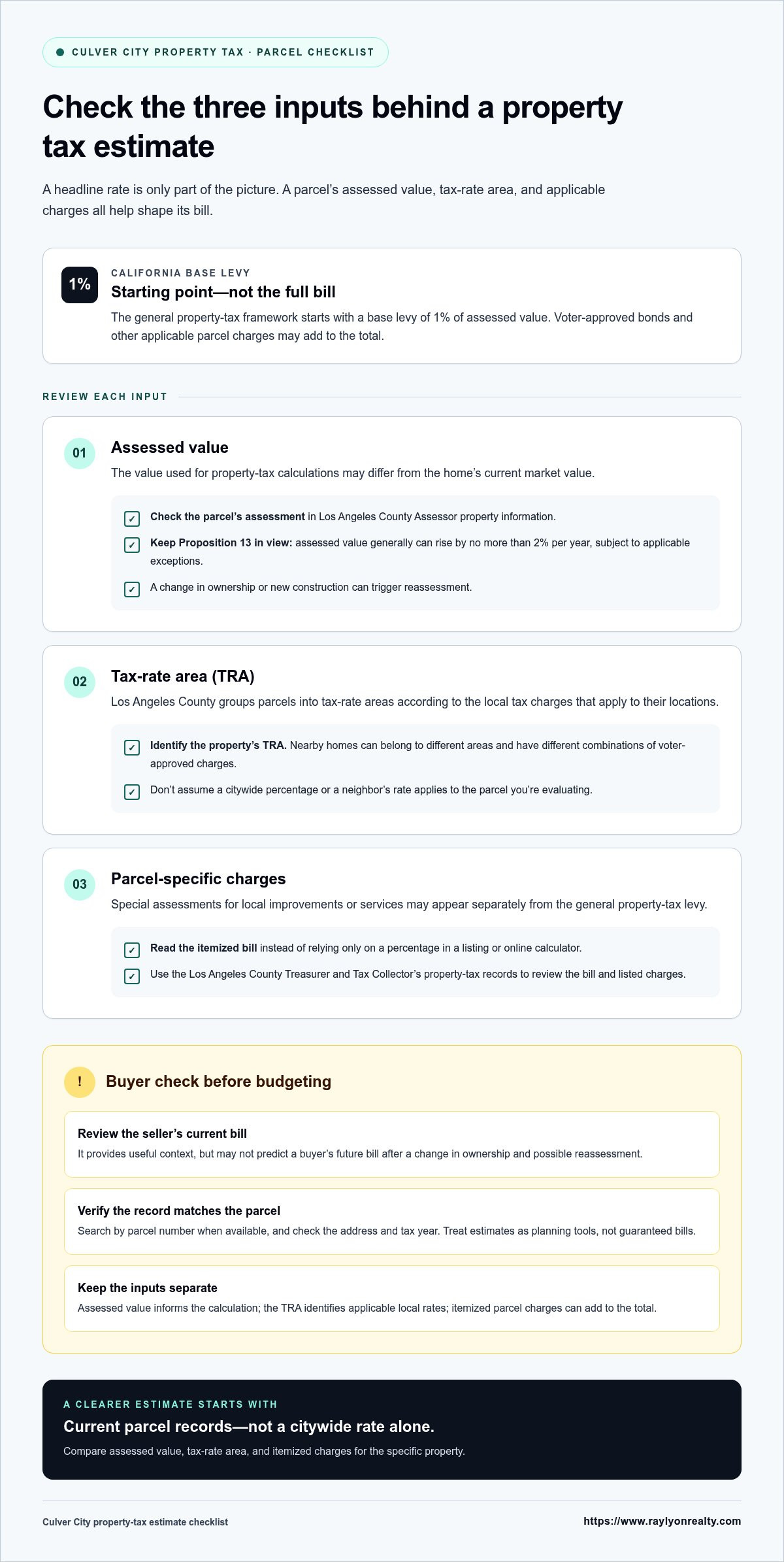
To understand a property tax bill, separate three inputs: the property’s assessed value, the tax-rate area (TRA) tied to its location, and any charges attached to the parcel. These inputs work together, but they aren’t interchangeable. A tax rate alone can’t tell you the bill unless you know the value and which local charges apply.
Assessed value and California Proposition 13
Assessed value is the value used for property tax calculations. It can differ from current market value, which reflects what a home might sell for now. Under California’s Proposition 13 framework, assessed value is generally based on the property’s value when acquired and can rise by no more than 2% per year, subject to applicable exceptions. A change in ownership or new construction can trigger reassessment. For county guidance, consult the Los Angeles County Property Tax Overview.
This distinction matters for buyers. A seller’s assessed value may reflect years of limited annual increases, while a buyer’s value after a purchase may be reassessed. The seller’s current bill is useful background, but it doesn’t necessarily forecast a buyer’s future bill. The Los Angeles County Assessor explains assessment practices and property values; consult its guidance for details about how the rules apply to a particular property.
Local charges, tax-rate areas, and parcel records
Once you understand the assessed value, identify the TRA. Los Angeles County assigns parcels to these areas based on the local tax charges that apply. Nearby homes can fall into different TRAs, so they may have different combinations of voter-approved charges, even if their assessed values are similar. The parcel’s bill may also list special assessments separately from the general property tax levy.
To understand a parcel’s tax bill, identify its assessed value, applicable tax-rate area, and itemized parcel-specific charges. Use the Los Angeles County Assessor’s official property information to review assessment details, then consult the Los Angeles County Treasurer and Tax Collector’s property tax records for the bill and listed charges. Search by the property’s parcel number when available, and make sure the record matches the correct address and tax year. These records clarify a specific parcel’s details, but they don’t make a general online estimate a guaranteed bill.
For budgeting, keep each input visible rather than collapsing everything into a single percentage: assessed value informs the calculation, the TRA identifies applicable local rates, and parcel charges can add to the total. The culver city property tax rate is therefore best evaluated through current parcel records, not assumed from a neighboring home. Ray Lyon Realty’s buyer representation helps clients assess local properties and compare the details involved in a purchase. Explore buyer representation with Ray Lyon Realty.
How to Compare Culver City Property Tax Estimates Without Guesswork
Estimates are easiest to compare when you know what each one includes. A calculator may apply a general percentage to a home price, while a county record reflects details tied to a specific parcel and tax year. Treat each figure as a starting point, then check its inputs against official records before using it to compare homes.
A repeatable method for checking a property’s estimate
Start with the parcel number, which helps distinguish a property from nearby homes with similar addresses. Use Los Angeles County Assessor records to find its assessed value. Then identify the parcel’s tax-rate area and review the current itemized charges in the Los Angeles County Treasurer and Tax Collector’s tax-bill records.
Compare the official bill with any online estimate. Beside each figure, record the amount, tax year, source, and assumptions. Note whether the estimate uses assessed value or a purchase-price assumption, and whether it accounts for parcel charges. The California State Board of Equalization’s California Property Tax System Overview provides background on how the state’s property tax system is administered. For a specific parcel, current county records are the practical reference.
| Estimate input | Where to look | Limitation to keep in mind |
|---|---|---|
| Assessed value | Los Angeles County Assessor records | It may differ from current market value or a buyer’s future assessment. |
| Tax-rate area | County parcel information and tax records | A nearby property may be assigned to a different area. |
| Itemized charges | Los Angeles County Treasurer and Tax Collector bill | Charges and totals should be matched to the correct parcel and tax year. |
| Online estimate | Calculator or listing estimate | Inputs may be incomplete, outdated, or based on assumptions that aren’t shown. |
Which estimate differences deserve a closer look?
If two figures don’t match, first check whether they use the same assessed value. One may rely on the seller’s existing assessment; another may estimate using a buyer’s expected purchase price. Those are different assumptions, not necessarily a calculation error.
Next, compare tax-rate areas and itemized charges. A difference in local charges can explain why two similar homes have different totals. Also check for stale tax-year information, a missing parcel identifier, or a rate with no stated source. If a calculator doesn’t explain its assumptions, treat its output as a rough planning figure rather than a substitute for the official bill.
Keep a simple comparison record for every property: parcel number, assessed value, tax-rate area, bill amount, tax year, source, and estimate assumptions. That makes it easier to see whether the culver city property tax rate estimate differs because of the property’s value, its location-specific charges, or the method used. Ray Lyon Realty’s buyer guidance for comparing homes can help put those figures in the context of a broader purchase decision.
What Culver City Homebuyers Should Check Before Budgeting for Property Taxes
A seller’s current tax bill is a useful starting point, but it isn’t a promise of what you’ll pay after buying the home. Before making an offer, review the parcel’s latest records and consider how a change in ownership could affect its assessed value. Use this checklist to build a more realistic estimate of the property’s ongoing costs.
- Match the records to the property. Get the parcel number and confirm it corresponds to the home you’re considering. Similar addresses or neighboring parcels can have different records, so don’t rely on a street name alone.
- Review the latest available tax bill. Look at the tax year, assessed value, total amount due, and itemized charges. Note whether the record is current and whether any listed charges are separate from the general property tax levy.
- Record the applicable tax-rate area. The parcel’s location determines which local tax charges may apply. Keep this detail with the bill so you can distinguish a rate-area difference from an assessed-value difference when comparing homes.
- Compare the seller’s assessment with your purchase assumptions. California rules can lead to reassessment after a change in ownership. A seller’s current assessed value may reflect a different ownership history, so use it as context rather than assuming the same assessment will continue for you.
- Label every estimate clearly. If you use an online calculator or listing estimate, write down its source, date, tax year, parcel identifier, and assumptions. Until it’s reconciled with official parcel information, treat it as an estimate, not a confirmed bill.
- Plan for a possible supplemental bill. A change in ownership may result in a supplemental assessment and a separate tax bill reflecting the difference between the prior assessed value and the reassessed value for the applicable period. Supplemental bills are often sent two to six months after closing. Check Los Angeles County guidance for the current calculation, timing, and payment instructions.
- Include verified figures in your home comparison. Ray Lyon Realty’s buyer representation can help you factor parcel tax records into a broader ownership-cost review. Keep the current bill separate from your estimate of post-purchase taxes so the distinction stays clear as you evaluate offers.
This review can help prevent a familiar budgeting mistake: treating the seller’s bill as a reliable forecast of your own. The culver city property tax rate is only one part of the picture; the parcel’s assessment and charges also matter. Discuss your Culver City home-buying plans with Ray Lyon Realty.
Use a Parcel-Specific Tax Estimate to Make a More Confident Culver City Decision
A useful estimate turns tax information into one part of a larger home-buying decision. Start with the parcel, compare homes on consistent terms, budget for possible changes, and consider how each property fits your priorities. The culver city property tax rate isn’t a stand-alone answer: the parcel’s assessment and charges help shape the bill, while California’s broader property tax rules provide the framework.
A short decision checklist for Culver City buyers
- Verify the parcel and tax year. Match the official record to the correct property and make sure the bill or estimate covers the tax year you’re reviewing. A figure without a clear parcel identifier or date can be difficult to compare reliably.
- Compare official records across your shortlist. Review assessed values, tax-rate areas, and itemized charges for each property. Keep the tax details separate from listing estimates, which may rely on simplified assumptions or older information.
- Budget for possible post-purchase changes. A change in ownership can affect assessed value under California rules, so don’t assume the seller’s bill will carry over. Use current Los Angeles County guidance to understand reassessment and any supplemental bill that may follow.
- Consider the whole ownership picture. Compare the tax estimate alongside purchase price, property condition, and your intended ownership plans. A lower current bill doesn’t necessarily mean a lower future bill, and tax figures alone can’t tell you whether a home suits your needs.
- Make the decision using consistent assumptions. Note which values are official, which are estimates, and what each estimate assumes. This gives you a clearer basis for weighing options without treating an uncertain figure as a guaranteed cost.
Some inputs are specific to the parcel: its assessed value, tax-rate area, and listed charges. Other rules, including California’s general assessment framework, apply more broadly. Keep those categories distinct. A statewide rule can explain how values are treated, but it won’t identify every charge on an individual property’s bill.
Put the tax details in context
Tax records are most useful when considered alongside the home and your plans. A property may compare favorably on condition or location but require a different ownership-cost budget. Another may have a seller’s bill that looks modest because its assessment reflects prior ownership. Neither detail should be viewed in isolation. The goal is a grounded comparison, not false precision.
Ray Lyon Realty guides buyers through property searches, offers, and escrow, helping them evaluate a home’s broader financial picture as they move toward a decision.
If you’re weighing homes in Culver City, talk with Ray Lyon Realty about your home-buying plans. A clear view of the parcel, budget, and your priorities can make the next step more manageable.
Make Your Next Home Search More Informed
A home decision is about more than the number on a listing. As you narrow your options, give each property the same careful review: consider how its tax estimate fits with its condition, price, and your plans for owning it. A parcel-based view of the culver city property tax rate can help you compare homes with fewer assumptions and clearer questions.
Bring those details into your home search rather than waiting until every number feels perfectly certain. Ray Lyon Realty represents residential buyers across the Westside of Los Angeles, with guidance through property searches, offers, and escrow. That support can help you weigh the financial picture while staying focused on the home and terms that fit your goals.
Talk with Ray Lyon Realty about your home-buying plans and take the next step with a thoughtful perspective.
Frequently Asked Questions
Is the Culver City property tax rate the same for every home?
No. The culver city property tax rate can vary by parcel because local tax-rate areas and applicable charges differ. Two homes on the same street may not have identical tax bills. For example, a difference in the parcels’ tax-rate areas or assessments could change the total. Compare each property’s county records rather than assuming a nearby home’s bill is a reliable match.
How can I find the property tax bill for a specific Culver City address?
Search Los Angeles County property records using the address or, preferably, the parcel number, then match the result to the correct property. The Los Angeles County Assessor provides assessment information, while the Los Angeles County Treasurer and Tax Collector provides tax-bill records. Check the tax year and parcel identifier before relying on a bill. If an address search returns several results, use the parcel number to distinguish them.
Can a Culver City property’s assessed value change after it is sold?
Yes. A change in ownership can trigger reassessment under California’s property tax rules. A buyer shouldn’t assume the seller’s assessed value will remain in place after closing. For instance, a long-held property may have an assessment that differs from its sale price. The Los Angeles County Assessor’s records and guidance can help buyers understand the assessment details and interpret them during purchase planning.
What is a supplemental property tax bill in California?
A supplemental property tax bill accounts for the change in assessed value after a qualifying event, such as a change in ownership. It is separate from the regular annual bill and covers the applicable part of the fiscal year. New buyers may receive one after closing, often two to six months later. Review Los Angeles County’s current instructions for the amount, due dates, and payment options rather than assuming escrow has covered it.
Can I appeal the assessed value of a Culver City property?
Property owners can appeal an assessed value. The filing window provided for Los Angeles County is July 2 through November 30, but owners should confirm the current dates, eligibility, forms, and filing instructions with the county before acting. Keep relevant assessment records and information about the property available as you review the process. An appeal concerns assessed value, not simply disagreement with the total tax bill or local charges.
Can a homeowner’s exemption reduce property taxes in Culver City?
Yes. California’s homeowner’s exemption provides a $7,000 reduction in assessed value for an eligible primary residence. It reduces the value used in the property tax calculation, not the bill by $7,000. The resulting tax savings depend on the applicable rates and charges for that parcel. Check current Los Angeles County Assessor guidance for eligibility and how to claim the exemption, especially if you’ve recently purchased or changed your primary residence.