

What if the best lead isn’t the owner with the most obvious sign of distress? Learning how to find a motivated seller in los angeles takes more than scanning online lists or spotting a foreclosure notice. Those clues can be outdated, incomplete, or easy to misread without neighborhood context. A public record or property issue also doesn’t prove an owner wants to sell.
It’s understandable to look for clear signals and a practical path to a good opportunity. This guide explains how to assess possible signs of selling interest, compare public records with local networks and agent guidance, and approach owners respectfully. You’ll also learn how to evaluate a property on its merits rather than assume a seller’s circumstances mean a discount is available. In Santa Monica, Mar Vista, and Venice, local context can help you assess whether a property fits your goals and decide what to investigate next.
Key Takeaways
- Use how to find a motivated seller in los angeles as a research question, not a search for guaranteed bargains. A seller’s timing or circumstances may suggest interest, but only a direct conversation can clarify it.
- Combine public records, neighborhood observation, personal referrals, and agent relationships to build a fuller picture of potential opportunities.
- Compare research methods by their usefulness and limitations before investing time in a lead or paid data tool.
- Set clear property criteria, verify the information you find, and make a straightforward introduction that gives the owner room to decline.
- Before moving forward, weigh the property’s condition, timing, fit, and the seller’s stated priorities as part of your due diligence and offer planning.
What a motivated seller means in the Los Angeles market
A motivated seller is an owner who is willing to consider a sale based on their timing, priorities, or plans. That willingness alone doesn’t mean the owner is in financial distress, needs to sell immediately, or will accept less than the property’s fair value.
Motivation describes a person’s readiness to explore a transaction, not a label attached to a home. An owner may be open to selling because their plans have changed, even if the property is well maintained and there’s no urgent problem. Another owner might face a pressing deadline but still need a particular price or timeline before moving forward.
For buyers researching how to find a motivated seller in los angeles, this distinction matters. A public record, an unoccupied-looking house, deferred maintenance, or a listing that has been available for a while may prompt further research. None confirms that the owner wants to sell. Treat each observation as a reason to seek reliable context, not as evidence of private circumstances or an invitation to assume a discount.
Seller decisions can reflect several factors at once. Timing may be tied to a move or a planned purchase. Property condition may influence whether an owner wants to handle repairs before selling. Personal circumstances and investment goals can shape whether the owner wants to sell, keep the property, or consider different terms. A signal may suggest a conversation is possible, but only the owner can explain their plans and what would make a sale work for them.
Why owners consider selling in Los Angeles
Reasons vary from household to household. An owner may be relocating, looking for a home that better suits changing needs, or reconsidering an investment property. In Santa Monica, Mar Vista, or Venice, nearby homes may differ in condition, use, and history, but no neighborhood has a single seller profile. Local context helps you understand a property; it can’t reveal an owner’s intentions. Ask respectfully, and let the owner describe their preferred timing.
Motivation, distress, and a below-market sale are different things
These terms shouldn’t be treated as interchangeable. An owner can be interested in selling without experiencing hardship, and a distressed property owner may not be ready to sell. Neither situation establishes a willingness to accept a below-market offer. Avoid drawing conclusions from a home’s appearance or public records. Instead, learn what the owner wants, assess the property using relevant information, and let fair value and priorities emerge through informed discussion and negotiation.
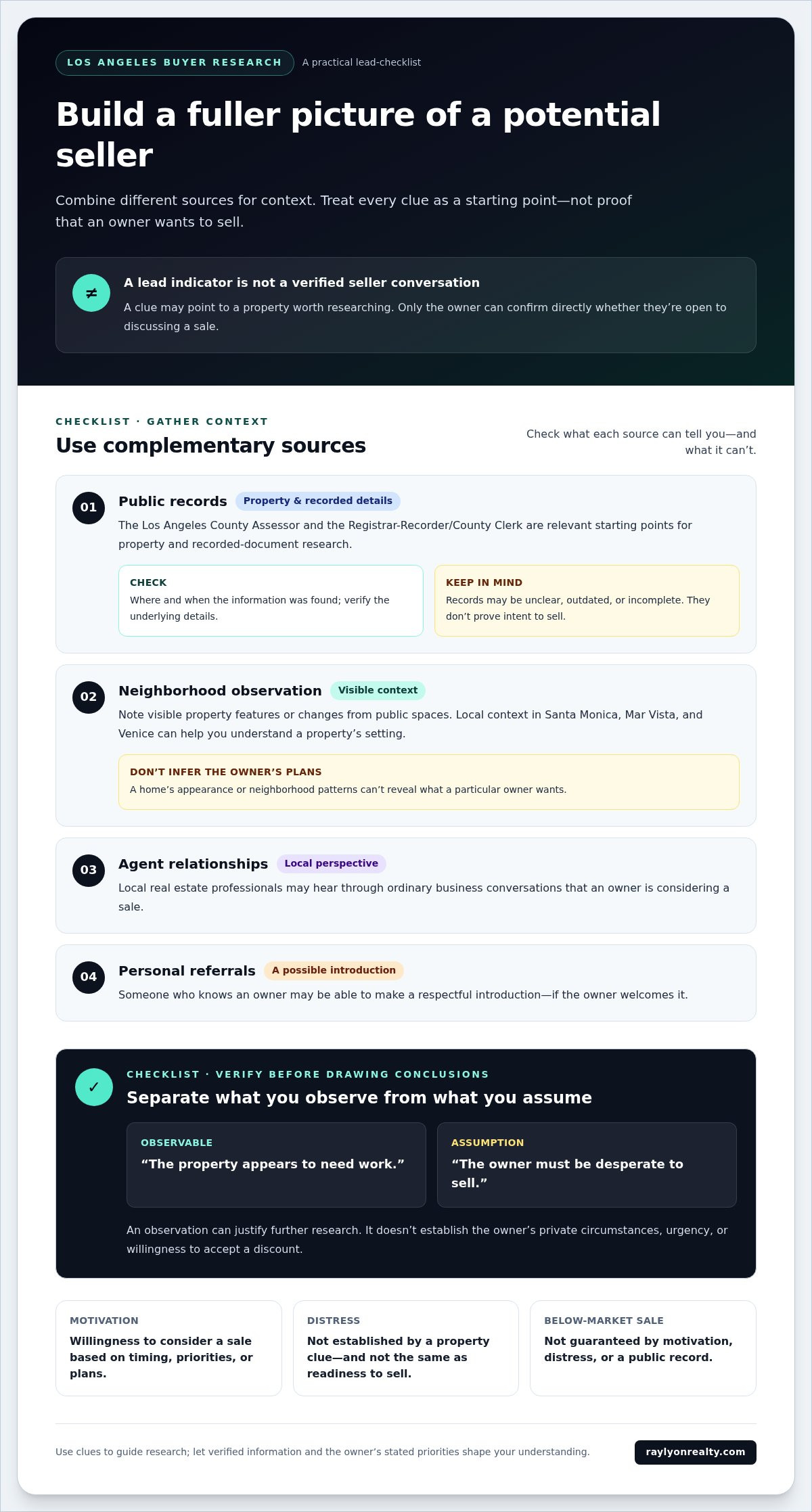
A careful buyer separates what’s observable from what’s known. “The property appears to need work” is an observation. “The owner must be desperate to sell” is an assumption. Keeping that boundary clear helps you evaluate opportunities thoughtfully and approach owners with respect, while leaving room for a sale to make sense for both sides.
How to identify possible motivated sellers across Los Angeles
Finding potential opportunities is less about locating one perfect list and more about bringing different kinds of information together. Public records can help you understand basic property details. Neighborhood knowledge adds context, while real estate professionals and personal referrals may surface a possible opportunity before it’s widely marketed. Each route has limits, so compare clues rather than treating any single one as confirmation.
A lead indicator points to a property worth researching; a verified seller conversation is an owner’s direct confirmation that they’re open to discussing a sale. That distinction keeps your search focused on facts and helps you avoid acting on assumptions.
As you explore how to find a motivated seller in los angeles, use these sources as complementary starting points:
- Public records: Review relevant ownership and property information, then check its source and date.
- Neighborhood observation: Note visible property features or changes from public spaces, without assigning a reason to them.
- Agent relationships: Local professionals may hear that an owner is considering a sale through ordinary business conversations.
- Personal referrals: Someone who knows an owner may be able to make a respectful introduction, if the owner welcomes it.
Use public records as clues, not conclusions
The Los Angeles County Assessor and the Registrar-Recorder/County Clerk are relevant starting points for property and recorded-document research. Look for information that helps identify the property or clarify recorded details, and note where and when you found it. Records can require interpretation and may not be current or complete. They don’t explain an owner’s private circumstances or prove an intention to sell.
Use restraint as you interpret what you find. A recorded document or a change in property information may justify checking the underlying details, but it shouldn’t become a story about the owner’s finances, family, or urgency. If a record appears unclear, treat it as unresolved rather than filling gaps with speculation. This makes your research more useful and keeps your next step grounded in what you can verify.
Find local context through neighborhood knowledge and relationships
Santa Monica, Mar Vista, and Venice each contain homes with varied conditions, uses, and ownership histories. Nearby properties can offer context for understanding a home’s setting, but neighborhood patterns don’t reveal what a particular owner wants. Local real estate professionals may learn of potential interest through conversations and relationships. That can help a buyer assess an opportunity, but it doesn’t guarantee access to an off-market property or mean an owner is ready to engage.
Personal referrals can add a human connection, but let the owner decide whether to continue the conversation. An introduction isn’t consent to repeated contact, and a third party’s impression isn’t the owner’s confirmation. A Westside buyer’s agent can help interpret local context and assess whether a property fits your goals. Ray Lyon Realty represents buyers across the Westside, including Santa Monica, Mar Vista, and Venice, and can help you evaluate potential properties within your search.
Compare motivated-seller research methods before choosing your approach
The best research method depends on what you’re trying to learn. Public records and paid data tools can help organize property information, while local relationships may offer context that a database can’t capture. None can confirm an owner’s intentions on its own. Compare each route by its usefulness, limits, and the next step it supports, rather than by how many names or properties it produces.
A larger lead list isn’t automatically a better list. For a residential buyer, a smaller set of properties that fit the location, condition, and budget you’re considering may be more useful than a high volume of unverified contacts. Wholesale lead-generation strategies may serve a different purpose, so don’t assume their emphasis on lead quantity translates into a suitable purchase opportunity.
| Source | Likely usefulness | Limitations | Suitable next step |
|---|---|---|---|
| Public records | Can provide recorded property or ownership details to investigate. | Information may need interpretation and may not reflect current plans. | Check the underlying information and assess whether the property fits your criteria. |
| Local referrals | May provide a personal introduction or context about a property. | A referral doesn’t establish that the owner wants to sell. | Ask whether the owner is open to an introduction, then let them decide. |
| Agent relationships | Can add neighborhood context and help identify potential property fits. | Relationships don’t guarantee access to a particular home or an interested seller. | Discuss your search criteria and evaluate any opportunity on its merits. |
| Paid data tools | May collect or organize property details for further research. | Coverage, recency, and accuracy can vary; a result isn’t proof of intent. | Independently interpret the information before considering outreach or an offer. |
Public records and data tools versus local relationships
Records and data tools can make information easier to sort, but they may offer limited insight into a property’s local context or an owner’s current goals. Relationships can provide useful context, though what someone has heard still needs verification. For either route, track the source and date of information, separate confirmed details from assumptions, and use research to guide a thoughtful next step, not to presume consent or selling interest.
Working independently versus using buyer representation
Working independently gives you direct control over your criteria and research, but you’ll need to assess property fit, interpret available information, and prepare your own offer strategy. Buyer representation can add local perspective as you identify and evaluate properties, then guide you through offer preparation and escrow. Local buyer representation can support clearer decisions, but it can’t guarantee a motivated seller or a successful purchase.
For buyers weighing how to find a motivated seller in los angeles, choose the approach that answers a practical question: does this property fit your goals, and is there a respectful way to learn whether the owner is open to a conversation? Treat paid results, referrals, and professional insight as inputs to that decision, not as proof that a deal is waiting.
A respectful, practical process for verifying seller interest
A promising lead is only a starting point. Before making contact, decide what you’re looking for, check what you know, and consider whether the property genuinely fits. This helps you spend time on viable opportunities rather than assumptions about an owner’s circumstances.
Respectful verification protects both the owner’s choice and the buyer’s time. Use this sequence to move from initial research to a clear decision:
- Define your criteria. Set priorities for location, intended use, condition, and timing. For example, decide whether you’re considering a home that needs work or only one that’s ready to occupy.
- Screen the property. Check whether the address fits those priorities before pursuing a lead. A property outside your target area or plans may not merit further action, even if a data source flags it.
- Cross-check what you’ve learned. Compare relevant property information across reliable sources, and note when it was gathered. Separate confirmed details from inferences, such as why a home looks vacant or what an old record might mean.
- Consider whether a conversation is appropriate. Don’t target someone based on presumed financial hardship, age, health, or another sensitive personal circumstance. If you have a legitimate reason to make an introduction, keep it accurate and give the owner control over whether to respond.
- Confirm interest and assess fit. If the owner is open to talking, listen to their plans and timing. Then consider whether the property and any stated priorities work with your goals before deciding on a next step.
Screen a lead before starting a conversation
Review the facts that matter to your search, not details that invite speculation about the owner. A property’s visible condition may help you anticipate questions about repairs, but it doesn’t establish what work is needed or whether the owner plans to sell. If information conflicts or seems dated, treat it as unresolved. This keeps your research focused and helps prevent an inaccurate or intrusive approach.
Ask about goals, timing, and property details without applying pressure
If an owner is willing to engage, start with open-ended questions: “Are you considering a sale?” or “Is there a timing that would work well for you?” If the answer is yes, ask what matters most to them. Their priorities may include timing, certainty, or other terms, not only price. Don’t press for personal explanations. Before choosing a contact method or making an approach, verify the current California and federal requirements that apply to your situation. Keep any communication truthful, respectful, and easy to decline.
A buyer-focused process connects research with property fit and a considered offer. Ray Lyon Realty represents buyers in the Los Angeles home search, from identifying potential properties through offer preparation and escrow.
Turn a promising Los Angeles lead into a considered next step
A conversation can make a property worth a closer look, but it doesn’t decide whether the home is right for you. Compare what you learn with your goals, the property’s condition, and the surrounding neighborhood before shaping an offer. An owner’s willingness to talk isn’t proof that the property is worth less or that a particular price will be accepted.
Evaluate the opportunity before making an offer
Start with fit. Consider whether the location, layout, condition, and intended use suit your plans. For a home in Santa Monica, Mar Vista, or Venice, neighborhood context can help you assess whether the property aligns with your priorities, but nearby homes aren’t identical. Review relevant property information and comparable sales as part of your price research, not as a guarantee of value.
Then organize questions for appropriate follow-up. You may need to understand the property’s condition, the owner’s preferred timing, and any priorities they’ve chosen to share. Due diligence can include reviewing available property information, considering inspections, and understanding the proposed transaction terms before you commit. Keep the process grounded in evidence. A seller’s circumstances don’t replace careful property evaluation.
Get local guidance for a Westside purchase
Buyer representation can help bring the moving parts together, from identifying properties and considering neighborhood context to planning an offer and working through escrow. Ray Lyon Realty represents residential buyers across the Los Angeles Westside, including Santa Monica, Mar Vista, and Venice. For an investment property, guidance can help you assess whether the home fits your objectives without promising a particular return or access to a specific opportunity.
If you’re researching how to find a motivated seller in los angeles, keep the focus on the purchase you’re prepared to make. Summarize your preferred locations, property type, condition range, intended use, and timing. That gives your buyer’s representative a practical framework for reviewing potential fits and discussing offer considerations. It also helps distinguish a lead that sounds interesting from a property that deserves your attention.
Before making an offer, consider what information you still need, which questions remain open, and whether the proposed terms work for your plans. Offer preparation should reflect the property and the seller’s stated priorities, while leaving room for negotiation. No research method or representation can ensure that an owner will sell or that an offer will be accepted. The aim is a clear, informed decision.
For a Westside purchase, Ray Lyon Realty can help you consider your Los Angeles buying goals and evaluate practical next steps.
Make your next move with a clear buying plan
The next step isn’t chasing every possible lead. It’s getting specific about the purchase you want to make, then using that clarity to recognize when a real opportunity fits. As you consider how to find a motivated seller in los angeles, focus on the property and the conversation, not assumptions about the owner. A well-matched home can still be worth exploring even when the seller’s reasons or timing differ from what you expected.
Ray Lyon Realty offers residential buyer representation across the Los Angeles Westside, with local expertise in Santa Monica, Mar Vista, and Venice. For buyers considering an investment property, guidance can help connect the property’s characteristics with their objectives, without promising a particular outcome.
Ready to discuss your priorities and potential next steps? Talk with Ray Lyon Realty about your Los Angeles buying goals.
Frequently Asked Questions
What is a motivated seller in real estate?
A motivated seller is a property owner who is open to considering a sale, perhaps because their plans, needs, or priorities have changed. The term describes possible willingness to transact, not a confirmed financial problem or a promise of a discount. For buyers, the useful distinction is between a clue that warrants research and an owner’s direct statement that they’re willing to discuss selling.
How can I find off-market sellers in Los Angeles?
To explore how to find a motivated seller in los angeles, first write down your target area, property type, intended use, and must-have features. Then combine public information, local knowledge, personal introductions, and agent relationships to identify properties worth researching. Keep a simple record of each lead’s source and date, and note which details need verification before you consider making contact.
Do motivated sellers always accept a lower offer?
No. An owner’s interest in selling doesn’t establish the price or terms they’ll accept. For example, a seller may value a closing timeline that suits their plans but still expect an offer supported by the property’s condition and relevant market information. Evaluate the home independently, and treat price, timing, and other terms as points to understand and negotiate rather than assumptions based on a seller’s apparent motivation.
Are public records enough to identify a motivated seller?
No. Public records can help you research recorded property details, but they don’t tell you whether an owner is currently considering a sale. A record may also be difficult to interpret without additional context. If you find a detail that seems relevant, note what it actually says and what remains unknown. Avoid treating a record as proof of the owner’s finances, personal situation, or selling plans.
Can a real estate agent help find motivated sellers in Los Angeles?
Yes. A local agent can help you sharpen your search, assess whether a property suits your needs, and think through an offer if you decide to proceed. For instance, if you’re comparing homes with different layouts or conditions, an agent can help organize the questions that matter to your decision. Agent relationships may reveal potential opportunities, but they can’t ensure a specific owner will sell or a purchase will succeed.
Is it legal to contact a homeowner about selling in California?
Requirements can depend on factors such as the contact method, who receives the message, and the circumstances. Publicly available property information doesn’t automatically mean every kind of outreach is appropriate. Before contacting an owner, verify the current California and federal requirements that apply to your planned approach with an appropriate legal or compliance professional. Keep communication factual, respectful, and easy for the recipient to decline.
What should I ask a homeowner who may be willing to sell?
Start by asking whether they’re open to discussing a possible sale, then let them guide the conversation. If they’re interested, you might ask what timing would suit them, what transaction details matter most, and what information they’re comfortable sharing about the property. Don’t press for personal reasons. Write down the owner’s stated preferences accurately, then review property questions and possible offer terms with your buyer’s representative before deciding what to do next.