

Could two Los Angeles sellers accept similar offers and walk away with very different amounts? Absolutely. Seller closing costs in Los Angeles depend not only on the sale price but also on the property’s jurisdiction and the terms of the purchase agreement. That can make it difficult to estimate your proceeds before you list or review an offer.
The amount you take home is usually lower than the sale price. In 2026, total seller closing costs, including commission, typically range from 7% to 10% of the sale price. Location also matters: the City of Los Angeles has its own transfer tax in addition to the county tax, while other cities in Los Angeles County have different rules.
This guide explains common seller costs, including commission, escrow, title, prorated property taxes, and possible buyer credits. It also covers how city and county taxes, financing, and property-specific details affect an estimate. Use these factors to compare offers and build a more realistic picture of your net proceeds.
Key Takeaways
- Seller closing costs in Los Angeles vary with the property’s jurisdiction, existing obligations, and the terms negotiated in the sale.
- Identify the property’s city before estimating transfer taxes; countywide rules alone may not show the full picture.
- Separate transaction expenses from your mortgage payoff to see how each affects the proceeds you take home.
- Gather your loan payoff, HOA details, property-tax information, and known liens to build a useful estimate.
- Compare a preliminary proceeds estimate with your pricing strategy and each offer’s terms before deciding what works for you.
What seller closing costs in Los Angeles can include
Seller closing costs are transaction expenses and property-related obligations accounted for at closing. They are deducted from the seller’s proceeds. Some are common parts of a sale; others depend on the property’s location, financing, association, or purchase agreement. For example, a real estate transfer tax may be imposed by a state, county, or municipality, so the property’s jurisdiction can affect the final figures.
Seller net proceeds are what remains from the sale price after the mortgage payoff, liens, closing costs, prorations, and any agreed credits or other obligations are deducted. An estimate is a planning tool, not a quote. Final amounts and who pays them can vary by transaction.
Which costs commonly appear on a seller’s closing statement?
Escrow and title-related charges may appear on the closing statement. Their allocation can depend on the purchase agreement and local practice. The same applies to other transaction charges, so don’t assume every cost is automatically assigned to the seller.
Your property’s obligations also affect your proceeds. If you have a mortgage, the payoff generally includes the remaining loan balance and accrued interest through the payoff date. Recorded liens that must be cleared as part of the sale can also reduce what you receive. These are property-specific obligations, not brokerage fees.
Shared expenses may be prorated at closing. Property taxes and HOA dues, for instance, may be divided based on the period each party owns the home or the terms of the transaction. The closing figures reflect the applicable dates and amounts.
Which costs are optional, negotiated, or property-specific?
Not every deduction is automatic. A buyer credit or contribution toward repairs can reduce your proceeds if you agree to it in the contract or during negotiations. Review those terms alongside the offer price: a credit changes what you keep even if the headline price stays the same.
HOA-related charges depend on the property and its association. A sale may involve fees for transferring documents or ownership records, but the charges and responsibility can vary. Homes without an HOA won’t have those association-specific items.
Tax preparation or legal advice may be useful for your individual situation, but these are separate professional services, not universal closing fees. Keep them distinct from charges on the closing statement when estimating your sale proceeds. Grouping costs as transaction charges, property obligations, or negotiated items gives you a clearer starting point for reviewing the estimate.
Los Angeles transfer taxes: why the property’s city matters
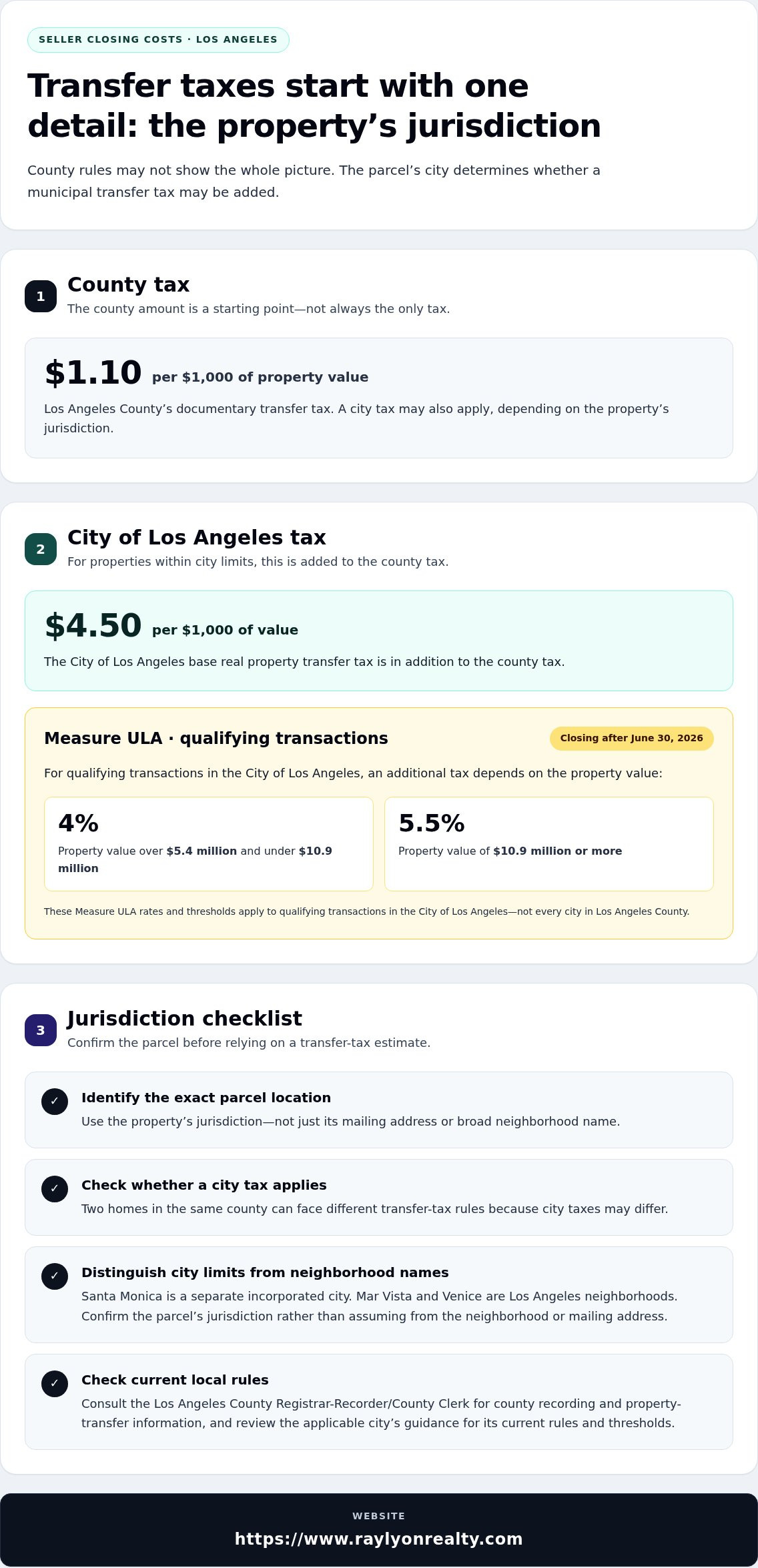
Transfer taxes can be a substantial line in a seller’s closing estimate, and the county rate may not be the only one that applies. Los Angeles County’s documentary transfer tax is $1.10 per $1,000 of property value. Some cities also impose their own tax, so two homes in the same county can face different transfer-tax rules.
The parcel’s jurisdiction determines which county and city transfer-tax rules may apply. Start an estimate of seller closing costs in Los Angeles with the property’s exact location, not just its mailing address or broad neighborhood name.
How county and city transfer taxes can differ
For a sale within the City of Los Angeles, the city’s base real property transfer tax adds $4.50 per $1,000 of value to the county tax. For qualifying transactions closing after June 30, 2026, Measure ULA adds another tax: 4% when the property value is over $5.4 million and under $10.9 million, and 5.5% at $10.9 million or more. These rules apply to the City of Los Angeles, not every city in the county.
| Jurisdiction | 2026 transfer-tax information | What to keep in mind |
|---|---|---|
| Los Angeles County | $1.10 per $1,000 of property value | County documentary transfer tax; a city tax may also apply. |
| City of Los Angeles | $4.50 per $1,000, plus applicable Measure ULA rates and thresholds | City tax is added to the county tax for properties within city limits. |
| Santa Monica | Verify the applicable municipal rules for the parcel | Santa Monica is an incorporated city, with its own municipal jurisdiction. |
For county recording and property-transfer information, consult the Los Angeles County Registrar-Recorder/County Clerk. Before relying on an estimate, review the applicable city’s current guidance for its rules and thresholds.
What sellers in Santa Monica, Mar Vista, and Venice should verify
Santa Monica is a separate incorporated city, so don’t apply City of Los Angeles rates to a Santa Monica property. Mar Vista and Venice, by contrast, are Los Angeles neighborhoods. Neighborhood names and mailing addresses don’t always establish the taxing jurisdiction, so confirm the parcel’s location. The Mar Vista neighborhood guide offers local context, while the parcel determines which tax rules may apply.
Since jurisdiction affects the estimate, consider the property’s location alongside your pricing strategy and offer terms to better understand likely proceeds. Explore seller representation in Los Angeles for support coordinating a sale from pricing through closing.
What changes your Los Angeles home sale’s total closing costs?
The final statement reflects more than a standard list of fees. To make a seller-specific estimate, sort potential deductions into four groups: location-based charges, loan-related obligations, property-related costs, and terms negotiated with the buyer. The mix depends on the parcel, your ownership and financing, and the agreement for this sale.
- Location-based: Transfer taxes can vary by jurisdiction, as described above.
- Loan-related: Your mortgage payoff, including interest through the payoff date, reduces proceeds. It’s a debt paid from the sale, not a brokerage fee.
- Property-related: Recorded liens, HOA charges, and applicable tax prorations may affect the closing figures.
- Negotiated: Buyer credits or agreed repairs can change the amount credited or paid at closing.
These categories help separate likely obligations from items that depend on negotiation. For statewide tax information, the California Department of Tax and Fee Administration provides official guidance on taxes it administers. Questions about how taxes apply to your individual sale may require advice tailored to your situation.
How the sale contract affects who pays
The purchase agreement records the parties’ agreed cost allocations, credits, and repair terms. A charge commonly handled a certain way in local practice isn’t automatically a binding obligation for every seller. The signed contract governs the agreement between buyer and seller.
For example, a buyer and seller might negotiate a credit after inspections or agree that one party will cover a particular transaction charge. The closing statement should reflect those terms. Review them alongside the offer price, since credits and allocations affect what you ultimately keep.
How property condition, financing, and ownership affect proceeds
Start with the property’s specific obligations. Request a current mortgage payoff figure, account for any liens that must be addressed, and include relevant HOA charges. If repairs are part of the sale agreement, confirm how they will appear in the closing paperwork. These items can differ substantially from one property to another.
Property-tax prorations depend on the applicable tax period and closing date. The statement allocates the relevant amount between the parties according to the transaction details, so the final figure may differ from an earlier rough estimate.
Ownership can add another layer. An investment property or a home held in a trust may raise tax or documentation questions specific to the transaction. A qualified tax or legal adviser can address those matters. For a realistic estimate of seller closing costs in Los Angeles, combine the property details, payoff information, location, and negotiated terms rather than relying on a one-size-fits-all figure.
How to estimate seller closing costs and net proceeds
A useful estimate starts with the details of your sale, not a generic percentage. Work through these steps to build a planning figure for seller closing costs in Los Angeles:
- Choose a realistic sale-price scenario. Use a price range grounded in the property and current market. Identify the parcel’s jurisdiction so you can account for applicable county and city transfer taxes.
- Gather property and loan information. Request an up-to-date mortgage payoff estimate, including accrued interest. Collect HOA details, current property-tax information, and records of known liens or other obligations tied to the property.
- Add seller-side transaction charges. Include verified transfer taxes, escrow and title charges, and any other costs assigned to you by the proposed contract. Use transaction-specific figures rather than general cost ranges.
- Account for adjustments. Estimate applicable tax and HOA prorations based on the expected closing date. Add any buyer credits or repair costs you’ve agreed to, and note items that are still uncertain.
- Subtract obligations and charges from the sale price. The remainder is your estimated net proceeds. Compare more than one sale-price or contract scenario to see how changes could affect the result.
A practical seller net-proceeds worksheet
Keep the calculation simple and traceable. Start with the assumed sale price, then subtract the mortgage payoff, liens, verified seller-side charges, prorations, and negotiated credits or repair costs. For each line, record the estimated amount, its source, the date you obtained it, and whether it’s confirmed or provisional.
This makes it easier to spot outdated figures and update assumptions as the sale progresses. Treat the result as a planning estimate, not a guaranteed closing amount. Final figures depend on the transaction and closing documents.
When to update the estimate during escrow
Refresh your worksheet when you accept an offer, agree to a credit or repair, or the expected closing date changes. Each may affect the sale terms, payoff amount, or prorations. Before closing, compare your estimate with the settlement statement and reconcile the payoff information and applicable adjustments.
Seller representation can connect pricing, offer terms, and closing coordination as the estimate develops. For more context, read this guide to Los Angeles real estate agents. To discuss a sale and build a clearer proceeds estimate, connect with Ray Lyon Realty about selling your home.
Plan your Los Angeles sale with a clear view of closing costs
A strong sale plan looks beyond the offer price. The property’s jurisdiction, loan and other obligations, and negotiated terms all shape the amount you may take home. Review a preliminary proceeds estimate alongside your pricing strategy to set expectations before listing and compare offers with a clearer picture of their financial impact.
The estimate depends on details that can change, so treat it as a working document. Update it as you learn more about the property, receive current payoff information, and negotiate sale terms. This makes costs easier to track without mistaking an early projection for the final closing figure.
Questions to resolve before accepting an offer
- Where is the parcel, exactly? Confirm its jurisdiction and identify the transfer-tax treatment that may apply. A neighborhood name or mailing address alone may not settle the question.
- What obligations will be paid or adjusted at closing? Review the latest mortgage payoff, known liens, HOA charges, and expected tax prorations.
- What does the offer require? Check proposed buyer credits, repair agreements, and the allocation of transaction charges against the estimated proceeds.
- How do the timing and terms compare? Consider estimated net proceeds and expected closing timing, not just the headline offer price. Different terms can affect both your bottom line and plans for your next move.
Taking these questions in order helps you compare scenarios fairly. If a key figure is provisional, mark it that way and don’t treat it as settled until the relevant transaction details appear in the closing documents.
Get local guidance for your sale
Local market knowledge can inform pricing and offer review. Ray Lyon Realty represents residential sellers across the Westside, including Santa Monica, Mar Vista, and Venice, with support for pricing, marketing, negotiation, and coordination through closing. This local perspective connects a property’s location and circumstances to the decisions you make as a seller.
As you plan, bring your anticipated sale details and current property information into the conversation. A preliminary estimate can be reviewed alongside your pricing strategy and, once offers arrive, their terms. For a more informed plan, Plan your Los Angeles home sale with Ray Lyon Realty.
Make your next sale decision with confidence
The clearest estimate of seller closing costs in Los Angeles starts with the property’s exact jurisdiction, then accounts for its financial obligations and the terms negotiated with the buyer. Transfer taxes can differ by location, while mortgage payoffs, liens, prorations, and agreed credits shape the proceeds you ultimately receive.
Before choosing an offer, compare estimated net proceeds and timing alongside the headline price. A preliminary estimate is a useful planning tool. Updating it as the sale details become clearer can help you make informed decisions.
Ray Lyon Realty brings a Westside Los Angeles residential-market focus to seller representation, including pricing, marketing, offer negotiation, and coordination through closing. Plan your Los Angeles home sale with Ray Lyon Realty and take the next step with a clearer view of your sale.
Frequently Asked Questions
What closing costs does a seller pay in Los Angeles?
Common seller expenses can include transfer taxes, escrow and title charges, mortgage payoff interest, prorated property taxes, and HOA-related costs. A seller may also have liens to clear or buyer credits and repair costs agreed to in the contract. Not every item applies to every sale, and the purchase agreement can affect who pays particular charges. Review the property’s location, obligations, and negotiated terms together.
How much are seller closing costs in Los Angeles?
As a general 2026 estimate, total seller closing costs, including commission, typically range from 7% to 10% of the sale price; excluding commission, they generally fall between 1.5% and 3%. These are broad ranges, not a quote or prediction for a specific property. Your location, loan payoff, HOA, tax prorations, and contract terms can all change the amount, so build an estimate from your transaction details.
Who pays the transfer tax when selling a home in Los Angeles?
The parties can negotiate who pays transfer taxes, and the purchase agreement determines the agreed allocation. For properties within the City of Los Angeles, the 2026 county documentary transfer tax is $1.10 per $1,000 of value, with the city’s base tax of $4.50 per $1,000 also applying. Measure ULA may add tax above its applicable thresholds. Confirm the parcel’s jurisdiction and current rules before estimating proceeds.
Does the seller pay closing costs in California?
Yes, sellers commonly pay some costs at closing, but there isn’t one fixed list that applies to every California sale. Charges may include transfer taxes, escrow or title items, loan payoff obligations, prorations, and costs agreed to in the contract. Buyers and sellers can negotiate some allocations. Review the purchase agreement and a transaction-specific proceeds estimate to understand which charges are assigned to you.
Are seller closing costs different in Santa Monica and Los Angeles?
They can be. Santa Monica is an incorporated city with its own municipal jurisdiction, while the City of Los Angeles has its own transfer-tax rules, including its base tax and Measure ULA for qualifying sales. Mar Vista and Venice are Los Angeles neighborhoods, but confirm the parcel’s jurisdiction rather than relying only on a mailing address or neighborhood label. That location check helps identify which city rules may apply.
How do I calculate my net proceeds from selling a home?
Start with a realistic sale-price estimate, then subtract the mortgage payoff, liens, applicable seller-side closing charges, tax and HOA prorations, and any credits or repairs you’ve agreed to. Identify the property’s jurisdiction to estimate transfer taxes, and use current figures for loan and association obligations. Track each amount and whether it’s confirmed or provisional. The result is a planning estimate; final proceeds depend on the closing statement.
Can a buyer negotiate for the seller to pay some closing costs?
Yes. A buyer can propose that the seller cover certain costs or provide a credit, and the seller can accept, decline, or negotiate the request. Any agreed allocation or credit should appear in the purchase agreement and closing figures. Compare the request with the offer price and other terms, since a higher headline price may not mean higher proceeds if credits or other obligations reduce what you receive.